
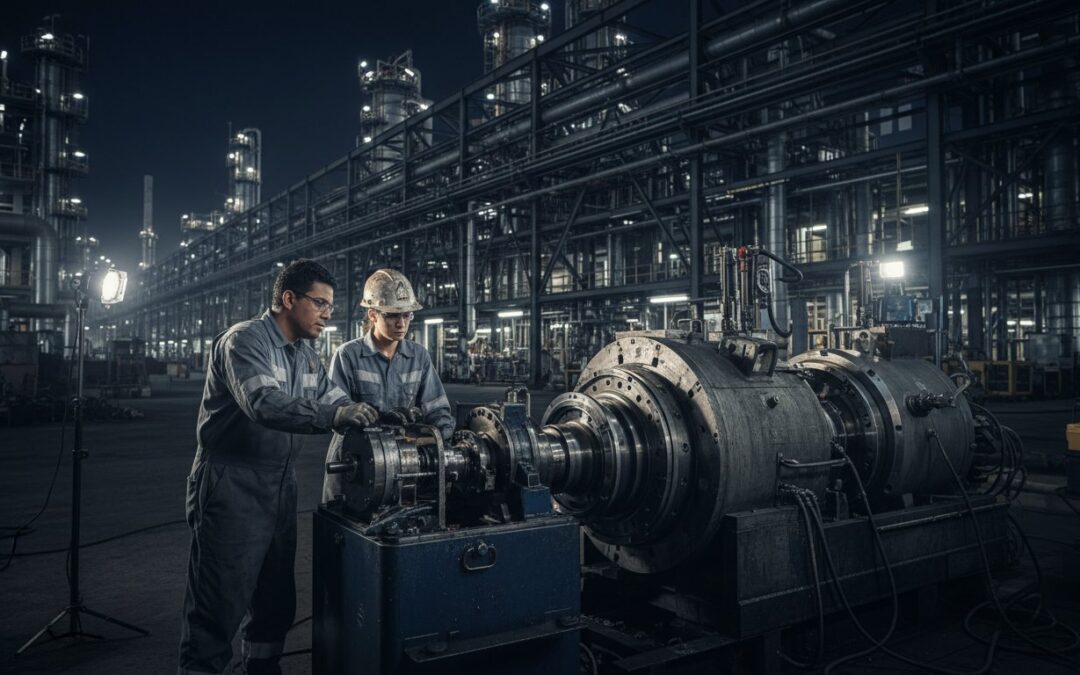
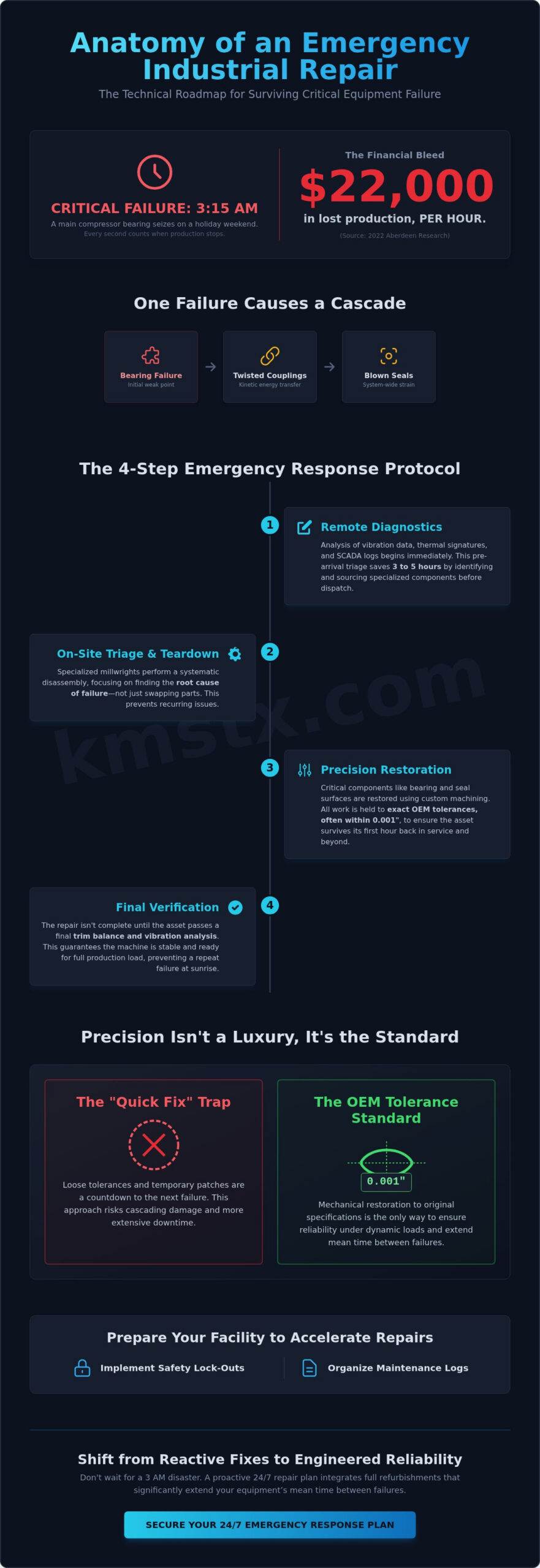
Imagine it’s 3:15 AM on a holiday weekend when the main bearing on a critical compressor finally gives out. You know that every hour that machine sits idle costs the plant roughly $22,000 in lost production according to 2022 Aberdeen Research data. It’s a high-stakes race against the clock where you’re caught between the need for speed and the rigid demands of OEM tolerances. Finding a reliable 24/7 industrial machine repair service becomes the difference between a controlled recovery and a multi-day disaster.
You likely agree that a quick fix is just a countdown to the next failure; you need a solution that holds up under load. This guide provides a technical roadmap for managing emergency repairs on heavy rotating equipment. You’ll learn how to achieve rapid restoration to original specifications without compromising on precision balancing or machining standards. We’ll examine the essential steps for field diagnostics, shop-based component restoration, and the final verification processes required to keep your plant schedule on track.
Key Takeaways
- Identify the cascading mechanical impacts of unplanned downtime and why immediate intervention is critical for stabilizing high-speed rotating systems.
- Explore the logistics of a rapid emergency response, from initial remote vibration analysis to the tactical deployment of specialized millwrights.
- See how a 24/7 industrial machine repair service utilizes custom machining to restore critical bearing and seal surfaces to exact OEM tolerances.
- Learn the essential site-prep steps, including safety lock-outs and maintenance log organization, that help field technicians hit the ground running.
- Shift your focus from temporary fixes to long-term reliability by integrating full refurbishments that significantly extend your equipment’s mean time between failures.
The High Stakes of Unplanned Downtime in Rotating Assets
A 24/7 industrial machine repair service is more than just a phone number in a maintenance log. It’s a critical safety net for high-speed mechanical systems that don’t follow a nine-to-five schedule. When a shaft is spinning at 3,600 RPM, the margin for error doesn’t exist. Static equipment like storage tanks can often wait for a scheduled shift, but rotating machinery operates under dynamic loads that make every minute of vibration or heat buildup a threat to the entire facility. If a bearing fails at 2:00 AM, the clock starts ticking on a financial bleed that affects more than just the bottom line.
The financial impact of these failures is staggering. According to a 2022 report from Senseye, unplanned downtime costs large industrial plants an average of 27 hours per month. For a Fortune Global 500 company, this translates into millions of dollars in lost productivity and wasted energy. Beyond the immediate loss of output, sudden stops cause secondary system strain. When a high-torque system grinds to a halt, the kinetic energy has to go somewhere. This often leads to twisted couplings or blown seals in connected equipment. Maintaining rigorous industrial maintenance protocols is the only way to mitigate these cascading failures before they require a total rebuild.
To better understand the reality of these emergency calls, watch this helpful video:
Critical Failures in Centrifuges and Gearboxes
Industrial centrifuges are prone to both progressive and catastrophic failure modes. You might notice a progressive failure like slight bearing pitting during a routine check, but a catastrophic failure happens in an instant when an unbalanced bowl shears a mounting bolt. When you call for 24/7 industrial machine repair service, the goal is to catch these issues before the rotor assembly clears the housing. Gearbox seizures are equally destructive because they act as a hard stop for the entire production line. A seized gear in a primary drive can ripple backward, damaging the motor windings and potentially forcing a complete replacement of the drive train.
- Shaft Damage: Rapid friction-induced heat can warp a shaft within seconds of a lubrication failure.
- Housing Integrity: Vibration from a failing centrifuge can crack cast iron housings, making the unit unrepairable.
- Upstream Impact: A sudden gearbox lockup often snaps conveyor belts or drives downstream pumps into a cavitation state.
The Role of Precision in Emergency Situations
Precision isn’t a luxury during an emergency repair; it’s the standard that determines if the machine will survive its first hour back in service. Triage is for field dressings, but rotating assets require exactness. If a technician doesn’t maintain OEM tolerances within 0.001 inches during a midnight repair, the asset will likely fail again by sunrise. We rely on vibration analysis to identify the root cause of the failure, ensuring that the fix isn’t just a temporary patch. Mechanical restoration is the return of an asset to its original engineering specifications.
The Anatomy of a 24/7 Emergency Industrial Repair Response
When a critical pump or blower fails at 2:00 AM, the response isn’t just about speed; it’s about technical precision under pressure. A professional 24/7 industrial machine repair service starts long before the service truck arrives at your gate. It begins with a remote diagnostic phase where technicians analyze vibration data, thermal signatures, or SCADA logs. Identifying a bearing frequency spike or an imbalance signature remotely allows the team to pull the right parts from inventory immediately, saving 3 to 5 hours of transit time for specialized components.
Once the millwrights are on-site, the process moves into a systematic teardown. We don’t just swap parts. We look for the “why” behind the failure. If a gearbox failed due to gear tooth pitting, we’re checking for lubrication starvation or misalignment that might have caused the issue. Restoration isn’t complete until the asset passes a final trim balance and vibration analysis. We ensure the equipment operates within ISO 10816 standards for vibration severity before handing it back to your production team. This methodical approach reduces the risk of infant mortality in repaired assets by approximately 40 percent.
Field Service vs. Shop-Based Repair
Deciding whether to fix a machine on the floor or ship it out is a high-stakes call. Field service is ideal for seal replacements, laser alignments, and bearing swaps that don’t require heavy machining. However, if a shaft is scored or a rotor needs precision balancing to G2.5 tolerances, the asset must go to a machine shop. Moving a 10,000-pound motor involves complex rigging logistics, but the controlled environment of a shop allows for custom machining that simply isn’t possible with portable tools. You can view our technical capabilities to see how we handle these heavy-duty transitions.
Technical Troubleshooting on the Fly
Experience matters when you’re managing the “unknown unknowns” found inside a casing. Technicians use non-destructive testing (NDT), such as dye penetrant or ultrasonic thickness gauging, to find hairline fractures that lead to catastrophic failure. We rely on empirical data from previous failures to isolate issues in pumps and blowers quickly. If we open a housing and find secondary damage to the volute, we have to pivot the repair strategy instantly. This real-time decision-making keeps the project moving without waiting for a 9-to-5 management approval chain.
Precision Machining and Balancing: Why ‘Quick Fixes’ Fail
When a critical pump or turbine fails at 3:00 AM, the immediate pressure to resume operations often leads to “slap-and-ship” repairs. This approach is a gamble against the laws of physics. Rotating equipment operates under intense centrifugal forces. For instance, at 3,600 RPM, an imbalance of just one ounce at a 12-inch radius generates over 450 pounds of centrifugal force. If that imbalance reaches a few grams on a high-speed rotor, the resulting force can exceed thousands of pounds, effectively hammering the internal components into a secondary failure. A professional 24/7 industrial machine repair service doesn’t just swap parts; it addresses the underlying mechanical geometry that caused the failure.
Restoring worn bearing fits and seal surfaces through custom machining is non-negotiable. If a shaft journal is worn by 0.003 inches, a new bearing will lack the required interference fit, leading to fretting and eventual seizure. Every emergency overhaul must include dynamic balancing services to ensure the assembly meets ISO 1940/1 G2.5 or G1.0 standards. Without this precision, you’re merely installing a new fuse in a shorted circuit. The machine might spin, but it won’t last.
Restoring OEM Specifications Under Pressure
CNC machining is the backbone of a rapid response. When components are obsolete or have 20-week lead times, we fabricate them from raw stock to match or exceed original specifications. We prioritize concentricity and alignment in high-speed shafts. If a rotor isn’t perfectly centered within its housing, the resulting eccentric motion destroys mechanical seals in a matter of days. Precision machining prevents this by ensuring that new bearings and seals sit perfectly square, eliminating the edge loading responsible for 40% of premature bearing failures.
Vibration Analysis as a Quality Benchmark
The final stage of any emergency repair is validation. We use vibration signatures to verify that the 24/7 industrial machine repair service was successful. By capturing velocity and acceleration data, we establish a clean baseline for your future rotating equipment maintenance. This post-repair testing is the most critical step in an emergency response. It identifies resonance issues or structural looseness that a visual check can’t detect, providing the empirical proof that the equipment is safe to return to full load.
Strategic Triage: Preparing Your Facility for Emergency Technicians
When a critical asset fails, the first 60 minutes of response define the trajectory of the entire recovery. Effective preparation for a 24/7 industrial machine repair service involves more than just making a phone call; it requires a systematic stabilization of the environment. Safety protocols must be the absolute priority. Technicians cannot begin work until Lock-out/Tag-out (LOTO) procedures are verified according to OSHA 1910.147 standards. Conduct a site-specific hazard assessment to identify secondary risks like high-pressure steam lines or chemical exposures that could impede the repair team’s arrival.
Logistical readiness is equally vital. If the failure involves a 500 HP motor or a large-scale centrifugal compressor, the repair crew will likely arrive with heavy rigging or specialized transport. Clear a minimum 10-foot wide staging path and ensure overhead crane access is unobstructed. Designate a single point of contact, typically a senior maintenance lead, to facilitate immediate technical decisions without the delay of a committee approval process. This ensures that the 24/7 industrial machine repair service operates with maximum velocity from the moment the team steps onto the plant floor.
The Information Exchange
Technicians require granular data to diagnose the root cause of a failure. Be ready to provide specific metrics from the event, including the exact load, operating speed, and the duration of the anomaly. Reviewing the last 12 months of vibration reports and maintenance logs helps the team identify if this is a chronic bearing issue or a sudden mechanical fatigue. Efficiency increases significantly when you have critical industrial machine spare parts already staged on-site. Having OEM-spec seals or bearings available can reduce the total repair timeline by 15 to 20 hours in many emergency scenarios.
Minimizing Collateral Damage
Rapid teardowns often create secondary risks for nearby equipment. Use heavy-duty welding blankets or debris screens to shield adjacent precision machinery from metal fragments or grinding dust. Manage fluids according to environmental protocols; an unplanned oil spill can add 4 hours of cleanup to an already tight schedule. Speed is the goal, but skipping safety steps on the plant floor often leads to accidents that halt the repair indefinitely. Maintaining a disciplined workspace ensures that the focus remains on the primary asset recovery and long-term reliability.
Contact the specialists at KMS Technologies to optimize your emergency response plan and minimize operational downtime.
Engineering Reliability into Every 24/7 Repair Cycle
A 2:00 AM call for a seized bearing is a symptom, not just a crisis. While the immediate objective of a 24/7 industrial machine repair service is to restore production, the secondary goal involves analyzing why the asset failed in the first place. We focus on transitioning your facility from a cycle of constant fire-fighting to a sustainable emergency machine repair strategy. This shift requires looking beyond the broken part to the entire system. By opting for full refurbishments instead of quick patches, plants often see the mean time between failures (MTBF) increase by 25% to 40%. The ultimate goal of high-tier emergency service is to ensure that specific failure mode never occurs again.
A reliable service partner acts as a long-term consultant. We track the history of your rotating equipment to identify recurring issues that might stem from improper installation, lubrication failures, or operational stressors. When we finish a repair, we don’t just hand over the keys; we provide the data needed to prevent the next shutdown. This methodical approach turns a stressful breakdown into an opportunity for mechanical improvement.
The Kelsey Machine Services Advantage
Our team brings over 45 years of specialized experience in heavy rotating equipment restoration to every project. We’ve eliminated the gap between field service and the machine shop by integrating both teams under one roof. This synergy ensures that the precision measurements taken on-site are perfectly translated into the machining process. Our technical expertise in industrial centrifuge repair sets a high standard for all our work. Centrifuges require exacting tolerances and perfect balance; we apply that same level of rigor to every pump, gearbox, and turbine we service.
Building a Partnership for Reliability
Moving from reactive to proactive maintenance requires a partner who understands the day-to-day realities of your shop floor. We use data-driven insights from every 24/7 industrial machine repair service call to help you build a more resilient maintenance schedule. This partnership is built on trust and verified results. We provide:
- Warranted repairs that meet or exceed original equipment manufacturer specifications.
- Root cause analysis reports to help your team adjust operational parameters.
- Detailed documentation for every stage of the teardown and rebuild process.
Reliability isn’t something you buy; it’s something you engineer into your process over time. When your critical equipment goes down, you need more than a mechanic with a wrench. You need a team that understands the stakes. Contact our 24/7 response team for immediate assistance and let’s get your operation back on track with a focus on long-term stability.
Securing Mechanical Integrity for the Long Haul
Unplanned downtime remains a primary threat to operational profitability, with industry research indicating that major outages can cost facilities upwards of $260,000 per hour. Success in these high-pressure moments depends on moving beyond temporary patches toward comprehensive engineering solutions. It’s vital to integrate precision dynamic balancing and exact machining tolerances to prevent repeat failures. Proper preparation is your best defense; having a clear triage plan ensures that field teams can begin work the moment they arrive on-site.
KMS Technologies leverages 40+ years of industrial experience to restore your critical rotating assets. We operate a full-service precision machine shop and maintain a large-scale inventory of OEM and aftermarket parts to bypass typical supply chain delays. Our 24/7 industrial machine repair service focuses on returning equipment to peak performance levels through rigorous technical standards. We don’t just fix the immediate break; we engineer reliability back into your system to protect your long-term production. You can trust our team to handle the heavy lifting while you manage the rest of the facility.
Request 24/7 Emergency Support for Your Rotating Equipment to restore your facility’s operational capacity today.
Frequently Asked Questions
What qualifies as an emergency industrial machine repair?
An emergency repair is any mechanical failure that halts production or poses an immediate safety risk to your crew. This includes catastrophic bearing failures in 500 HP motors or vibration levels that spike above 0.5 inches per second. If a machine’s failure stops 10% or more of your facility’s output, it’s a priority event that requires immediate intervention to prevent compounding losses.
Can you repair my industrial gearbox on-site or does it need to go to a shop?
We handle about 85% of gearbox issues on-site, including seal replacements and bearing swaps. If our initial borescope inspection shows more than 0.005 inches of wear on the gear teeth or shaft, we’ll move it to the shop. Shop repairs allow us to use specialized hydraulic presses and climate-controlled environments for high-precision machining that isn’t possible in a typical plant setting.
Do you carry spare parts for major centrifuge and pump brands?
Our inventory includes 1,200 unique SKUs for major brands like Alfa Laval, Bird, and Goulds. We stock 90% of the common wear components for the top 5 industrial pump models used in chemical processing. If a specific part isn’t in our local warehouse, our 24/7 industrial machine repair service network can usually source it from regional hubs in under 12 hours.
How fast can a field service team be dispatched to my facility?
Our 24/7 industrial machine repair service aims to have a technician mobilized and on the road within 2 hours of your emergency call. For facilities located within a 150-mile radius, 94% of our teams arrive on-site in under 4 hours. We keep a rotating crew on standby every day of the year to ensure we don’t leave your critical equipment sitting idle while your downtime costs mount.
What information should I have ready when I call for 24/7 service?
You should have the equipment serial number and the last 3 months of maintenance logs ready for our technicians. Providing the 12-digit model number allows us to pull the exact CAD drawings before we even leave the shop. If you have recent vibration data or thermal imaging reports, share those too. These details help us identify 75% of likely failure points before we arrive on-site.
Is dynamic balancing included in your emergency repair process?
We include dynamic balancing as a standard step for every rotating assembly repair we perform. Our technicians use portable kits to balance components to ISO 21940-11 standards, typically achieving a G2.5 grade or better. This process usually reduces residual vibration by 40%, which significantly extends the life of your bearings. We don’t consider a job finished until the machine runs smoothly at its full operational RPM.
How do you ensure the quality of a repair done in an emergency timeframe?
Every emergency job follows a 15-point inspection checklist and utilizes calibrated laser alignment tools. We use Prüftechnik systems to ensure alignment is within a 0.002-inch tolerance. After the repair, we record final vibration and temperature readings to verify the machine meets its original design specs. This data-driven approach ensures we don’t trade long-term reliability for a quick fix that might fail again.
What types of rotating equipment do you specialize in for 24/7 service?
Our team specializes in high-speed centrifuges, multi-stage pumps, industrial gearboxes, and cooling tower fans. We’ve spent 30 years working on 400 different equipment models across the energy and manufacturing sectors. Most of our work involves units ranging from 50 HP to 2,500 HP. We understand the specific tolerances required for these machines and how to maintain them effectively in continuous duty environments.