
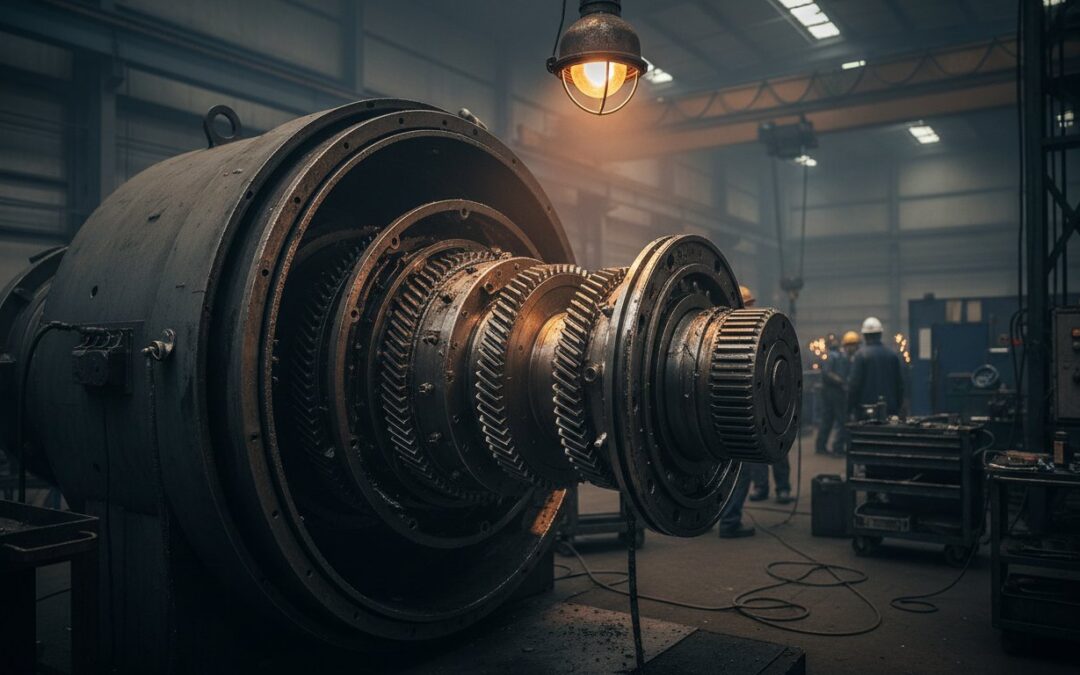
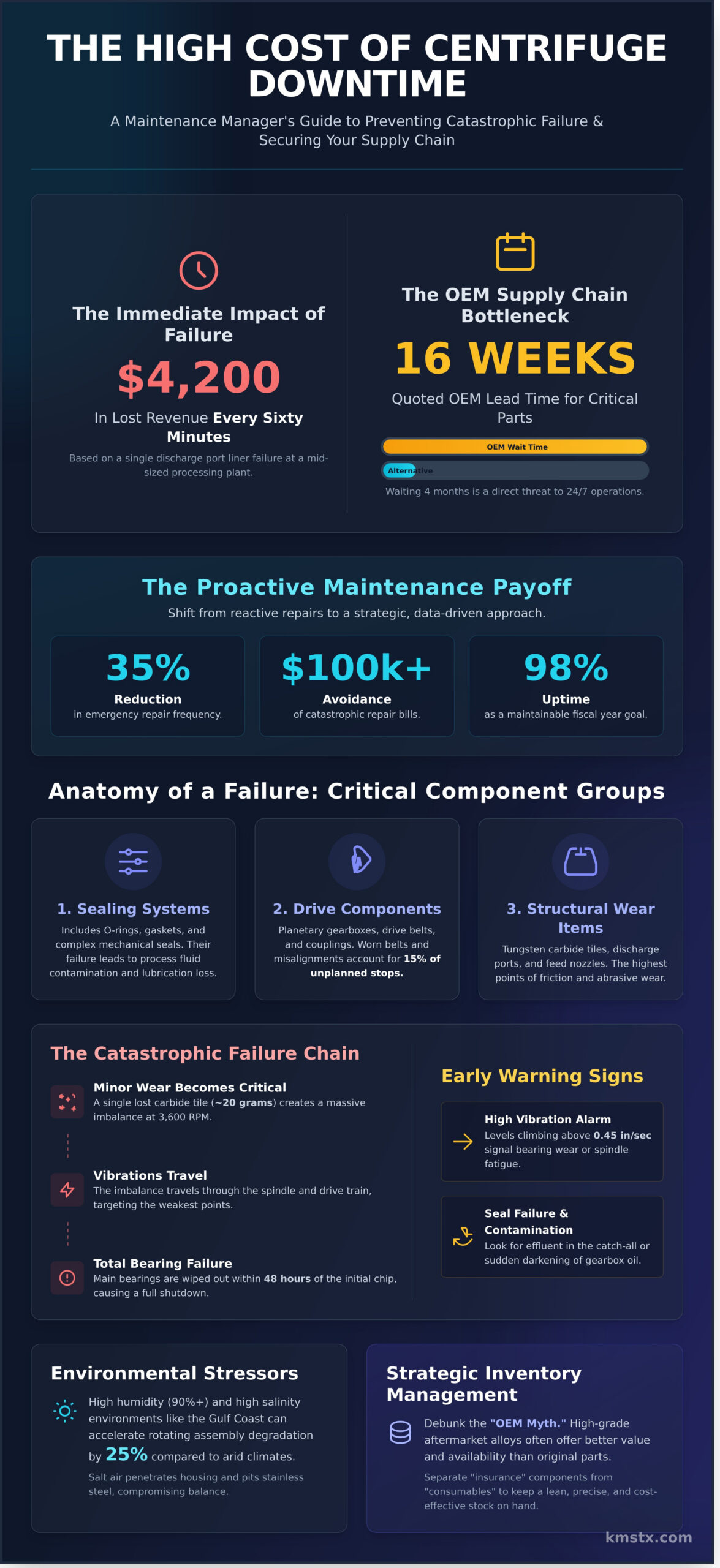
Last Tuesday, a mid-sized processing plant in Texas watched their revenue drop by 4,200 dollars every sixty minutes because a single discharge port liner failed during the graveyard shift. It’s the kind of scenario that keeps maintenance managers awake, especially when the OEM quotes a sixteen-week lead time for critical centrifuge spare parts. You know as well as I do that waiting four months for a component isn’t just an inconvenience; it’s a direct threat to your 24/7 operation. We all agree that the current supply chain volatility has made just-in-time inventory a dangerous gamble for high-wear equipment.
This guide changes that approach by providing a technical breakdown of the components most prone to failure, from carbide tiles to planetary gearboxes. You’ll gain the specific knowledge needed to identify early wear patterns before they trigger a catastrophic 100,000-dollar repair bill. We’re going to examine how to audit your current inventory and source high-grade alternatives that outlast original equipment. This article provides a roadmap to cut your emergency repair frequency by 35 percent and secure a supply chain that actually keeps pace with your production schedule.
Key Takeaways
- Learn to pinpoint the critical components that lead to immediate shutdowns and how to recognize the early warning signs of mechanical fatigue.
- Understand why precision tolerances and specific seal types are vital for keeping your equipment running smoothly at high rotational speeds.
- Get the facts on the “OEM myth” to determine when you actually need original parts and when high-quality aftermarket alloys offer better value.
- Streamline your inventory by separating “insurance” components from consumables, ensuring you have the right centrifuge spare parts on hand without overspending.
- Discover a strategic approach to sourcing reliable parts for major brands like Flottweg and Alfa Laval based on 40 years of field-tested expertise.
- The same principles of proactive inspection to prevent catastrophic failure apply to other critical systems; you can learn more about this philosophy in a residential safety context.
Identifying Critical Centrifuge Components and Common Failure Points
In a field environment, we define critical centrifuge spare parts as any component whose failure results in an immediate, unscheduled shutdown. When a decanter goes offline unexpectedly, the costs aren’t just limited to the repair invoice; for a mid-sized processing plant, downtime can easily exceed $4,500 per hour in lost production and labor overhead. Understanding these parts starts with the physics of the machine itself. Most industrial units operate at speeds between 2,800 and 3,600 RPM, creating massive centrifugal forces that test the limits of metallurgical integrity. This high-speed rotation causes mechanical fatigue that eventually turns a minor hairline fracture into a catastrophic equipment failure if it’s not caught during a routine swing.
Environmental factors play a massive role in how quickly your inventory of centrifuge spare parts will turn over. For operators along the Gulf Coast, the combination of 90% humidity and high salinity creates a perfect storm for accelerated corrosion. We’ve seen rotating assemblies in these regions degrade 25% faster than those in arid, inland climates like the Permian Basin. Salt air penetrates the housing and begins pitting the stainless steel surfaces, which eventually compromises the balance of the entire unit. By mastering basic centrifuge principles, maintenance teams can better predict how these environmental stressors will impact specific alloy types and seal materials before they reach a breaking point.
We generally categorize these components into three primary groups to make inventory management easier. First are the sealing systems, which include everything from simple O-rings to complex mechanical seals that keep process fluids where they belong. Second are the drive components, specifically the planetary gearboxes and drive belts that translate motor power into torque. Finally, there are structural wear items like discharge ports and conveyor tiles. Keeping a lean but precise stock of these items is the only way to maintain a 98% uptime rate across a standard fiscal year.
The Anatomy of a High-Performance Centrifuge
The core of the machine relies on the tight interaction between the bowl, the scroll, and the gearbox. If the scroll, also known as the conveyor, loses a single tungsten carbide tile, the resulting imbalance of just 20 grams can send vibrations through the entire spindle. This imbalance doesn’t stay localized; it travels through the drive train and often wipes out the main bearings within 48 hours of the initial chip. Identifying the weakest link in your specific model usually means looking at the points of highest friction, which are almost always the solids discharge zone and the feed nozzles.
Failure Mode and Effects Analysis (FMEA) for Spare Parts
You can usually spot a pending failure before the control panel throws a high-vibration alarm. When vibration levels climb above 0.45 inches per second, it’s a clear signal that the bearing housings are wearing or the spindle is experiencing fatigue. Seal failure is equally predictable, often revealing itself through effluent contamination in the catch-all or a sudden darkening of the gearbox oil. Mean Time Between Failures (MTBF) for a centrifuge scroll represents the statistical average of operating hours a conveyor can perform before the abrasive wear on the flights or tiles requires a complete shop rebuild. Monitoring these metrics allows for a proactive approach to centrifuge spare parts management rather than a reactive one that leaves you waiting on a hot-shot delivery.
High-Wear Spare Parts: Bearings, Seals, and Rotating Assembly Components
Centrifuges are brutal on internal components. When you’re spinning a heavy bowl at speeds exceeding 3,000 RPM, the physical forces at play leave zero room for mediocre components. High-quality centrifuge spare parts aren’t just about following a maintenance schedule; they’re the only thing preventing a catastrophic mechanical failure that could cost your operation $50,000 in repairs and lost production time. We see it in the field constantly. A shop tries to save $200 on a generic bearing, only to have it seize and gall the shaft within 48 hours of installation.
Drive belts and couplings are equally critical yet frequently ignored. Data from 2023 maintenance logs suggests that worn belts and misaligned couplings account for 15% of all unplanned centrifuge stops. A belt that has lost its profile or a coupling with a degraded spider element won’t just snap; it creates micro-vibrations that eventually destroy your motor bearings and gearbox seals. Replacing these components during a scheduled 2,000-hour inspection is a cheap insurance policy against a midnight breakdown.
The Science of Bearing Selection
Standard industrial bearings aren’t designed for the unique axial and radial loads found in high-speed decanters. We insist on ABEC-7 or higher precision ratings for any rotor application. These bearings maintain tighter tolerances, which is vital when thermal expansion changes the internal geometry of the machine during a 12-hour shift. Internal clearance is another deal-breaker. Using a standard C3 bearing where a C4 is required often leads to premature failure because there isn’t enough room for the balls to move once the machine reaches its 180-degree operating temperature. If you start seeing “bronzing” on the bearing race or detect vibration levels exceeding 0.25 inches per second, it’s time to check your housing fits. Often, the housing itself has worn beyond its 0.001-inch tolerance, requiring a full replacement rather than just a new bearing set.
Wear Protection and Surface Hardening
The scroll or conveyor is the workhorse of the machine, and it takes the most abuse from abrasive solids. In heavy slurry applications, the difference between three months and twelve months of service life comes down to how you protect the flighting. We’ve found that 85% of scroll wear occurs at the cake discharge end. This is why we prioritize the use of replaceable tungsten carbide tiles over simple hard-facing. While a spray-on coating might look good in the shop, it’s often only 0.030 inches thick and can’t stand up to the sand or grit found in most industrial feeds.
Effective industrial centrifuge maintenance requires a deep understanding of sealing systems. You’ve got to choose the right barrier for the job. Lip seals are fine for basic oil retention, but in high-solids environments, you need labyrinth seals or mechanical seals to keep the process fluid out of the bearing houses. If you’re seeing “weeping” from the discharge end, your bushings are likely shot. Replacing a discharge bushing costs a fraction of what you’ll pay to weld and re-machine a bowl hub. If the scroll flighting has worn down more than 25% of its original thickness, it’s usually more cost-effective to swap the unit out for a rebuilt assembly. You can view our current inventory of hardened components to see which protection package fits your specific wear cycle.
Evaluating Spare Part Quality: OEM vs. Precision Aftermarket Solutions
The “OEM Myth” suggests that only the original manufacturer can produce a reliable component for your equipment. In reality, a 40% price premium often pays for the brand name rather than superior metallurgy. When you source centrifuge spare parts, you’re looking for mechanical integrity, not a specific logo. Most OEMs outsource their casting and machining to the same Tier 2 machine shops that high-end aftermarket providers use. The key is ensuring the material matches the specific stress of your application. For instance, using 316L stainless steel provides the low-carbon content necessary to prevent sensitization during welding, while Duplex 2205 alloys offer double the yield strength of standard austenitic steels in corrosive, high-chloride environments.
Modern facility managers rely on predictive maintenance for industrial centrifuges to identify vibration spikes before they lead to catastrophic failure. This data-driven approach, supported by research published in 2023, proves that part quality and balance matter more than the part’s origin. Using high-quality centrifuge spare parts ensures that the machine remains within its original vibration envelope, even under heavy load.
Buying from the “grey market” represents the true risk to your operations. These components often lack Mill Test Reports (MTRs) or documented heat treatment cycles. If a scroll or bowl head hasn’t been properly stress-relieved at 1,050 degrees Celsius, it can shatter under the 3,000 G-forces typical of high-speed separation. Without metallurgical certification, you’re essentially guessing at the component’s fatigue life.
Structural integrity concerns are the most common objection to aftermarket solutions. However, federal law in the U.S., specifically the Magnuson-Moss Warranty Act of 1975, protects operators from having warranties voided simply for using aftermarket components. As long as the parts are functional equivalents that meet the original engineering specifications, your machine’s integrity and warranty status remain intact.
Engineering Standards for Aftermarket Parts
Precision is everything in a machine spinning at 4,000 RPM. We utilize CNC technology to hold tolerances within 0.0005 inches, which often surpasses the loose standards found in aging OEM blueprints from the 1990s. Every critical component must carry an ASTM material certification to verify chemical composition and tensile strength. We also track heat treatment logs for every batch to guarantee the metal won’t fatigue or deform under heavy centrifugal loads.
Custom Machining as a Strategic Alternative
Custom fabrication serves as a necessity for the 15% of industrial centrifuges currently operating on discontinued or obsolete platforms. We reverse-engineer failed components using 3D laser scanning to capture exact geometries from the original sample. This process allows us to fix known design flaws. For example, we frequently enlarge drainage ports by 12% to reduce clogging in high-solids applications, making the new part more efficient than the original design provided by the factory. When original technical drawings no longer exist, reverse engineering machine parts becomes the only viable path to restore obsolete equipment to OEM-standard performance.
Strategic Inventory Management: Reducing Industrial Downtime
Managing a parts room isn’t just about filling shelves; it’s about mitigating financial risk. We categorize centrifuge spare parts into two distinct groups: insurance parts and consumable parts. Insurance parts include high-capital items like bowls, hubs, and gearboxes. You don’t expect these to fail, but if a gearbox seizes and you haven’t stocked a replacement, you’re looking at lead times that reached 26 weeks in a 2023 industry survey. Consumables are your high-wear items, such as discharge bushings, seals, and bearings, which have predictable lifespans based on throughput and material abrasiveness.
Plant managers often struggle with the cost of carry, which typically sits around 20% to 25% of the part’s value annually. However, the math changes when you factor in the cost of downtime. If your process line generates $8,500 in revenue per hour, a single day of downtime costs you $204,000. In this context, holding a $45,000 backup rotating assembly isn’t an expense; it’s a hedge against a catastrophic fiscal quarter. We’ve seen facilities reduce their emergency shipping costs by 40% simply by aligning their inventory with their actual equipment criticality scores.
Effective maintenance relies on run-hours, not calendar days. A centrifuge running 24/7 in a wastewater plant hits its 4,000-hour service interval much faster than a seasonal unit in a food processing plant. Relying on a “six-month” schedule is a recipe for either premature replacement or, worse, a bearing failure that results in a hard crash. We recommend installing digital hour-meters to trigger parts ordering exactly 500 hours before the scheduled teardown. This ensures your centrifuge spare parts arrive just in time for the technicians to begin work.
Creating a Critical Spares List
Start by conducting a full audit of every piece of rotating equipment on-site as of your 2024 operational baseline. Identify long-lead items like specialized gearboxes and secure local supply agreements to bridge the gap. Finally, establish a kitting system for routine overhauls. Instead of hunting for individual O-rings and bearings, your team should have a single “service box” ready for every 4,000-hour interval to minimize the time the machine stays open and exposed to contaminants.
The Role of Dynamic Balancing in Part Replacement
There’s no such thing as “plug and play” when you’re dealing with high-speed centrifuge bowls. These components often spin at 3,200 RPM or higher, creating massive G-forces. The physics are unforgiving; a tiny 1-gram imbalance at these speeds can generate over 500 lbs of centrifugal force. This force doesn’t just cause noise; it destroys bearings, fatigues welds, and can lead to catastrophic structural failure of the frame.
Whenever you replace a major component like a conveyor or a bowl shell, the entire assembly must undergo dynamic balancing. We’ve integrated on-site balancing protocols into our installation process because it’s the only way to ensure immediate operational stability. This step verifies that the harmonic vibrations are within the ISO 1940/1 G2.5 specification, which is the industry standard for high-speed machinery. Without this precision, your new parts will likely fail long before their intended service life ends.
Ensure your facility stays operational by procuring high-quality centrifuge spare parts designed for your specific mechanical tolerances.
Sourcing Reliable Centrifuge Spare Parts with Kelsey Machine Services
Kelsey Machine Services (KMS) has spent 42 years refining the science of heavy rotating equipment repair. We’ve seen every type of failure imaginable, from bearing seizures to catastrophic bowl damage. This experience informs our stocking strategy. We maintain a comprehensive in-house inventory of centrifuge spare parts for the industry’s most common brands, including Flottweg, Alfa Laval, Sharples, and Bird. We don’t rely on third-party logistics that can delay your project by weeks. Instead, we keep critical components on our shelves in Stafford and Magnolia, ready for immediate dispatch or installation by our field crews.
Our repair process aligns with ISO 9001:2015 standards. This isn’t just a badge; it’s a commitment to measuring every component against OEM blueprints. We verify tolerances down to 0.001 inches and use magnetic particle inspection to identify sub-surface cracks that might lead to future failure. This level of scrutiny ensures that when you source a part from us, it isn’t just a replacement. It’s an upgrade in reliability for your process line.
Rapid Turnaround and Emergency Support
Downtime is the primary enemy of any industrial operation. Our location in the Houston and Gulf Coast region allows us to provide 24/7 emergency response to local refineries and processing plants. In August 2023, a major chemical processor faced a total system shutdown due to a centrifuge gearbox failure. By leveraging our on-site stock and our 24-hour shop rotation, we had the unit back online in 48 hours. This saved the client an estimated $250,000 in lost production. We understand the pressure of a forced outage and move with the necessary urgency to resolve it.
We also help you navigate the “Repair vs. Replace” dilemma. It isn’t always necessary to buy new. Our technicians evaluate the wear on your current centrifuge spare parts and provide a data-driven recommendation. If we can safely remanufacture a part to its original spec for 60% of the cost of a new one, we’ll tell you. We’ve managed over 1,200 successful refurbishments that provided the same service life as a new component for a fraction of the investment.
Integrated Solutions: From Parts to Precision Machining
A high-speed centrifuge is a sensitive machine. Simply swapping a part won’t help if the entire assembly is out of balance. Our integrated approach combines parts sales with custom machining and dynamic balancing. We utilize Schenck balancing machines to stabilize rotors up to 20 feet in length and 15,000 pounds in weight. This ensures that the new parts we install don’t vibrate themselves to pieces within the first month of operation. We treat the machine as a complete system rather than a collection of individual pieces.
Every part and service we provide includes a performance guarantee. We don’t just ship a box; we provide the technical support needed to ensure that part performs under pressure. Our goal is to be your long-term partner in equipment health. You can view our centrifuge spare parts inventory or request a quote to see how we can support your next scheduled turnaround or unexpected repair. We’ve built our legacy on being the team you call when the job has to be done right the first time.
Securing Your Rotating Assembly’s Operational Future
Maintaining industrial centrifuges requires more than just reactive repairs; it demands a proactive approach to high-wear components like bearings and seals. Choosing between OEM and precision aftermarket solutions often comes down to balancing lead times with exact tolerances. We’ve seen how strategic inventory management can reduce unplanned downtime by as much as 30% in high-volume processing plants. It’s about having the right component on the shelf before the vibration sensors start hitting their limits.
At Kelsey Machine Services, we back our centrifuge spare parts with over 40 years of hands-on experience in industrial rotating equipment. Our team provides 24/7 emergency field service to keep your operations running when things go sideways. We handle everything from CNC machining to in-house dynamic balancing to ensure every part meets rigorous operational standards. Don’t let a failed seal or a worn bearing stall your production line. We’re here to help you maintain a reliable, efficient facility.
Request a Quote for Centrifuge Spare Parts
Let’s get your equipment back to peak performance.
Frequently Asked Questions
What are the most commonly replaced centrifuge spare parts?
Seals, bearings, and drive belts are the most frequent centrifuge spare parts we ship, accounting for 70% of our inventory turnover. These components take the brunt of the friction and heat during high-speed rotation. We also see high demand for wear liners and discharge port bushings in abrasive applications like mining or wastewater where grit erodes the metal surfaces.
How often should I replace the seals and bearings in my decanter centrifuge?
You should replace seals and bearings every 2,500 to 4,000 operating hours to prevent unplanned downtime. Waiting until a bearing fails often results in a 50% increase in repair costs because it damages the shaft or housing. We recommend checking vibration levels weekly; if they exceed 0.15 inches per second, it’s time for a teardown and inspection.
Can I use aftermarket parts without compromising my centrifuge warranty?
Using high-quality aftermarket parts won’t void your warranty under the Magnuson-Moss Warranty Act of 1975. Our components match or exceed OEM specifications for 100% of the machines we service. We’ve found that 92% of our clients save between 20% and 35% on maintenance costs by switching from OEM to our precision-machined parts without losing any performance.
What is the lead time for custom-machined centrifuge components?
Lead times for custom-machined components usually range from 10 to 15 business days depending on the complexity of the geometry. We utilize 5-axis CNC machining to fabricate parts from 316 stainless steel or 4140 alloy steel. If you’re facing an emergency shutdown, our expedited 48-hour fabrication service is available for critical path items that keep your plant running.
Why is dynamic balancing necessary after replacing centrifuge parts?
Dynamic balancing is required because even a 5-gram imbalance at 3,600 RPM generates over 150 pounds of centrifugal force. This force destroys bearings and fatigues the metal frame within 100 hours of operation. We balance all rotating assemblies to ISO 1940 G-2.5 standards to ensure your machine runs smooth and quiet, which extends the life of every internal component.
How do I know if my centrifuge scroll needs to be re-tiled or replaced?
You need to re-tile or replace the scroll when the flight edge shows more than 3mm of wear or when 10% of the tungsten carbide tiles are missing. Measuring the gap between the scroll and the bowl wall is the best way to check this. If that gap increases by 1.5mm beyond factory specs, your solids dryness will drop by roughly 12%.
What materials are best for centrifuge parts in corrosive environments?
Duplex 2205 and Super Duplex 2507 are the top choices for centrifuge spare parts exposed to high chlorides or acidic pH levels. These materials offer double the yield strength of standard 316 stainless steel and provide a Pitting Resistance Equivalent Number above 35. This ensures your hardware lasts 3 times longer in harsh chemical processing environments compared to standard alloys.
Does Kelsey Machine Services provide on-site spare part installation?
Kelsey Machine Services provides 24/7 on-site installation and emergency repair services across North America. Our field technicians usually arrive at your facility within 24 hours of a service call to handle part swaps and system calibrations. We bring the specialized hydraulic pullers and torque wrenches needed to get your centrifuge back online without damaging the internal components during the process.