
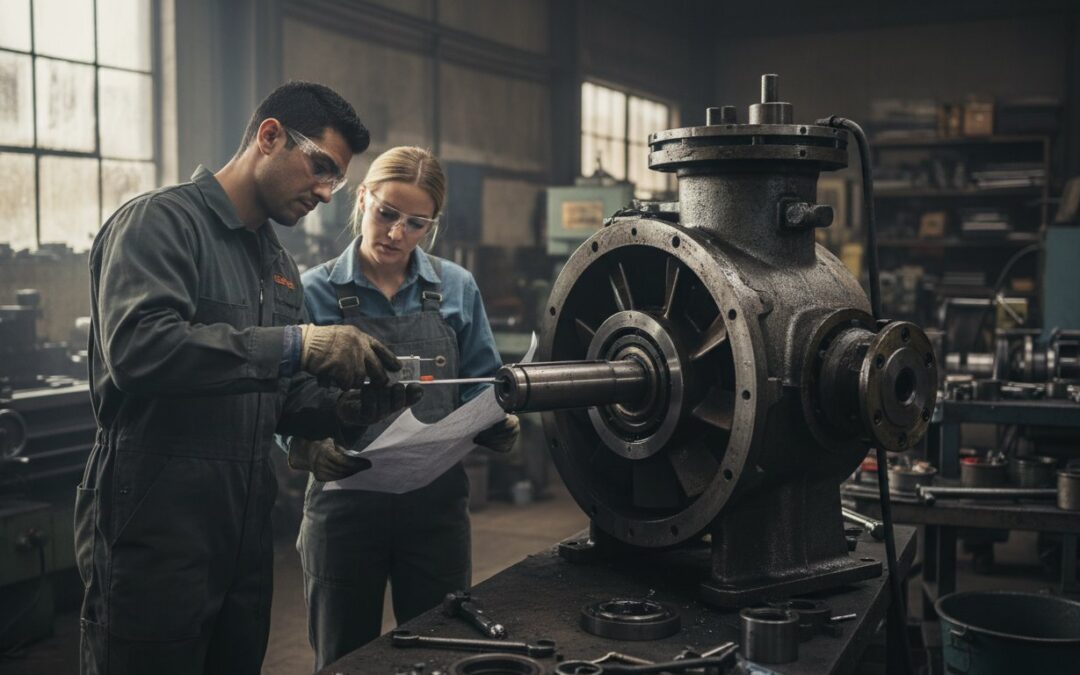
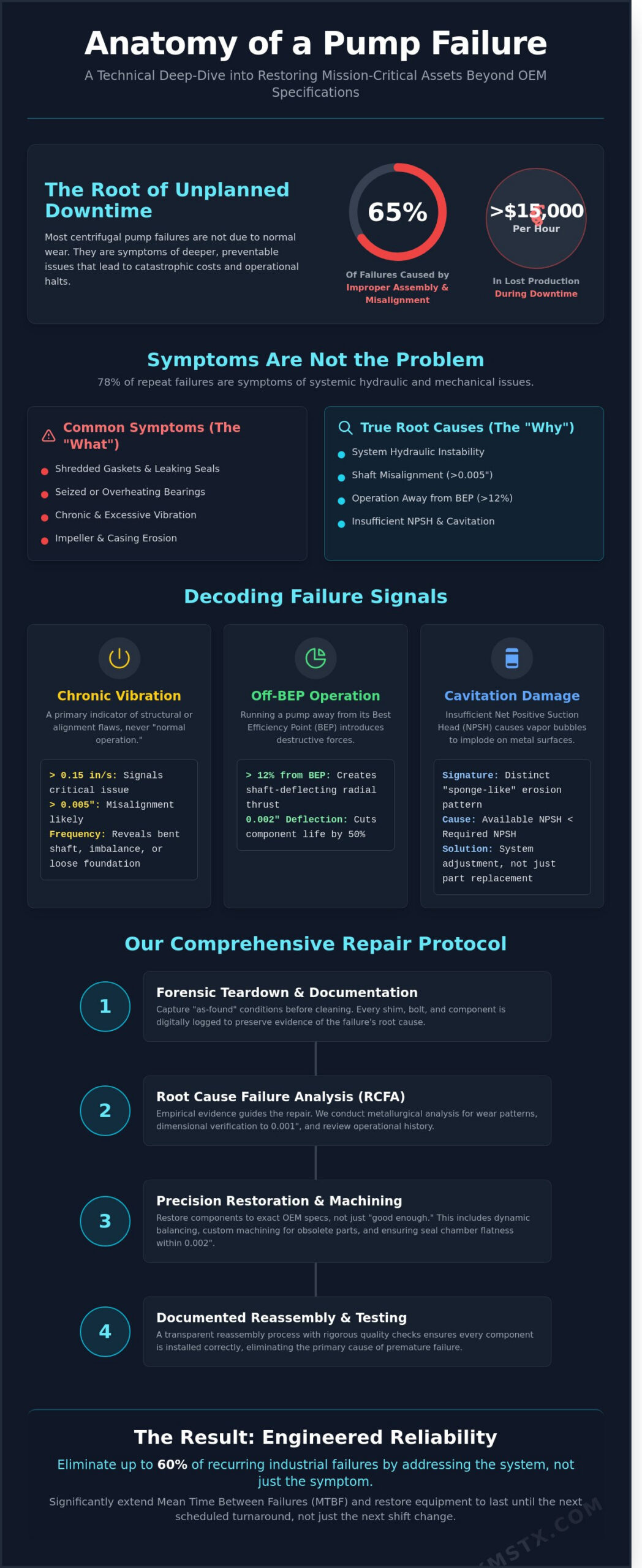
Recent industry data indicates that approximately 65% of centrifugal pump failures are caused by improper assembly or misalignment rather than standard wear and tear. You’ve probably seen the impact firsthand when a critical unit returns from a shop only to vibrate or leak within 48 hours of installation. It’s a costly cycle that can result in over $15,000 per hour in lost production for high-volume facilities. When you’re looking for industrial pump repair Houston, you don’t just need a mechanic; you need a technical partner who understands that a pump is only as reliable as its tightest tolerance.
We agree that transparency during the teardown process is non-negotiable for any serious maintenance team. This article provides a technical deep-dive into restoring your mission-critical assets to exact OEM specifications while significantly extending your mean time between failures. We’ll cover everything from precision dynamic balancing to the rigorous documentation and 24/7 support protocols required to ensure your equipment survives the most demanding operational environments.
Key Takeaways
- Identify the true root causes of equipment failure by analyzing hydraulic instability and mechanical seal performance rather than just addressing surface wear.
- Establish a precise restoration baseline through a documented teardown process that captures critical “as-found” measurements to ensure OEM compliance.
- Learn the technical distinctions between basic repairs and full refurbishments, including when to utilize custom machining for obsolete components.
- Minimize operational downtime by leveraging 24/7 field services and on-site troubleshooting for expert industrial pump repair Houston when equipment removal isn’t an option.
- Discover how four decades of engineering expertise and a deep spare parts inventory can be utilized to significantly accelerate your project turnaround times.
Diagnosing Root Causes in Industrial Pump Failure
Effective industrial pump repair Houston requires looking past the shredded gasket or the seized bearing. Most technicians see a failed component and replace it, but data suggests that 78% of these failures are symptoms of systemic hydraulic issues rather than simple age. If you’re replacing mechanical seals every six months, the seal isn’t the problem; the system’s hydraulic stability is. High-energy pumps often suffer from internal recirculation when they aren’t matched to the system’s actual head requirements. This creates pressure pulsations that hammer the seal faces, leading to heat checking and carbon fracture.
Chronic vibration serves as a primary diagnostic indicator of deeper structural or alignment flaws. It’s never just “normal operation.” When a pump vibrates at frequencies exceeding 0.15 inches per second, it’s often a signal of 0.005-inch misalignment or structural resonance. These forces don’t just stay in the casing. They travel through the shaft, destroying the bearing housing and causing catastrophic failure in the power end. Identifying the specific frequency of the vibration helps determine if the issue is a bent shaft, an unbalanced impeller, or a loose foundation bolt. Similar vibration analysis techniques are critical for industrial blower maintenance where bearing fatigue and harmonic resonance follow comparable failure patterns.
Hydraulic and Mechanical Stress Factors
Operating a pump more than 12% away from its Best Efficiency Point (BEP) creates radial thrust that deflects the shaft. Even a deflection of 0.002 inches at the seal face can cut component life in half. We also evaluate Net Positive Suction Head (NPSH) margins. When the available NPSH drops below the required levels, vapor bubbles form and collapse against the impeller. This cavitation leaves a distinct “sponge-like” erosion pattern on the metal. Identifying these specific metallurgical signatures allows us to adjust suction piping or impeller trim rather than just swapping parts. Similar hydraulic stress patterns are commonly found in other rotating equipment, where hydraulic drive repair services require the same level of precision analysis to identify root causes of failure.
Root Cause Failure Analysis (RCFA) Procedures
Our RCFA process relies on empirical evidence to stop the cycle of “repair and repeat.” We analyze wear patterns under magnification to distinguish between abrasive wear from 40-micron particulates and chemical attack on 316 stainless steel components. Documenting these findings in a detailed report ensures that maintenance schedules are based on actual run-time data. This technical rigor is why industrial pump repair Houston facilities must prioritize data over guesswork. We track the following during every teardown:
- Metallurgical Analysis: Checking for pitting vs. erosion patterns on the impeller vanes.
- Dimensional Verification: Measuring tolerances to within 0.001 inches to ensure fit.
- Operational History: Comparing the pump’s performance curve against the actual field flow rates.
By treating the pump as part of a larger system, we eliminate the root causes that lead to 60% of recurring industrial failures. It’s about engineering a solution that lasts until the next scheduled turnaround, not just until the next shift change.
The Comprehensive Protocol for Pump Teardown and Inspection
When a unit arrives for industrial pump repair Houston, the teardown process functions as a forensic investigation. It’s not just about disassembly; it’s about capturing the “as-found” condition before any cleaning or machining alters the evidence. Technicians document every component’s orientation, shim thickness, and bolt torque. This initial stage establishes a baseline for the entire restoration. Without a documented, step-by-step protocol, critical data regarding the root cause of failure often disappears in the parts washer. We track 100% of the components through a digital log to ensure nothing is overlooked during the eventual reassembly.
Cleaning involves more than just removing grease. We utilize specialized media blasting and chemical baths to strip away scale and oxidation without compromising the base metal. Once the parts are clean, we move into a rigorous inspection phase. This results in a comprehensive report featuring high-resolution photographic evidence of cavitation, erosion, or heat tinting. This level of detail allows plant managers to see exactly why a pump failed, turning a simple repair into a learning opportunity for the maintenance team. If you’re seeing repeated failures, our team can analyze your pump performance data to identify systemic issues.
Dimensional Inspection and Tolerances
Precision is the difference between a pump that lasts ten years and one that fails in ten months. Technicians measure shaft runout and housing bores using calibrated micrometers, often holding tolerances within 0.001 inches. We check impeller clearances against the original OEM specifications to identify efficiency losses. Seal chamber faces undergo testing for flatness and perpendicularity to the shaft axis. A deviation of even 0.002 inches can significantly shorten the lifespan of a mechanical seal, leading to premature downtime and increased costs.
Non-Destructive Testing (NDT) Methods
Visual checks don’t reveal the microscopic fatigue cracks that lead to catastrophic housing bursts. We employ dye penetrant and magnetic particle inspection (MPI) to find surface defects in high-stress areas like the impeller vanes and shaft keyways. For high-pressure pumps, ultrasonic testing identifies internal casting flaws that could compromise the unit under load. Finally, we perform hydrostatic testing at 150% of the maximum allowable working pressure. This ensures the casing integrity is fully restored before the pump returns to the field. These systematic checks provide the technical certainty required for heavy industrial operations.
Precision Restoration: Repair vs. Refurbishment Standards
In the Houston ship channel and surrounding refineries, there’s a massive difference between a quick fix and a technical overhaul. A patch job might replace a single failed seal to stop a leak, but a full refurbishment resets the clock on the entire unit’s service life. This process is essential for restoring API 610 standards, which govern centrifugal pumps in high-temperature, high-pressure hydrocarbon services. When a pump undergoes a full technical overhaul, every critical dimension is measured against original specifications; it’s about returning the equipment to its peak performance curve rather than just making it operational.
For facilities managing industrial pump repair Houston projects, the decision to refurbish often stems from the high cost of downtime. A failed boiler feed pump can cost a plant $15,000 per hour in lost production. By choosing a full refurbishment, engineers ensure that internal clearances, metallurgy, and structural integrity meet or exceed the requirements for modern petrochemical applications. This methodology effectively eliminates the “infant mortality” phase of equipment restarts by verifying every component’s fit and function before it leaves the shop.
Dynamic Balancing and Vibrational Stability
Precision balancing is the foundation of rotating equipment longevity. Technicians balance impellers and shafts to ISO 1940 G1.0 or G2.5 standards to minimize centrifugal forces that punish internal components. Achieving these tight tolerances can extend bearing life by 40% and prevent premature mechanical seal failure caused by shaft deflection. Dynamic balancing reduces parasitic power loss by ensuring the motor’s energy is dedicated to fluid movement instead of fighting mechanical resistance and internal vibration. This level of stability is critical for high-speed assemblies where even a few grams of unbalance can lead to catastrophic casing failure. These same precision balancing principles apply to industrial blower maintenance where rotor imbalance can create destructive harmonic vibrations throughout the entire system.
Custom Machining for Critical Components
OEM support often disappears for legacy equipment, or lead times for a new shaft might exceed 24 weeks. This is where custom machining becomes a necessity for industrial pump repair Houston operations. Technicians use reverse engineering to fabricate shafts, sleeves, and wear rings from high-grade alloys like 17-4 PH stainless steel. Applying specialized tungsten carbide coatings to these components can increase erosion resistance by 500% in abrasive slurry applications. This approach allows plants to keep obsolete but structurally sound equipment in service without compromising on safety or efficiency.
Optimizing Reliability Through Field Service and Maintenance
Industrial operations in the Gulf Coast don’t stop for a broken seal or a seized bearing. When critical infrastructure fails, waiting for a shop slot often results in production losses exceeding $12,500 per hour. Effective industrial pump repair Houston relies on a 24/7 emergency response model that brings precision engineering directly to your facility. On-site troubleshooting often reveals that the issue isn’t internal to the pump but is caused by system-side variables like suction cavitation or improper valve sequencing. Resolving these factors on the skid prevents the unnecessary cost of pulling equipment that’s actually functioning within its design parameters.
Predictive Maintenance and Vibration Analysis
Catching a subsurface defect before it leads to a catastrophic shaft break saves an average of 35% in total lifecycle costs. Our teams utilize high-resolution accelerometers to identify bearing frequencies and resonance issues that are invisible to the naked eye. By analyzing the spectral data, we pinpoint specific failure modes like inner race pitting or cage instability. We also integrate thermal imaging to detect friction points where temperatures climb above 175°F; this usually indicates lubrication breakdown or cooling jacket obstructions. Every newly commissioned or repaired pump receives a baseline vibration profile to ensure compliance with ISO 10816-3 standards. These same diagnostic techniques are essential for comprehensive industrial hydraulic drive repair services where metallurgical fatigue and bearing degradation follow similar failure patterns. For facilities managing positive displacement equipment, implementing reciprocating compressor maintenance protocols that include oil analysis and valve health monitoring can prevent the same types of catastrophic failures we see in centrifugal pumps.
On-Site Installation and Laser Alignment
The final installation determines whether a pump lasts ten years or ten months. Traditional dial indicator methods often fall short because they can’t account for bracket sag over long spans. We utilize dual-beam laser alignment tools to achieve tolerances within 0.0005 inches. This level of precision is vital for correcting “soft foot” conditions where the pump frame distorts under bolt torque. Our technicians also perform final checks on coupling gaps and pipe strain. If the piping exerts more than 50 pounds of force on the flange, it will pull the casing out of alignment and ruin the mechanical seals within weeks.
Kelsey Machine Services: Engineering Excellence in Pump Repair
Kelsey Machine Services (KMS) brings 42 years of technical experience to every project involving heavy rotating equipment. We’ve spent decades troubleshooting the specific failure modes found in the Gulf Coast’s demanding industrial environments. Our facility serves as a primary hub for industrial pump repair Houston, where we combine traditional craftsmanship with modern engineering precision. We understand that a pump failure at 2:00 AM can halt an entire production line, which is why we maintain a 24/7 emergency support team ready to deploy for national industrial operations.
We maintain an internal inventory of over 12,500 critical spare parts. This stock allows our team to bypass the 8 to 12-week supply chain delays that often stall projects. Our full-service machine shop features horizontal boring mills and dynamic balancing equipment capable of handling rotors up to 5,000 pounds. We don’t just replace parts; we engineer solutions. If a component is obsolete, our machinists can reverse-engineer and manufacture it to exact tolerances in-house.
The KMS Advantage: Quality and Speed
Technical labor isn’t just about assembly. It’s about restoring OEM performance through precise tolerances. We utilize calibrated micrometers and laser alignment tools to ensure every rebuild meets or exceeds original specifications. Every major overhaul includes a documented 12-month warranty on workmanship, providing peace of mind for your most critical assets. This same commitment to precision extends to our Industrial Centrifuge Repair services, ensuring all your rotating equipment operates at peak efficiency.
Partnering for Long-Term Operational Stability
Moving from reactive repairs to a strategic maintenance partnership is the most effective way to protect your bottom line. We’ve compiled a deep technical library containing legacy equipment specifications and drawings dating back to 1980. This data allows us to support and rebuild industrial pump repair Houston assets that the original manufacturers may no longer service. Our team provides detailed technical evaluations for all pump assets, identifying specific wear patterns before they lead to catastrophic failure. Contact our Houston shop today for a technical evaluation of your current pump fleet.
Securing Long-Term Reliability for Your Rotating Assets
Maintaining operational uptime requires more than just swapping parts; it demands a thorough understanding of mechanical failure modes. Effective industrial pump repair Houston relies on a systematic teardown and the engineering depth needed to identify the root cause of every vibration or seal leak. By adhering to strict refurbishment standards, you ensure that equipment doesn’t just run, but performs at peak efficiency for its entire service life. Our protocol eliminates the guesswork that often leads to repeat failures.
Kelsey Machine Services brings 40 years of specialized rotating equipment experience to every project. We utilize a fully equipped precision machine shop to handle complex metallurgical repairs and tight-tolerance machining in-house. If an unexpected outage occurs, our 24/7 emergency field service teams are available to restore your production schedule immediately. It’s time to move beyond temporary patches and invest in precision engineering that lasts. Technical experts are standing by to help you stabilize your fluid systems.
Request a Technical Evaluation for Your Industrial Pump
We’re ready to get your systems back to peak performance and keep your facility running smoothly.
Frequently Asked Questions
What are the most common causes of industrial pump failure?
Mechanical seal failure accounts for 35% of all unscheduled pump shutdowns we see in heavy industry. Bearing fatigue, typically caused by lubrication contamination or shaft misalignment, contributes to another 20% of equipment downtime. We often find that these issues stem from operating the pump too far from its Best Efficiency Point, which can reduce the lifespan of internal components by 50% or more.
How long does a typical industrial pump overhaul take?
A standard industrial pump repair Houston project typically requires 10 to 14 business days for a complete technical overhaul. This timeline includes the initial teardown, precision measurement of all tolerances, and the lead time for specialized seal or bearing kits. If custom machining for a shaft or wear ring is necessary, we’ve seen timelines extend by 5 additional days to ensure the metallurgy meets OEM specs.
Can you repair industrial pumps from manufacturers that are out of business?
Yes, we can repair pumps from defunct manufacturers by utilizing 3D scanning and reverse engineering to recreate critical parts. Our shop produces impellers and shafts that meet or exceed original 1980s or 1990s specifications using modern alloys. This process often saves facilities the 40,000 dollar cost of piping modifications required to install a completely different pump model.
What is the difference between dynamic balancing and static balancing for pumps?
Static balancing involves correcting a heavy spot on a single plane while the part is stationary, but dynamic balancing corrects imbalances across multiple planes while the rotor spins at operational RPMs. We balance all rotating assemblies to ISO 21940-11 G2.5 standards to minimize vibration. This precision reduces bearing loads by 25%, which directly extends the mean time between failures for high-speed centrifugal equipment.
Do you provide on-site pump troubleshooting and vibration analysis?
Our field technicians provide on-site vibration analysis using 4-channel data collectors to identify resonance or misalignment issues before they cause a catastrophic break. We’ve found that 15% of pump issues are actually related to baseplate rigidity or pipe strain rather than the pump itself. By performing these diagnostics in the field, we ensure the root cause is addressed so the failure doesn’t recur 3 months later.
Is it more cost-effective to repair or replace an industrial pump?
It’s generally more cost-effective to repair a pump if the total overhaul cost remains below 60% of the replacement price. For large scale API 610 pumps, a repair can save 50,000 dollars or more compared to buying new. However, if the casing thickness has decreased by more than 25% due to corrosion, we’ll recommend a replacement. We provide a detailed cost-benefit analysis for every industrial pump repair Houston project to help you make the right call.
What standards do you follow for pump repairs in the oil and gas industry?
We adhere strictly to API 610 standards for centrifugal pumps used in petroleum and gas processing to ensure maximum safety and reliability. Our technicians also follow ASME B73.1 guidelines for chemical process pumps, maintaining clearances within 0.002 inches of design specs. Following these rigorous protocols ensures that every overhauled unit meets the 20-year design life expectations common in Gulf Coast refineries.