
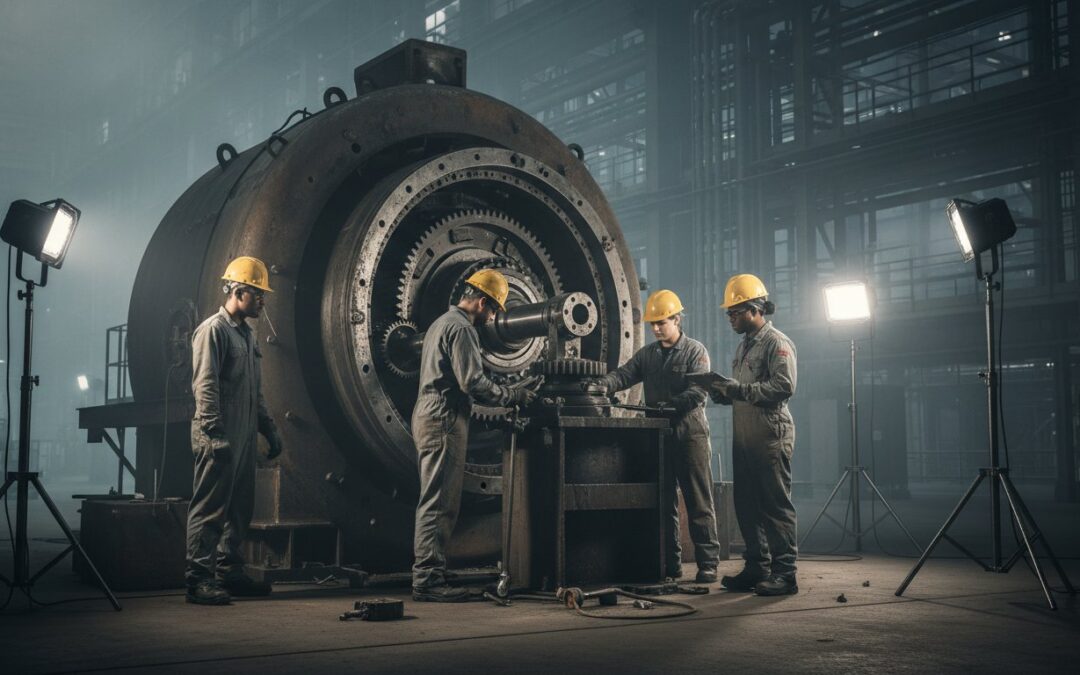
Last Tuesday at 3:14 AM, a vibration sensor on a critical 5,000 HP compressor in a Beaumont refinery hit the red zone, triggering an immediate facility-wide shutdown. You know the feeling of that sudden silence. It’s a silence that costs an average of $22,000 per hour in lost production while your team scrambles to find a specialist who actually understands complex gearbox tolerances. Finding reliable emergency machine repair Gulf Coast isn’t just about getting the lights back on; it’s about ensuring the fix holds under the brutal humidity and high-load cycles of the region.
We agree that a “band-aid” repair is often worse than the original failure because it invites a second, more catastrophic shutdown. You need a partner who treats a centrifuge or turbine failure with the same precision as a new build. This guide will show you how to manage these critical failures using rapid response strategies and precision engineering. We’ll examine the specific steps required for root cause identification and the workmanship standards that keep your heavy assets running long after the initial crisis has passed.
Key Takeaways
- Identify the specific criteria that define a mechanical emergency and learn how to mitigate the cascading costs of unplanned downtime.
- Analyze the mechanical triggers behind rotating equipment failure and why precision balancing is non-negotiable for machine longevity.
- Determine the most efficient logistical path for emergency machine repair Gulf Coast by weighing the benefits of rapid on-site troubleshooting versus shop refurbishment.
- Master a structured response protocol to secure failing assets and preserve critical evidence for a thorough root cause failure analysis.
- Discover how 24/7 precision engineering standards can stabilize your most critical industrial assets during high-stakes mechanical failures.
What Constitutes Emergency Machine Repair in Heavy Industry?
Industrial emergency repair for rotating equipment isn’t just about getting a machine to spin again. It’s a high-stakes technical intervention required when a critical asset like a high-speed pump or a multi-stage gearbox fails unexpectedly. In the heavy industrial corridors of the Gulf Coast, these failures often occur in environments where 24/7 operation is the baseline. Effective emergency machine repair Gulf Coast services focus on returning equipment to precise tolerances rather than applying a temporary patch. We distinguish between a simple ‘break-fix’ approach and a technical refurbishment; the latter involves analyzing why the failure happened and correcting the root cause based on established reliability engineering principles to prevent a repeat event. Key equipment usually requiring this level of urgent care includes decanter centrifuges, complex gearboxes, and high-pressure boiler feed pumps.
To better understand the precision required in these high-stakes repairs, watch this detailed look at heavy mechanical restoration:
Identifying Critical Asset Failure
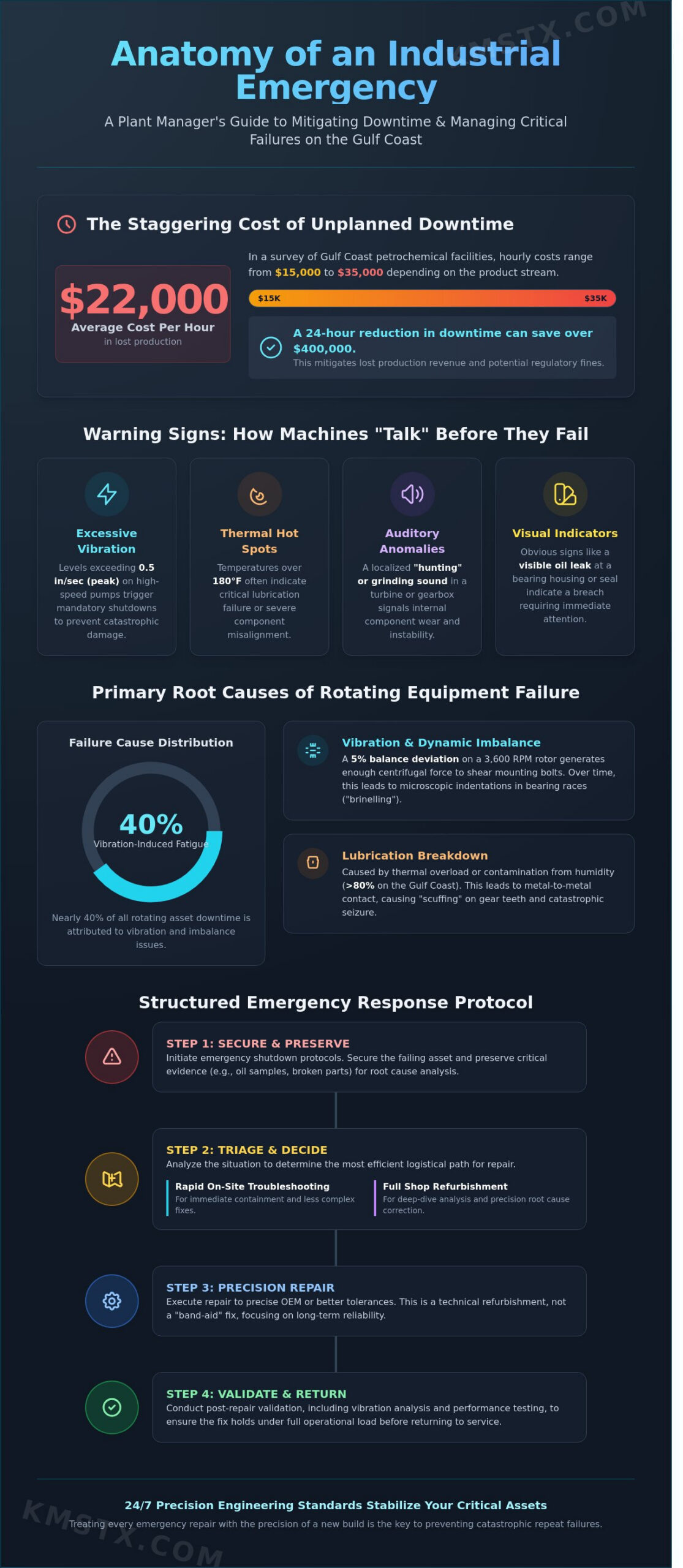
Machines talk before they fail. You just have to listen. Visual and auditory indicators, such as a localized “hunting” sound in a turbine or a visible oil leak at a bearing housing, are often the first signs of trouble. Reliability teams use thermal imaging to spot hot spots that exceed 180 degrees Fahrenheit, which often indicates lubrication failure or misalignment. When vibration levels on a high-speed pump exceed 0.5 inches per second (peak), a mandatory emergency shutdown is usually triggered to prevent catastrophic internal damage. Detecting these anomalies early allows for a transition from a chaotic breakdown to a managed emergency repair.
The Impact of Unplanned Downtime
The financial toll of a stopped line is staggering. In a 2023 survey of Gulf Coast petrochemical facilities, unplanned downtime costs averaged $15,000 to $35,000 per hour depending on the product stream. Beyond the immediate revenue loss, secondary risks include safety hazards from pressurized seal failures and potential environmental compliance violations if a pump failure leads to a spill. Rapid response from an emergency machine repair Gulf Coast specialist isn’t just about fixing a part; it’s about mitigating these long-term liabilities. A 24-hour reduction in downtime can save a mid-sized refinery over $400,000 in lost production and regulatory fines. Swift action protects both the balance sheet and the facility’s safety record.
The Technical Root Causes of Rotating Equipment Failure
Rotating equipment doesn’t just stop working; it undergoes a systematic degradation process that often culminates in a violent mechanical event. In the high-stakes environment of the Gulf Coast, where humidity levels often exceed 80%, the margin for error in machine maintenance is razor-thin. When a centrifuge or turbine operating at 3,600 RPM experiences even a 5% deviation in balance, the resultant centrifugal force can be enough to shear mounting bolts or shatter ceramic seals. This level of mechanical stress makes emergency machine repair Gulf Coast a critical necessity for plants running 24/7 cycles. Precision balancing isn’t a luxury; it’s the baseline for preventing the vibration-induced fatigue that accounts for nearly 40% of all rotating asset downtime.
Lubrication breakdown is another primary driver of catastrophic seizure. When oil viscosity drops due to thermal overload or chemical contamination, metal-to-metal contact occurs within milliseconds. In heavy-duty gearboxes, this leads to adhesive wear and “scuffing” on gear teeth. Before a technician even touches a seized gearbox, plant managers should ensure their site follows OSHA Emergency Action Plan guidelines to maintain safety during high-pressure repair scenarios. Once safety is established, the focus shifts to why the lubricant failed, whether it was a pump malfunction or a simple seal breach that allowed salt air to compromise the sump.
Vibration and Dynamic Imbalance
Subtle imbalances in a rotor assembly generate harmonic forces that travel through the shaft to the bearings. Over time, these forces cause “brinelling,” where the bearing races develop microscopic indentations. Utilizing industrial equipment vibration analysis allows technicians to see these issues in the frequency domain before they manifest as audible noise. Resonance is particularly dangerous; it occurs when the machine’s operating speed matches its natural structural frequency. If left unchecked, resonance can amplify small vibrations by a factor of 10, leading to a total structural failure of the housing.
Material Fatigue and Component Wear
In the Gulf Coast’s corrosive atmosphere, material fatigue accelerates. Centrifuge bowls and scrolls are especially susceptible to stress fractures when processing abrasive slurries. These cracks often start at the microscopic level, hidden beneath layers of process buildup. When an OEM part is ten years old and no longer stocked, emergency machine repair Gulf Coast often requires immediate custom machining. Rebuilding a shaft or housing to within 0.0005 inches of original specs is often faster than waiting for a six-month lead time on a new unit. If you’re facing a critical component failure, you can consult with our engineering team to discuss rapid turnaround machining solutions.
- Stress Fractures: Often caused by cyclic loading and corrosive pitting in 316 stainless steel.
- Obsolete Parts: Solved through reverse engineering and precision CNC milling.
- Seal Integrity: Compromised by shaft run-out exceeding 0.002 inches.
Strategic Response: Field Service vs. Shop Refurbishment
When a critical asset fails at a refinery or processing plant, the decision between field repair and shop refurbishment dictates both the timeline and the final bill. Managers must evaluate the physical footprint of the damage immediately. If the failure involves external components or minor internal wear, field services provide the fastest path to uptime. However, if a catastrophic internal failure occurs, moving the equipment is the only way to guarantee a reliable fix. A NIST report on maintenance costs indicates that unplanned downtime in manufacturing can cost $50 billion annually across the sector; every hour saved in the decision phase is direct capital preserved.
The cost-benefit analysis of mobilization versus transportation is often a matter of simple math. Mobilization fees for a four-man field crew might range from $5,000 to $12,000 per day. While that seems high, it’s frequently more economical than the $25,000 required for heavy-haul trucking and crane rentals needed to move a 50,000-pound compressor. If the repair is estimated to take more than five days, the efficiency and specialized tooling of a shop environment usually offset the transportation overhead. Choosing the right path for emergency machine repair Gulf Coast facilities requires balancing these logistics against the technical requirements of the hardware.
The Role of On-Site Field Services
Specialized field teams use mobile machine shops to stabilize equipment directly on the plant floor. Executing on-site equipment maintenance during a tight 12-hour window can prevent a total plant shutdown. These technicians utilize portable laser alignment tools, such as Prüftechnik systems, and vibration analyzers to find the root cause of a failure. For emergency machine repair Gulf Coast operators often rely on these mobile units to perform precision field balancing when a rotor shows signs of resonance. This avoids the 24-hour delay of loading and trucking heavy machinery through coastal traffic.
Comprehensive Shop Refurbishment
Shop refurbishment becomes non-negotiable when component tolerances fall outside of 0.001-inch specifications. A controlled environment is essential for dynamic balancing, as even minor ambient vibrations in a field setting can skew the data. Shops utilize heavy-duty CNC machinery to resurface shafts and housings with a level of precision that portable lathes can’t match. Before any equipment leaves the facility, it undergoes a full string test and documented run-up. This documentation provides 100% verification of performance before the machine is bolted back onto its foundation, ensuring the repair holds up under operational loads.
The Emergency Response Protocol for Plant Managers
When a primary drive, pump, or turbine fails, the first 60 minutes of your response determine whether the outage lasts two days or two weeks. A chaotic reaction often leads to missed diagnostic data or safety lapses that prolong downtime. You need a systematic approach to stabilize the environment before calling for an emergency machine repair Gulf Coast specialist to intervene. Taking the right steps immediately ensures that the repair team arrives to a controlled site with the data they need to start work.
Stabilization and Documentation
Safety is the absolute priority. Lock-out/tag-out (LOTO) procedures for rotating equipment must be executed immediately to prevent secondary damage or personnel injury. Once the site is secured, don’t rush to clear away debris or wipe down leaked fluids. These materials are forensic clues for failure analysis. Use a critical equipment failure response checklist to capture the state of the machine at the moment of the event.
- Capture Telemetry: Pull the last 72 hours of SCADA or vibration monitoring data. Look for thermal excursions exceeding 15% of baseline.
- Visual Records: Take high-resolution photos of the fracture surfaces, lubrication levels, and any discolored metal that suggests overheating.
- Stakeholder Briefing: Inform the operations team of the expected 24-hour window for the initial assessment to manage production expectations.
Expediting the Repair Process
Speed in the shop depends on the quality of the information you provide. Don’t just tell the machine shop the “pump is broken.” Provide a technical data package that includes original OEM tolerances, material grades, and current shaft alignment readings. If your facility maintains a spare parts inventory for at least 80% of high-wear components, you’ll likely reduce the total repair cycle by 3 to 5 days.
Logistics are the final hurdle in an emergency machine repair Gulf Coast scenario. Between regional traffic on I-10 and heavy industrial congestion, moving a 10,000-pound rotor requires pre-planned routes. Coordinate with hotshot drivers who understand the specific requirements of hauling precision-machined components; for those looking to maintain the heavy-duty vehicles involved in these operations, you can explore Diesel Engine Repair with Diego’s Shop to prevent logistical delays. Clear communication with your repair partner about the exact failure mode prevents unnecessary diagnostic hours once the equipment hits the shop floor. This direct hand-off ensures the focus stays on the rebuild rather than discovery.
If you’re currently facing a critical system failure, contact our team to initiate an emergency technical assessment today.
Precision Engineering: The Kelsey Machine Services Standard
Forty years on the shop floor teaches you things a manual can’t. At Kelsey Machine Services, we’ve spent four decades refining our approach to heavy rotating machinery, focusing on the specialized needs of the petrochemical and power generation sectors. We don’t just patch equipment; we restore it. Our commitment to 24/7 emergency industrial repair ensures that critical infrastructure stays operational when it matters most. For facilities requiring immediate emergency machine repair Gulf Coast, our response teams are ready to mobilize within hours, not days.
Technical credibility is our primary currency. In heavy industry, generic marketing doesn’t solve a bearing failure or a misaligned shaft. We prioritize empirical data and precision measurements over corporate slogans. Every repair we perform is engineered to meet or exceed original equipment manufacturer (OEM) specifications. Whether we’re working with tolerances of 0.0005 inches or complex metallurgy, the goal is always long-term mechanical integrity. This focus on technical rigor has allowed us to support Gulf Coast facilities through 40 years of evolving industrial standards.
Our Specialized Repair Capabilities
We provide deep expertise in industrial centrifuge and gearbox restoration, focusing on units that other shops might consider obsolete. Our core capabilities include:
- Precision Centrifuge Restoration: Full teardowns and rebuilds of decanter and basket models to restore factory performance.
- Advanced Dynamic Balancing: High-speed balancing to ISO 1940 standards to ensure vibration-free operation and bearing longevity.
- Custom Fabrication: In-house machining of shafts, sleeves, and housings for discontinued or hard-to-find components.
These services ensure that even the most complex rotating assemblies return to service with 100% confidence. We don’t guess at the solution; we measure it.
A Partnership in Industrial Reliability
Reliability isn’t a one-time event; it’s a strategy. We help our clients move from reactive firefighting to predictive maintenance models that identify issues before they cause a shutdown. Every repair we complete includes comprehensive technical documentation and a full warranty, providing a clear audit trail for your maintenance records. If you’re facing a critical failure, our emergency machine repair Gulf Coast services provide the technical backup you need. Contact our team today to discuss your specific repair requirements or to request immediate mobilization for your facility.
Securing Your Production Timeline Through Technical Expertise
Managing rotating equipment means you’re constantly balancing performance against the risk of catastrophic failure. Every minute of downtime represents lost revenue and potential safety risks. We’ve discussed how identifying root causes like misalignment or lubrication breakdown is the only way to stop the cycle of repeat repairs. Whether your situation calls for immediate 24/7 field service response or utilizing a full-service precision machine shop for complex refurbishments, having a vetted protocol in place saves critical hours. With 40+ years of industrial experience, we’ve seen how precision engineering directly impacts a plant’s bottom line. It’s not just about getting back online; it’s about ensuring the repair holds under the harshest conditions. For dependable emergency machine repair Gulf Coast operators can trust, having the right technical partner makes the difference between a temporary patch and long-term reliability. Don’t wait for a total system seizure to evaluate your response strategy. You’ve got the tools and the knowledge to keep your facility running at peak capacity.
Contact Kelsey Machine Services for 24/7 Emergency Support and keep your facility moving forward.
Frequently Asked Questions
What qualifies as an emergency machine repair for industrial operations?
An emergency involves any mechanical failure that causes a total production stoppage or creates an immediate safety risk for your crew. We categorize a 100% loss of function on a critical path component as a top priority. If a gearbox failure costs your facility $20,000 per hour in lost throughput, it’s an emergency. Our emergency machine repair Gulf Coast services also cover equipment that exceeds OSHA vibration or noise limits by more than 15%.
How quickly can a field service team mobilize for a Gulf Coast facility?
Our field technicians typically mobilize within 4 hours for any facility located between Houston and New Orleans. If your site is in a more remote coastal area, we guarantee a specialist will be on site within 24 hours. We keep 10 service trucks fully stocked with diagnostic tools and rigging gear at all times. This setup ensures we don’t waste time loading equipment when your plant is down and every minute counts.
Can you repair gearboxes and centrifuges from any OEM brand?
We repair all major industrial brands including Falk, Lufkin, Alfa Laval, and Bird. Our shop technicians focus on the specific metallurgy and mechanical tolerances of the components rather than just the brand name. Since 2010, we’ve successfully restored over 500 different equipment models from 40 unique manufacturers. If OEM parts aren’t available, our in house machining center can reverse engineer components to meet or exceed the original factory specifications.
Is dynamic balancing included in the emergency repair process?
Dynamic balancing is a standard requirement for every emergency machine repair Gulf Coast project involving rotating assemblies. We balance rotors and shafts to ISO 1940/1 standards, usually hitting a G1.0 or G2.5 precision grade. This process removes 95% of the internal forces that cause premature bearing failure. We don’t consider a repair finished until the equipment runs smooth, as skipping this step often leads to another breakdown within 90 days.
What information should I have ready when calling for emergency service?
You’ll need the equipment nameplate data, specifically the serial number and model, to help us pull technical drawings. It’s also helpful to provide the last 3 vibration reports and a clear description of the failure symptoms. Knowing if the unit is leaking oil or making a high pitched grinding sound helps our team pack the right parts. These details can save our technicians 2 hours of diagnostic work once they arrive at your gate.
Do you provide on-site troubleshooting for high-vibration issues?
Our team uses CSI 2140 vibration analyzers to perform full spectral analysis while your equipment is still running. We can identify specific issues like misalignment, structural looseness, or inner race bearing defects without a full teardown. In 90% of our service calls, we identify the root cause within the first 4 hours on site. This data driven approach prevents your team from replacing parts that aren’t actually broken, which saves both time and money.
What is the difference between a repair and a full refurbishment?
A repair focuses on fixing the specific fault that stopped the machine so you can get back to work. A refurbishment is a complete overhaul where we replace 100% of bearings and seals and restore all fits to original tolerances. While a standard repair carries a 90 day warranty, our full refurbishments come with a 2 year performance guarantee. Refurbishing an older unit can extend its service life by another 10 to 15 years.
Are spare parts available for immediate replacement during an emergency?
We maintain a $3 million inventory of high grade bearings, seals, and gaskets to support immediate turnarounds. If a specialized shaft or gear is destroyed, our machine shop can manufacture a custom replacement in less than 48 hours. This capability means you don’t have to wait on an OEM lead time that might stretch to 16 weeks. Our goal is to keep your downtime to a minimum by controlling the entire parts supply chain.