
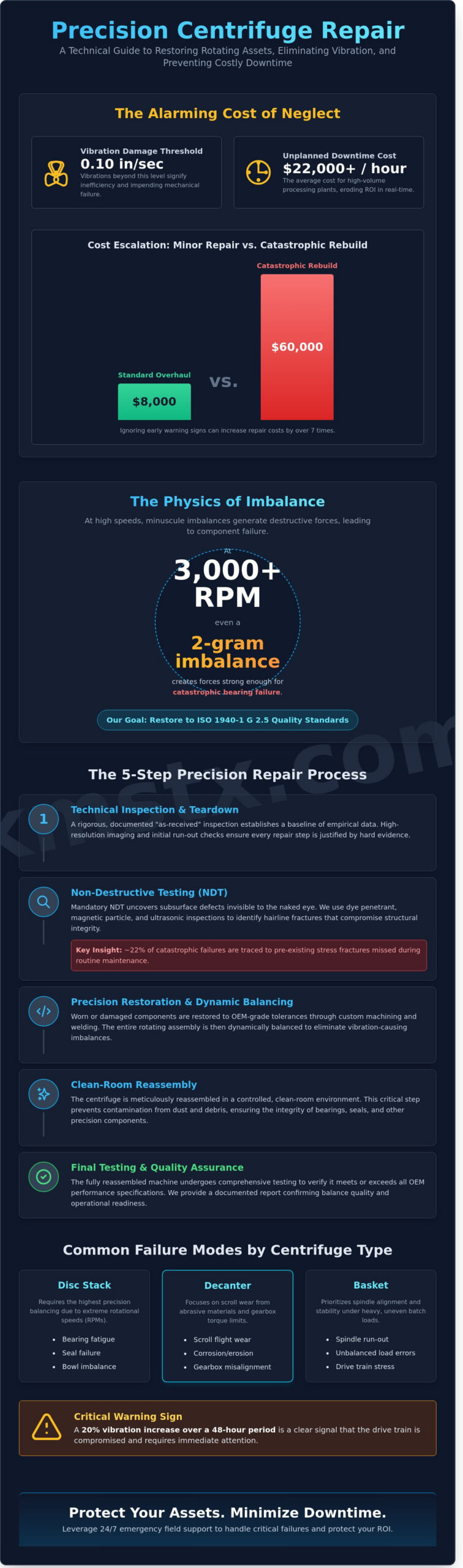
If your rotating assembly is vibrating beyond 0.10 inches per second, you aren’t just losing efficiency; you’re watching your ROI erode in real time. According to 2023 industry benchmarks, unplanned downtime in high-volume processing plants often costs upwards of $22,000 per hour. You know the stress of a sudden shutdown, especially when parts for 15 year old models seem impossible to source. It’s a reality of the job that keeps many maintenance managers up at night.
This technical guide provides the exact engineering steps required for professional centrifuge repair, focusing on restoring equipment to full operational status using precision balancing and OEM-grade tolerances. You’ll learn how to identify early signs of bearing fatigue and implement a refurbishing process that meets ISO 1940-1 G 2.5 quality standards. We’ll walk through the specific inspection, balancing, and assembly techniques that eliminate excessive vibration and significantly extend the lifecycle of your most valuable rotating assets.
Key Takeaways
- Master the teardown process and learn how Non-Destructive Testing (NDT) uncovers hairline fractures that visual inspections often miss.
- Get a clear breakdown of the costs and technical criteria used to decide between a targeted centrifuge repair and a complete machine refurbishment.
- Understand the physics behind dynamic balancing and why even a few grams of unbalance at high RPMs can lead to catastrophic bearing failure.
- Learn the importance of clean-room reassembly and documented inspections to ensure your rotating separators meet or exceed OEM specifications.
- Discover how to leverage 24/7 emergency field support to handle critical failures and minimize the high costs of unplanned downtime.
The Fundamentals of Industrial Centrifuge Repair and Reliability
Industrial centrifuge repair is the technical restoration of high-speed rotating separators to original equipment manufacturer (OEM) tolerances. It’s a precision-heavy process that goes far beyond simple parts replacement. When a machine operates at 3,000 RPM or higher, even a 2-gram imbalance generates enough centrifugal force to damage internal components. True repair involves returning every component of the rotating assembly to its baseline geometric and balance specifications to ensure the machine can handle the intense mechanical loads of daily production.
While the scale of industrial rotation is immense, the same principles of mechanical reliability apply to residential equipment. In the Dallas-Fort Worth area, dfwspincycle.com offers professional washer and dryer rentals for those who prioritize uptime and performance in domestic settings.
The cost of neglecting these machines is rarely subtle. Minor vibration is often the first indicator of trouble, but if it’s ignored, it leads to catastrophic bearing and spindle failure. A repair that might have cost $8,000 for a standard overhaul can quickly escalate into a $60,000 rebuild if the bowl crashes or the spindle seizes. Precision is the only way to avoid these unplanned outages that halt entire production lines in chemical or food processing plants.
To better understand this concept, watch this helpful video:
The Role of Rotating Equipment in Critical Infrastructure
Centrifuges act as the heart of separation processes in wastewater treatment facilities and chemical refineries. These systems process thousands of gallons of slurry per hour, relying on fundamental centrifuge principles to isolate solids from liquids under extreme G-forces. Because these machines operate under such high stress, operators must prioritize rotating equipment maintenance to protect the integrity of mechanical seals and gears. High-speed disc stack units, decanters, and basket centrifuges each have unique mechanical requirements, but they all share a common need for absolute rotational stability to prevent structural fatigue in the housing.
Common Failure Modes in Heavy Centrifuges
Failure in heavy centrifuges usually follows a predictable pattern. Erosion and corrosion in the bowls and scrolls are common in abrasive applications, such as mining or municipal sludge dewatering. These material losses create mass imbalances that trigger bearing fatigue. You can identify the “warning signs” of an impending seizure by monitoring heat signatures and vibration levels. If a vibration sensor shows a 20% increase over a 48-hour period, it’s a clear signal that the drive train is compromised. Gearbox misalignment is another frequent culprit, as it places uneven torque on the assembly and accelerates wear on the drive motor. A comprehensive centrifuge repair requires a full mechanical audit of the rotating assembly to identify these root causes before they lead to a total system failure.
- Disc Stack: Requires high-precision balancing due to extreme RPMs.
- Decanter: Focuses on scroll wear and gearbox torque limits.
- Basket: Prioritizes spindle alignment and batch-load stability.
Technical Inspection and Failure Analysis: The Teardown Process
Every professional centrifuge repair begins long before a technician picks up a wrench. We start with a rigorous, documented incoming inspection to establish a baseline of empirical data. In a 2023 review of industrial decanters, approximately 22% of catastrophic failures were traced back to pre-existing stress fractures that went unnoticed during routine field maintenance. We document the “as-received” condition with high-resolution imaging and initial run-out checks to ensure every subsequent step is justified by hard evidence rather than guesswork.
NDT and Structural Integrity Testing
We don’t take chances with the health of a rotating bowl. Non-Destructive Testing (NDT) is a mandatory phase for identifying subsurface defects that compromise safety. Dye penetrant and magnetic particle inspections reveal hairline fractures in critical load-bearing areas that aren’t visible to the naked eye. For decanter scrolls, we utilize ultrasonic gauges to measure material thickness in high-wear zones. If the flighting has worn down by more than 3.5mm in a specific section, the structural integrity of the assembly is at risk.
Adhering to strict centrifuge maintenance and safety protocols ensures the assembly can handle the massive centrifugal forces required during high-speed operation. This scientific approach to structural testing prevents the risk of fragmentation, which can occur if a compromised bowl is returned to service without proper metallurgical validation.
Dimensional Analysis and Tolerance Verification
Precision is the only metric that matters during a teardown. We utilize calibrated micrometers and bore gauges to verify interference fits on bearing seats and spindles. If a main shaft shows a run-out exceeding 0.002 inches, the machine won’t just vibrate; it’ll eventually destroy its own bearing housings. Our technicians compare every measurement against OEM prints or our proprietary database of industrial specifications.
The goal is to return the machine to a “zero-hour” mechanical condition. If a bearing housing shows 0.005 inches of “egg-shaping” from a previous seizure, it’s flagged for immediate machining or replacement. This data-driven analysis allows us to build a Scope of Work that targets the root cause of the failure. If you’ve noticed a steady increase in vibration levels, a comprehensive technical evaluation
Evaluating Repair vs. Refurbishment vs. Replacement
Deciding between a patch job and a full overhaul is a common headache for plant operators. A spot repair focuses strictly on the immediate failure, such as replacing a seized bearing or a damaged seal. While this gets the machine spinning again for a lower upfront cost, it’s often a temporary fix that ignores the 15% to 20% wear on other critical internal components. A full refurbishment, by contrast, involves stripping the rotating assembly down to the bare metal and restoring every surface to a zero-hour state.
The 60% rule is the standard benchmark used in most heavy industries. If the cost of a centrifuge repair exceeds 60% of the price of a brand-new unit, replacement usually looks like the better financial move. However, this logic often fails when you look at current supply chain realities. In 2024, lead times for new high-speed decanters often range from 14 to 22 months. A comprehensive refurbishment can typically be completed in 6 to 10 weeks, making it the only viable path to avoid catastrophic production losses.
- Spot Repair: Addresses the 1% of parts that failed; best for emergency mid-run fixes.
- Refurbishment: Restores the entire assembly; adds 10 to 15 years of service life.
- Replacement: Essential if the main bowl or scroll has suffered structural fatigue beyond 40% of wall thickness.
Cost-Benefit Analysis for Maintenance Managers
Smart maintenance planning requires looking at the Total Cost of Ownership (TCO) over a 10-year window. Refurbishing an older machine allows you to modernize it. You can replace outdated packing seals with modern mechanical seals or swap standard carbon steel for 316L stainless steel in high-wear zones. This approach turns industrial centrifuge repair into a performance upgrade. Custom machining often allows us to tighten tolerances to 0.0005 inches, which is tighter than the original factory specs from twenty years ago.
The “OEM Quality” Objection
Operations teams sometimes worry that a third-party shop can’t match the original manufacturer’s precision. That’s a dated perspective. Modern specialized shops use the same 5-axis CNC equipment and Schenck dynamic balancers found in OEM factories. We don’t just guess at the specs; we reverse-engineer them to ensure the rotating assembly meets or exceeds ISO 1940-1 G2.5 balance standards. Every major restoration comes with a full 12-month warranty, providing the same peace of mind you’d get from a new purchase but at a fraction of the cost and wait time.
Precision Restoration: Dynamic Balancing and Custom Machining
Centrifuge repair isn’t finished until the rotating assembly is perfectly balanced. Think about the physics involved. A decanter centrifuge running at 3,600 RPM generates massive centrifugal forces. If a scroll or bowl is out of balance by just 50 grams at a 10-inch radius, it can exert over 400 pounds of centrifugal force on the bearings. This force doesn’t just cause noise; it causes rapid fatigue, heat buildup, and eventually, catastrophic structural failure. You’re not just fixing a machine; you’re stabilizing a high-speed system that needs to run 24/7 without shaking itself apart.
The Science of Multi-Plane Dynamic Balancing
Achieving a smooth run requires advanced dynamic balancing services that meet ISO G-2.5 or even G-1.0 standards for high-speed applications. We don’t just balance the fully assembled unit. Each component, including the bowl, scroll, and hub, must be balanced individually before they’re joined. This multi-plane approach ensures that internal couples and static unbalance are neutralized at the source. Every final test run should document vibration levels, typically aiming for less than 0.10 inches per second (IPS). This data provides the baseline for your predictive maintenance program and guarantees long-term reliability in the field.
In-House Machining and Part Fabrication
Lead times for OEM components often stretch into months, which is unacceptable for critical operations. When industrial machine spare parts are obsolete or unavailable, custom fabrication becomes the only viable path. We restore worn bearing fits using “sleeve and bore” techniques or precision metalizing to bring journals back to original tolerances within 0.0005 inches. Metallurgy is the priority here. If you’re fabricating a custom conveyor shaft or gear, the alloy must match the thermal expansion and hardness profiles of the original assembly to prevent galling.
High-quality centrifuge repair requires protecting these components from future damage. Hard-facing with tungsten carbide tiles or spray-on coatings on the scroll flights adds a critical layer of protection. In many abrasive mining or wastewater applications, these custom wear-protection techniques extend the service life of the rotating assembly by 200% compared to factory-standard parts. It’s about making the machine better than it was when it left the OEM floor.
If your equipment is showing signs of excessive vibration or wear, contact our technical team to discuss a precision restoration plan.
Executing the Repair: Reassembly and Field Service Support
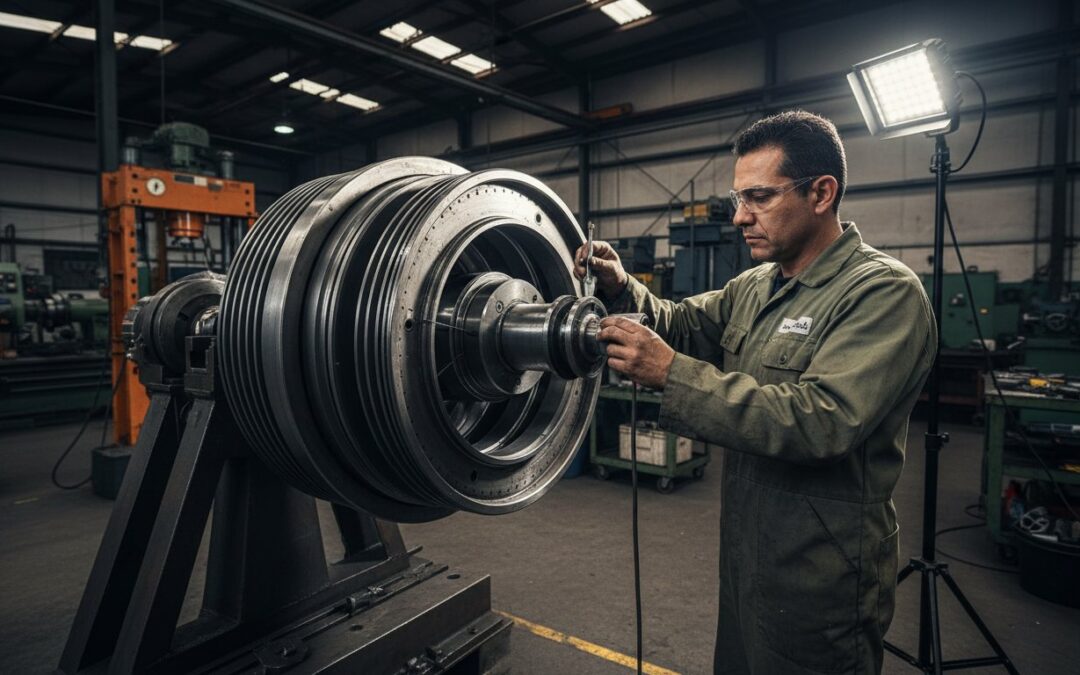
The final stage of a professional centrifuge repair requires a controlled environment that mirrors a laboratory more than a traditional machine shop. We perform the final assembly of rotating elements in a clean-room setting to ensure that airborne particulates don’t contaminate the bearing housings. Even a microscopic grain of grit can cause localized heating or premature surface fatigue when a bowl is spinning at 3,000 RPM. By maintaining strict cleanliness protocols, we protect the precision tolerances achieved during the machining phase.
Emergency Response and Field Service
When a critical separation process goes offline, the financial impact often exceeds $10,000 per hour in lost throughput. Our emergency machine repair teams deploy to your site to perform initial vibration analysis and borescope inspections before extraction begins. This on-site troubleshooting helps determine if the failure is rooted in the rotating assembly or the drive system. To minimize the “Downtime Gap,” we streamline the logistics of transporting 20,000-pound assets to our facility and commit to providing a comprehensive teardown report within 24 hours of arrival.
Final Testing and Quality Assurance
We don’t consider a centrifuge repair complete until the unit passes a full-speed mechanical string test. We mount the rotating assembly on a specialized test stand to monitor vibration signatures and bearing temperatures in real-time. Our technicians look for a steady-state vibration velocity below 0.10 inches per second. Once the unit meets these benchmarks, we provide a technical report containing balance certificates, dimensional “as-built” data, and a summary of all replaced components.
The path to a successful restart involves more than just bolting the machine down. Post-repair commissioning ensures that the centrifuge integrates perfectly with your plant’s existing PLC and control logic. We provide your operators with specific instructions for the initial ramp-up, focusing on lubrication flow rates and seal pressure settings. To prevent the next catastrophic failure, we help you establish a predictive maintenance schedule. This plan typically includes oil analysis and vibration monitoring every 500 operating hours, allowing you to catch minor deviations before they require another full overhaul. This methodical approach transforms a reactive fix into a long-term reliability strategy for your facility.
Maximizing Asset Life Through Precision Restoration
Maintaining the mechanical integrity of high-speed rotating equipment requires a systematic approach that integrates deep failure analysis with precision machining. When you’re managing a centrifuge repair, the success of the restoration depends on the quality of the dynamic balancing and the accuracy of the CNC machining used to restore critical tolerances. Our team brings over 40 years of industrial rotating equipment expertise to every project, ensuring that root causes are identified during the technical teardown process rather than just treating the symptoms of wear.
Restoring these complex assemblies isn’t just about getting the machine back online; it’s about extending the service life of your assets through field-proven engineering and 24/7 emergency troubleshooting. By utilizing in-house CNC machining and dynamic balancing capabilities, we maintain total control over the restoration timeline and quality standards. This hands-on approach minimizes operational downtime and ensures your equipment returns to service with OEM-level reliability. We’re ready to help you solve your most difficult rotating assembly challenges and get your operations back to peak performance.
Request a Technical Quote for Centrifuge Restoration
Frequently Asked Questions
How much does a typical industrial centrifuge repair cost?
Repair costs vary based on the extent of component wear and the specific model requirements. A basic bearing and seal replacement represents the lower end of the spectrum, while a full rotating assembly restoration involving bowl welding and re-balancing requires more resources. We provide detailed quotes after a 25 point teardown inspection to ensure you aren’t surprised by hidden costs later in the process.
What is the average turnaround time for a full centrifuge refurbishment?
A full centrifuge refurbishment typically requires 3 to 5 weeks from the initial teardown to final testing. This timeline accounts for the 48 hour soak period for cleaning, precision machining of wear surfaces, and dynamic balancing. If we need to source specialized parts from European manufacturers, the lead time might extend by 10 to 14 days depending on current logistics.
Can you repair centrifuges from manufacturers like Westfalia, Alfa Laval, or Sharples?
We provide comprehensive centrifuge repair services for Westfalia, Alfa Laval, and Sharples units, along with other major brands like Bird and Flottweg. Our shop maintains a library of 500+ OEM specifications and tolerances for these specific models. We use high grade stainless steel and specialized alloys that meet or exceed the original manufacturer standards to ensure the unit handles 3,000 G-forces without failure.
What is the difference between static and dynamic balancing?
Static balancing addresses the weight distribution of a component while it’s stationary, but dynamic balancing corrects imbalances that only appear when the unit spins at operational RPMs. For industrial centrifuges, dynamic balancing is mandatory because even a 5 gram deviation at 3,600 RPM generates enough vibration to destroy bearings within 100 hours of operation. We use 2 plane dynamic balancing to ensure stability across the entire speed range.
How do I know if my centrifuge bowl has a structural crack?
You can identify structural cracks in a centrifuge bowl through non-destructive testing methods like Liquid Penetrant Testing (LPT) or Magnetic Particle Inspection (MPI). Visual inspections often miss micro-fissures that develop under high centrifugal stress. If your unit shows a 15% increase in vibration levels during steady state operation, it’s a signal to pull the bowl and perform a formal assessment immediately.
Do you provide on-site centrifuge troubleshooting before I ship the unit?
Our field technicians provide on-site troubleshooting to diagnose vibration, heat, or separation issues before you commit to shipping the unit. We use portable vibration analyzers to collect data on the 3 primary axes. In 40% of cases, we find that the issue stems from foundation resonance or piping stress rather than the rotating assembly itself, saving you the cost of unnecessary transport.
Is it possible to upgrade an older centrifuge during the repair process?
It’s common to upgrade older units during the centrifuge repair process by integrating modern Variable Frequency Drives (VFDs) or applying tungsten carbide hard surfacing to conveyor flights. These retrofits can increase the lifespan of wear components by 300% in abrasive applications. We also offer control panel migrations that replace 20 year old analog relays with digital PLC systems for better data logging.
What kind of warranty is provided on a refurbished industrial centrifuge?
We provide a 12 month warranty on all parts and labor associated with a refurbished industrial centrifuge. This coverage starts from the date of installation or 18 months from the date of shipment, whichever occurs first. Our policy covers any defects in materials or workmanship, ensuring your equipment meets the 8,000 hour annual runtime requirement typical in 24/7 industrial environments.