

Last Tuesday at 3:15 AM, a maintenance supervisor in a Midwest refinery watched a critical planetary gearbox lock up, halting a line that represents 15% of their daily throughput. You’ve likely stood on that same shop floor, feeling the heat from a seized bearing while knowing that every minute of lost production eats directly into the quarterly margin. It’s tempting to opt for a quick fix, but a “patch-up” job often leads to a more violent failure just weeks later. Effective emergency industrial equipment repair isn’t about speed alone; it’s about applying precision engineering under extreme time constraints to ensure the machine doesn’t just restart, but stays operational.
This guide provides a technical roadmap for managing catastrophic equipment failures through rapid diagnostics and expert restoration strategies. You’ll learn how to stabilize your operations while maintaining the same rigorous standards you’d expect from an original equipment manufacturer. We’ll break down the process of root cause identification, specialized repair techniques for heavy centrifuges, and the precise steps needed to prevent a recurrence of the failure.
Key Takeaways
- Learn how to identify the specific mechanical thresholds that separate routine maintenance from a true emergency in high-stakes industrial environments.
- Discover how to utilize vibration analysis and full teardown inspections to pinpoint internal distress before it leads to a total asset failure.
- Determine when on-site field services are sufficient and when a comprehensive shop restoration is the only path back to OEM-spec reliability.
- Understand why precision engineering, such as dynamic balancing and custom machining, is non-negotiable during an emergency industrial equipment repair.
- Explore a strategic approach to restoration that combines decades of mechanical expertise with the engineering rigor needed to minimize critical downtime.
Defining Emergency Industrial Equipment Repair for Heavy Rotating Assets
Most facilities handle standard Maintenance, Repair, and Operations (MRO) on a set schedule to keep things moving. However, emergency industrial equipment repair is a different animal entirely. It’s the difference between a scheduled oil change and an engine seizing on the highway. In high-stakes environments like oil and gas or chemical processing, an emergency is defined by any unplanned stoppage that halts the primary production line or creates an immediate safety hazard. When a 500-horsepower motor or a high-speed centrifuge fails, the clock doesn’t just tick; it burns money.
To better understand the scale of these high-pressure situations, watch this video on rapid response for industrial assets:
Rotating equipment like gearboxes, pumps, and centrifuges requires specific protocols because of the tight tolerances involved. A vibration increase of just 0.05 inches per second can signal a looming catastrophic event. Technicians can’t just wing it during these moments. They have to follow original equipment manufacturer (OEM) specifications to ensure the dynamic balance and metallurgical integrity are maintained. If you ignore these specs during a rush, you’re likely just setting the stage for a second, more expensive failure three weeks down the road.
The True Cost of Unplanned Downtime
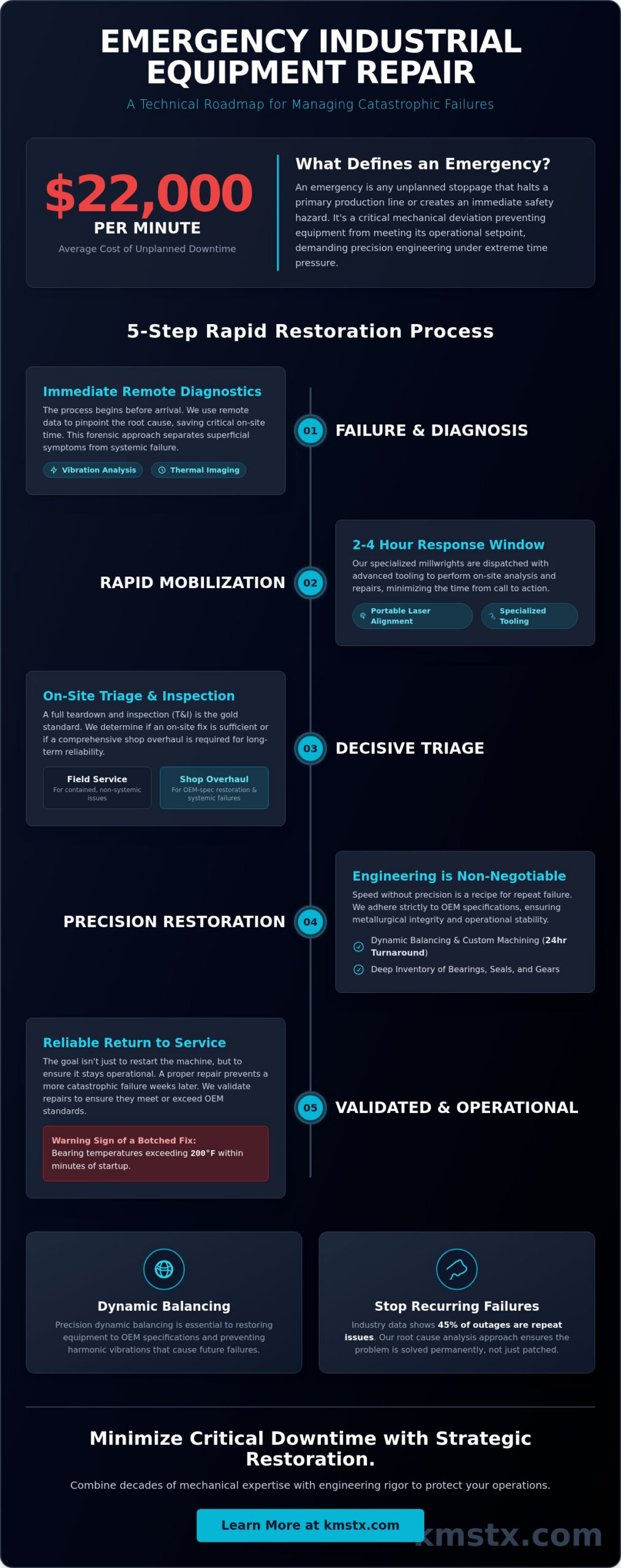
The financial impact of a breakdown often dwarfs the actual invoice for the repair. A 2022 industry report indicated that unplanned downtime costs large-scale manufacturers an average of $22,000 per minute. Beyond the hourly production loss, you’re looking at secondary risks like downstream pressure surges or environmental leaks that can trigger regulatory fines. Critical failure in rotating assets is any mechanical deviation that prevents the equipment from meeting its operational setpoint or poses an immediate risk to personnel and surrounding infrastructure.
Key Components of a 24/7 Emergency Response
Effective emergency industrial equipment repair relies on more than just a technician with a basic toolkit. It requires a tiered approach to get back online safely:
- Immediate Diagnostics: Using vibration data or thermal imaging shared via secure links to identify the root cause before the service team arrives on-site.
- Rapid Mobilization: Dispatching millwrights equipped with portable laser alignment tools and specialized pullers within a 2 to 4-hour window.
- Parts Inventory: Having immediate access to a deep stock of bearings, seals, and gears, or the ability to machine custom components in-house within 24 hours.
Speed is essential, but it doesn’t replace the need for technical precision. A botched emergency fix can result in bearing temperatures exceeding 200 degrees Fahrenheit within minutes of startup, leading right back to square one. Trusting the process means balancing the urgency of the deadline with the requirements of the machine’s design.
Technical Diagnostics: Identifying Failure Modes Under Pressure
Emergency industrial equipment repair requires more than a quick fix; it demands a forensic approach to data. Vibration analysis provides the initial roadmap. By measuring velocity and acceleration across specific frequency bands, technicians can identify whether a centrifuge’s 10,000 RPM rotor is suffering from a localized imbalance or a deeper bearing race defect. A full teardown and inspection (T&I) remains the gold standard during critical failures. Relying on external readings alone is risky. In high-torque gearboxes, what looks like a simple seal leak often masks systemic mechanical fatigue or gear tooth pitting that only becomes visible once the housing is opened.
Distinguishing between superficial wear and systemic fatigue is the difference between a 24-hour fix and a recurring nightmare. In 2023, industry data indicated that 45% of unplanned outages were caused by misdiagnosed fatigue. If the metal shows signs of work hardening or microscopic stress cracks, the component’s structural integrity is compromised. It’s not just about getting the machine spinning again. It’s about ensuring it doesn’t catastrophically fail the moment it hits full load.
Diagnostic Methodologies for Rotating Machinery
Borescope inspections allow for a visual assessment of internal cavities without a total strip-down, which is vital when time is limited. Non-destructive testing (NDT), such as dye penetrant or ultrasonic testing, identifies cracks that the naked eye misses. Analyzing lubricant contamination acts as a window into the machine’s health. Finding copper or lead particles often points to bushing or bearing wear, while high silicon levels suggest seal failure. Document every piece of evidence before any parts are cleaned or moved. This data is the only way to prove what actually happened inside the machine.
Root Cause Analysis (RCA) in Emergency Scenarios
Fixing a broken shaft without asking why it snapped leads to a repeat failure. Root cause analysis must be integrated into the rapid-turnaround workflow. Common culprits include dynamic imbalance or misalignment, which accounts for nearly 50% of all rotating equipment damage. If you’re performing emergency industrial equipment repair, you need to verify the foundation and coupling alignment before restart. Addressing the source of the stress ensures the repair lasts until the next scheduled turnaround rather than failing within 48 hours. Using ISO 10816 standards to baseline the machine after the repair provides the necessary data to confirm the root cause was actually addressed.
On-Site Field Service vs. Comprehensive Shop Overhaul
Deciding between a field fix and a shop haul is the most critical choice during an emergency industrial equipment repair. It’s often a battle between the clock and the micrometer. Field service keeps assets in place; this eliminates the 48 to 72 hour delay often associated with rigging, permits, and logistics. However, field environments aren’t always conducive to the tolerances required for 0.001-inch precision. You have to weigh the immediate production restart against the risk of a sub-optimal repair that might fail again within months.
The Scope of Field Service Maintenance
Field crews focus on rapid triage and stabilization. This involves vibration analysis, laser alignment, and replacing modular components like seals or bearings. Following established rotating equipment maintenance protocols on-site can resolve approximately 65% of common mechanical failures. The main limitation is the environment. Wind, dust, and humidity make it nearly impossible to perform high-level bore restoration or intricate welding without risking particulate contamination. If the fix requires a cleanroom or heavy lifting beyond the capacity of mobile cranes, the field approach reaches its technical ceiling.
The Advantages of a Fully Equipped Machine Shop
When a component suffers catastrophic structural damage or severe wear, a shop overhaul becomes mandatory for OEM-spec reliability. In the context of a high-stakes emergency industrial equipment repair, the shop offers diagnostic certainty that field tools simply cannot match. These facilities provide access to 5-axis CNC machinery and heavy-duty dynamic balancing stands that can handle rotors weighing over 10,000 pounds. For complex assemblies, such as those detailed in our guide on industrial gearbox repair, a controlled environment is the only way to ensure proper gear mesh and preload settings.
Logistics play a massive role in this decision. Moving a 20-ton turbine isn’t just about the truck; it’s about the specialized rigging and transport permits that can add 15% to the total repair timeline. You’re balancing the immediate need to resume production against the long-term integrity of the asset. Consider these factors before making the call:
- Contamination Risk: Can the repair be performed without exposing internal tolerances to plant floor debris?
- Machining Requirements: Does the repair require surfacing or boring that only a stationary mill can provide?
- Testing Capabilities: Is full-load testing required before the asset is reintegrated into the process line?
A field patch might get you through the week, but a shop restoration often extends the asset’s life by another 10 to 15 years. It’s a calculated risk based on the cost of the next hour of downtime versus the cost of a repeat failure.
Precision Engineering: The Core of Industrial Equipment Restoration
Precision engineering isn’t just a buzzword; it’s the technical line between a repair that lasts a decade and one that fails during startup. During an emergency industrial equipment repair, the pressure to resume operations often leads to shortcuts, yet technical accuracy remains the only way to prevent a secondary failure. When a critical shaft or housing is damaged, waiting 16 weeks for an OEM replacement usually isn’t an option for a facility losing five figures in hourly revenue. Expert machinists use precision grinding and milling to restore tolerances within 0.0005 inches of original specifications, effectively bypassing supply chain bottlenecks by reclaiming existing metal.
The intersection of speed and accuracy defines high-level technical machining. While CNC programming is standard for production runs, emergency restoration often requires manual machining expertise to handle one-off, complex geometries where digital blueprints don’t exist. Fabricating obsolete or long-lead parts in-house allows a shop to bypass global logistics delays, turning a three-month wait into a 48-hour turnaround.
The Science of Dynamic Balancing
High-speed rotating assets like blowers, turbines, and fans are incredibly sensitive to minor mass distribution errors. Centrifugal force increases with the square of the rotational speed; this means a small imbalance at 3,600 RPM can generate thousands of pounds of destructive force that will shred bearings and seals in days. Professional dynamic balancing services identify these heavy spots and correct them through methodical material removal or addition. Adhering to ISO 21940-11 balancing grades ensures that equipment longevity is maximized by significantly reducing the mechanical stress and heat generation that lead to premature fatigue.
Refurbishment and Component Rebuilds
Restoration often requires more than simple metal removal. Hard surfacing and specialized thermal spray coatings, such as tungsten carbide or Stellite, provide essential wear resistance for components operating in abrasive or corrosive environments. We see this frequently in centrifuge bowls and scrolls where material erosion is a constant threat. A proper rebuild follows a strict protocol to ensure the asset returns to service in better-than-new condition:
- Detailed dimensional inspection and NDT (Non-Destructive Testing) to identify hairline fractures or sub-surface flaws.
- Precision welding and machining to restore critical fit surfaces to OEM specifications.
- Rebuilding internal components, such as gearbox internals or centrifuge scrolls, with upgraded materials.
- Final validation protocols that include run-outs and vibration analysis to match factory requirements.
Technical machining during a crisis requires a steady hand and a deep understanding of metallurgy. A shop that understands this balance can fabricate a custom gear or sleeve in 36 hours, saving a facility from weeks of lost production. If your rotating equipment is vibrating out of spec or showing signs of wear, you need a team that understands the physics of the fix.
Strategic Reliability with Kelsey Machine Services
Kelsey Machine Services has provided specialized mechanical solutions since 1982, bringing over 40 years of field-tested expertise to every job site. We don’t believe in temporary patches that fail under pressure. Instead, the KMS approach integrates rapid response with the kind of engineering rigor usually reserved for new manufacturing. We focus on critical components like centrifuges, gearboxes, pumps, and blowers, ensuring each unit meets or exceeds original specifications before it returns to service. Our facility maintains a massive spare parts inventory, which allows us to bypass the supply chain delays that often stall recovery efforts. By keeping essential components in stock, we’ve reduced lead times for emergency industrial equipment repair by as much as 40% in recent projects.
Our 24/7 Emergency Support Framework
When a system fails in the middle of a shift, you need immediate technical clarity. Our framework ensures you have direct access to senior technicians and engineering staff, not just a dispatch service. We provide turnkey solutions that cover the entire lifecycle of an emergency industrial equipment repair. This includes the initial failure analysis, precision machining, dynamic balancing, and final commissioning. We take full accountability for the project; it’s the reason our repairs are warranted to provide long-term operational peace of mind. It’s about getting the job done right the first time so you don’t have to revisit the same failure point six months down the road.
Partnering for Long-Term Asset Health
While we’re experts at crisis management, our ultimate goal is helping your facility move from reactive emergency response to a predictive maintenance strategy. We’ve seen that consistent monitoring can reduce total maintenance costs by 25% over a three-year period. Our team works with you to develop customized service agreements for your most critical infrastructure. We focus on vibration analysis and thermal imaging to catch issues before they trigger a shutdown. We treat every repair as an opportunity to analyze wear patterns and suggest upgrades to metallurgy or seal designs. If your operation is currently facing a mechanical crisis, Contact Kelsey Machine Services for Emergency Support to leverage our technical team’s decades of experience.
Restoring Reliable Production Cycles
Managing heavy rotating assets requires a systematic approach to technical diagnostics and precision engineering. When a critical failure occurs, the choice between on-site field service and a comprehensive shop overhaul determines the long-term reliability of your machinery. Precision matters most when the clock is ticking. Utilizing dynamic balancing and full-service CNC machining ensures that components return to service with tighter tolerances than standard OEM specifications. For over 40 years, our team has addressed these high-pressure scenarios by focusing on the root cause of mechanical failure rather than just the symptoms. Successful emergency industrial equipment repair hinges on 24/7 rapid mobilization and a deep understanding of failure modes. You don’t have to navigate these technical challenges alone while downtime costs mount. Partnering with experts who prioritize precision over speed ensures your facility stays online and efficient.
Request Immediate Emergency Support from Kelsey Machine Services
Your equipment is the backbone of your operation, and it’s ready to perform at its peak again.
Frequently Asked Questions
What qualifies as an emergency in industrial equipment repair?
An emergency is defined by a total production stoppage or a critical safety risk that threatens your personnel. If a primary centrifuge or gearbox fails and results in a 100% loss of throughput for a facility, it’s an emergency. This also includes instances where environmental containment is breached or structural integrity is compromised. We prioritize these cases because every hour of downtime can cost a facility over $10,000 in lost revenue.
How quickly can a field service team be dispatched for a critical failure?
Our field service teams are typically dispatched within 2 to 4 hours of receiving a confirmed service request for local facilities. For regional sites within a 250 mile radius, we aim for same day arrival to begin diagnostics. We maintain a 24/7 on call rotation to ensure that emergency industrial equipment repair starts immediately. Our goal is to have a technician on site with the necessary diagnostic tools before the next shift rotation begins.
Can you repair industrial equipment from major brands like Flottweg or Falk?
Yes, we regularly perform repairs on high performance brands like Flottweg decanter centrifuges and Falk power transmission systems. Our shop is equipped to handle the tight tolerances required by these manufacturers, often working to within 0.001 inches of original specifications. We use specialized pullers and press equipment designed for these specific frames. Whether it’s a bowl rebuild or a gear set replacement, we ensure the unit meets or exceeds original performance benchmarks.
What is the difference between dynamic balancing and static balancing in an emergency?
Static balancing corrects the center of gravity while the part is stationary, but dynamic balancing is necessary for high speed components like rotors or fans. In an emergency, we use portable analyzers to perform dynamic balancing while the equipment is at its operational RPM. This process identifies centrifugal imbalances that static methods miss. Proper dynamic balancing to ISO 1940/1 G2.5 standards can reduce bearing wear by up to 50% and prevent future catastrophic failures.
Do you provide a warranty on emergency mechanical repairs?
We provide a 12 month warranty on all workmanship and materials used during emergency mechanical repairs. This coverage ensures that the component performs as expected under standard operating conditions. Every repaired unit undergoes a 4 hour test run or a full vibration analysis before it’s cleared for service. If a failure occurs due to our repair process within that 365 day window, we prioritize the rework at no additional labor cost to your facility.
Is it possible to fabricate replacement parts if the OEM has a long lead time?
We can fabricate critical components in house when OEM lead times exceed 8 weeks. Our machine shop utilizes CNC lathes and mills to turn out shafts, sleeves, and bushings from 4140 alloy steel or 316 stainless steel. We’ve successfully reduced wait times from months to under 72 hours for custom machined parts. This capability is essential for emergency industrial equipment repair when the original manufacturer no longer supports the model or has a backordered inventory.
What information should I have ready when calling for emergency service?
You should have the equipment make, model, and serial number ready when you call. It’s also helpful to provide a 2 sentence description of the failure and any specific error codes from the PLC. If possible, send 3 high resolution photos of the damaged area or the nameplate. Having this data allows our engineers to pull technical drawings and pack the correct specialized tools; this can save 3 to 5 hours of onsite diagnostic time.