
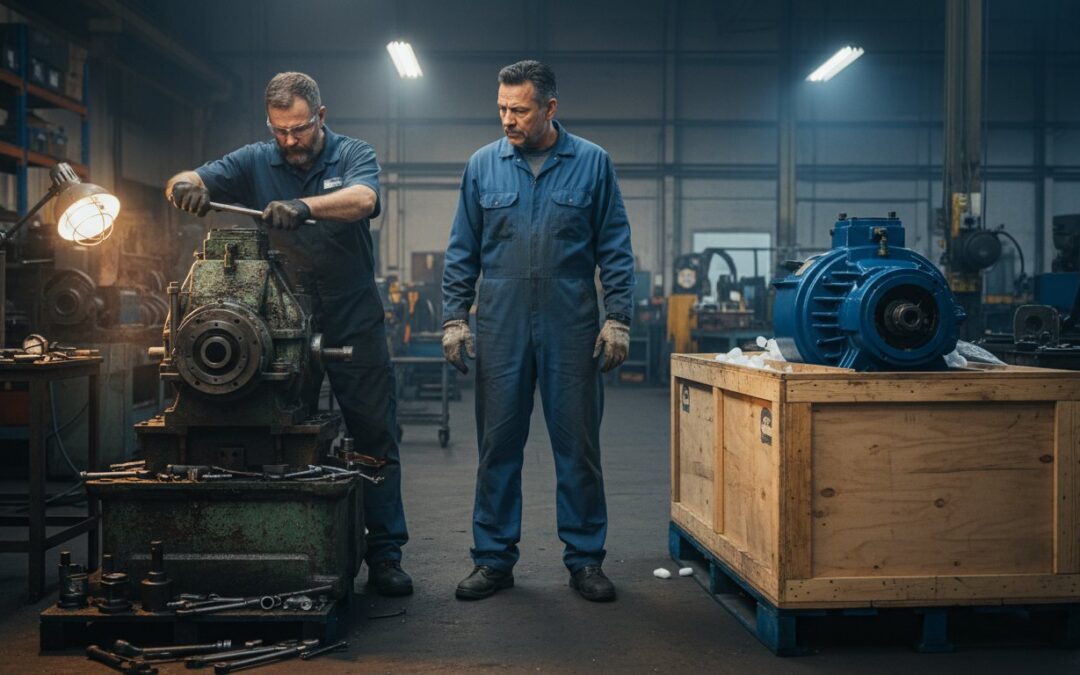
The brand-new OEM unit sitting on your loading dock might actually be a riskier bet for your 2026 uptime than the 15-year-old rotating asset currently in your shop. It’s a tough reality to face when you’re looking at a $300,000 purchase order, but “new” doesn’t always guarantee reliability in a market where lead times often exceed 52 weeks. You’ve likely felt the squeeze of shrinking CapEx budgets while being asked to maintain 98% availability on aging lines. It’s a difficult balance that every experienced maintenance manager has to strike when the pressure is on to avoid unplanned downtime.
This guide provides a technical roadmap for evaluating industrial equipment refurbishment vs replacement based on asset condition and long-term ROI. You’ll learn how to analyze the mechanical integrity of your hardware to determine if a professional restoration can actually outperform a total replacement. We’ll walk through a clear financial justification framework and a reliability checklist to give you the confidence to extend asset life without compromising your facility’s operational stability through 2026.
Key Takeaways
- Distinguish between a temporary “quick fix” and a full technical refurbishment that restores your rotating assets to OEM or better-than-OEM standards.
- Master the “50% Rule” and other critical economic thresholds to determine when a machine is worth the investment or has reached its terminal end of life.
- Navigate the industrial equipment refurbishment vs replacement decision by learning how to identify structural fatigue and “lemon” units that drain your maintenance budget.
- Learn why root cause analysis and dynamic balancing are essential steps to ensure your refurbished equipment achieves long-term reliability.
- Evaluate the total impact of equipment failure on your bottom line to determine if refurbishment offers a higher ROI than a total capital replacement.
The Industrial Dilemma: Why the Refurbishment vs. Replacement Debate Matters
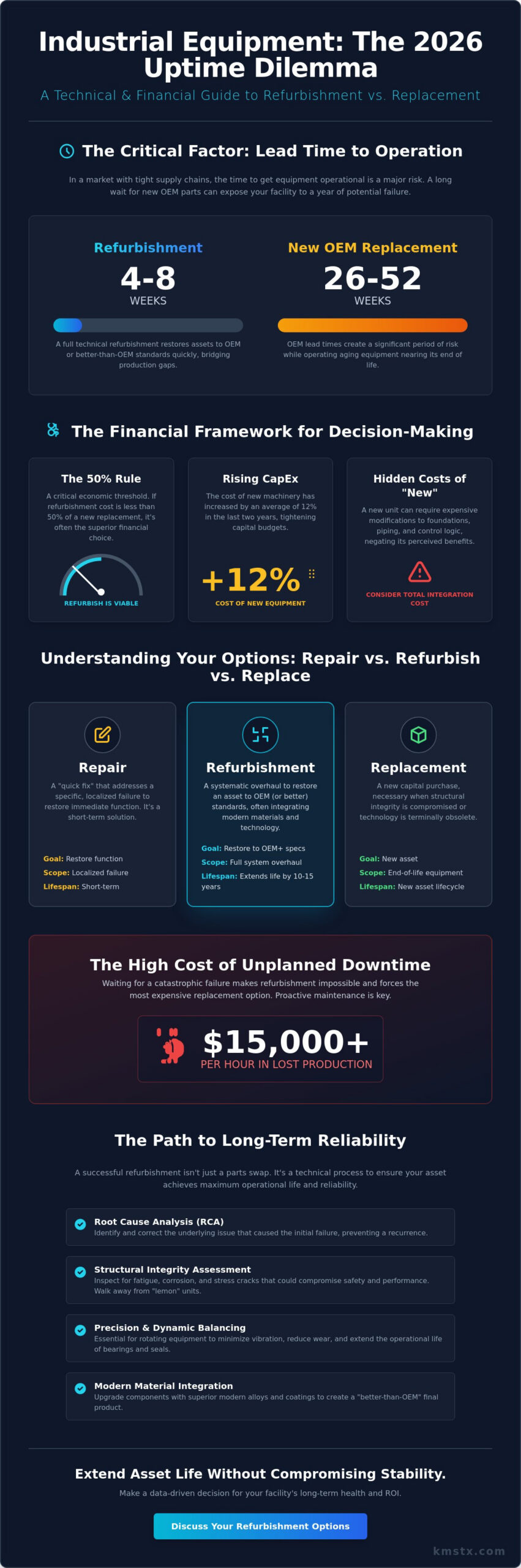
Industrial facilities face a tightening economic squeeze as we move through 2026. Maintenance budgets are under a microscope; meanwhile, the capital expenditure required for new machinery has risen by an average of 12% over the last two years. This financial pressure makes the industrial equipment refurbishment vs replacement debate a critical conversation for plant managers and reliability engineers. It is no longer just about the invoice price. It is about the total lifecycle cost and the long-term viability of the asset. Choosing Remanufacturing or a high-quality overhaul often aligns better with a circular industrial economy than simply scrapping a heavy asset that still possesses structural integrity.
Buying a brand-new unit does not always guarantee a better fit for your specific process. Many legacy systems have been fine-tuned over decades to meet precise operational parameters. A new machine might require extensive modifications to existing piping, foundations, and control logic, adding hidden costs that negate the perceived benefits of “new” technology. Refurbishment allows a facility to retain that specialized integration while restoring the machine to its original performance specifications.
To better understand the trade-offs between these two paths, watch this video on making the right choice for your assets:
The Hidden Costs of Unplanned Downtime
Unplanned downtime is a silent profit killer in heavy industry. For a typical mid-sized processing plant, an unexpected pump or compressor failure can cost upwards of $15,000 per hour in lost production and wasted labor. Waiting for a total mechanical breakdown makes refurbishment nearly impossible because the core components often suffer catastrophic, irreparable damage. Proactive rotating equipment maintenance identifies these issues during scheduled outages before they spiral out of control. It prevents the scenarios where a total replacement becomes the only, and most expensive, option left on the table.
Supply Chain Realities: OEM Lead Times in 2026
Lead times for new industrial units remain a significant hurdle for operational continuity. Original Equipment Manufacturers currently report wait times of 26 to 52 weeks for specialized rotating equipment due to ongoing raw material shortages and logistics bottlenecks. In contrast, a specialized repair shop can typically complete a full industrial equipment refurbishment vs replacement cycle in just 4 to 8 weeks. Operating an aging, vibrating asset while waiting a full year for a replacement order is a gamble that most risk-averse facilities cannot afford to take. Refurbishment acts as a strategic bridge, maintaining production levels without the year-long exposure to potential failure.
Defining the Scope: Repair, Refurbishment, and Total Replacement
Distinguishing between a standard field repair and a technical refurbishment is vital for operational planning. A repair typically addresses a localized failure to restore immediate function. Refurbishment involves a systematic overhaul designed to bring an asset back to original equipment manufacturer (OEM) standards or, in many cases, exceed them by integrating modern materials. This distinction is the core of the industrial equipment refurbishment vs replacement debate. While a repair might get a plant through the week, refurbishment extends the asset’s lifecycle by another 10 to 15 years.
Total replacement is usually reserved for instances where structural integrity is compromised or when the technology is so antiquated that parts are no longer machined. If a centrifuge bowl shows evidence of intergranular corrosion or stress cracks that exceed 20% of the wall thickness, the safety risk mandates a new purchase. For most heavy machinery, the middle ground is a modular rebuild. This approach focuses on high-wear assemblies like gearboxes or rotating elements while retaining the massive, non-wearing structural frames.
The Refurbishment Process: More Than a Coat of Paint
A true refurbishment begins with a complete teardown to the bare metal. This allows technicians to perform non-destructive testing (NDT), such as ultrasonic thickness gauging and magnetic particle inspection, to identify sub-surface fatigue that isn’t visible to the naked eye. During this phase, we often find that upgrading to ceramic-tiled conveyors or high-performance seals can solve 90% of the design flaws found in older models. Utilizing a Cost & ROI Guide helps determine if these upgrades stay within the 50% to 60% threshold of the cost of a new machine.
Why Centrifuges and Gearboxes are Ideal Candidates
Heavy rotating assets are the best candidates for this process because their value is concentrated in precision-machined housings and heavy cast iron frames. These components rarely wear out; it’s the internal rotating assembly that bears the brunt of the process. In the energy sector, industrial centrifuge repair Texas facilities focus on dynamically balancing these assemblies to G-2.5 standards or better. When evaluating industrial equipment refurbishment vs replacement for high-speed assets, the decision usually rests on whether the frame can support another 15 years of vibration. If you’re managing a fleet of decanters, you can consult with our technical team to evaluate your rotating assembly’s current tolerances.
The Decision Framework: 5 Key Factors to Evaluate Your Assets
Deciding between industrial equipment refurbishment vs replacement requires more than a glance at a spreadsheet. You’ve got to look at the iron. The 50% rule remains the standard benchmark; if the restoration quote exceeds half the price of a new unit, you usually buy new. However, with global supply chain lead times for heavy rotating assets often stretching past 14 months in 2026, that threshold is shifting. If a rebuild gets you back online in six weeks while a new unit takes over a year, the lost production time makes refurbishment the clear winner.
Before committing, evaluate these five critical areas:
- Structural Integrity: This is your first hard stop. If the main frame or cast housing shows signs of systemic fatigue or non-repairable cracking, the asset is scrap.
- Technical Viability: Assess if the core components can handle the higher pressures or speeds required by your current production targets.
- Maintenance History: Use your CMMS data. A machine with a history of recurring shaft misalignments might have an underlying geometry issue that a standard repair won’t fix.
- Total Cost of Ownership (TCO): You must account for energy efficiency. Newer IE4 or IE5 rated motors might save enough in electricity over a five-year period to justify the higher upfront cost of replacement.
- Reliability Projections: Determine if a restored unit can realistically provide another 10 years of service without an overhaul.
Calculating the Return on Investment (ROI)
Buying new sounds simple until you factor in the hidden costs. A new model often requires different piping configurations, foundation reinforcements, or updated electrical switchgear. You also have to train your crew on a new control interface. Professional refurbishment often includes a warranty that rivals an OEM’s 12-month standard, providing peace of mind without the installation headaches. The ROI of refurbishment is the ratio of extended service life to restoration cost.
Performance Upgrades During Restoration
A rebuild is an opportunity to out-perform the original factory specs. By utilizing precision dynamic balancing services Houston, shops can reduce vibration levels well below the original OEM tolerances, which directly extends bearing life. Custom machining allows you to use modern, wear-resistant alloys that weren’t available when the machine was first built. This process lets you tune the equipment to your specific application, often solving design weaknesses that caused the original failure. When considering industrial equipment refurbishment vs replacement, remember that a restored unit can actually be more reliable than a brand-new one because the infant mortality failures of new components have already been engineered out.
Assessing Lifecycle Limits: When to Walk Away from an Old Asset
When weighing industrial equipment refurbishment vs replacement, the most critical factor is identifying when an asset has simply reached its terminal point. It’s not always about a single breakdown. Often, it’s the “Lemon Factor” where a specific unit requires three or more major interventions within a 12-month window. If your maintenance logs show that a machine’s Mean Time Between Failure (MTBF) has dropped below 1,000 operational hours despite expert care, you’re no longer maintaining it; you’re just delaying the inevitable. At this stage, the economic end of life has been met, and further investment yields diminishing returns.
Recognizing Structural and Metallurgical Failure
The decision between industrial equipment refurbishment vs replacement often hinges on whether the core structure can still support the load. You must look for terminal fatigue in the base metal or main housing. If non-destructive testing reveals stress corrosion cracking or if erosion has thinned housing walls by more than 15% of the original OEM specification, the unit is no longer safe for a rebuild.
- Precision Machining Limits: While machining can restore bearing fits, it cannot fix a warped frame that prevents proper alignment.
- Safety Overrides: If the structural integrity of a pressure vessel or high-speed rotating component is in question, safety must always override potential cost savings.
- Vibration Signatures: Persistent, non-linear vibrations that remain after balancing usually point to deep-seated structural cracks.
The Problem with Obsolete Spare Parts
Parts-chasing is a hidden drain on operational budgets. For machines that have passed the 20-year mark, the original equipment manufacturer (OEM) may no longer support the model. This forces teams into a cycle of searching for used components or paying for expensive custom fabrication. While sourcing industrial machine spare parts Texas providers stock can bridge the gap for many legacy systems, there’s a point where the lead times for custom-made seals or gears become unsustainable.
Technological obsolescence also plays a major role as we move through 2026. A legacy motor might still spin, but if it operates at 70% efficiency while modern IE4-rated units hit 94%, the energy waste is staggering. Modern control systems also offer predictive diagnostics that older hardware simply cannot support. If your legacy equipment lacks the ports for real-time vibration and thermal sensors, you’re flying blind. The ROI on a new machine often pays for itself within 24 months through reduced utility bills and the elimination of “ghost” downtime caused by sensor failures on outdated boards.
Before you commit to another expensive repair cycle, ensure your hardware is actually worth the investment. Contact KMS Technologies for a technical evaluation of your mission-critical systems.
Restoring Reliability: The Kelsey Machine Approach to Refurbishment
At Kelsey Machine, we don’t start by swinging a hammer. Our technical philosophy dictates a rigorous root cause analysis before the first wrench turns on a project. When you’re weighing industrial equipment refurbishment vs replacement, you need to know why the asset failed in the first place. Replacing a failed pump or gearbox with a brand-new unit won’t solve systemic issues like pipe strain or chronic misalignment. We dig into the vibration data and wear patterns to ensure the failure doesn’t repeat itself once the machine returns to the floor.
Our facility prioritizes in-house precision machining and dynamic balancing to maintain total control over quality. We work to tolerances as tight as 0.0001 inches because we’ve seen how even a minor deviation leads to premature bearing failure in high-speed applications. Transparency drives our process. Every client receives a comprehensive report package that includes high-resolution inspection photos and a 25-point measurement log. You’ll see exactly what our technicians saw during the teardown, with no hidden costs or surprise repairs.
We often deliver a “Better Than New” result. Legacy frames from the 1970s and 80s often feature superior casting quality and mass compared to modern, lighter-weight counterparts. By integrating modern sealing technologies and upgraded metallurgy into these robust frames, we provide a solution that exceeds original OEM specifications. It’s a way to keep the structural integrity of your old iron while benefiting from 2026-grade reliability standards.
A Scientific Approach to Rotating Equipment
We utilize vibration analysis and precision tolerances to ensure every rotating assembly operates with clinical stability. This scientific rigor is vital for industrial gearbox repair Houston projects, where gear mesh patterns must be perfect to handle high-torque loads. Every refurbished unit leaves our shop backed by a 12-month performance warranty, giving your maintenance team the same confidence they’d have with a factory-fresh machine.
Partnering for Long-Term Asset Management
Strategic refurbishment cycles are the most effective way to reduce the frequency of emergency machine repair Gulf Coast facilities often face. Instead of waiting for a catastrophic “run-to-fail” event, we help you develop a roadmap for your fleet. Facilities that implement these planned cycles typically see a 30% reduction in unplanned downtime within the first 18 months. This data-driven schedule helps you decide the industrial equipment refurbishment vs replacement question based on actual wear trends rather than guesswork. Contact our engineering team today for a technical evaluation of your rotating assets.
Optimizing Your Asset Strategy for the Next Decade
Deciding on industrial equipment refurbishment vs replacement requires a hard look at the technical reality of your machinery. You can’t rely on guesswork when production targets are on the line for 2026. Successful operators prioritize a rigorous evaluation of lifecycle limits and mechanical integrity before committing to a massive capital expenditure. Extending the life of rotating equipment through precision dynamic balancing and custom machining often provides a more reliable path than waiting on long lead times for new units. It’s about getting the most out of what you already own while ensuring the hardware remains up to modern performance standards.
Kelsey Machine delivers over 40 years of technical expertise in restoring critical assets to peak performance. We handle everything in-house, from specialized machining to 24/7 emergency field support, so you aren’t left waiting for third-party contractors. When you need a partner who understands the grit and precision of the shop floor, we’re ready to help you navigate these complex mechanical decisions. Your equipment has more life in it than you might think.
Talk to an Expert about Your Equipment Refurbishment Options
Frequently Asked Questions
How do I know if my equipment is a candidate for refurbishment?
Equipment is a prime candidate for refurbishment if the primary structural frame remains within 5% of its original engineering tolerances. We look for heavy components that are expensive to cast or machine but don’t suffer from fatigue. If the core structure is intact, we can replace the internal wear parts, seals, and electronics to restore the unit to full operational status.
What is the typical cost difference between refurbishing and replacing?
Refurbishing an industrial asset generally costs between 40% and 60% of the price of a brand-new machine. When weighing industrial equipment refurbishment vs replacement, this price gap allows facilities to reallocate capital to other critical plant upgrades. You’re essentially securing a like-new machine for roughly half the investment required for a 2026 model.
Does refurbished equipment come with a warranty?
Refurbished units typically carry a 12-month warranty on all replaced components and labor. This matches the standard warranty period offered by 85% of original equipment manufacturers for new hardware. It ensures your operation is protected against defects in workmanship or parts during the first year of post-service operation.
How long does the refurbishment process usually take compared to buying new?
The refurbishment process usually takes 8 to 12 weeks, whereas lead times for new industrial machinery in 2026 often exceed 30 weeks due to global supply chain backlogs. Choosing to refurbish can get your production line back to full capacity 4 months sooner than waiting for a factory delivery. This speed is a critical factor in the industrial equipment refurbishment vs replacement decision for time-sensitive projects.
Can a refurbished machine perform as well as a brand-new unit?
A refurbished machine often meets or exceeds original factory specifications. By integrating modern sensors and updated control logic, we frequently see a 10% to 15% improvement in cycle times compared to the machine’s original performance. It doesn’t just return to its previous state; it becomes a more efficient version of the asset your team already knows how to operate.
What happens if the inspection reveals the equipment cannot be refurbished?
If a 48-point technical inspection reveals terminal structural fatigue or irreparable frame cracks, we provide a detailed report explaining the failure. At that point, the machine is typically decommissioned and sold for scrap value or used as a donor for spare parts. We won’t proceed with a project if the safety or long-term reliability of the final unit is compromised.
How does refurbishment impact my company’s sustainability goals?
Refurbishing a machine saves approximately 80% of the energy required to manufacture a new unit from raw materials. It keeps tons of steel out of landfills and reduces the carbon footprint associated with global shipping and heavy smelting. This approach directly supports corporate ESG goals by extending the lifecycle of existing industrial assets instead of consuming new resources.
Is it possible to upgrade the capacity of my machine during refurbishment?
We can often increase machine capacity by 20% by installing high-efficiency motors and modernizing the drive systems. Refurbishment provides a perfect window to address bottlenecks that weren’t considered when the machine was first installed. You aren’t stuck with old output levels when you’re using 2026 technology during the rebuild process.