

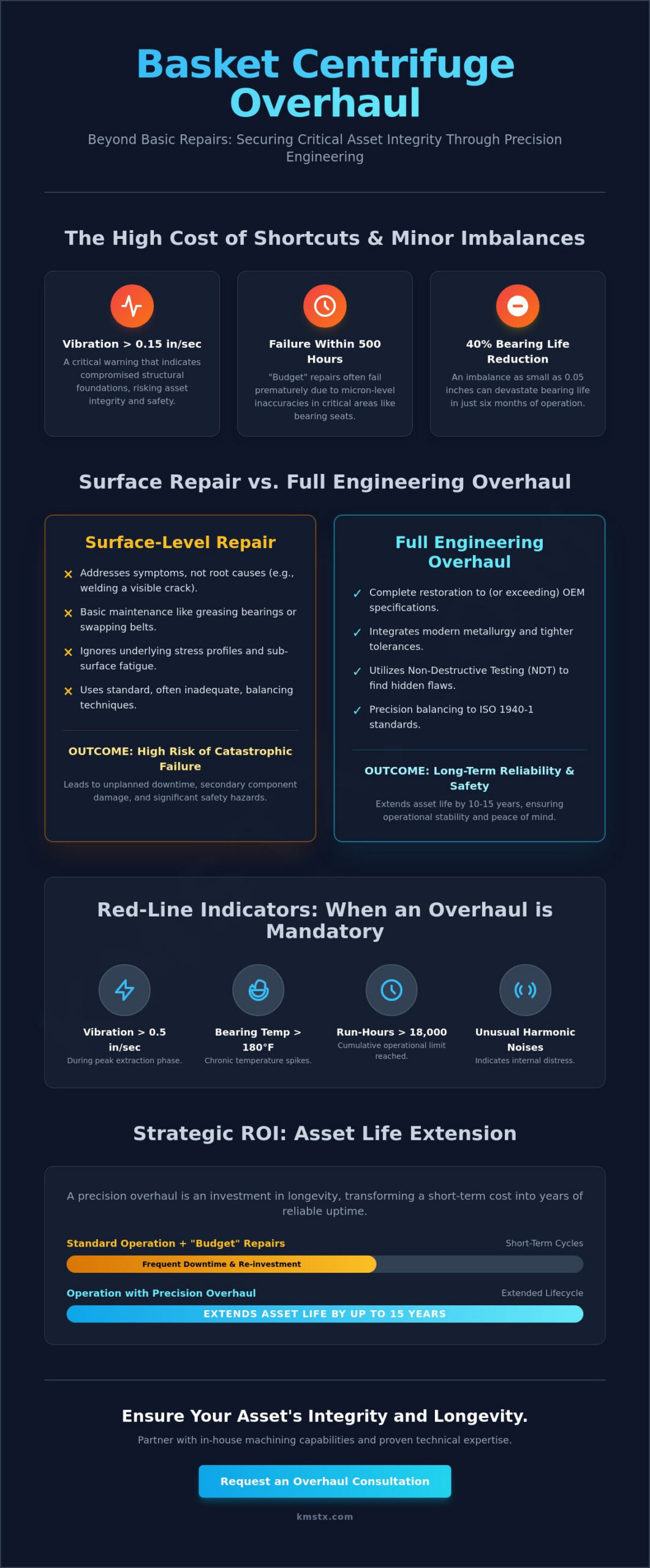
A single vibration spike exceeding 0.15 inches per second doesn’t just mean your centrifuge is loud; it’s a signal that your structural foundations are being compromised. Most maintenance leads have seen the fallout of “budget” repairs that fail within 500 hours because a bearing seat was off by a few microns. When you invest in basket centrifuge overhaul services, you aren’t just paying for new paint; you’re securing the mechanical integrity of a critical asset. You know that shortcuts in the machine shop always lead to unplanned downtime and secondary component failure.
This guide details the engineering protocols required to restore equipment to original OEM specifications and ensure long-term operational reliability. You’ll learn how to verify dynamic stability and why ISO 1940-1 balancing standards are non-negotiable for high-speed rotating assemblies. We’ll examine the specific documentation needed to prove your asset meets its original design clearances, effectively extending its lifecycle by another 10 years through proprietary restoration techniques and meticulous data verification.
Key Takeaways
- Distinguish between surface-level repairs and a full engineering restoration to ensure your equipment meets original OEM standards for critical separation processes.
- Discover how specialized basket centrifuge overhaul services utilize Non-Destructive Testing (NDT) to identify sub-surface fatigue and prevent catastrophic rotating assembly failure.
- Learn the technical requirements for restoring dynamic stability through precision balancing and custom machining to safely handle intense industrial G-force demands.
- Evaluate the total cost of ownership to see how a strategic, precision overhaul can extend the operational life of your asset by up to 15 years.
- Identify the essential criteria for choosing a partner with the in-house machining capabilities and technical expertise needed to minimize operational downtime.
Defining the Basket Centrifuge Overhaul: Beyond Basic Repair
Routine maintenance often involves little more than greasing bearings or swapping out a belt. A targeted repair might address a specific leak or a failed motor. However, professional basket centrifuge overhaul services represent a complete engineering restoration that returns the equipment to its original design intent. In critical sectors like pharmaceutical manufacturing, chemical processing, and food production, these machines operate at the intersection of high velocity and high stakes. A solid grasp of centrifuge principles helps operators understand that these machines aren’t just spinning tubs; they’re high-precision instruments managing massive centrifugal forces that can exceed 2,000 Gs during a standard cycle.
We treat OEM specifications as the baseline for performance, not the final goal. Engineering standards have evolved since many of these units were first commissioned in the 1990s or early 2000s. An overhaul allows us to integrate modern metallurgy and tighter tolerances that weren’t available twenty years ago. Patch repairs in high-speed rotating environments are inherently risky. If a technician simply welds a visible crack without addressing the underlying stress profile, they’re setting the stage for a catastrophic structural failure. Precision is the only way to ensure safety and longevity.
To better understand the physical requirements of this process, watch this helpful video:
The Anatomy of a High-Performance Basket
The basket and spindle assembly endure immense stress loads every time the machine ramps up to speed. In corrosive environments, such as those found in specialty chemical plants, the material integrity of the 316L stainless steel or Hastelloy components can degrade through pitting or stress-corrosion cracking. Minor imbalances might seem trivial at first, but they escalate into structural fatigue as the vibration energy travels through the spindle and into the bearing housing. We’ve seen 0.05 inches of imbalance lead to a 40% reduction in bearing life over just six months of operation.
When an Overhaul Becomes Mandatory
Identifying the right time for basket centrifuge overhaul services requires a mix of data and field experience. Chronic vibration that persists after balancing, temperature spikes in the bearing housing exceeding 180 degrees Fahrenheit, and unusual harmonic noises are all red-line indicators. Changes in the process side, such as a 15% increase in slurry density, can also accelerate wear beyond what the original engineers predicted. The overhaul threshold is reached when cumulative run-hours exceed 18,000 or when vibration amplitude consistently surpasses 0.5 inches per second during the peak extraction phase. Ignoring these signs doesn’t just risk the machine; it risks the entire production line’s safety and uptime.
The Engineering Protocol: Teardown, Inspection, and Measurement
The restoration process for high-speed rotating equipment begins with a forensic teardown rather than a simple disassembly. We treat this stage as a crime scene investigation to preserve evidence of failure modes that might be obscured by a hasty cleanup. Technicians document the “as-found” state, recording everything from lubricant contamination levels to the specific orientation of wear patterns on the conveyor flights. This raw data guides the entire restoration strategy and ensures that the root cause of an imbalance or bearing failure is addressed, not just the symptoms.
Effective basket centrifuge overhaul services rely on a systematic approach to identifying structural fatigue. We log fastener torques during the initial break-down to check for hardware that may have stretched or loosened under operational stress. If a basket shows a 12% reduction in wall thickness due to erosion, it changes the entire safety profile of the machine. We don’t guess at these numbers; we establish a data-driven baseline before any metal is cut or any parts are ordered.
Non-Destructive Testing and Metallurgical Analysis
Dye penetrant and magnetic particle inspection (MPI) are mandatory for checking rotating assemblies for sub-surface cracks. We focus heavily on basket welds and spindles where centrifugal forces are most concentrated. Stress corrosion cracking (SCC) often hides in 300-series stainless steel components, particularly if the unit has processed chloride-heavy fluids at high temperatures. We also assess the integrity of tungsten carbide coatings. If a wear-resistant liner shows more than 10% delamination, it indicates a bond failure that could lead to catastrophic vibration during operation.
Precision Metrology and Tolerance Checks
Precision metrology moves beyond basic calipers to ensure the asset returns to its original design intent. We measure bearing fits and seal journals with micron-level accuracy to prevent premature component failure. Spindle run-out is checked to ensure it remains within 0.001 inches of the original manufacturer drawings. We evaluate basket concentricity and wall thickness because years of abrasive service can thin out the metal in ways that aren’t visible to the naked eye. All measured data is compared to industrial centrifuge repair Texas standards for rotating assets to guarantee compliance with heavy-duty operational requirements.
Rigorous measurement prevents the “stack-up” of tolerances that often causes reassembled machines to run hot or vibrate. If you’re noticing a steady increase in bearing temperatures or a loss of separation efficiency, it’s time to speak with an engineering expert about a comprehensive inspection. Catching a 0.005-inch deviation in a journal fit today can save you from a total spindle replacement six months from now.
Restoring Dynamic Stability: Precision Balancing and Machining
When a basket rotates at high velocities, centrifugal force isn’t just a number on a spec sheet. It’s a physical reality that demands perfect equilibrium. A 100-gram imbalance at the rim of a 36-inch basket can translate into hundreds of pounds of centrifugal force during operation. This force doesn’t just vibrate the machine; it destroys bearings, fatigues welds, and compromises the structural integrity of the entire housing. High-quality basket centrifuge overhaul services prioritize the restoration of this dynamic stability to prevent catastrophic failure and unplanned downtime.
Restoration begins with a thorough inspection of interference fits. Over years of service, the mating surfaces between the spindle and the basket hub often succumb to fretting or galling. If these fits aren’t restored to within 0.0005 inches of the original design, the basket will never sit true. We utilize custom machining to bring these critical dimensions back to life, ensuring the rotating assembly functions as a single, cohesive unit rather than a collection of vibrating parts.
Advanced Dynamic Balancing Procedures
Static balancing might suffice for slow-moving pulleys, but vertical basket units require multi-plane dynamic analysis. We don’t just look for heavy spots while the basket is stationary. We spin the entire assembly at operational speeds to identify how mass distribution shifts under load. Our process aims for G-level balance specifications that far exceed the standard ISO 1940 Grade 2.5 requirements. You can find more technical details on how these procedures shield your hardware by reviewing precision dynamic balancing services Houston. By eliminating harmonic vibrations at the source, we extend the mean time between failures for your drive motors and gearboxes.
Component Restoration and Fabrication
Abrasive slurries are relentless. They erode journals and wear down the internal geometry of the basket. When we identify worn journals, we use specialized sleeving and grinding techniques to restore the original diameter without compromising the metallurgical properties of the shaft. It’s a precise science that requires deep knowledge of thermal expansion and material science.
- Sleeving and Grinding: We restore bearing seats to OEM tolerances to ensure proper heat dissipation and load distribution.
- Custom Fabrication: If an OEM component has a 20-week lead time or is completely obsolete, we fabricate replacements in-house using high-strength alloys.
- Hard-Facing: Applying tungsten carbide tiles or specialized hard-facing to high-wear zones can increase the component lifespan by 250% in aggressive environments.
Modernizing the unit is just as important as repairing it. During the basket centrifuge overhaul services process, we often replace outdated packing glands with high-performance labyrinth seals. We also upgrade standard bearings to modern high-load variants that handle axial and radial forces more efficiently than the original parts installed decades ago. This isn’t just a repair; it’s an engineering upgrade that prepares the machine for another decade of heavy service.
Strategic Overhaul Planning: ROI and Asset Life Extension
Deciding to pull a unit for basket centrifuge overhaul services involves more than just a maintenance budget; it’s a strategic play for the bottom line. A full engineering restoration can add 10 to 15 years of reliable service to an existing machine. This approach avoids the steep capital expenditure of a new unit, which often carries a 40 to 50 week lead time in the current market. By contrast, a comprehensive overhaul is usually completed in 12 to 16 weeks. When you evaluate the total cost of ownership (TCO), the math favors restoration in roughly 85% of industrial applications where the frame remains structurally sound.
We use predictive maintenance data, specifically tri-axial vibration analysis and oil debris monitoring, to pinpoint the exact window for service. This prevents the nightmare of a mid-production failure. Most facilities coordinate these overhauls with scheduled 2025 or 2026 plant turnarounds to ensure that downtime doesn’t bleed into active production cycles. Planning ahead allows for the procurement of long-lead items like specialized bearings or custom-machined spindles before the machine even leaves your floor.
- Capital Preservation: Overhauls typically cost 40% to 60% less than a new tier-one replacement.
- Operational Continuity: Reusing existing footprints avoids expensive piping and electrical re-runs.
- Asset Reliability: Precision balancing and tolerances often exceed original OEM factory specs.
Repair vs. Overhaul vs. Replacement
A unit hits the “beyond economical repair” threshold when the cost of restoration exceeds 65% of the price of a new machine. However, don’t let a low-cost replacement unit fool you. Many modern, budget-friendly centrifuges lack the heavy-duty casting and structural integrity of older, American-made frames. Restoring a high-quality legacy frame often provides better long-term stability and higher G-force capabilities than a cheaper, lightweight alternative. The engineering value of a restored unit lies in its proven durability under your specific process conditions.
Integrating Modern Upgrades during Overhaul
An overhaul is the perfect time to drag older equipment into the modern era. We often see a 20% increase in process efficiency just by retrofitting Variable Frequency Drives (VFDs). These allow for precise ramp-up speeds and better control over cake moisture content. We also integrate advanced vibration sensors that provide real-time data to your control room. This setup ensures your hardware meets the stricter safety and environmental regulations slated for 2026, such as updated ISO 13849-1 safety interlock standards, protecting your operators and your compliance record.
Partnering with Kelsey Machine Services for Critical Overhauls
Overhauling heavy rotating machinery isn’t a task for a general repair shop. It requires a specific technical pedigree that most facilities simply can’t match. Kelsey Machine Services (KMS) leverages four decades of hands-on expertise in the restoration of complex industrial systems. We’ve seen how internal stresses and corrosion cycles affect metallurgy over thousands of operating hours. Our team doesn’t just replace worn components; we re-engineer the unit for longevity. By performing all machining and balancing in-house, we eliminate the risks associated with third-party vendors and maintain total control over tight tolerances.
Our commitment to transparency means you receive a detailed engineering report at the conclusion of every project. These reports aren’t just brief summaries. They are data-heavy documents that provide warranted performance metrics and a clear history of the work performed. To keep your facility running without interruption, we manage a robust inventory of industrial machine spare parts Texas plants need for immediate repairs. This strategic stockpile allows us to execute basket centrifuge overhaul services faster than shops that wait on overseas shipping or backordered OEM components.
The KMS Quality Assurance Process
Reliability isn’t assumed; it’s proven through empirical data. Our quality assurance process involves rigorous shop testing and run-in protocols that simulate actual field conditions before the unit is delivered. We monitor thermal growth and lubrication effectiveness across several hours of operation. You’ll receive final vibration signatures and balance reports that serve as a baseline for future performance monitoring. Integrating these results into a long-term rotating equipment maintenance strategy ensures that your overhauled centrifuge maintains its precision for years of continuous service.
24/7 Support and Field Service Integration
When a centrifuge suffers a catastrophic failure, the financial impact of downtime accumulates by the minute. KMS provides specialized emergency machine repair Gulf Coast services to address these critical situations 24/7. Our senior technicians handle on-site commissioning and startup assistance to verify that the basket centrifuge overhaul services meet your specific process requirements. We don’t consider the job finished until the machine is fully integrated into your workflow and operating at peak efficiency. This field-level support bridge the gap between shop repair and operational reality.
Securing Long-Term Reliability for Your Rotating Assets
Restoring a centrifuge requires more than a standard repair kit and a fresh coat of paint. True engineering restoration focuses on returning the equipment to its original design specifications through a rigorous teardown and inspection protocol. By addressing dynamic stability with in-house dynamic balancing and precision machining, we eliminate the microscopic imbalances that lead to premature bearing failure. Every project we handle results in a comprehensive engineering report, giving your team a documented baseline for future performance monitoring.
Kelsey Machine Services leverages over 40 years of industrial rotating equipment expertise to facilitate these complex restorations. We’ve seen how strategic basket centrifuge overhaul services can significantly extend the life of an asset while improving operational safety. It’s about making sure your equipment doesn’t just run, but runs reliably under heavy load. If you’re managing critical machinery, don’t leave the restoration process to chance or generalist shops that lack specialized tooling and technical depth.
Consult with a KMS Engineer about your Basket Centrifuge Overhaul to ensure your next turnaround is handled with technical precision. Let’s get your equipment back to its peak operating condition.
Frequently Asked Questions
What is the typical turnaround time for a full basket centrifuge overhaul?
A standard basket centrifuge overhaul usually takes between 4 and 6 weeks to complete. This timeline accounts for the initial teardown, NDT testing, and sourcing high-precision components like spindles or bearings. If your unit requires custom machining or specialized metallurgical repairs, you should plan for an additional 14 days. We’ve seen that roughly 20% of delays stem from unforeseen corrosion discovered only after the basket is stripped of its coating.
How do I know if my basket centrifuge needs an overhaul or just new bearings?
You’ll know an overhaul is necessary when vibration levels exceed 0.20 inches per second even after a bearing swap. If a dial indicator shows more than 0.003 inches of run-out on the main shaft, the issue is likely structural rather than just a worn race. Simply replacing bearings on a distorted shaft leads to premature failure within 500 operating hours. A full inspection helps identify if the basket geometry has shifted under centrifugal load.
Can you overhaul basket centrifuges from brands that are no longer in business?
Yes, we frequently provide basket centrifuge overhaul services for legacy equipment from manufacturers that closed their doors 20 years ago. Our team uses coordinate measuring machines to map out dimensions and recreate critical components to within 0.001 inch tolerances. This reverse engineering process ensures your older units maintain a 100% compatibility rate with modern safety standards. It’s a practical way to extend the life of a 30 year old machine without a full capital replacement.
Is dynamic balancing performed on the basket alone or the entire rotating assembly?
Dynamic balancing must be performed on the entire rotating assembly to account for cumulative tolerances. While balancing the basket alone is a start, it doesn’t address the 0.002 inch deviations that occur when you stack the spindle, hub, and drive components together. We aim for an ISO 1940/1 Grade G2.5 balance specification. This level of precision reduces bearing loads by 30% and significantly extends the mean time between failures for your equipment.
What kind of warranty is provided on a centrifuge rebuild?
Most rebuilds come with a 12 month warranty that covers both workmanship and replacement parts. Some shops offer a 2,000 hour runtime guarantee, whichever milestone your plant hits first. This coverage ensures that if a seal fails or a vibration issue crops up within the first year, the repair costs are fully covered. It’s a standard safeguard that gives your maintenance team peace of mind after a major service investment.
How does an overhaul affect the original OEM performance specifications?
A professional overhaul restores the machine to 100% of its original OEM performance specifications. In many cases, using modern alloys or improved seal designs can actually boost original throughput by 5% to 8%. We don’t just aim for “good enough” repairs; we ensure the unit handles the same G-force and RPM ratings it had on day one. This restoration process is vital for maintaining the safety ratings required in high pressure chemical environments.
What are the most common causes of basket centrifuge failure in chemical plants?
Chemical plants see the highest failure rates from stress corrosion cracking and localized pitting. Data shows that 45% of basket failures in these environments start as microscopic cracks in the weld zones or perforations. Another 30% of issues stem from chemical erosion that thins the basket wall, eventually leading to an out of balance condition. Catching these issues during a scheduled basket centrifuge overhaul services cycle prevents catastrophic structural failure during high speed operation.
Can an overhaul include upgrades to the centrifuge’s safety and control systems?
You can definitely integrate safety and control upgrades during the restoration process. Replacing old analog gauges with digital vibration monitors and redundant PLC interlocks is standard practice for 90% of our modern rebuilds. These upgrades ensure your equipment complies with current OSHA and internal safety protocols. It’s much more cost effective to install these sensors while the machine is already disassembled for its mechanical overhaul.