
Did you know the average industrial fixed asset is now 24 years old? That’s the oldest these machines have been in nearly seven decades. For an operator, it means the margin for error on your gearbox is thinner than ever. You’ve likely felt that gut-punch when a critical line stops because of a seized drive. With unplanned downtime costing the average Fortune 500 company roughly 11% of its annual revenue, you can’t afford to wait for a catastrophic bang to take action. Learning to identify the signs of impending gearbox failure is the only way to stay ahead of the curve, especially as 65% of maintenance teams shift toward AI-driven monitoring by the end of 2026.
This guide provides the technical breakdown you need to catch acoustic, thermal, and kinetic warning signs before they lead to a total teardown. We’ll explore clear diagnostic criteria that help you decide exactly when to pull a unit for repair. You’ll also get the data points needed to justify maintenance budgets to leadership, ensuring your facility avoids the 326 hours of annual downtime that plague the average plant. Whether you’re preparing for the mandatory January 2027 EU Machinery Regulation requirements or simply managing a legacy fleet, this framework keeps your operations running and your costs predictable.
Key Takeaways
- Map the P-F Interval for your rotating assets to accurately predict the window between initial detection and total functional loss.
- Differentiate between normal operational noise and the specific acoustic signatures that act as critical signs of impending gearbox failure.
- Recognize how kinetic indicators like vibration amplitude and shaft misalignment directly impact the service life of your seals and bearings.
- Implement a practical diagnostic workflow that uses oil analysis and visual inspections to justify maintenance decisions without unnecessary teardowns.
- Learn how advanced restoration protocols, including Non-Destructive Testing (NDT), can find hairline fractures and internal distress invisible to the naked eye.
Understanding Impending Gearbox Failure in Heavy Industry
In the world of heavy industry, a gearbox doesn’t just “break” out of nowhere. Failure is almost always a process, not a single event. We define impending failure as that critical window between the first detectable abnormality and the moment the unit actually stops spinning. This period is known as the P-F Interval, where “P” is the potential failure point and “F” is the functional failure. If you can spot the signs of impending gearbox failure during this window, you’re looking at a manageable repair. If you miss it, you’re looking at a scrap heap.
The gearbox serves as a critical node in your production chain, acting as the bridge between prime movers and driven equipment. Because it’s a closed system, it often hides its distress until the internal damage is severe. To visualize how these failures manifest in different types of drive systems, watch this helpful video regarding common indicators in variable systems:
The Economic Impact of Unplanned Downtime
When a gearbox fails, it doesn’t just affect one machine; it often halts an entire processing line. For a Fortune 500 company, unplanned downtime can swallow roughly 11% of annual revenue. There’s a massive financial difference between a planned refurbishment, which can save you 30% to 50% compared to buying new, and an emergency 24/7 teardown. Implementing a consistent rotating equipment maintenance strategy ensures you aren’t paying premium freight and overtime rates for a crisis that could’ve been avoided three months ago.
Fixed-Ratio vs. Variable Speed Failure Modes
The way signs of impending gearbox failure appear depends heavily on the application. In fixed-ratio mechanical transmission systems with constant loads, wear is usually steady and predictable. However, in variable speed or cyclic-load applications, load shock becomes the primary enemy. These sudden torque spikes can cause micro-pitting in gear teeth, even when using proprietary alloy metallurgy designed for high-stress environments. Understanding how load shock influences your specific wear patterns is the first step in moving from reactive “firefighting” to a proactive maintenance culture that respects the age and reality of your equipment.
The 4 Primary Indicators of Internal Gearbox Distress
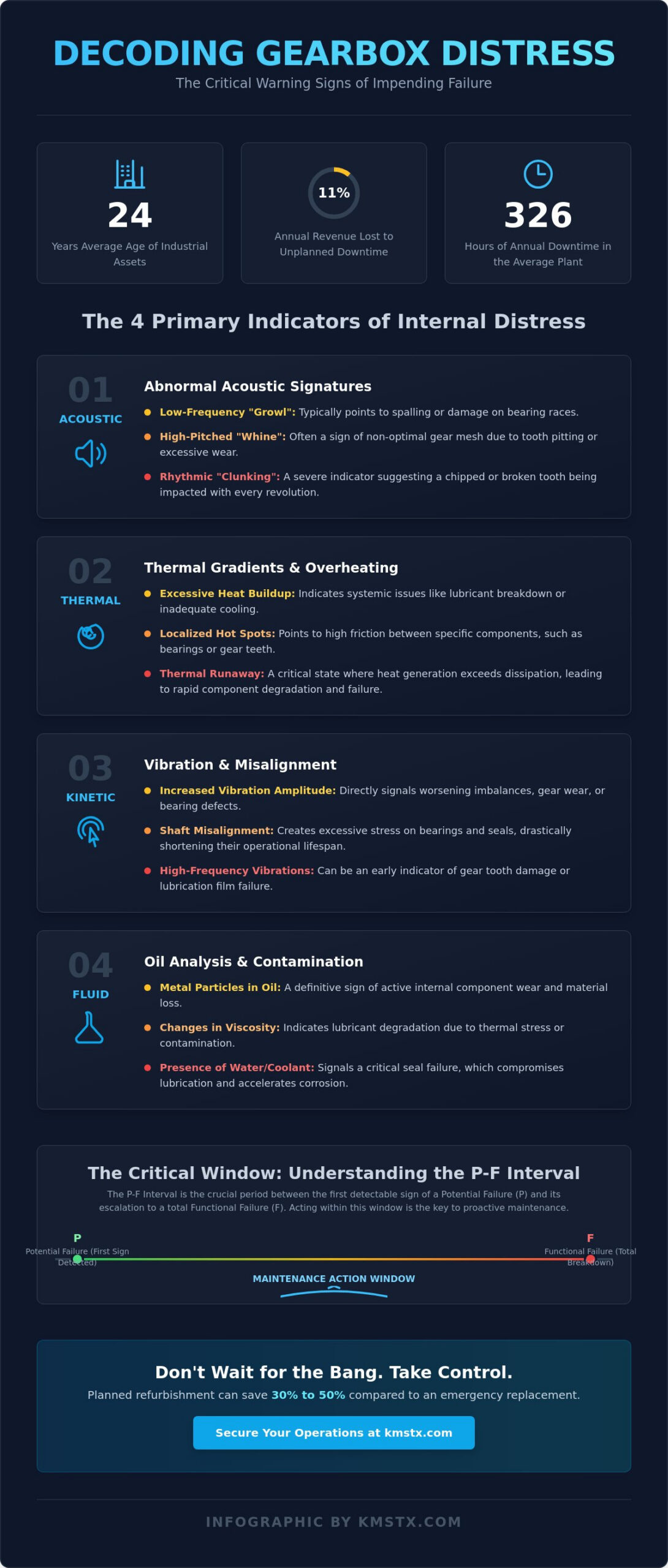
Moving from the theoretical P-F interval into the actual shop floor reality requires a shift in how you process data from your machinery. Industrial gearboxes don’t behave like automotive transmissions; you won’t always get a “check engine” light or a simple gear slip. Instead, identifying the signs of impending gearbox failure involves monitoring four distinct pillars of mechanical health: acoustics, thermodynamics, kinetics, and fluid chemistry. When these four areas begin to deviate from their established baselines, the unit is actively communicating its distress. Ignoring these signals usually leads to the 11% revenue loss associated with unplanned downtime seen in large-scale manufacturing facilities.
Abnormal Acoustic Signatures and Decibel Spikes
Acoustic monitoring is often the first line of defense for an experienced operator. You’ve likely spent years tuning your ears to the specific hum of your plant, making it easier to spot a low-frequency “growl” that typically points to spalling on bearing races. If the sound shifts to a high-pitched “whine,” it’s often a sign that the gear mesh is no longer optimal, likely due to tooth pitting or excessive wear on the flanks. A rhythmic “clunking” is a much more severe indicator, often suggesting a chipped or broken tooth that’s being hammered with every revolution of the shaft. These sounds shouldn’t be dismissed as “old machine noise,” as they represent physical material loss within the housing.
Thermal Gradients and Overheating
Thermal runaway occurs when localized friction generates heat faster than the lubricant can dissipate it. Most industrial gearboxes are designed to operate within a steady range, typically between 120°F and 160°F, depending on the load and ambient conditions. Citing the Top 5 warning signs from maintenance experts highlights that heat is one of the most reliable precursors to total seizure. Using infrared thermography allows you to map these gradients non-invasively, identifying hot spots around specific bearings or seal interfaces that indicate a lack of lubrication or severe internal misalignment.
While sound and heat are the most obvious indicators, kinetic instability and lubricant health provide the granular data needed for a precise diagnosis. Increased vibration amplitude often serves as a precursor to bearing collapse, while the oil itself acts as a blood sample for the machine. If you’re seeing “glitter” or dark particulate in the sight glass, the wear has already reached a critical stage. To ensure your assets stay within operational specs, it’s vital to integrate these findings into a comprehensive rotating equipment maintenance program before the damage requires a total replacement.
- Acoustic: Listen for shifts from steady hums to rhythmic clunks or high-pitched whines.
- Thermal: Monitor for deviations exceeding 20°F above your established baseline temperature.
- Kinetic: Use vibration sensors to catch decibel spikes in the high-frequency range.
- Chemical: Perform regular oil analysis to detect metal flaking and viscosity breakdown.
Deciphering Kinetic Signs: Vibration and Misalignment
Kinetic data serves as the physical pulse of your equipment. While acoustic spikes tell you what might be happening, vibration data tells you exactly where the distress is located and how severe the degradation has become. Mechanical looseness typically manifests as increased amplitude in your vibration readings, which is often one of the most quantifiable signs of impending gearbox failure. When a shaft isn’t perfectly aligned, it forces the bearings and seals to absorb loads they weren’t designed to handle, leading to premature fatigue and eventual seizure.
Shaft misalignment is a silent killer of industrial gearboxes. It doesn’t just wear out the gears; it destroys the integrity of your seals, leading to the lubricant leaks discussed in previous sections. Even in lighter mechanical systems, the Signs of Impending Gearbox Failure often start with these subtle shifts in how power is transferred through the drive train. For high-speed units where tolerances are tight, utilizing dynamic balancing services Houston is a critical step in protecting your heavy rotating assets from the 326 hours of annual downtime that the average facility faces.
Bearing Failure and Frequency Analysis
Bearing failure typically progresses through four distinct stages that can be mapped with precision. In Stage 1, the distress is only detectable in the ultrasonic or high-frequency ranges. By the time you reach Stage 4, the damage is audible to the naked eye and the housing temperature is climbing rapidly. Spotting spalling or pitting during the high-frequency phase allows for a planned swap during a scheduled window. If you wait until the bearing clearance changes, you’ll see a massive shift in gear backlash. This change in backlash alters the tooth contact pattern, which is a primary sign of impending gearbox failure that often results in catastrophic tooth breakage.
Structural Resonance and Foundation Issues
It’s vital to distinguish between internal gearbox faults and external structural issues. Structural resonance or a “soft foot” condition can mimic internal faults by creating high vibration amplitudes that aren’t actually caused by the gears themselves. If your baseplate isn’t rigid or the foundation has settled over the 24 years that the average industrial asset has been in service, external vibration can induce internal wear through fretting. You’ve got to look at the difference between axial vibration, which usually points to misalignment, and radial vibration, which is a classic sign of imbalance. Precision machining and proper baseplate leveling are the only ways to ensure external forces don’t chew through your internal components.
Immediate Diagnostic Workflow for Maintenance Teams
Once you’ve flagged potential signs of impending gearbox failure, the next 24 to 48 hours are critical for preventing a total asset loss. You don’t need a corporate consultant; you need a field-hardened workflow that identifies the root cause without an immediate teardown. Moving from monitoring to diagnosing requires a methodical approach that combines physical inspection with data-driven analysis. This process ensures you have the technical justification needed when asking for a maintenance budget or a scheduled line stoppage during your next planning meeting.
- Step 1: Visual and Acoustic Walk-around: Look for fresh oil weeping at seal interfaces and listen for the rhythmic clunking or high-frequency whines we discussed earlier.
- Step 2: Oil Sampling: Collect a representative sample following ASTM D4057 protocols. Don’t just pull from the bottom of the sump where sludge and heavy water settle.
- Step 3: Real-Time Kinematics: Deploy portable vibration sensors to capture a snapshot of the current frequency spectrum, looking for decibel spikes in the bearing frequencies.
- Step 4: Load Data Review: Check your SCADA or historian for torque spikes from the last 30 days that might’ve initiated a fracture.
- Step 5: Expert Borescope: If the data is inconclusive, consult a restoration expert to look inside the housing while the unit is still in situ.
Oil Debris Analysis (ODA) and Ferrography
Think of your gearbox lubricant as a blood sample for the machine. Analytical ferrography allows us to look at the morphology of wear particles under a microscope to determine their origin. If we see large, jagged steel flakes, we know we’re looking at severe gear tooth fatigue. If we see tiny, spherical particles, it’s a sign of bearing distress often caused by electrical discharge or moisture. Simple oil changes often mask these deeper mechanical pathologies, leading to a clean sample that hides a failing component. You’ve got to analyze the debris, not just the viscosity, to truly understand the signs of impending gearbox failure in high-load environments.
Borescope Inspections: Seeing Inside the Box
A borescope inspection is the most cost-effective way to perform a non-destructive internal review. By threading a high-definition camera through inspection ports or breather holes, you can spot micro-pitting and scuffing on the gear teeth long before they lead to a catastrophic seizure. This allows you to document wear patterns and build a long-term reliability trend for your asset. It’s the difference between guessing at internal damage and having a clear visual record of the gear carrier’s health. For a deeper look at how to structure your reliability program, check out our guide on rotating equipment maintenance to prevent these issues from recurring.
Engineering Restoration: The Kelsey Machine Services Protocol
When the signs of impending gearbox failure become too significant to ignore, the focus shifts from monitoring to high-precision restoration. At Kelsey Machine Services (KMS), we don’t just “fix” a unit; we execute a scientific teardown and engineering overhaul. Every component is stripped and cleaned in a controlled environment to remove decades of oxidized lubricant and metal particulate. Once the internals are exposed, our team utilizes Non-Destructive Testing (NDT), including magnetic particle and dye penetrant inspections, to identify hairline fractures in the housing or gear carriers. These microscopic defects are often the root cause of the kinetic instability and vibration spikes discussed in earlier sections.
Restoration requires more than just swapping parts. Our shop utilizes custom machining to bring shafts and bearing seats back to OEM specifications, or in many cases, to improve upon the original tolerances. After assembly, every unit undergoes a rigorous testing protocol. This includes a no-load run-in to check for thermal stability and a full-load test to ensure the acoustic signatures are within acceptable decibel ranges. We don’t release a gearbox until the data confirms it’s ready for another lifecycle in the field.
Restoring to OEM Specifications and Beyond
Modern engineering allows us to upgrade legacy equipment that has been in service for the 24-year average seen in today’s industrial facilities. By integrating modern labyrinth seals and high-capacity roller bearings, we often deliver a unit that outperforms its original design. This “OEM-plus” approach is detailed extensively in our guide to industrial gearbox repair Houston, where we break down the specific metallurgy and precision alignment standards we use to extend the P-F interval for your assets.
Rapid Turnaround and Emergency Response
We understand that a failing gearbox can cost a facility 11% of its annual revenue in lost production. That’s why we’ve optimized our logistics for emergency machine repair Gulf Coast, providing 24/7 response for critical failures. Our process is supported by a massive industrial machine spare parts Texas inventory, which allows us to bypass long lead times for specialized bearings and seals. By catching the signs of impending gearbox failure early and partnering with a restoration expert, you transform a potential catastrophe into a controlled, warranted mechanical overhaul that secures your production line for years to come.
Securing Your Production Through Precision Diagnostics
Managing industrial assets that average 24 years of age requires more than a “wait and see” approach. You’ve seen how the P-F Interval provides a narrow but vital window to intervene before a potential failure becomes a functional one. By integrating acoustic checks, vibration analysis, and oil debris monitoring, you can effectively map the signs of impending gearbox failure long before they halt your processing line. This proactive strategy is the only way to protect against the 11% revenue loss that typically follows catastrophic downtime.
When the data shows a deviation, you need a partner who understands the stakes of a 24/7 operation. With 40+ years of technical engineering expertise, Kelsey Machine Services provides the full technical teardown and NDT reporting required to restore your equipment to OEM standards. Whether you’re facing a critical emergency or planning a scheduled overhaul, we offer 24/7 emergency field service response across the Gulf Coast. Request a Technical Consultation for Your Industrial Gearbox today to ensure your facility stays online and efficient. Taking the right steps now keeps your production steady and your maintenance budget under control.
Frequently Asked Questions
How can I tell if my industrial gearbox is overheating without a sensor?
You can identify overheating by looking for scorched or blistered paint on the housing and smelling the acrid, burnt odor of oxidized lubricant. If you splash a small amount of water on the casing and it sizzles or evaporates instantly, the surface temperature likely exceeds 200°F (93°C). This level of heat usually indicates a severe lack of lubrication or a bearing that’s already in the final stages of failure.
Is a small amount of metal in the oil filter normal for a heavy gearbox?
Fine, microscopic “wear dust” is expected during the first 100 hours of a new unit’s run-in period, but jagged flakes or silver “glitter” larger than 10 microns are never normal. These larger particles are clear signs of impending gearbox failure caused by gear tooth spalling or bearing race fatigue. If you can feel the grit between your fingers, the internal components are actively shedding material and require an immediate borescope inspection.
What is the most common cause of sudden gearbox failure in high-torque applications?
Lubricant starvation and extreme shock loading are the primary drivers of sudden mechanical seizure. A torque spike that exceeds the unit’s design limit by 200% can cause instantaneous tooth shear or shaft fracture, especially in assets that have been in service for over 20 years. Maintaining proper oil levels is your best defense, as 60% of catastrophic failures in high-torque drives stem from simple seal leaks that went unnoticed.
Can vibration analysis predict exactly when a gearbox will seize?
Vibration analysis identifies the specific location and severity of a fault, but it provides a window of time rather than a specific minute of failure. It allows you to map the P-F interval, helping you plan a shutdown before the machine reaches the point of functional loss. Since 71% of maintenance professionals now use these predictive tools, it’s the most reliable way to avoid the 326 hours of annual downtime seen in the average plant.
What is gear pitting and can it be repaired without replacing the gear?
Gear pitting is surface fatigue that creates small craters on the gear teeth due to repeated high-stress contact. If the pitting is “initial” and hasn’t progressed to destructive levels, you can sometimes arrest the damage by improving the lubricant’s film strength or adjusting the gear alignment. However, once the pits cover more than 25% of the tooth’s contact area, the gear must be replaced to prevent a total tooth fracture.
Should I stop my machine immediately if I hear a new whining sound?
You don’t always need an emergency E-stop for a new noise, but you should check the decibel levels against your baseline. A 10 dB increase in gear mesh frequency is a technical sign of impending gearbox failure that warrants a scheduled inspection within the next 24 hours. If the whine is accompanied by a rhythmic thumping or clunking, you should stop the machine immediately to prevent the broken parts from “grenading” the entire housing.
How often should I perform oil ferrography on a critical asset?
Perform analytical ferrography quarterly for critical assets to establish a baseline for wear particle morphology. If your sensors detect a 15% increase in vibration or a sudden temperature spike, move to a monthly sampling cadence until the issue is resolved. This proactive approach is a cornerstone of the 27% of maintenance teams that have successfully transitioned from reactive to predictive maintenance strategies.
What is the difference between a minor refurbishment and a full technical restoration?
A minor refurbishment typically involves replacing external seals and accessible bearings to stop leaks and reduce noise. A full technical restoration includes a total teardown, NDT for hairline fractures, and custom machining to bring every shaft and seat back to OEM specifications. Restoration is a more intensive process that can lead to cost savings of 30% to 50% compared to purchasing a brand-new unit, while also extending the machine’s life for another two decades.