

If your centrifuge is hitting its high-vibration trip point, you aren’t just looking at a mechanical glitch; you’re staring down a $2,580 daily service fee for an outside representative to walk through your gate. Most maintenance teams feel the pressure when the floor starts humming, wondering if they’re dealing with a simple process slug or a bearing about to weld itself to the shaft. It’s a high-stakes guessing game where a wrong call leads to expensive unscheduled downtime or a catastrophic failure of high-speed rotating equipment. While standards like ISO 20816-3:2022 provide the technical benchmarks for vibration, they don’t always tell you what to do when the machine is shaking right now.
We agree that distinguishing between a minor unbalance and a complex structural issue is one of the toughest jobs on the shop floor. This guide simplifies troubleshooting industrial centrifuge vibration by teaching you how to analyze frequency and timing to pinpoint the root cause. You’ll learn a clear diagnostic path to stabilize the machine immediately and differentiate between process errors and terminal mechanical failures. We’ll also provide the specific criteria you need to decide when a field fix is enough and when it’s time to pull the unit for a full refurbishment.
Key Takeaways
- Understand how minor imbalances at high operational speeds generate massive kinetic forces that can lead to catastrophic structural failure.
- Master a systematic approach to troubleshooting industrial centrifuge vibration by quickly distinguishing between process-related material buildup and true mechanical wear.
- Learn to interpret vibration signatures and FFT data to pinpoint specific faults in bearings, hubs, or splines before they cause a total system shutdown.
- Implement a field-proven 5-step diagnostic sequence to isolate the rotating assembly and verify the integrity of anchor bolts and isolators.
- Establish clear operational thresholds to determine when field fixes are no longer safe and a professional shop restoration is necessary to prevent equipment loss.
Identifying the ‘Shake’: Why Industrial Centrifuge Vibration Requires Immediate Action
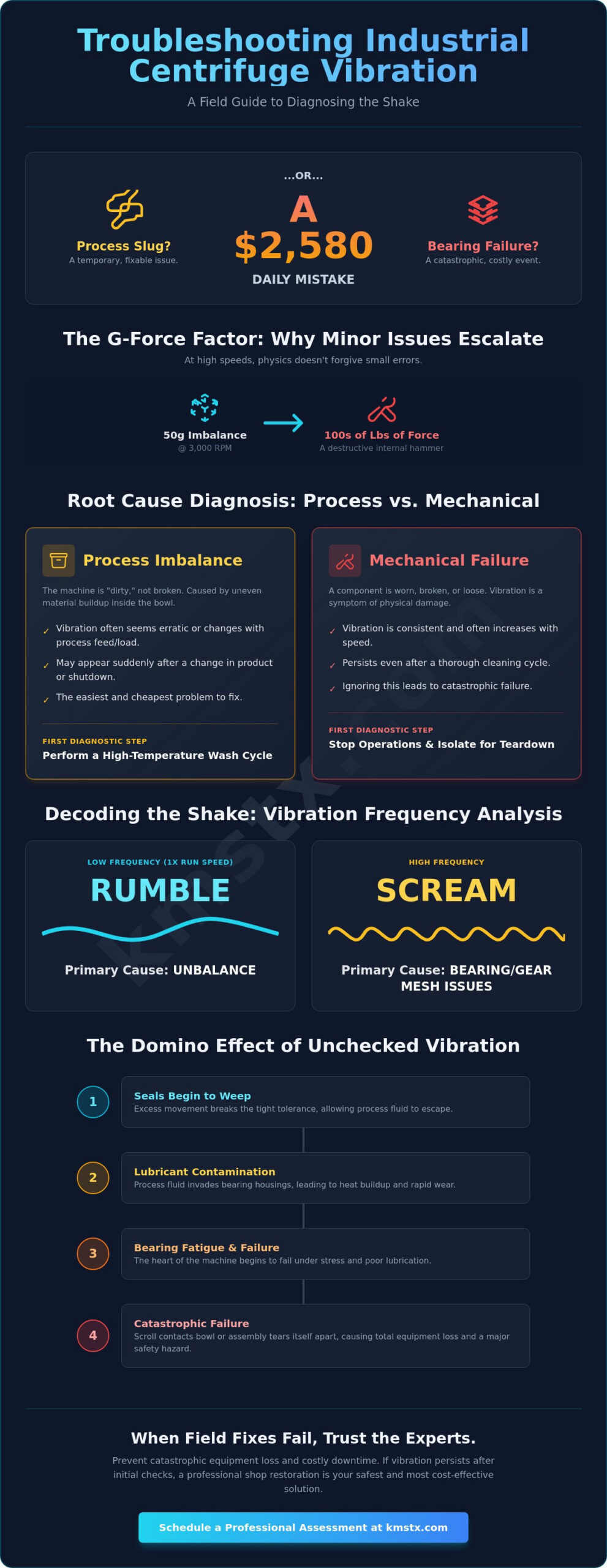
Vibration isn’t just a noise or a nuisance; it’s the physical manifestation of kinetic energy that has lost its way. When you’re troubleshooting industrial centrifuge vibration, you’re essentially looking for where that energy is escaping the designed path. In high-speed centrifuge technology, precision is the only thing standing between a productive shift and a total equipment loss. Think about a standard decanter running at 3,000 RPM. A tiny imbalance of just 50 grams on the bowl wall can generate hundreds of pounds of centrifugal force. At those speeds, physics doesn’t forgive. This “G-force Factor” turns a minor unbalance into a hammer that beats your machine to death from the inside out.
The damage usually follows a predictable domino effect. It starts with the seals. They’re designed for incredibly tight tolerances, and even a few mils of excess movement causes them to weep. Once the seals fail, process fluid often migrates into the bearing housings. This contaminates the lubricant, leading to rapid heat buildup and eventual bearing fatigue. If the vibration isn’t addressed, it eventually transfers to the rotating assembly itself. This can cause the scroll to contact the bowl, which is almost always the point of no return for the machine’s internal components.
The True Cost of Ignoring Vibration Signs
Ignoring these signs hits your bottom line before the machine even stops. High vibration levels disrupt the “G-wall” needed for clean separation, which immediately tanks your product purity and increases solids carryover. Beyond the centrifuge itself, that mismanaged energy travels back through the drive train. It shakes gearboxes and drive motors, often causing premature winding failure or gear teeth pitting. The ultimate risk is a “walk-away” failure. In these rare but catastrophic cases, the kinetic energy is so great that the machine can tear itself off its mounts, creating a massive safety hazard for anyone on the floor.
Vibration Categories: Global vs. Local
Effective troubleshooting industrial centrifuge vibration requires you to categorize the movement accurately. We generally split these issues into two camps:
- Global Vibration: This is when the entire frame, skid, or foundation is moving. This often points to structural issues, such as loose anchor bolts or a compromised concrete pad.
- Local Vibration: This is specific to a component, like the motor mount, the bowl, or the gearbox. It suggests the issue is internal to the rotating assembly.
- Frequency-Based Analysis: Low-frequency shakes (typically 1x the running speed) usually scream unbalance. High-frequency “screaming” or “singing” typically points to failing bearings or gear mesh issues.
While ISO 20816-3:2022 provides the technical thresholds for “allowable” versus “critical” vibration, an experienced operator can usually feel when a machine has moved from a healthy hum to a failure-state rumble. Catching it in the “local” stage saves you from the “global” repair bill.
Root Cause Analysis: Mechanical vs. Process Imbalance
When you’re knee-deep in troubleshooting industrial centrifuge vibration, the first task is determining if the machine is actually broken or if it’s just dirty. It sounds simple, but many maintenance teams waste thousands on a teardown when a high-temperature wash cycle would’ve solved the problem. On the other hand, misdiagnosing a mechanical failure as a process issue can lead to a catastrophic event that puts your entire line out of commission. You have to separate the “software” from the “hardware” before you pick up a wrench.
Most vibration events fall into two buckets: process-induced and mechanical-structural. While sludge buildup is a common culprit, it’s a mistake to ignore internal clearances or shaft integrity. If the shake persists after the bowl is clean, you’re likely looking at deep-seated issues that require specialized rotating equipment maintenance to restore the machine’s precision balance. Understanding the physics behind these failures is the only way to avoid a repeat performance.
Process-Induced Vibration: The ‘Dirty Bowl’ Problem
Process imbalance is the “quick fix” scenario every operator hopes for. In decanter centrifuges, this usually manifests as an uneven solids cake distribution. If the feed consistency fluctuates or the machine experiences a sudden slug, the solids don’t distribute evenly against the bowl wall. For disc stack units, the problem is often clogged nozzles or ports that prevent the machine from discharging solids symmetrically. A 30-minute hot water flush or a chemical “clean-in-place” (CIP) cycle is your best diagnostic tool here. If the vibration levels drop significantly after the wash, you’ve confirmed the issue is process-related and not a mechanical defect.
Mechanical Root Causes: Beyond the Surface
If the wash cycle doesn’t settle the machine, the problem is likely permanent. Mechanical failures often start small. Worn or pitted bearings create high-frequency “noise” that you can’t see but can certainly feel through the frame. More serious is the erosion of scroll flights or the bowl wall itself. In abrasive applications, losing just a few grams of metal from one side of the scroll causes a permanent mass shift. You might also be dealing with a bent shaft or misaligned couplings, especially if the machine has survived a hard restart or a severe slugging event recently. These issues won’t go away with a wash; they require a shop-level intervention. If you’re seeing these persistent mechanical signs, it’s a good idea to consult with an expert in precision rotating assembly repair before the damage spreads to the gearbox.
Structural Resonance and Thermal Distortion
Sometimes the root cause isn’t in the bowl or the bearings. Structural resonance happens when the machine’s operating speed matches the natural frequency of the support skid or the floor. It feels like the whole building is moving. This often crops up after a foundation change or if the support steel has corroded. Then there’s thermal distortion, a common “startup ghost.” As the centrifuge heats up, the rotating assembly can bow slightly due to uneven temperature distribution. This temporary unbalance usually settles once the machine reaches a steady-state temperature, but it’s a heart-stopper during the first 20 minutes of a run.
Diagnostic Tools and Forensic Vibration Data Analysis
Don’t just rely on your boots to feel the floor shaking. When you’re deep into troubleshooting industrial centrifuge vibration, you need to transition from subjective “feel” to objective data. While a simple handheld vibration pen is better than nothing for a quick spot check, it only gives you the “overall” vibration level. It doesn’t tell you the story of why the machine is shaking. Today, online monitoring systems account for over 63% of the global market because they capture the real-time data needed to catch a failure before it becomes a headline. To truly understand a machine’s health, you have to look at the Vibration Signature through a Fast Fourier Transform (FFT) spectrum.
The FFT takes that complex, messy vibration signal and breaks it down into individual frequency peaks. It’s like deconstructing a chord played on a piano into its individual notes. Each “note” or peak corresponds to a specific mechanical or process issue. By analyzing these peaks, you can stop guessing if the problem is a loose bolt or a failing bearing. We also use secondary layers like ultrasound to catch early-stage bearing turbulence and thermography to find “hot spots” in gearboxes that vibration sensors might miss during the early stages of a fault.
Interpreting Frequency Peaks (FFT)
Reading an FFT spectrum is about looking at where the energy is concentrated relative to the machine’s running speed (RPM). A massive peak at exactly 1x the RPM is the classic signature of unbalance; it’s the most common diagnosis and usually points back to the “dirty bowl” or erosion issues we discussed earlier. If you see a strong peak at 2x the RPM, you’re likely looking at a misalignment between the motor and the gearbox or a bent shaft. Non-synchronous peaks—those that don’t line up with a multiple of the running speed—are often the “screams” of a bearing race that’s starting to pit or flake. Identifying these specifically prevents you from wasting time on an alignment job when the bearings are the real culprit.
The Role of Precision Dynamic Balancing
Field balancing is often a necessary “band-aid” to keep production moving, but it has limits. You can’t balance out a mechanical defect like a worn spline or a cracked hub. For long-bowl decanters, single-plane balancing in the field often fails because it doesn’t account for “couple unbalance” at the opposite end of the machine. Achieving true OEM specs requires precision dynamic balancing services that utilize multi-plane analysis in a controlled shop environment. This process ensures the entire rotating assembly is harmonized, which is the only way to guarantee a long mean time between failures (MTBF) after the machine goes back into service.
The 5-Step Troubleshooting Sequence for Field Teams
When the floor starts humming, you need a repeatable process to find the source without guessing. This 5-step sequence is designed to help field teams isolate variables quickly. It’s the standard for troubleshooting industrial centrifuge vibration when every hour of downtime costs thousands in lost production. Following this order prevents you from tearing down a perfectly good rotating assembly when the real culprit is a $50 anchor bolt or a clogged feed pipe.
- Step 1: The ‘Empty Run’ Test. Start the machine without feed. If the vibration persists while empty, the issue is purely mechanical. If it only shakes when loaded, the problem lies in your process consistency or solids cake distribution.
- Step 2: External Inspection. Check your anchor bolts and isolators. A loose bolt or a cracked foundation pad can mimic a serious internal failure by allowing the frame to bounce.
- Step 3: Internal Inspection. Open the casing and look for the ‘Dirty Bowl’ issues mentioned in previous sections. Check for loose wear plates or liners that may have shifted during operation.
- Step 4: Lubrication and Bearing Check. Use your thermography tools to look for uneven heat across the housings. Listen for the high-frequency ‘singing’ that signals a bearing race failure.
- Step 5: Alignment Audit. Verify the motor-to-gearbox and gearbox-to-centrifuge paths. Even a slight offset in the drive train can cause a 2x RPM vibration peak that stresses your couplings.
The ‘Clean and Inspect’ Protocol
A quick wash cycle doesn’t always clear everything. You have to look in the specific areas where solids hide, such as behind the hub, inside the scroll flights, or under the liners. Even a few grams of dried material in these pockets creates a massive imbalance at 3,000 RPM. While you’re in there, check for ‘tramp metal’ damage. If you see scarring on the bowl ID or chipped scroll edges, you’re looking at a permanent mass shift that a simple cleaning won’t fix. All wear parts must be measured against OEM tolerances to ensure they haven’t eroded beyond the point of stability. If you find significant scarring, it’s a sign that foreign objects have compromised the rotating assembly’s geometry.
Checking Structural Integrity
Sometimes the machine is fine, but the foundation is failing. Inspect your vibration isolators to see if the springs or rubber mounts have bottomed out or dry-rotted. If they’ve lost their elasticity, they’re transmitting energy directly into the floor instead of absorbing it. You also need to watch for ‘soft foot’ issues where the frame doesn’t sit flat on the skid. This condition actually twists the machine frame, which forces the bearings out of alignment regardless of how well the motor is positioned. Pipe strain is another silent killer. If your rigid piping connections are pulling or pushing on the centrifuge, they’re introducing external forces that the machine’s internal balancing can’t overcome. If your field audit reveals these structural issues or severe internal wear, you should reach out to a technical expert in troubleshooting industrial centrifuge vibration to evaluate the frame’s integrity before a catastrophic failure occurs.
When Field Fixes Fail: The Role of Professional Restoration
Sometimes, the diagnostic sequence reveals a problem that a field crew simply can’t fix on-site. If you’ve been troubleshooting industrial centrifuge vibration and still see levels exceeding 0.5 inches per second (ips), you’ve reached the limit of field stabilization. At this threshold, the machine has moved from “rough” to “critical.” Continuing to run at these levels risks a catastrophic failure that could write off the entire asset. When field balancing and cleaning fail to bring the shake into an acceptable range, professional industrial centrifuge repair is the only way to protect your long-term reliability.
A shop-level teardown offers an advantage that field inspections can’t match: the ability to see the hidden killers. We often find cracked hubs, worn splines, or bearing races that have spun and hogged out the housing. These issues are invisible during a standard field audit but will defeat any attempt at a local fix. OEM specifications are the only acceptable benchmark for high-speed rotating assets. If the internal tolerances are out by even a few thousandths of an inch, the resulting centrifugal force will eventually find that weakness and exploit it.
What Happens During a Professional Overhaul?
A professional restoration goes far beyond just swapping bearings. It starts with Non-Destructive Testing (NDT), such as dye penetrant or magnetic particle inspection, to locate stress cracks in the bowl and scroll that could lead to a “walk-away” failure. From there, technicians perform hard-surfacing and re-tiling of scroll flights to restore the original geometry and mass distribution. The process concludes with high-speed balancing in a dedicated bunker. This allows the assembly to be tested at its actual operational RPM, ensuring “zero-vibration” performance before the unit ever leaves the shop.
Selecting a Repair Partner
Not every machine shop is equipped to handle the precision required for a centrifuge. You need to evaluate their specific capabilities; do they have the heavy-duty lathes and multi-plane balancing machines necessary for your specific model? Turnaround time is usually the biggest concern for maintenance teams, so look for a partner with a robust industrial machine spare parts in texas to avoid waiting weeks for a simple seal or bearing kit. Finally, ensure they offer 24/7 support for emergency machine repair. When a primary centrifuge goes down, you don’t have the luxury of waiting until Monday morning for a response. A reliable partner understands the cost of your downtime and has the technical depth to solve the problem the first time.
Restoring Stability to Your High-Speed Operations
Effective troubleshooting industrial centrifuge vibration starts with a systematic approach that separates process-induced unbalance from terminal mechanical failure. We’ve established that while a hot water wash can often clear a dirty bowl, issues like structural resonance or eroded scroll geometry require a deeper look at frequency signatures. Don’t let a “good enough” field fix mask a developing catastrophic failure. Once your vibration levels cross that 0.5 ips threshold, the safety of your team and the life of your asset depend on professional intervention.
Kelsey Machine Services brings over 40 years of heavy rotating equipment experience to your shop floor, providing the technical depth needed to solve the most complex vibration challenges. Our full-service machine shop features high-speed dynamic balancing and 24/7 emergency response to ensure your critical assets are back online without delay. If you’re struggling with persistent instability, Contact Kelsey Machine Services for Expert Centrifuge Troubleshooting and Repair. You can keep your plant running smoothly with the right data and a reliable partner by your side.
Frequently Asked Questions
What is the maximum acceptable vibration level for an industrial centrifuge?
According to ISO 20816-3:2022, the maximum acceptable vibration for machines in this class is generally 0.28 inches per second (ips) for steady operation. Once you cross the 0.50 ips threshold, the machine is in a critical failure state. Running at these levels for even a few hours can cause permanent damage to your bearing housings and seals, leading to expensive repairs.
Can a centrifuge vibrate if the bowl is empty?
Yes, and this is a vital step in troubleshooting industrial centrifuge vibration. If the machine shakes during an empty run, the problem is purely mechanical, such as a bent shaft or a permanent mass shift from erosion. If the vibration only appears when you introduce feed, you’re likely dealing with process issues like uneven solids distribution or a clogged discharge port that disrupts the balance.
How do I tell the difference between a bearing failure and an unbalance issue?
You need to look at the frequency spectrum to find the answer. A classic unbalance issue shows up as a massive peak at exactly 1x the running speed (RPM). Bearing failures usually manifest as high-frequency, non-synchronous “noise” that doesn’t line up with the machine’s rotation. While unbalance feels like a heavy thumping, bearing failure often sounds like a high-pitched whine or grinding through the housing.
What causes a decanter centrifuge to vibrate only at certain speeds?
This usually points to structural resonance or the machine crossing a “critical speed.” Every rotating assembly has a natural frequency where it wants to vibrate. If your operating speed or a foundation weakness matches that frequency, the vibration amplifies significantly. This is common in plants where the support steel has corroded by 15% or more, which changes the skid’s overall stiffness and resonance point.
Is it safe to continue running a centrifuge with moderate vibration?
It’s never recommended to ignore vibration levels above 0.28 ips. While the machine might not fly apart immediately, moderate vibration acts like a slow-motion hammer on your internal components. You’ll eventually see a 40% reduction in bearing life and frequent seal leaks. If the level hits 0.70 ips, you should trigger an emergency shutdown to prevent a total loss of the rotating assembly.
How often should I check the dynamic balance of my centrifuge?
You should verify the balance annually or whenever you replace internal wear parts. In abrasive applications, we’ve seen scroll flights lose 200 grams of material in six months, which is more than enough to cause a trip. Regular checks through a permanent monitoring system, which now leads 63% of the market, can help you track these trends before they require an unscheduled shop visit.
Can a worn gearbox cause the centrifuge bowl to vibrate?
Yes, a failing gearbox can transmit vibration directly back into the bowl assembly. If the internal gears are pitted or the bearings in the gearbox are failing, the resulting torque fluctuations create a “chatter” that shows up on your sensors. This often manifests as high-frequency peaks in your FFT data that don’t match the bowl’s primary rotation speed but correlate with the gear mesh frequencies.
What role does ‘soft foot’ play in centrifuge vibration?
Soft foot occurs when one of the machine’s feet doesn’t sit flush on the foundation, which twists the frame when you tighten the anchor bolts. This slight twist forces the bearings out of alignment, creating a vibration that looks like a bent shaft. Checking for soft foot is a critical part of troubleshooting industrial centrifuge vibration because it’s an external fix that prevents expensive internal repairs.