
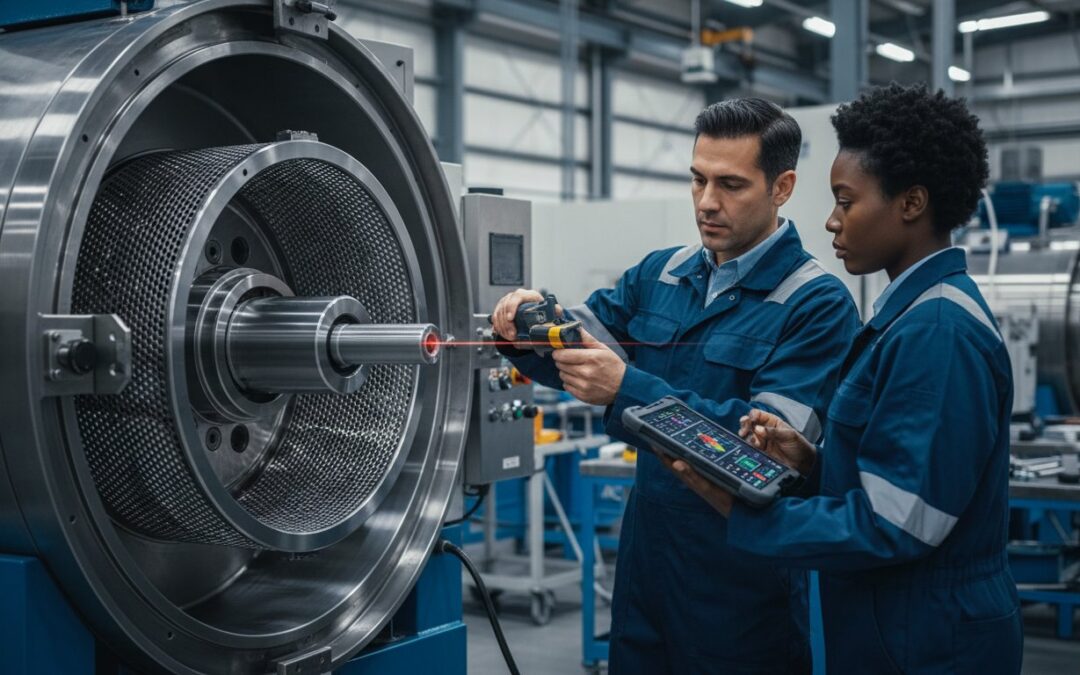
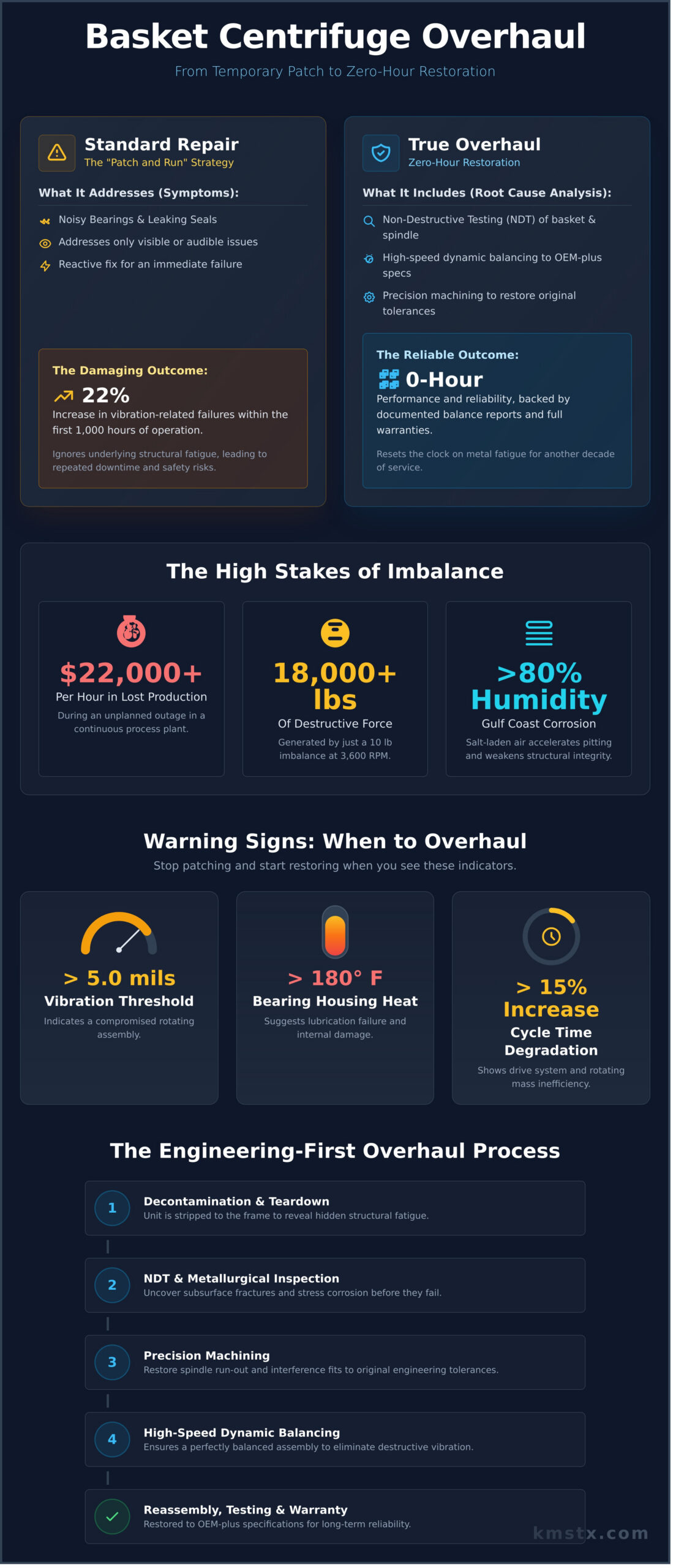
A standard bearing swap isn’t a true basket centrifuge overhaul; it’s a temporary patch that often ignores the underlying structural fatigue responsible for a 22% increase in vibration-related failures within the first 1,000 hours of operation. We’ve all seen what happens when a machine is rushed back into service only to rattle itself apart three months later. It’s frustrating to watch a piece of equipment spend more time in the shop than on the line, especially when you’re dealing with the tight margins of a 24/7 production schedule. You know that a poorly balanced basket isn’t just a nuisance; it’s a safety risk that threatens your entire facility’s uptime.
This guide breaks down the rigorous mechanical standards required to achieve a zero-hour restoration that meets or exceeds original engineering tolerances. We’ll show you how to move beyond simple repairs to reach a level of reliability backed by documented balance reports and full warranties. We’re going to dive into the specifics of spindle run-out measurements, high-speed dynamic balancing, and the metallurgical assessments that ensure your equipment performs exactly like it did on day one.
Key Takeaways
- Differentiate between symptomatic repairs and the mechanical rigor required to bring high-G rotating assets back to true zero-hour performance.
- Explore the role of Non-Destructive Testing (NDT) in uncovering subsurface fractures within the basket and spindle before they compromise site safety.
- Learn why a comprehensive basket centrifuge overhaul relies on dynamic balancing and precision machining to restore interference fits to original design standards.
- Pinpoint the primary failure modes, from lubrication issues to cake imbalance, that stress the spindle assembly and lead to unplanned downtime.
- See how a technical, engineering-first approach to restoration ensures your equipment meets OEM-plus specifications for long-term reliability.
The Engineering Stakes of Basket Centrifuge Overhauls
Operating a basket centrifuge isn’t like managing a standard pump or a static mixer. You’re dealing with a piece of equipment that routinely generates forces thousands of times greater than gravity to achieve precise liquid-solid separation. At these speeds, mechanical integrity isn’t just a goal for the maintenance team; it’s a non-negotiable requirement for site safety. When a machine spins at 3,000 RPM, a minor imbalance or a microscopic stress crack in the basket wall can escalate into a structural failure in a matter of seconds. This high-stakes environment is why we distinguish between a simple repair and a full basket centrifuge overhaul.
In our experience, a repair is often a reactive measure meant to fix a specific symptom, such as replacing a leaking seal or a noisy bearing. It’s a “patch and run” strategy that serves a purpose in an emergency but doesn’t address the underlying fatigue of the system. A true overhaul is a proactive restoration of the entire unit to zero-hour specifications. This process involves stripping the machine to its frame, NDT testing every critical weld, and ensuring every tolerance meets or exceeds the original equipment manufacturer’s standards. It’s the only way to reset the clock on metal fatigue and ensure the machine is reliable for another decade of service.
Environmental factors play a massive role in how quickly these machines degrade, especially for facilities located along the Gulf Coast. In 2023, industrial sites in regions like Pasadena or Lake Charles faced average humidity levels above 80%, which, when combined with salt-laden air, creates an aggressive electrolytic environment. This climate accelerates pitting corrosion in stainless steel baskets and weakens the structural integrity of the rotating assembly. When you combine this environmental stress with the constant vibration of high-G operation, the risk of unplanned downtime becomes a statistical certainty rather than a possibility.
The economic consequences of a sudden failure are staggering. In a continuous process plant, such as a pharmaceutical refinery or a chemical processing unit, an unplanned outage can cost upwards of $22,000 per hour in lost production. Beyond the immediate loss of revenue, the collateral damage to upstream and downstream equipment can triple the total recovery cost. Investing in a systematic basket centrifuge overhaul is a strategic capital decision that protects the bottom line by eliminating the volatility of “run-to-failure” maintenance models.
This principle of investing in preventative overhauls to avoid costly downtime applies across industries. For example, in commercial logistics, where vehicle reliability is paramount, working with a specialist like Tim Halpin Equipment Corp for truck equipment and upfitting serves the same strategic purpose.
Centrifugal Force and Structural Integrity
Understanding centrifugal force principles is vital because any deviation in the basket’s geometry can lead to catastrophic failure. At high velocities, minor defects like basket perforations or thinning weld seams are amplified by the square of the speed. Material science is the backbone of our evaluation process; we look for stress corrosion cracking and erosion patterns that aren’t visible to the naked eye. The radial stress on a centrifuge spindle increases exponentially with rotational velocity, where the force exerted is defined by the formula F = m * r * ω², meaning a 10 pound imbalance at 3,600 RPM generates over 18,000 pounds of centrifugal force. This massive load requires a perfectly balanced rotating assembly to prevent spindle deflection and bearing housing destruction.
When to Move from Maintenance to Full Overhaul
Knowing when to stop patching and start overhauling depends on quantifiable data. If your vibration sensors are consistently hitting thresholds above 5.0 mils, or if you’re seeing heat signatures on the bearing housings that exceed 180 degrees Fahrenheit, the internal components are likely compromised. Cycle-time degradation is another red flag; if it’s taking 15% longer to reach target speeds or if the braking time has drifted significantly, the drive system and rotating mass are no longer efficient. There’s a “point of no return” where the cost of repeated minor repairs exceeds the cost of a full restoration. If you’re noticing these indicators, you should also look for signs your decanter centrifuge needs repair, as similar mechanical stresses often affect both types of equipment in your facility.
Anatomy of an Overhaul: Teardown, NDT, and Inspection
A successful basket centrifuge overhaul begins with a methodical teardown. You can’t assess what you can’t see. We start with a full steam decontamination to strip away chemical residues and process cake that often hide structural fatigue. Once the unit is stripped to the frame, every component is tagged and organized. We document the “as-found” condition immediately. This report isn’t just paperwork; it’s a legal and insurance necessity that tracks wear patterns against the last service cycle, often dating back 24 to 36 months. It provides the baseline data needed to justify the repair scope and ensures compliance with plant safety standards.
Non-Destructive Testing (NDT) Protocols
We don’t guess when it comes to structural integrity. For stainless steel baskets, dye penetrant testing is the first line of defense. It reveals stress corrosion cracking around the perforations that the naked eye misses. If the basket is carbon steel, magnetic particle inspection is used to find subsurface fractures in the high-stress areas near the hub. We also utilize ultrasonic thickness testing. If a basket wall has lost more than 10% of its original OEM thickness due to abrasive slurry wear, it’s a candidate for replacement rather than repair. Visual inspection of the curb and discharge ports is equally critical. Sharp edges where there used to be radius curves tell us exactly how the solids are eroding the housing.
Evaluating the Rotating Assembly
The spindle is the heart of the machine. We set up dial indicators to check for runout. Standard tolerances for basket spindles are tight; we look for deviations within .001 to .003 inches. Anything beyond that creates a harmonic imbalance that destroys bearings. During this phase, we also pull the gearbox and hydraulic couplings for a bench test. If you’re seeing premature bearing failure, the root cause is often found in these drive components. Understanding dynamic balancing procedures is vital because even a spindle that meets runout specs can still vibrate if the mass distribution is off. We measure bearing housings with inside micrometers to ensure they haven’t “egged out” over years of operation. If you need a hand verifying these tolerances, our team offers precision inspection services to get your baseline data right.
Finally, we check the seal surfaces. A seal sleeve with a groove deeper than .005 inches won’t hold vacuum or pressure; this leads to leaks that can ruin a new set of bearings in a week. Every measurement is recorded against the OEM technical manual. This data-heavy approach ensures that the basket centrifuge overhaul moves from the inspection phase to the repair phase with a clear, evidence-based roadmap. We don’t like surprises in the middle of a build, and neither do your maintenance budgets. By identifying these subsurface and dimensional issues early, we eliminate the risk of catastrophic failure during the first high-speed run after reassembly.
Precision Restoration: Machining and Dynamic Balancing
When you’re dealing with equipment spinning at 1,500 RPM, “close enough” is a recipe for catastrophic failure. A professional basket centrifuge overhaul isn’t just a parts replacement project; it’s a return to zero-tolerance geometry. Over years of service, abrasive slurries and chemical corrosion degrade the critical surfaces that hold your machine together. We see bearing seats that have wallowed out by 0.005 inches and seal landings etched with deep grooves that no new O-ring can bridge. Precision machining is the only way to correct these deviations and ensure the unit doesn’t shake itself apart within six months of being back online.
Restoring these fits requires a mix of traditional manual machining and modern CNC technology. When an OEM stops supporting a machine built in 1985, we don’t scrap the unit. We utilize CNC pathing to fabricate obsolete components like spindle nuts or specialized wash headers from 4140 alloy steel or 316 stainless. This capability allows us to maintain the original design specifications even when the original parts manuals are the only documentation left. It’s about ensuring the interference fits are tight enough to prevent fretting but precise enough for proper thermal expansion during operation.
The perforated basket presents its own set of challenges. These components aren’t just metal cylinders; they’re dynamic structures that must handle uneven cake-load distribution. During the machining phase, we check for concentricity across the entire length of the basket. If the basket is out of round by even a fraction of an inch, the resulting centrifugal forces at high speed will create a whip effect. This stress eventually leads to stress-corrosion cracking around the perforations, which can cause a total structural breach.
Dynamic Balancing to ISO 1940 Standards
Static balancing might work for a slow-moving pulley, but it’s useless for high-speed filtration. We balance every rotating assembly to ISO 1940 standards, typically targeting a G2.5 grade for standard industrial use or G1.0 for high-speed, sensitive applications. A G1.0 balance grade is significantly tighter, requiring the residual unbalance to be less than 1 gram-millimeter per kilogram of rotor mass. The balance grade represents the product of the specific unbalance and the angular velocity, effectively defining the peak vibration velocity in millimeters per second.
- G2.5 Grade: The standard for most industrial centrifuges, providing a balance between cost and vibration suppression.
- G1.0 Grade: Reserved for high-precision spindles where even minor harmonics could damage sensitive downstream instrumentation.
- Residual Unbalance: Excessive unbalance doesn’t just cause noise; it increases the radial load on bearings by up to 300%, leading to premature spalling and cage failure.
Machining and Component Refurbishment
We don’t just replace bearing housings; we save them. By boring out a damaged housing and pressing in a custom-machined sleeve, we restore the “like-new” interference fit required for the bearing’s outer race. This process is often superior to buying new cast housings that may have internal porosities. To combat the high-wear environments found in the discharge zone, we apply surface hardening techniques such as HVOF (High Velocity Oxygen Fuel) thermal spraying. This adds a layer of tungsten carbide that tests at 70 HRC, significantly extending the service life of the component against abrasive cake solids.
If you’re operating in the Gulf Coast region, utilizing specialized Dynamic balancing services in Houston ensures that your refurbished basket meets these stringent tolerances before it leaves the shop floor. This final verification step is what prevents foundation stability issues and keeps your vibration sensors from tripping during the first high-speed ramp-up. Every basket centrifuge overhaul we complete includes a full report of the final balance weights and positions, providing a technical baseline for your future preventative maintenance cycles.
Mitigating Operational Risk: Failure Modes and Prevention
If you’ve spent any time on a plant floor, you know that a centrifuge doesn’t just stop without warning. It signals its intent to fail long before the spindle snaps. Most catastrophic failures stem from three primary culprits: mechanical imbalance, inadequate lubrication, or chemical corrosion. When a basket centrifuge overhaul is finally required, the teardown usually reveals a history of neglected minor symptoms that compounded over time. For instance, a 5% deviation in mass distribution across the basket can increase bearing loads by over 40% at high operational RPMs.
Cake imbalance remains the most frequent operational hazard in filtration. When solids don’t distribute evenly during the feed cycle, the resulting eccentric load puts immense stress on the spindle assembly. This isn’t just a vibration issue; it’s a structural threat. A spindle designed for 1,200 RPM can experience fatigue cracks in under 500 cycles if the imbalance exceeds 1.5 kilograms. This stress eventually migrates to the gearbox and motor mounts, turning a simple component repair into a full-system rebuild that drains your maintenance budget.
Common Failure Modes in Filtration Centrifuges
Spindle fatigue often occurs due to the combination of cyclic loading and chemical embrittlement, particularly in environments with high chloride concentrations. Bearing wash-out is another frequent killer. When a primary seal fails, process fluids contaminate the lubricant, reducing its viscosity by up to 60% within hours. Finally, erosion of the basket rim, often caused by abrasive slurries, slowly shifts the center of gravity. This erosion leads to a loss of equilibrium that manual inspections might miss until the wear exceeds a 2mm threshold.
The Kelsey Machine Services Preventive Protocol
We recommend a lubrication schedule strictly dictated by operational RPM and temperature rather than simple calendar dates. Every 2,000 hours of operation, a technician should perform ultrasonic NDT on the basket welds to catch micro-fractures before they propagate. Training operators is equally vital. A veteran operator can often hear a 200 Hz harmonic shift in the machine’s hum before a vibration sensor trips at 0.7 inches per second. This human element remains your first line of defense against unplanned downtime.
Vibration monitoring systems act as a continuous EKG for your rotating equipment. By tracking velocity and acceleration across three axes, these systems identify bearing wear or shaft misalignment months before a failure occurs. Integrating these sensors into your SCADA system allows for predictive maintenance. This data-driven approach can extend the time between a basket centrifuge overhaul by 25% or more, depending on the corrosivity of your process media. Reliable monitoring ensures that you’re only pulling the machine when the data says it’s necessary, not just because the manual suggests a date.
Protect your high-value assets by scheduling a comprehensive vibration analysis and risk assessment with our field engineering team.
The Kelsey Machine Standard: Restoring Industrial Assets
For over 43 years, our team has anchored its operations within the Texas Gulf Coast industrial corridor. This technical heritage isn’t just about time spent in a shop; it’s about a deep understanding of the environmental and mechanical stresses unique to this region. Our Stafford and Magnolia facilities are precision environments specifically engineered to handle heavy rotating equipment. We don’t treat a basket centrifuge overhaul as a simple part replacement. We treat it as a comprehensive restoration of a critical asset that must perform under extreme centrifugal loads.
Our commitment to what we call “OEM-plus” specifications means we don’t just aim to meet original factory standards. We often exceed them. By utilizing modern metallurgy and advanced balancing techniques, we return equipment that frequently displays tighter tolerances than its original build. We recognize that downtime is the enemy of profitability. That’s why we maintain a 24/7 emergency response capability for critical infrastructure and scheduled plant turnarounds. If a machine fails during a midnight shift, our engineers are ready to move. We’ve seen how a 48 hour delay can cost a facility upwards of $250,000 in lost production, so we prioritize speed without sacrificing technical integrity.
Why Technical Credibility Matters
A partner who ignores the geoscientific and mechanical complexity of rotating machinery is a liability. High speed centrifuges are subject to complex harmonic frequencies and material fatigue that require more than a surface level fix. Our proprietary repair processes focus on minimizing the total cost of ownership (TCO) by extending the mean time between failures (MTBF). We don’t just patch leaks; we analyze why the failure occurred to prevent its recurrence.
Consider a project we completed in July 2022 for a major Houston chemical plant. They were facing chronic bearing failures on a mission-critical unit. Our team performed a full basket centrifuge overhaul that included a proprietary resonance analysis. By recalibrating the internal harmonics and upgrading the spindle alloy, we reduced operating vibration levels by 22%. This adjustment didn’t just fix the machine; it added an estimated three years to its operational life cycle, saving the client thousands in premature replacement costs.
Getting Started with Your Overhaul
The process begins with streamlined logistics. We manage the equipment transport and shop intake to ensure your assets are tracked from the moment they leave your site. Once the unit arrives at our Stafford or Magnolia shop, it undergoes a rigorous diagnostic phase. We don’t guess at what’s wrong. We use empirical data to create a restoration roadmap that fits your specific operational timeline.
If you’re managing a fleet of aging assets or preparing for an upcoming turnaround, now is the time to evaluate your equipment’s health. You can contact our engineering team for a basket centrifuge evaluation to discuss your specific technical requirements. We provide detailed consultations and preliminary quotes that reflect the actual scope of work needed to bring your machinery back to peak efficiency. Don’t wait for a catastrophic failure to address your equipment needs; proactive restoration is always the more cost-effective path.
Protecting Your Production Timeline Through Technical Precision
A successful basket centrifuge overhaul requires more than just a standard parts swap. It demands a rigorous teardown followed by Non-Destructive Testing to catch microscopic fatigue cracks before they lead to catastrophic failure. Precision machining and ISO-compliant dynamic balancing are the only ways to eliminate the excessive vibration that destroys bearings and seals. We’ve spent over 40 years mastering these restoration protocols because we know that a single day of unplanned downtime can derail an entire month’s production schedule.
Restoring these high-speed assets to their original specifications isn’t just a maintenance task; it’s an investment in your facility’s safety and operational efficiency. Whether you’re dealing with a scheduled maintenance cycle or an immediate mechanical breakdown, our team provides 24/7 Emergency Field Service to keep your operations moving forward. Don’t leave your equipment’s reliability to chance when proven engineering standards are available to do the job right. Consult with a KMS Specialist on Your Centrifuge Overhaul to discuss your specific restoration needs. We’re ready to help you extend the life of your rotating equipment and maximize your return on investment.
Frequently Asked Questions
How long does a typical basket centrifuge overhaul take?
A standard basket centrifuge overhaul usually takes between 14 and 21 business days from the moment the unit arrives at our facility. This timeline accounts for the initial 48 hour inspection phase and the subsequent mechanical teardown. If we find heavy corrosion or need specialized machining for the spindle, it can add 7 days to the process. We aim to hit these windows because we know 1 day of downtime costs your plant roughly $15,000 in lost production.
Can you repair baskets from any OEM manufacturer?
Yes, we service baskets from all major OEMs including Bird, Alfa Laval, and Western States. Our shop uses 3D laser scanning to verify tolerances against original factory specs, ensuring the fit is exact even without the original blueprints. About 85% of the units we see are from manufacturers that no longer offer direct support. We’ve developed a library of 500 plus proprietary CAD drawings to bridge that gap for older equipment.
What is the difference between a decanter and a basket centrifuge overhaul?
The main difference lies in the complexity of the rotating assembly and the solids discharge mechanism. A basket centrifuge overhaul focuses heavily on the spindle bearings and the integrity of the perforated basket wall. Decanters require additional attention to the internal scroll conveyor and the gearbox differential. While a basket unit might have 4 primary wear zones, a decanter often has 12 or more, requiring a more extensive 30 point inspection checklist.
Do you provide on-site vibration analysis before taking the equipment to the shop?
We perform on-site vibration analysis using ISO 10816 standards to establish a baseline before the unit is pulled. Our technicians look for specific frequency peaks that indicate bearing failure or structural resonance. By capturing this data in the field, we can pinpoint whether the issue is a simple imbalance or a deeper metallurgical failure. This 60 minute diagnostic saves time once the machine is on our floor.
What documentation is provided after the overhaul is complete?
You’ll receive a comprehensive 15 page technical report that includes material certificates for all new components and a full breakdown of the final tolerances. We include high resolution photos of the wear surfaces before and after the repair. Every report also features the final dynamic balance certificate and a 4 hour test run log. This documentation ensures your maintenance records meet the requirements for ISO 9001 compliance and internal safety audits.
Is dynamic balancing included in the standard overhaul package?
Dynamic balancing is a non-negotiable part of our standard package for every basket centrifuge overhaul we perform. We balance the rotating assembly to G-2.5 specifications on our 5,000 pound capacity Schenck machine. Operating at high RPMs means even 5 grams of imbalance can lead to premature bearing failure. We don’t consider a job finished until the vibration levels are below 0.10 inches per second during the final spin test.
How do you handle obsolete parts for older centrifuge models?
When OEM parts aren’t available, we utilize in-house CNC machining to manufacture components that meet or exceed the original 4140 or 316L stainless steel specs. We’ve successfully reverse-engineered over 200 obsolete shafts and hubs for machines built as far back as 1975. If a gear is stripped and the manufacturer is out of business, we cut a new one to match the existing pitch and pressure angle.
What is the warranty period for a full centrifuge refurbishment?
We provide a 12 month warranty on all parts and labor associated with a full refurbishment. This coverage starts the day the unit is recommissioned at your facility, not the day it leaves our shop. If a seal fails or a bearing runs hot within those first 365 days, we’ll have a technician on your site within 24 hours. We stand behind our work because we use premium SKF or FAG bearings in every build.