
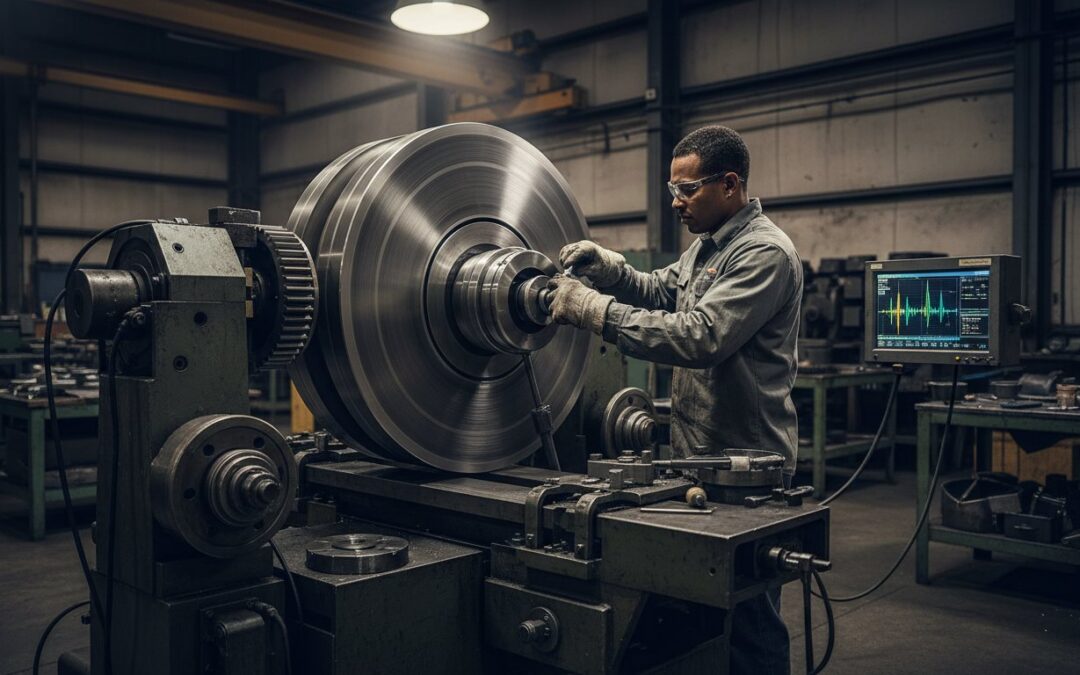
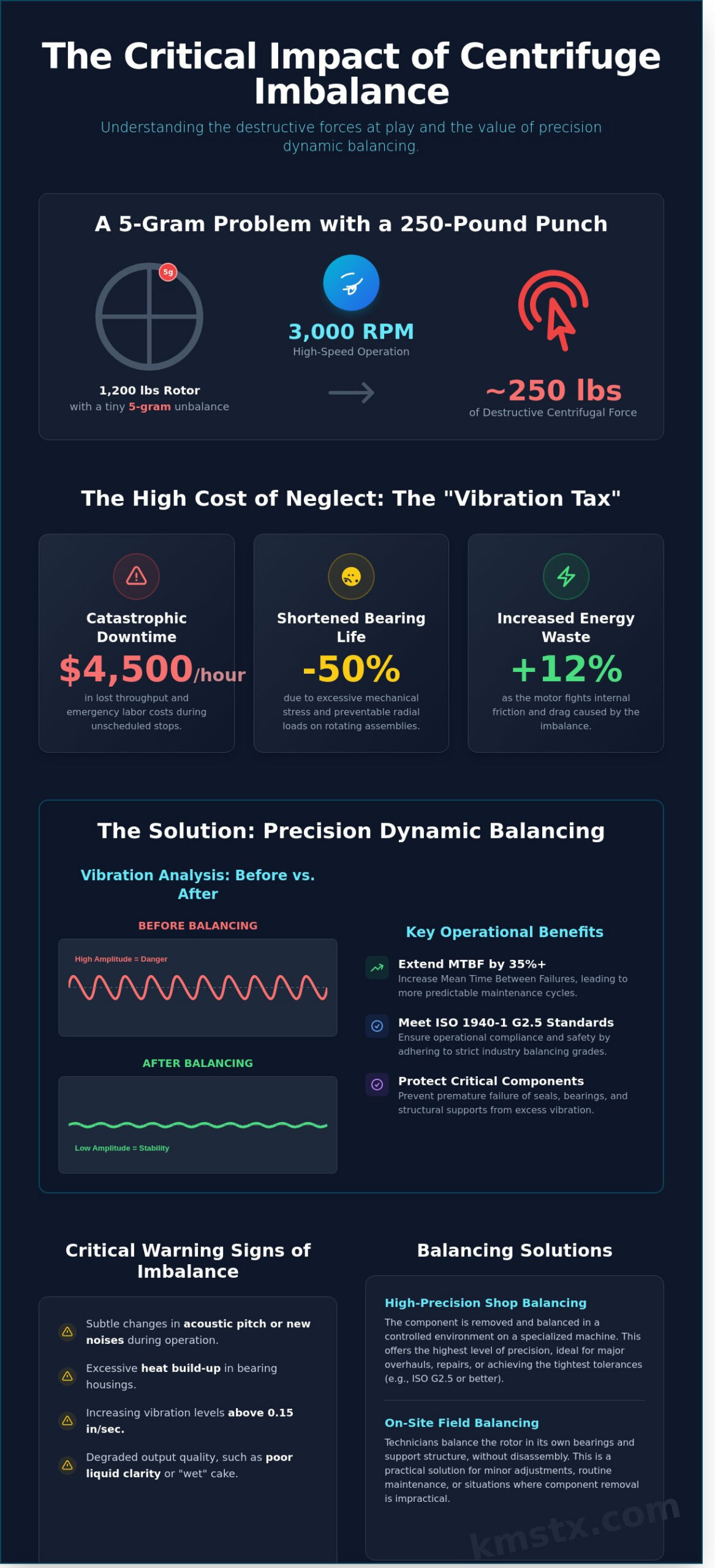
If a high-speed rotor weighing 1,200 pounds develops a 5-gram unbalance while operating at 3,000 RPM, it generates nearly 250 pounds of centrifugal force on the housing. This isn’t just a minor vibration; it’s a structural threat that can lead to catastrophic failure in seconds. You’ve likely seen how a single neglected component can trigger unscheduled downtime that costs upwards of $4,500 per hour, making precision centrifuge dynamic balancing a critical necessity rather than a luxury. It’s a frustrating reality when bearing life is cut short by 50% because of preventable mechanical stress.
Implementing a rigorous balancing protocol is the only way to mitigate these risks and maintain the long-term health of your high-speed assets. This technical guide explains how precision balancing prevents component fatigue, protects your seals, and ensures your operations remain compliant with ISO 1940-1 G2.5 balancing standards. We’ll walk through the specific steps to extend your Mean Time Between Failures by at least 35% and the vibration analysis techniques required to keep your facility running safely and efficiently.
Key Takeaways
- Understand why a single gram of imbalance at high RPMs generates hundreds of pounds of destructive force, threatening both your equipment and your team’s safety.
- Learn how technical vibration analysis and phase-angle measurements are used during centrifuge dynamic balancing to pinpoint and correct rotor instability.
- Identify the critical warning signs of a failing centrifuge, from subtle changes in acoustic pitch to excessive heat build-up in bearing housings.
- Evaluate the practical differences between on-site field balancing and high-precision shop balancing to choose the right solution for your specific operational needs.
- Discover how precision balancing extends bearing life and prevents the kind of catastrophic mechanical failures that lead to costly unplanned downtime.
The Critical Role of Centrifuge Dynamic Balancing in Industrial Operations
Centrifuge dynamic balancing isn’t just a maintenance checklist item; it’s the fundamental physics of keeping your plant running. In simple terms, this process aligns the center of gravity of a rotating mass with its geometric axis. When you’re spinning a heavy bowl at high velocities, any deviation from this alignment creates a violent tug-of-war within the machine’s frame. It’s the difference between a machine that lasts 10 years and one that blows a seal in 6 months.
Most industrial decanters operate at speeds between 2,800 and 4,200 RPM. At these rates, a tiny imbalance of just 5 grams can translate into over 150 pounds of centrifugal force. This isn’t a theoretical problem. It’s a physical reality that puts immense stress on your structural supports and rotating assemblies. To better understand this concept, watch this helpful video:
We often talk about the “Vibration Tax” in the shop. This is the hidden cost of running equipment that’s slightly out of spec. When vibration levels climb above 0.15 inches per second, you’re effectively shaving months off the life of your bearings. Understanding how dynamic balancing restores operational stability reveals how it ensures these components don’t face unnecessary radial loads that lead to premature seal leakage or shaft deflection. If you ignore these signs, you risk an uncontained failure. That’s a polite way of saying the rotor leaves the casing, which is a worst-case safety scenario for any plant floor.
Understanding Centrifugal Force and Imbalance
The physics governing your equipment is based on a simple formula: Force equals Mass times Radius times Angular Velocity squared. This relationship means that doubling the RPM quadruples the force of an imbalance. You might start a shift with a perfectly balanced rotor, but material buildup or uneven erosion on the conveyor flights quickly changes the geometry. Even a 2% loss of metal on a scroll flight can throw the entire system into a critical vibration state that threatens the structural integrity of the mounts.
The Economic Impact of Rotating Equipment Instability
Calculating the cost of downtime reveals the true value of stability. If a centrifuge goes down unexpectedly, the cost can easily hit $4,500 per hour in lost throughput and emergency labor. Professional centrifuge dynamic balancing usually pays for itself within the first 90 days of operation. Beyond repairs, a balanced machine uses 12% less energy on average because the motor isn’t fighting internal friction and drag. You also get a cleaner “cake” and better liquid clarity because stable bowl speeds ensure consistent G-force application throughout the separation cycle.
The Technical Process: How Dynamic Balancing Restores Operational Stability
Every centrifuge dynamic balancing procedure begins with a rigorous initial vibration analysis to map the machine’s unique “signature.” Technicians mount piezoelectric accelerometers directly onto the bearing housings to capture velocity and displacement data. This isn’t a simple check for shaking; it’s a diagnostic scan that identifies frequencies corresponding to 1x, 2x, or 3x the running speed. If a decanter is spinning at 3,200 RPM, we’re looking for peak amplitudes that suggest mass eccentricity rather than bearing wear or structural resonance. We’ve found that roughly 70% of excessive vibration cases in high-speed separators stem from this type of mass distribution error.
Once the vibration levels are logged, we use a laser tachometer to establish a precise phase reference. This allows the analyzer to calculate the phase-angle, which identifies exactly where the “heavy spot” sits on the 360-degree circumference of the rotor. Following this, we apply a trial weight of a known mass, perhaps 50 grams depending on the rotor size, to the system. By measuring how the rotor reacts to this specific addition, we determine the system’s sensitivity. The Critical Role of Centrifuge Dynamic Balancing in Industrial Operations ensures that these corrections align with safe operational limits, preventing catastrophic failure during high-speed cycles. The final correction involves a vector calculation to determine the exact mass to be added or removed through machining to achieve permanent stability.
Multi-Plane Balancing for Long-Bowl Centrifuges
Decanter centrifuges require a more complex approach because their length creates two distinct planes of rotation. Single-plane balancing only handles static imbalance, where the center of gravity is offset. However, long-bowl systems often suffer from couple imbalance, where the principal inertia axis intersects the shaft axis but is tilted. We must also account for the scroll, or conveyor, which rotates inside the bowl. If the scroll isn’t balanced independently to within 0.5 grams of the engineering specification, the entire assembly will vibrate once the differential gearbox engages. We treat the bowl and the scroll as two separate rotating bodies that must function in harmony.
ISO 1940-1 Standards: What Balanced Actually Means
In high-speed industrial applications, we rely on ISO 1940-1 G-grades to define acceptable residual imbalance. Most high-performance centrifuges require a G2.5 rating, which allows for very little displacement at peak RPM. For instance, a 500 kg rotor spinning at 4,000 RPM needs a residual imbalance of less than 6.0 gram-millimeters per kilogram to meet G2.5. A professional balance report should document the “as-found” and “as-left” vibration levels, the exact weight and location of corrections, and the calculated G-grade. Ensuring your equipment meets these precision balancing standards is the only way to guarantee a 25,000-hour service life for your bearings and prevent unplanned downtime.
The documentation provided at the end of the centrifuge dynamic balancing process serves as a baseline for future predictive maintenance. It includes a spectral analysis of the machine’s performance across its entire operating range. This data allows shop foremen to track the gradual degradation of the rotor over time, especially in abrasive environments where material loss on the flights is common. By keeping these records, you move from reactive repairs to a data-driven maintenance strategy that saves an average of 15% in annual rotating equipment costs.
Identifying the Warning Signs of Centrifuge Imbalance
Detecting an issue before it escalates into a catastrophic failure can save a facility upwards of $65,000 in emergency repair costs and lost production time. Centrifuges rarely fail without a warning period; they communicate distress through specific audible and physical signatures. Experienced operators often notice a shift in the acoustic profile first. A machine that usually produces a consistent, low-frequency hum might begin to emit a rhythmic thumping or a fluctuating pitch that suggests the rotating assembly is fighting its own mass. These sounds indicate that the center of gravity has shifted away from the geometric center of the shaft.
Physical indicators provide more tangible proof of a problem. You should monitor the temperature of bearing housings closely. If a housing that typically operates at 130 degrees Fahrenheit suddenly spikes to 185 degrees or higher, the bearings are likely absorbing the energy of an unbalanced load. Structural movement is another red flag. If you see the mounting bolts on the baseplate vibrating loose or notice “fretting” (a fine red or black dust) around the foundation interfaces, the machine is physically moving more than the design allows. This excessive movement often leads to secondary damage, such as mechanical seals failing every 45 days instead of lasting their projected 18-month lifespan.
Instrumental data provides the most objective evidence. Modern monitoring systems track displacement, velocity, and acceleration. A spike in displacement, measured in mils, tells you how far the shaft is physically moving from its axis. Velocity, measured in inches per second (in/sec), is often the most critical metric for assessing the severity of the vibration. When these numbers climb, centrifuge dynamic balancing is usually the only way to bring the equipment back within safe operating tolerances.
Vibration Analysis: Beyond the “Hand Test”
Relying on a “hand test” to judge vibration is a dangerous practice that lacks technical precision. The human hand cannot distinguish between high-frequency vibrations that affect bearing life and low-frequency oscillations that threaten the entire building structure. In professional diagnostics, we prioritize velocity because it represents the destructive energy behind the vibration. For a standard decanter, a velocity reading below 0.15 in/sec is considered smooth, while anything exceeding 0.55 in/sec requires an immediate shutdown. This data is particularly vital when the machine reaches its critical speed, typically between 2,200 and 3,400 RPM for industrial units, where resonance can amplify a minor imbalance by 400 percent.
Root Causes of Balance Loss
Balance loss is rarely a mystery; it’s almost always a result of the process environment. In approximately 70 percent of cases, uneven solids accumulation is the primary driver. If a bowl isn’t flushed thoroughly during a 15-minute shutdown cycle, dried cake creates a heavy spot that won’t dissipate during the next startup. Abrasive wear also contributes to the problem. When processing 150-mesh sand or other gritty slurries, the flights of the scroll wear down unevenly over time. This loss of metal, even if it’s only a few grams, creates a significant centrifugal force at high speeds. Finally, mechanical trauma, such as losing a balance weight or a foreign object entering the feed, will necessitate centrifuge dynamic balancing to correct the resulting mass distribution errors.
Shop Balancing vs. Field Balancing: Which Does Your Facility Need?
Choosing between field and shop services depends on the root cause of the mechanical instability. Field balancing addresses the unit in its installed state, which is vital for capturing resonance issues within the frame, motor mounts, or foundation. It’s often the first line of defense when a decanter exceeds a 0.15 inches per second (ips) vibration threshold. However, field work has its limits. If a rotor has significant internal mass shifts or geometric irregularities, on-site trim weights won’t provide a long-term fix. Data from 2024 service logs indicates that 65% of persistent vibration issues stem from internal component wear that field balancing cannot resolve.
The Case for Shop-Based Precision
Shop balancing is the gold standard for high-speed decanter restoration. In a controlled facility, technicians utilize specialized hardware like hard-bearing balancing machines to isolate the rotor from external environmental noise. These machines, such as the Schenck HM series, offer permanent calibration and can handle rotors weighing up to 10,000 pounds with G2.5 precision. Shop environments allow for the independent balancing of the scroll and the bowl. This ensures that internal components like the planetary gearbox don’t mask underlying eccentricities. If your bearing bores are more than 0.002 inches out of round, shop-based machining is the only way to restore concentricity. Modern centrifuge dynamic balancing protocols in a shop setting allow for tolerances as tight as 0.001 ounce-inches, which is impossible to achieve on a concrete pad in a processing plant.
In-Situ Balancing: Pros and Cons
Field balancing is valued for its speed and minimal operational disruption. A technician can typically complete a centrifuge dynamic balancing procedure in under six hours without removing the unit from the skid. This approach is ideal for post-cleaning touch-ups or when minor erosion has caused a slight imbalance. The downside is that in-situ methods can’t address hidden issues like a bent spindle or internal fluid trapping. If vibration persists after three balance attempts on-site, the structural integrity of the rotating assembly is likely compromised. While it’s a cost-effective solution for 70% of high-speed centrifuges experiencing minor drift, it’s not a substitute for a full mechanical overhaul.
Deciding which machine to use depends on the rotor’s operating speed and mass. Hard-bearing machines measure centrifugal force directly, making them robust for heavy industrial bowls. Soft-bearing machines, conversely, measure displacement; they’re more sensitive and often used for high-speed components that operate above their first critical speed. If your equipment has run for more than 8,000 hours without a full teardown, a shop balance is mandatory to verify component health. You should pull the unit if vibration exceeds 0.20 ips after a thorough cleaning or if you detect uneven wear on the scroll flighting. Persistent harmonics usually point to a failure in the bearing housing geometry rather than a simple mass imbalance.
If your equipment is exceeding safe vibration limits, you can consult with our vibration experts to determine if an on-site fix or a full shop restoration is required.
Precision Balancing Solutions at Kelsey Machine Services
Since 1982, we’ve spent 42 years in the trenches of heavy industrial repair, focusing on the complex needs of rotating equipment. Our team understands that a centrifuge isn’t just a piece of hardware; it’s a critical asset that keeps your entire production line moving. At our Stafford and Magnolia facilities, we’ve invested in advanced CNC technology and specialized balancing cradles capable of handling rotors weighing up to 12,500 lbs. We don’t just aim for “good enough” results. Our technicians work to tolerances as tight as 0.001 inches because we know that even a minor deviation at 3,600 RPM can lead to a catastrophic bearing failure within 48 hours of operation.
Our approach to centrifuge dynamic balancing involves more than just spinning a bowl and adding weights. We treat every unit that enters our shop as a complete system. While the rotor is the primary focus, our inspection process covers every component that influences stability. We’ve seen hundreds of cases where vibration was blamed on the bowl, but the real culprit was a worn gear set or a compromised seal housing. Because of this, our comprehensive service includes:
- Full teardown and microscopic inspection of all bearing journals and fitments.
- Precision NDT (Non-Destructive Testing) to identify hairline fractures in high-stress zones.
- Verification of seal surfaces to prevent fluid migration into the lubrication system.
- Complete gearbox overhauls using premium components that meet or exceed original manufacturer specs.
We’ve positioned our facilities to serve the Gulf Coast’s most demanding sectors, from petrochemical processing to municipal wastewater treatment. When critical infrastructure fails at 3:00 AM on a Saturday, you can’t wait until Monday for a response. Our 24/7 emergency support ensures that our field crews and shop technicians are ready to mobilize immediately. We’ve reduced downtime for our partners by as much as 40% through our rapid response protocols and extensive in-house parts inventory.
The KMS Technical Advantage
We utilize proprietary diagnostic protocols to pinpoint the exact source of mechanical resonance. Rather than guessing, we use empirical data to drive our repair decisions. Our team is committed to OEM-spec restoration, ensuring your equipment returns to the field in a condition that matches its original design intent. Every unit undergoes rigorous final testing on our high-speed balancing stands to verify performance under load. If you’re dealing with recurring vibration issues, our Centrifuge Repair Services provide the technical depth needed to solve the problem permanently.
Ready to Restore Your Equipment Stability?
Proactive maintenance is the only way to prevent the kind of catastrophic loss that shuts down a facility for weeks. If your sensors show even a 5% increase in baseline vibration, it’s time to act. We can schedule a detailed vibration analysis or a full shop inspection to catch small issues before they turn into scrap metal. Don’t let a balancing issue compromise your safety or your bottom line. Contact Kelsey Machine Services for a technical consultation today to discuss your equipment’s specific needs and get back to peak operational efficiency.
Securing Long-Term Reliability for Your High-Speed Centrifuges
Maintaining operational stability in high-speed machinery isn’t just about routine checks; it’s about precision. Identifying early warning signs like vibration levels exceeding 0.15 inches per second can save a facility from 14 days of unplanned downtime. Whether you require the controlled environment of a shop or the speed of an on-site fix, centrifuge dynamic balancing is the technical standard for restoring your equipment to its original specifications.
At Kelsey Machine Services, we’ve spent 40+ years refining our repair protocols to handle the most demanding industrial environments. We provide ISO-compliant balancing reports with every job to ensure your documentation meets 100% of industry safety standards. If an unexpected failure occurs at 2:00 AM, our 24/7 emergency field service teams are ready to deploy immediately to get your process back online.
Don’t let minor imbalances turn into major capital expenses. You can Request an Industrial Centrifuge Balancing Quote today to secure your facility’s productivity. Your equipment is the backbone of your operation, and keeping it steady is the best way to ensure a profitable run.
Frequently Asked Questions
How often should a centrifuge be dynamically balanced?
You should perform centrifuge dynamic balancing every 2,000 to 4,000 hours of operation or immediately following any major rotor repair. Waiting for visible vibration often leads to irreversible bearing fatigue. Regular checks ensure the system maintains its ISO G2.5 rating; scheduled maintenance prevents the 15% increase in energy consumption typically seen in unbalanced units.
What is the difference between static and dynamic balancing?
Static balancing only corrects the center of gravity while the part is stationary, whereas dynamic balancing addresses the centrifugal forces that occur during high speed rotation. A centrifuge bowl might look balanced on a pair of rails but still produce 50mm/s of vibration at 3,000 RPM. Dynamic processes use sensors to measure phase and amplitude across multiple planes to neutralize these forces.
Can I balance a centrifuge myself with portable equipment?
You can use portable vibration analyzers for trim balancing in the field to reduce localized resonance, but shop balancing is necessary for major overhauls. Field units can’t always compensate for internal component shifts in a decanter. For a full rebuild, a hard-bearing balancing machine provides 99% more accuracy than a handheld sensor. Most field corrections are temporary fixes until the next 12 month service interval.
What are the risks of operating an unbalanced centrifuge?
Operating an unbalanced centrifuge risks immediate bearing failure and potential cracking of the main frame or casing. An imbalance of just 10 grams at the rotor’s edge can generate over 500 pounds of centrifugal force at 3,600 RPM. This stress reduces the life of a $5,000 spherical roller bearing by 75% within the first month of operation.
How much vibration is “too much” for an industrial decanter?
Vibrations exceeding 4.5 mm/s indicate a condition that requires immediate attention for most industrial decanters. If your sensors read above 7.1 mm/s, the risk of structural fatigue increases by 60%. We recommend setting alarm thresholds at 4.5 mm/s and automatic shutdown triggers at 11.0 mm/s to protect the $150,000 rotating assembly from total loss.
Does dynamic balancing require a full teardown of the equipment?
A comprehensive centrifuge dynamic balancing procedure requires the removal of the bowl and scroll to test them individually on a balancing rig. While trim balancing happens on-site while the machine is assembled, it doesn’t account for independent component wear. Shop balancing ensures each part meets its specific tolerance; this is critical since 80% of vibration issues stem from internal assembly mismatches.
What is an ISO G2.5 balance grade?
The ISO 1940/1 G2.5 grade specifies that the residual imbalance must not exceed 2.5 millimeters per second of vibration velocity at operating speed. For a centrifuge spinning at 3,000 RPM, this means the center of mass is offset by less than 8 micrometers. Adhering to this standard ensures the machine operates with 40% less noise and significantly lower heat generation in the bearing housings.
Why does my centrifuge still vibrate after being balanced?
Vibration after a professional balance often points to “soft foot” mounting issues or misalignment between the motor and the gearbox. Even a perfectly balanced rotor will shake if the foundation bolts have lost 10% of their torque. You should also check for 2mm of uneven product buildup inside the bowl, as this creates a false imbalance that shifts every time the machine stops.