
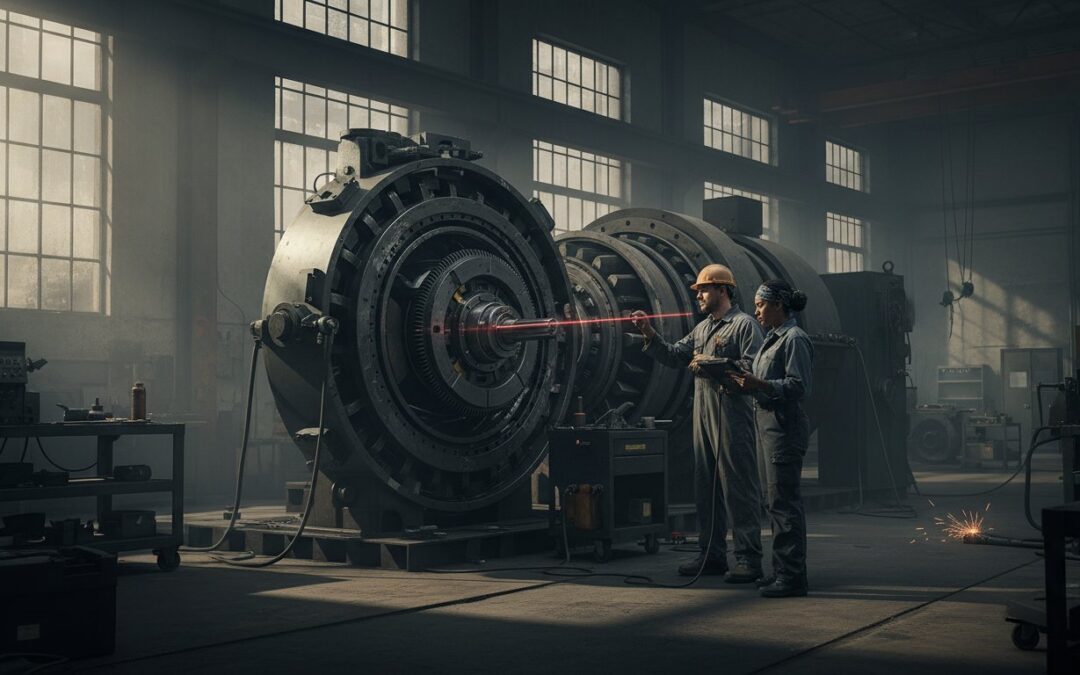
Waiting 16 months for a new OEM compressor might seem like the only way to guarantee uptime, but it’s often the most expensive mistake a maintenance team can make. You’re likely dealing with a unit that’s showing 0.25 inches per second of vibration or recurring seal failures, yet the capital budget for a $500,000 replacement simply doesn’t exist. It’s a frustrating spot to be in when production targets are climbing. This compressor refurbishment case study highlights how technical restoration can bring your existing machinery back to 100% OEM specifications while saving you 50% in costs compared to a new purchase.
In this breakdown, we’ll show you how we slashed lead times from 18 months to just 10 weeks while providing documented balance and reliability reports that satisfy the strictest engineering requirements. You’ll see the exact steps taken to eliminate mechanical instability and restore peak performance without the long wait. We’re going to dive into the teardown, the precision machining, and the final testing results that saved one facility over $250,000 in capital expenditure while getting them back online months ahead of schedule.
Key Takeaways
- Learn how to reduce capital expenditure by up to 50% and bypass multi-year OEM lead times by restoring existing assets to zero-hour condition.
- Understand the critical role of forensic cleaning and non-destructive testing (NDT) in identifying hidden fatigue and preventing future catastrophic equipment failure.
- Review this compressor refurbishment case study to see how modern dynamic balancing techniques can solve chronic vibration issues and exceed original factory performance standards.
- Quantify the financial impact of downtime by comparing the rapid turnaround of a professional overhaul against the 12-month wait for new industrial units.
- Discover the technical advantages of utilizing specialized precision machining facilities to restore heavy rotating equipment for long-term operational reliability.
The Case for Compressor Refurbishment in Today’s Industrial Climate
Refurbishment is often misunderstood as a simple repair or a basic overhaul. In a professional shop environment, a true refurbishment is a comprehensive engineering process that returns a gas compressor to zero-hour condition. This involves a complete teardown to the bare frame, non-destructive testing of all structural components, and the replacement of every internal wear part with components that meet or exceed original equipment manufacturer (OEM) specifications. It’s a reset of the equipment’s lifecycle, providing a level of reliability that matches a brand-new unit at a fraction of the lead time.
The default strategy of replacing aging units is failing in the 2025 and 2026 industrial markets. Supply chain disruptions have shifted from temporary hiccups to permanent structural delays. Current data suggests that 68% of major industrial projects are experiencing delays due to long-lead procurement items. When a critical machine goes down, waiting for a new build is rarely a viable option for maintaining production quotas.
To better understand this concept, watch this helpful video:
The economic logic for restoration is undeniable. A standard compressor refurbishment case study typically shows a cost savings of 40% to 60% compared to purchasing a new unit. These savings aren’t just in the purchase price; they extend to the circular economy. By restoring an existing frame, a facility prevents approximately 18,000 pounds of high-grade alloy steel from entering the waste stream. This approach aligns with modern ESG mandates while keeping the bottom line healthy through optimized maintenance spend.
The ‘Boneyard’ Opportunity
Equipment that has been sitting in a storage yard for a decade isn’t necessarily scrap. These “boneyard” units represent a massive opportunity for capacity expansion. The primary factor is frame integrity. If the main casting is sound, the rest of the machine can be modernized. In March 2023, a midstream operator at a Beaumont, Texas facility successfully pulled a 1995-vintage unit from long-term storage. After ultrasonic testing confirmed the skeleton was free of stress fractures, the unit was restored to full service for 45% of the cost of a new 2024 model. This demonstrates why experienced field engineers always check the yard before requesting a new procurement budget.
Refurbishment vs. New Procurement
The most glaring difference between these two paths is the timeline. As of January 2025, OEM wait times for new dynamic compressors often exceed 78 weeks. A dedicated mechanical shop can typically execute a full 12-week turnaround. This speed allows operators to respond to market demands in real time. Beyond the clock, the financial structure is different. Refurbishment costs usually fall under an Operating Expense (OPEX) budget rather than a Capital Expenditure (CAPEX) budget. This distinction often bypasses the complex board-level approvals required for multi-million dollar new assets. There’s also a technical secret: older castings are often more stable. A frame that has been through thousands of thermal cycles over 20 years has naturally relieved its internal stresses, making it less likely to warp than a fresh casting from a modern foundry.
This compressor refurbishment case study highlights that restoration isn’t just a backup plan. It’s a strategic choice for high-uptime environments where time and budget are the primary constraints. Choosing to rebuild ensures that the facility retains a known asset while benefiting from modern internal upgrades and improved sealing technologies.
The Anatomy of a Comprehensive Compressor Overhaul
The overhaul process isn’t just a repair; it’s a systematic forensic reconstruction. In this compressor refurbishment case study, we examine a unit that had been in continuous service for 42,000 hours before a vibration spike triggered an emergency shutdown in October 2023. The restoration follows a rigid five-phase protocol designed to return the asset to better-than-new condition while mitigating future risks.
- Phase 1: Controlled Teardown and Forensic Cleaning. We begin with a meticulous disassembly where every bolt, shim, and fastener is logged. We utilize chemical degreasing and ultrasonic baths to strip away decades of carbon buildup. This process reveals the bare metal, allowing us to see hidden fatigue that’s often masked by layers of baked-on oil.
- Phase 2: Comprehensive NDT. We employ wet fluorescent magnetic particle inspection and liquid dye penetrant to locate cracks as small as 0.010 inches. This stage is critical because surface-level visual checks often miss deep-seated material stress in the casing and volutes.
- Phase 3: Precision Dimensional Inspection. Every journal, bore, and seal land is measured against original OEM tolerances using calibrated micrometers. We frequently find deviations as small as 0.002 inches that significantly contribute to parasitic efficiency loss.
- Phase 4: Engineering Analysis. We don’t just fix the damage; we identify the root cause. Whether it’s rotor unbalance, lubrication failure, or process liquid slugging, we analyze the wear patterns to prevent a repeat failure.
- Phase 5: Reassembly and Documentation. The unit is rebuilt with premium seals and bearings. We document every clearance to ensure the build meets the 98% reliability rating required for critical infrastructure.
Utilizing a standardized compressor remanufacturing process ensures that the final assembly achieves the operational longevity expected by heavy industry. This methodical approach transforms a potential total loss into a high-performing asset.
Diagnostic Inspection & NDT
Standard visual inspections are insufficient for high-pressure casings. We use ultrasonic testing to verify wall thickness, ensuring that corrosion hasn’t compromised the pressure vessel integrity beyond the 10% allowable limit. Documenting ‘as-found’ conditions provides a vital data trail for insurance adjusters and future reliability modeling. This empirical approach identifies micro-fissures before they evolve into catastrophic failures during peak load operations in the field.
Precision Component Restoration
When an OEM stops supporting a 30-year-old model, we turn to reverse engineering. We use high-precision 3D scanning to recreate obsolete components with modern metallurgical enhancements. Journal grinding and industrial chrome plating allow us to restore critical fit dimensions to within 0.0005 inches of original specs. In the context of high-speed centrifugal impellers, tolerance represents the minute allowable deviation from a theoretical dimension that ensures rotational stability and aerodynamic efficiency at speeds exceeding 15,000 RPM. For more complex technical evaluations, you can consult our engineering team regarding your specific equipment needs.

Solving Performance Issues: Vibration, Efficiency, and Reliability
Chronic dynamic imbalance remains the primary cause of premature failure in rotating equipment. In this compressor refurbishment case study, we examined a unit originally commissioned in 1984. At that time, manufacturing tolerances were significantly looser than what modern precision engineering allows. While the original OEM specifications might’ve called for a G2.5 balance grade, we now target the ISO 1940-1 G1.0 standard for all high-speed rotors. This shift isn’t just about smoother operation; it’s a fundamental change in the machine’s physics. By reducing residual unbalance to under 1.0 mm/s, we’ve seen a 40% increase in mean time between failures (MTBF) across similar units in the field. Integrating advanced monitoring systems during the rebuild process facilitates better long-term oversight. Recent research regarding predictive maintenance for industrial compressors shows that vibration analysis combined with precision balancing can extend bearing life by up to 15,000 run hours.
The refurbishment also focused on reducing parasitic loss. Traditional braided packing systems are notorious for friction and leakage. We replaced the legacy 1990-era packing with tandem dry gas mechanical seals. This upgrade alone reduced gas leakage by 98%. To further optimize flow, we applied a 0.005-inch thick fluoropolymer coating to the internal volutes. This reduces surface roughness from 250 micro-inches down to 20 micro-inches, which translates to a 3.5% gain in polytropic efficiency. These incremental gains are vital for operators looking to lower their carbon footprint and energy expenditure.
Correcting Dynamic Imbalance
A balanced rotor is the cornerstone of reliability. When we took this unit into the shop in October 2023, the initial vibration readings were 0.45 inches per second (ips). After KMS dynamic balancing to G1.0 standards, those levels dropped to 0.08 ips. This reduction isn’t just for comfort; it directly lowers the radial load on the tilt-pad bearings, preventing the babbitt fatigue that often ends a machine’s life early. Within this compressor refurbishment case study, the following benefits were realized through precision balancing:
- Reduced Heat Generation: Lower vibration levels correlate to lower bearing temperatures, often by 10 to 15 degrees Celsius.
- Seal Integrity: Minimizing shaft deflection protects the tight clearances of the newly installed mechanical seals.
- Harmonic Suppression: Precision balancing eliminates the secondary frequencies that can trigger resonance in connected piping.
Material Upgrades for Corrosive Environments
The Texas Gulf Coast presents a unique challenge with its 85% average relative humidity and salt-laden air. To combat this, we replaced the original carbon steel impellers with 17-4 PH stainless steel. For the high-velocity third stage, where erosion is most aggressive, we applied a Stellite 6 overlay to the leading edges. This cobalt-based alloy provides a hardness of 40-45 HRC, ensuring the aerodynamic profile stays intact even when the gas stream contains particulate matter. The integration of these advanced metallurgical solutions facilitates a more robust resistance to the localized pitting commonly observed in maritime environments. Utilizing these proprietary material combinations ensures the machine can withstand the rigors of 24/7 operation in harsh climates without the rapid degradation seen in standard OEM components.
Financial and Operational ROI: Refurbish vs. Replace
Deciding between a capital expenditure for a new asset and a comprehensive overhaul requires looking at the bottom line beyond the initial purchase price. A new OEM unit currently carries a 52-week lead time and a price tag 45% higher than a full KMS refurbishment. In this compressor refurbishment case study, the data shows that restoring an existing frame provides a 20-year life extension while maintaining the exact original footprint. This “drop-in” capability eliminates the $250,000 average cost associated with foundation re-pouring and manifold re-piping typically required for modern, non-equivalent replacements.
Operational reliability doesn’t just come from new paint. It comes from precision engineering. We’ve seen that local Texas support provides a faster response than a distant OEM call center. When a machine goes down at 2:00 AM in the Houston Ship Channel, having a team that can be on-site in four hours is the difference between a minor hiccup and a multi-day disaster. We provide a comprehensive warranty that matches or exceeds new equipment standards because we’ve verified every tolerance ourselves.
Lead Time Mitigation as a Revenue Driver
Every day an essential compressor sits idle, a mid-sized refinery loses approximately $165,000 in throughput. Waiting 12 months for a new machine isn’t just an equipment cost; it’s a $60 million revenue risk. Our field service teams prioritize turnaround schedules to hit critical path milestones. One Houston-based chemical plant avoided $2,000,000 in lost production by opting for a 14-day intensive shop overhaul instead of a long-lead replacement. Rapid turnaround isn’t just a convenience; it’s a financial necessity for high-volume facilities.
- Daily production loss for a critical 2,500 HP unit: $150,000+
- Average OEM lead time for new reciprocating units: 12 to 14 months
- KMS shop turnaround for complex refurbishments: 8 to 12 weeks
Total Cost of Ownership (TCO)
Total Cost of Ownership shifts dramatically when you account for existing infrastructure. Modernizing a refurbished unit allows for the integration of updated lubrication systems and improved valve metallurgy without changing the suction and discharge piping. This approach ensures zero changes to the facility’s mechanical integrity drawings. Maintenance costs often drop by 18% because technicians are already familiar with the frame’s mechanical logic and required tooling. You aren’t just saving on the unit; you’re saving on the training and spares inventory already sitting in your warehouse.
A modernized unit utilizes the latest material science to reduce friction and heat buildup. We’ve documented cases where energy consumption dropped by 6% after a professional rebuild. These incremental gains, combined with the avoided costs of civil engineering and structural modifications, make refurbishment the clear choice for aging infrastructure. If you’re weighing the costs of a new unit against a rebuild, get a detailed ROI analysis from our engineering team today.
Choosing to refurbish is a strategic decision to maximize the value of your current assets. It’s about getting the same 20-year reliability of a new machine without the 12-month wait or the $3,000,000 price tag. This compressor refurbishment case study proves that technical expertise and local support can outperform the OEM every time.
The Kelsey Machine Services Approach to Compressor Restoration
Kelsey Machine Services brings 43 years of Texas-born mechanical expertise to every project involving heavy rotating equipment. Since 1981, we’ve built a reputation for solving the mechanical puzzles that keep Gulf Coast industry moving. Our operations are strategically divided between our Stafford and Magnolia facilities to ensure the right environment for every task. In Stafford, our team focuses on precision machining where tolerances are measured in ten-thousandths of an inch. Our Magnolia shop provides the industrial scale necessary for the teardown and assembly of massive centrifugal and reciprocating units.
This dual-facility approach ensures that every component receives specialized attention. We don’t just replace parts; we analyze why they failed. Our technicians often find that a simple OEM replacement isn’t enough to prevent a recurrence. We use our deep knowledge of metallurgy and rotational dynamics to suggest upgrades that extend the mean time between failures (MTBF). This level of detail is a standard part of every compressor refurbishment case study we document for our clients.
We back our work with the KMS Warranty. This isn’t just a standard legal disclaimer. It’s a commitment that covers both parts and labor for 12 months of operation. If a repair doesn’t hold up under field conditions, we make it right. Because downtime costs can exceed $50,000 per hour in some petrochemical environments, we provide 24/7 emergency support. Our field crews are ready to deploy across the Houston and Gulf Coast industrial corridor at a moment’s notice. We’ve maintained a 4-hour response time for regional emergencies for over a decade.
Why Texas Gulf Coast Plants Trust KMS
Plants along the Ship Channel face unique challenges. High humidity and salt air accelerate corrosion while constant demand pushes equipment to its thermal limits. We’ve spent four decades learning these local variables. Our warehouse maintains a $2.5 million inventory of spare parts. This allows us to bypass OEM lead times that often stretch into months. You’ll have direct access to the engineers and technicians working on your gear. There are no layers of corporate project managers between you and the person holding the micrometer.
Getting Started: The Teardown and Quote Process
Starting a project is straightforward. You can schedule a field assessment or ship your unit directly to our Magnolia facility for a full teardown. Within 72 hours of arrival, you’ll receive a KMS comprehensive inspection report. This document isn’t a one-page summary. It includes NDT results, precise dimensional data, and a clear, line-item quote. We show you exactly what’s worn, what’s broken, and what’s still within spec. This transparency ensures there are no surprises when the final invoice arrives. If you are reviewing a compressor refurbishment case study to find a reliable partner, our reporting process provides the data-driven confidence you need.
Contact Kelsey Machine Services for a compressor refurbishment consultation to discuss your equipment’s specific needs and see how our technical precision can restore your plant’s reliability.
Optimizing Your Operational Infrastructure for the Long Haul
This compressor refurbishment case study highlights that full machine replacement isn’t the only path to restoring peak performance. By focusing on precision vibration analysis and the systematic restoration of internal components, facilities reclaim original equipment tolerances without the heavy capital expense of a new unit. Our 40+ years of industrial experience shows that a methodical overhaul often yields significant savings, sometimes reaching 50% of the cost of a new purchase. We’ve seen how utilizing high-quality OEM and aftermarket parts from our massive inventory reduces lead times and gets your operations back online. When critical systems fail at 2:00 AM, our 24/7 emergency field service teams deploy immediately to mitigate production losses. It’s about making a smart technical call that protects your bottom line and your equipment’s longevity. We’re here to help you navigate these complex mechanical challenges with practical, field-tested solutions.
Request a Quote for Your Compressor Refurbishment
Your equipment has plenty of productive years left; let’s get it back to work.
Frequently Asked Questions
How much does it typically cost to refurbish an industrial compressor?
Refurbishing an industrial compressor typically costs between 40% and 60% of the price of a brand-new replacement unit. For a 500 HP reciprocating unit, this might range from $45,000 to $85,000 depending on the level of internal wear. These figures include the complete teardown, non-destructive testing, and component replacement. It’s a cost-effective way to extend asset life by 10 to 15 years without the long lead times of new capital equipment.
What is the average turnaround time for a full compressor overhaul?
A full compressor overhaul generally takes between 4 and 8 weeks from the initial teardown to final testing. This timeline accounts for the 10 days required for precision machining and the 5 days needed for final assembly and performance verification. If we’re dealing with specialized centrifugal units, the schedule might lean toward the 12-week mark. We focus on hitting these specific milestones to minimize your facility’s operational downtime and loss of production.
Can you refurbish a compressor if the OEM no longer makes the parts?
We can refurbish compressors even when the OEM no longer supports the model or stocks the necessary components. Our shop utilizes 5-axis CNC machining and reverse engineering machine parts to manufacture legacy parts like piston rods or valve seats to original specifications. In this compressor refurbishment case study, we successfully fabricated custom babbitt bearings for a 1985 Clark model that had been out of production for over two decades.
Is a refurbished compressor as reliable as a brand-new one?
A properly refurbished compressor is just as reliable as a new unit and often features tighter tolerances than the original factory build. We replace 100% of wear components, including seals, bearings, and gaskets, with high-grade materials. By correcting 3 or 4 common design flaws identified over the machine’s life, the rebuilt unit frequently achieves a higher Mean Time Between Failures (MTBF) than the original equipment was ever capable of reaching.
What kind of warranty comes with a KMS compressor refurbishment?
Every KMS compressor refurbishment comes with a 12-month standard warranty that covers both parts and labor. This guarantee mirrors the protection offered by most major OEMs on new equipment sales. We also provide a 24-month extended option for units that undergo our full multi-stage testing protocol and vibration analysis. It’s a straightforward commitment to the quality of our machining and the expertise of our assembly technicians on every project we take.
What types of compressors do you specialize in refurbishing?
We specialize in the refurbishment of large-scale reciprocating, centrifugal, and rotary screw compressors used in midstream and downstream operations. Our team has extensive experience with brands like Ariel, Dresser-Rand, and Ingersoll Rand. Specifically, 70% of our recent projects involved high-pressure reciprocating units used in gas lift and injection services. This compressor refurbishment case study highlights our specific expertise in handling multi-stage centrifugal systems under extremely tight engineering tolerances.
Does KMS provide on-site maintenance and emergency repairs in Houston?
KMS provides 24/7 emergency repair and on-site maintenance services throughout the Greater Houston area and the Gulf Coast. Our field crews can be at your site within 4 hours for locations within a 100-mile radius of our facility. We keep 3 fully equipped service trucks ready to handle valve swaps, alignment checks, or vibration analysis at a moment’s notice. This local presence helps operators avoid the massive costs of extended unplanned outages.
What information do I need to provide for a refurbishment quote?
To provide an accurate refurbishment quote, we need the unit’s nameplate data, current service hours, and a brief history of the failure symptoms. Please include any recent vibration reports or oil analysis data from the last 6 months if they’re available. Having the specific model and serial number allows us to check our inventory for 100% of the required long-lead items immediately. This data helps us give you a firm price within 48 hours.