

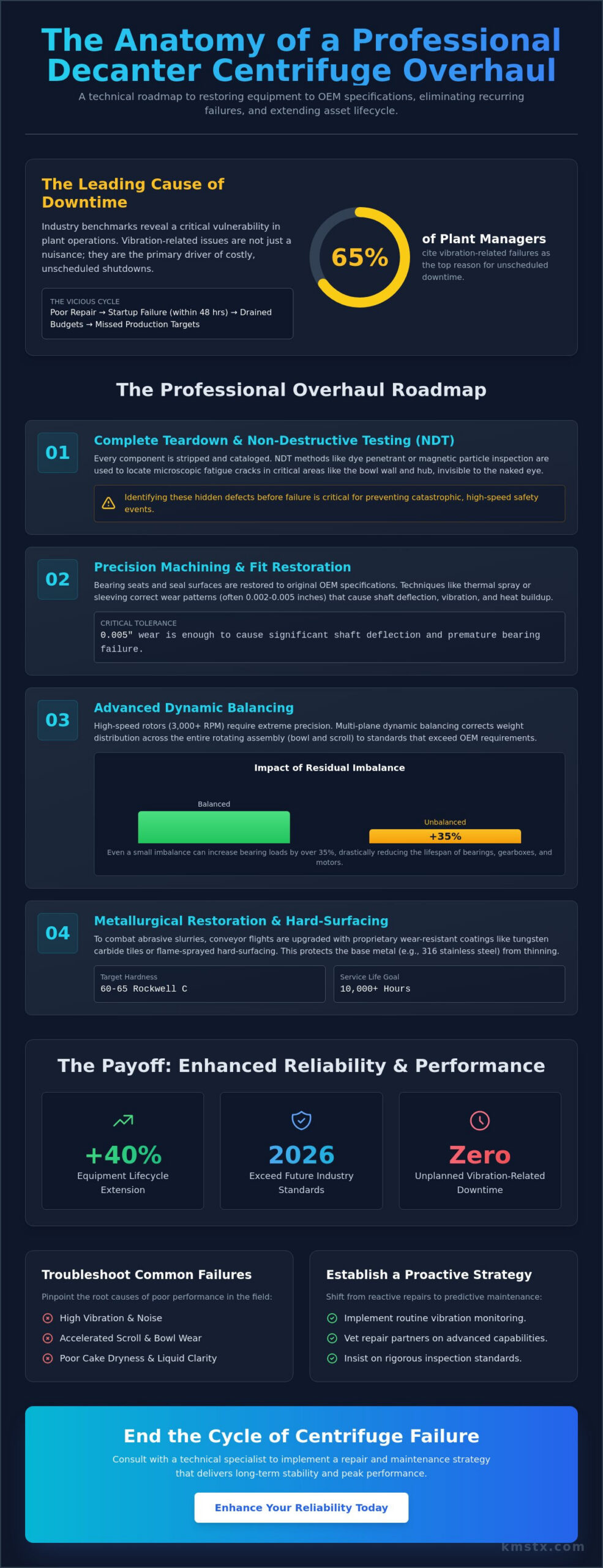
According to 2024 industrial maintenance benchmarks, nearly 65% of plant managers cite vibration-related failures as the leading cause of unscheduled downtime. You’ve likely dealt with the frustration of a centrifuge returning from a shop only to shake itself apart within 48 hours of startup. This cycle of poor-quality decanter centrifuge repair and maintenance drains your budget and kills your production targets. We know that waiting 12 weeks for an OEM response isn’t a viable strategy when your operations are on the line.
This technical guide provides a roadmap for restoring your equipment to original OEM specifications while implementing advanced 2026-standard dynamic balancing to ensure long-term stability. You’ll learn how to extend your equipment’s lifecycle by up to 40% using precision machining and certified field service protocols. We’ll walk through the specific steps required to eliminate recurring mechanical issues and keep your plant running without the constant threat of failure. From addressing scroll wear to implementing proprietary balancing techniques, we’re covering the engineering realities of industrial reliability.
Key Takeaways
- Understand how non-destructive testing and precision machining identify hidden fatigue and restore critical bearing fits to original OEM specifications.
- Establish a proactive strategy for decanter centrifuge repair and maintenance by using vibration monitoring as a predictive diagnostic tool to prevent unplanned downtime.
- Learn to troubleshoot common field failures by pinpointing the root causes of high vibration, scroll wear, and poor cake dryness.
- Discover how to vet a repair partner by looking beyond basic mechanical service for advanced shop capabilities and rigorous inspection standards.
The Role of Decanter Centrifuges in Modern Industrial Operations
Decanter centrifuges serve as the mechanical backbone for continuous solid-liquid separation in environments where downtime isn’t an option. As we move through 2026, industry standards have shifted toward demanding G-forces exceeding 3,000 x g and mechanical tolerances that are 15% tighter than those seen in the previous decade. These machines are essential in wastewater treatment, chemical processing, and oil-field solids control, where they facilitate the recovery of valuable products and the efficient management of waste streams. Success in these sectors relies on a deep understanding of the Decanter centrifuge operating principle to maintain process equilibrium.
Consistent decanter centrifuge repair and maintenance is no longer just a line item in a budget; it’s a strategy for economic survival. When a centrifuge operates at peak efficiency, it maximizes cake dryness and liquid clarity, directly reducing the costs associated with hauling waste or re-processing fluids. In high-volume chemical plants, even a 2% drop in separation efficiency can result in significant revenue loss over a fiscal quarter.
To better understand the practical side of keeping these machines running, watch this helpful video:
The Technical Anatomy of a Professional Centrifuge Overhaul
A professional overhaul is a rigorous engineering process that goes far beyond a basic “clean and inspect” routine. It starts with a complete teardown where every component is stripped and cataloged. Technicians perform non-destructive testing (NDT), such as dye penetrant or magnetic particle inspection, to locate microscopic fatigue cracks in the bowl wall or hub. At operating speeds often exceeding 3,000 RPM, these hidden defects represent significant safety risks. Effective decanter centrifuge repair and maintenance requires identifying these flaws before they lead to catastrophic mechanical failure.
Precision machining is the next critical phase. Bearing seats and seal surfaces frequently show wear patterns of 0.002 to 0.005 inches after heavy service. This might seem negligible, but it’s enough to cause shaft deflection and heat buildup. Machine shops must restore these fits to original OEM specifications, often using thermal spray or sleeving techniques to ensure a perfect interference fit. Reassembly protocols then dictate exact torque values and alignment checks to ensure the rotating assembly remains stable under load.
Precision Dynamic Balancing: The Core of Reliability
High-speed rotors demand extreme precision to survive 24/7 industrial cycles. Utilizing professional dynamic balancing services Houston is a mandatory step for both the bowl and the scroll. Technicians use multi-plane balancing to correct weight distribution across the entire length of the rotating assembly. If you leave even a small residual imbalance, it can increase bearing loads by more than 35%. This vibration doesn’t just annoy the operators; it actively eats away at the lifespan of your gearbox and drive motors.
Metallurgical Restoration and Hard-Surfacing
Abrasive slurries act like liquid sandpaper on the internal components of a centrifuge. During a rebuild, the base metal integrity of the conveyor flights is evaluated to ensure the 316 stainless steel or duplex alloy hasn’t thinned beyond safety limits. We apply proprietary wear-resistant coatings, such as tungsten carbide tiles or flame-sprayed hard-surfacing, to the leading edges. The goal is to achieve a hardness of 60 to 65 Rockwell C while maintaining enough ductility to prevent the material from chipping under impact. Proper decanter centrifuge repair and maintenance isn’t just about fixing what’s broken; it’s about upgrading the machine to handle the next 10,000 hours of service.
If your equipment is showing signs of increased vibration or decreased cake dryness, it’s time to evaluate your rotating assets. You can consult with a technical specialist to review your current wear patterns and vibration data before the next scheduled outage.
Strategic Maintenance Frameworks: Extending Asset Lifecycle
Decanter centrifuge repair and maintenance shouldn’t follow a generic template. A machine running 24/7 in a municipal wastewater plant faces different stressors than one handling abrasive mining tailings with a density exceeding 1.6 g/cm³. You need a schedule built on actual run hours and specific material characteristics. Most high-utilization plants find that a major inspection every 4,000 to 8,000 hours prevents catastrophic bearing failure and unexpected housing wear.
Vibration monitoring serves as your primary diagnostic tool. By tracking velocity and acceleration trends, you can identify unbalance or misalignment before the machine trips. It’s about data, not just reaction. Similarly, lubrication management requires more than a grease gun. It involves volume control and frequency based on thermal loads. Over-greasing causes as much heat-related damage as under-greasing. We see the best results when centrifuge care is part of a total rotating equipment maintenance strategy. This holistic approach ensures every motor, pump, and centrifuge in the train receives consistent oversight.
Preventive vs. Predictive Maintenance Models
Predictive models use tools like oil analysis to find microscopic metal fragments. This signals internal wear in gearboxes or main bearings months before a failure occurs. Statistics show that predictive maintenance can reduce maintenance costs by 25% compared to reactive “run-to-fail” approaches. Don’t wait for a high-vibration alarm. If the oil analysis shows rising copper or iron levels, pull the machine for a shop inspection. The ROI is clear; a scheduled $15,000 bearing swap is significantly cheaper than a $100,000 emergency rebuild after a high-speed wreck.
Managing Spare Parts and Critical Inventories
You can’t fix what you don’t have in stock. Long-lead items like planetary gearboxes or tungsten carbide tiles often take 12 to 24 weeks for delivery. Smart operators keep a “critical spares” kit on-site. Using a comprehensive procurement guide helps you decide between OEM and high-quality aftermarket parts. While OEM parts offer a guaranteed fit, some aftermarket components now use superior hardening processes that extend tile life by 15% in abrasive environments. Effective decanter centrifuge repair and maintenance relies on having these parts ready before the shutdown begins.
- Main Bearings: Keep one full set of matched bearings in climate-controlled storage.
- Seal Kits: Rubber components degrade over time; rotate this stock every 24 months.
- Conveyor Tiles: Maintain enough tiles for a full re-tile to avoid 3-month lead times.
Troubleshooting Common Decanter Failures in the Field
Field diagnostics for high-speed rotating equipment require a blend of vibration data and process observation. When a machine starts acting up, the first step is separating mechanical faults from process-induced stress. Effective decanter centrifuge repair and maintenance depends on identifying whether a failure is a symptom of internal wear or a result of upstream inconsistencies. You can’t just throw parts at a problem; you have to understand the physics of the bowl and scroll relationship.
Vibration Analysis and Diagnostics
Mechanical imbalance usually points to uneven erosion on the scroll or a lost tungsten carbide tile. If the vibration remains constant regardless of the feed rate, you’re likely looking at a mechanical issue. Check for a “soft foot” where the skid isn’t making full contact with the foundation. This creates a twisting force on the frame that mimics bearing failure. Structural resonance is different. It occurs when the machine’s operating frequency matches the natural frequency of the support structure. If a sudden bearing seizure or catastrophic imbalance occurs, securing emergency machine repair is vital to prevent secondary damage to the gearbox and motor mounts.
Process Optimization for Mechanical Longevity
Mechanical failures often start in the feed pipe. Constant fluctuations in feed rate or solids concentration create erratic torque loads on the planetary gearbox. These spikes can shorten gear life by as much as 40% compared to a steady-state operation. You also need to watch your polymer dosing. Improper chemistry leads to poor flocculation, causing the scroll to “slip” through the solids. This abrasive scrubbing wears down the conveyor flights much faster than a properly formed cake. To balance throughput with component life, you must optimize the differential speed. A delta n that’s too high increases wear, while one that’s too low risks plugging the bowl.
When you see poor cake dryness, check the scroll-to-bowl clearance. If the gap between the scroll flight and the bowl wall exceeds 1.5mm, the machine loses its ability to squeeze and push solids effectively. Conversely, if your centrate clarity is dropping, your weir plates might be set too low. Increasing the pool depth provides the residence time needed for fine particles to settle before the liquid overflows. Monitoring these variables is the cornerstone of decanter centrifuge repair and maintenance for any high-volume facility.
Motor overload is another common field issue that often gets misdiagnosed as an electrical fault. Before you pull the motor, check for these mechanical culprits:
- Solids accumulation: Dried cake buildup between the bowl and the casing creates massive friction.
- Gearbox drag: Worn internal bearings or contaminated oil increases the torque required to maintain differential speed.
- Feed spikes: A sudden 10% increase in solids concentration can exceed the motor’s rated amperage and trip the drive.
Selecting a Repair Partner: Beyond Basic Mechanical Service
Selecting a repair partner is a high-stakes decision for any plant manager. You’re not just looking for a mechanic with a crane; you’re looking for an engineering firm that understands rotational dynamics at speeds exceeding 3,000 RPM. A qualified shop must possess heavy-lift capabilities and dynamic balancing equipment that meets ISO 1940/1 G2.5 standards. Documentation acts as the backbone of this process. If a service provider doesn’t deliver a comprehensive inspection report detailing run-outs, bearing fits, and NDT results for scroll erosion, the repair lacks the necessary technical foundation.
KMS Technologies approaches industrial centrifuge repair with scientific rigor. We analyze the metallurgy and the physics of the separation process rather than just replacing parts. This ensures that every component functions within a tight tolerance window to prevent premature fatigue. Our service agreements prioritize post-repair support, including vibration monitoring and periodic inspections to catch wear before it leads to a catastrophic failure.
The KMS Technical Restoration Process
Our “Better than OEM” philosophy addresses the reality that factory designs often contain inherent weaknesses. We use custom machining to reinforce high-wear zones and optimize scroll geometry for improved solids conveyance. In a 2023 case study, we restored a mission-critical decanter for a Gulf Coast processing facility in under 72 hours. By utilizing our in-house engineering team and proprietary balancing protocols, we eliminated a chronic vibration issue that the original manufacturer failed to resolve during the initial setup.
Commitment to Industrial Reliability
Reliability is built on 40 years of rotating equipment history. It’s not enough to fix the machine; the team must ensure it stays operational under peak loads. Our field service experts facilitate on-site troubleshooting and startup to verify that the centrifuge integrates perfectly with your existing control systems. Before any asset leaves our facility, it undergoes a final 25-point checklist. This protocol ensures your decanter centrifuge repair and maintenance investment results in a machine ready for another 10,000 hours of continuous service. We don’t guess at tolerances; we measure them to the thousandth of an inch to guarantee long-term stability.
Protecting Your Industrial Separation Assets
Keeping high-speed separation equipment online requires a shift from reactive fixes toward a structured technical framework. We’ve seen how disciplined overhauls can extend a machine’s service life by 15 years or more when handled with precision. It’s not just about the mechanical parts; it’s about the data gathered through NDT testing and dynamic balancing that prevents future failures. Relying on a proven strategy ensures your facility avoids the high costs of unplanned downtime during peak production cycles.
KMS Technologies leverages 40+ years of rotating equipment expertise to deliver high-tier decanter centrifuge repair and maintenance. Our team provides 24/7 emergency field service response to keep your operations moving when things get tough. We don’t just fix parts; we focus on technical accuracy and real-world results to help you meet your operational goals. Consult with our centrifuge repair experts at KMS Technologies today to build a more resilient operation. Your equipment is the backbone of your process, and it deserves the highest standard of care.
Frequently Asked Questions
How often should a decanter centrifuge be pulled for a full inspection?
You should pull a decanter centrifuge for a full inspection every 12 to 18 months to prevent catastrophic mechanical failure. While daily monitoring catches immediate issues, a deep dive into the rotating assembly is necessary after 8,000 hours of operation. This schedule allows technicians to check for erosion on the scroll flights and assess the integrity of the tungsten carbide tiles before they wear down to the base metal.
What are the most common causes of excessive vibration in industrial centrifuges?
Excessive vibration is typically caused by uneven solids accumulation in the bowl or significant wear in the main bearings. If 50 grams of material sticks to one side of a high speed bowl, the centrifugal force at 3,000 RPM creates a massive imbalance. Proper decanter centrifuge repair and maintenance protocols require checking these mechanical tolerances regularly to keep vibration levels below 0.2 inches per second. Loose foundation bolts or a bent conveyor shaft also contribute to these stability issues.
Can a decanter centrifuge be repaired on-site, or must it go to a shop?
Minor repairs happen on-site, but major overhauls require a specialized shop environment. You can’t perform high speed dynamic balancing or precision machining in a field setting. Most facilities send units out when tolerances exceed 0.002 inches or when the bowl requires a 100 percent weld penetration repair that needs a controlled heat treatment. Field service is usually limited to seal replacements, gearbox oil changes, and basic belt tensioning.
What is the typical turnaround time for a full centrifuge overhaul?
A standard turnaround for a full overhaul ranges from 14 to 21 days depending on the availability of replacement parts. This timeline includes the initial teardown, sandblasting, NDT testing, and the final 4 hour test run. If the conveyor needs extensive hardfacing or the gearbox requires custom gears, the process can extend to 30 days. Scheduling your service during a planned plant shutdown is the best way to manage this window effectively.
How does dynamic balancing improve the lifespan of centrifuge bearings?
Dynamic balancing reduces the radial load on bearings by ensuring the center of mass aligns perfectly with the axis of rotation. When a bowl is balanced to a G2.5 ISO rating, it eliminates the parasitic forces that cause heat buildup and premature fatigue. This precision work can extend bearing life by 40 percent compared to an unbalanced unit. It’s a critical step in decanter centrifuge repair and maintenance that prevents the outer race from spinning in the housing.
Is it possible to upgrade an older centrifuge to modern wear-resistance standards?
You can upgrade units from the 1990s by replacing old flame-sprayed coatings with modern tungsten carbide tiles or sintered ceramic inserts. These materials offer 10 times the abrasion resistance of standard hardfacing. Technicians also install updated PLC controls and VFD drives to give older machines the same process precision as 2026 models. These retrofits often cost 60 percent less than purchasing a brand new machine while providing similar performance benchmarks.
What documentation should I expect from a professional repair facility?
You should receive a comprehensive data package that includes initial “as-found” measurements and final “as-left” specifications. This report must contain dye penetrant or magnetic particle inspection results for the bowl and hubs. Expect to see a certified balance report showing the final vibration levels and a 24 point checklist covering torque settings and clearance measurements. This paper trail is vital for your ISO compliance and future maintenance planning.
How do I know if my centrifuge gearbox is failing?
A failing gearbox usually signals trouble through a 15 degree rise in operating temperature or an increase in audible whining. Check the magnetic drain plug during your weekly inspection; if you see silver flakes or “fur,” the internal planetary gears are shedding metal. Excessive backlash in the input shaft is another red flag. Don’t ignore these signs, as a seized gearbox can cause the conveyor to crash into the bowl and double your repair costs.