

In 2026, a single industrial compressor failure can cost a manufacturing facility over $260,000 per hour in lost productivity and operational disruptions. It’s often recognized that persistent pressure exists to maintain peak isentropic efficiency as mandated by 10 CFR 431.345 while simultaneously avoiding the high capital expenditure of premature overhauls. Effectively diagnosing compressor performance issues requires a rigorous methodology that isolates intrinsic volumetric efficiency from external parasitic losses across the compressed air system.
A clear diagnostic path is facilitated through this guide to identify root causes of degradation before they manifest as catastrophic failures. Empirical data and field-proven strategies are utilized to validate the necessity of professional repair and optimize the longevity of critical rotating assets. By adhering to updated standards like ISO 8573-1:2024 and leveraging advanced diagnostic software, engineers can transition from reactive maintenance to a state of high-fidelity reliability. The following analysis explores the empirical frameworks necessary to isolate mechanical wear from system-wide inefficiencies, ensuring that every overhaul is a data-driven decision rather than a speculative response to fluctuating pressure gradients.
Key Takeaways
- It’s essential to recognize why the inability to maintain rated flow and pressure represents a more significant operational risk than a complete mechanical shutdown.
- The relationship between Compression Ratio and re-expansion volume is examined to facilitate the isolation of volumetric efficiency losses within the compression cycle.
- Methodologies are established to differentiate between high amperage draw caused by electrical anomalies and mechanical resistance originating from bearing drag or rotor imbalance.
- Standardized field protocols, including pump-down tests and load-profile comparisons, are integrated into the workflow for diagnosing compressor performance issues.
- The “teardown and inspect” process is detailed to validate when a professional overhaul is required to restore rotating equipment to proprietary OEM specifications.
Identifying the Warning Signs of Industrial Compressor Degradation
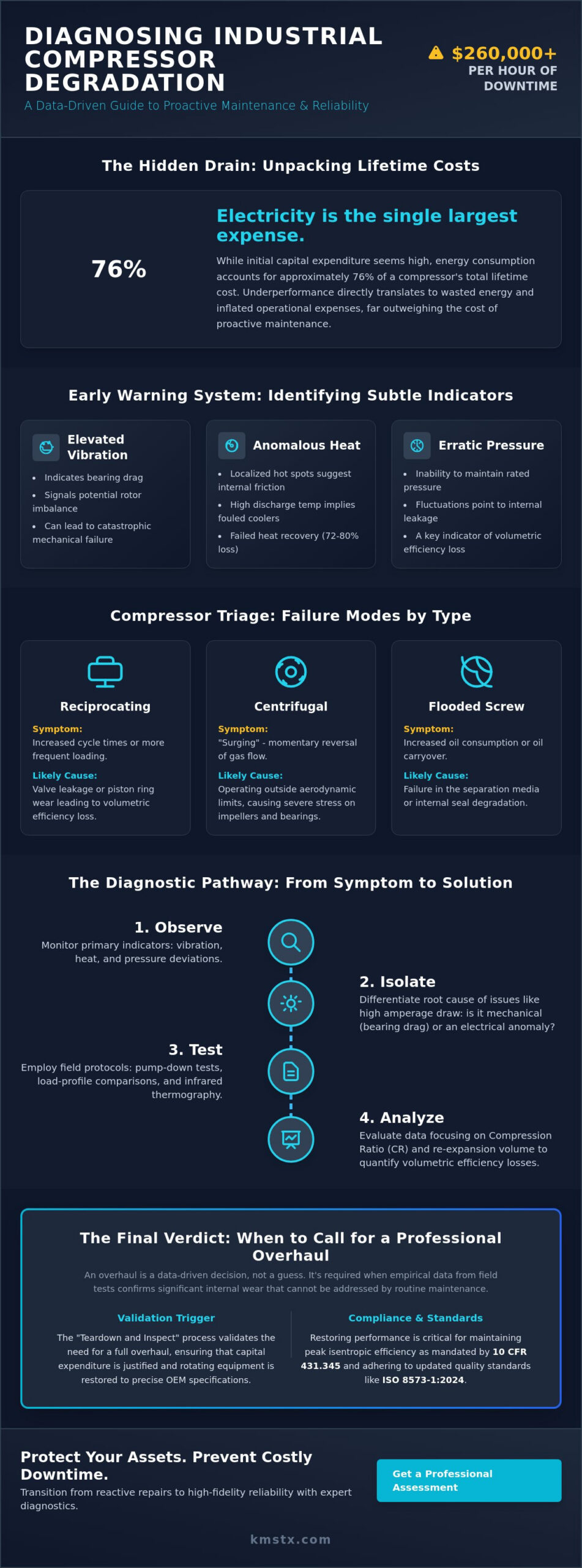
Industrial compressor performance is defined as the empirical ability of a unit to sustain a specific volumetric flow rate and discharge pressure while operating at its rated rotational velocity. While a catastrophic mechanical seizure provides an immediate signal for intervention, the condition of a unit that’s “running but underperforming” often represents a more insidious threat to operational margins. This state of degradation results in a direct increase in energy consumption, which is critical considering that electricity accounts for 76% of a compressor’s total lifetime cost. Effective protocols for diagnosing compressor performance issues must begin with a rigorous assessment of these deviations from the established baseline to prevent downtime that can exceed $260,000 per hour.
To visualize these diagnostic principles in a field setting, this technical overview provides a practical framework:
Primary indicators of system decline include elevated vibration levels, anomalous heat signatures, and erratic discharge pressure fluctuations. These variables are highly sensitive to ambient conditions. A 10 degree rise in inlet air temperature can significantly reduce mass flow, potentially masking or mimicking internal mechanical wear. Understanding the specific mechanical principles of various types of industrial compressors is necessary to interpret how these fluctuations manifest within different architectures. For instance, a drop in pressure in a rotary screw unit suggests different failure modes than a similar drop in a centrifugal unit, where aerodynamic limits play a larger role.
The Subtle Indicators of Capacity Loss
In reciprocating units, engineers should monitor for increased cycle times or more frequent loading phases, which typically indicate a loss of volumetric efficiency due to valve leakage or piston ring wear. Centrifugal systems might exhibit “surging,” a phenomenon where the gas flow reverses direction momentarily, causing severe mechanical stress on the impellers and bearings. For flooded screw compressors, an increase in oil consumption or carryover into the downstream air treatment system often signals a failure in the separation media or internal seal degradation. These subtle shifts often precede the mandatory isentropic efficiency levels required by 10 CFR 431.345.
Thermal Signatures and Heat Rejection
Infrared thermography is utilized to identify internal bypass events or valve leakages that aren’t visible to the naked eye. If an intercooler or aftercooler is fouled, the resulting high discharge temperatures will decrease air density and overall system efficiency. Localized hot spots on the compressor casing often indicate internal friction or a breakdown in the lubrication film. When heat recovery systems fail to recapture the 72-80% of thermal energy they’re designed for, it’s a clear sign that the internal thermodynamic cycle is compromised. Identifying these thermal anomalies early facilitates a proactive repair strategy rather than a reactive overhaul.
The Mechanics of Performance Loss: Valves, Seals, and Ratios
The fundamental efficiency of any industrial compression stage is governed by its Compression Ratio (CR). While basic diagnostics often define CR as the quotient of absolute discharge pressure over absolute suction pressure, this calculation fails to account for the dynamic volumetric losses inherent in degraded machinery. Diagnosing compressor performance issues necessitates an understanding of how internal wear, such as increased clearance in reciprocating cylinders or widened tolerances in screw rotors, creates a parasitic bypass that skews the expected CR. In reciprocating architectures, the re-expansion volume, which is the high-pressure gas trapped in the clearance pocket at the end of a stroke, must expand below the suction pressure before new gas can enter. If discharge valves are compromised, this re-expansion phase is artificially extended, which drastically reduces the effective stroke and total mass flow.
Lubrication quality serves as the primary safeguard for maintaining these critical mechanical tolerances. A breakdown in the hydrodynamic film leads to boundary lubrication conditions, where metal-on-metal contact increases friction and generates localized heat. This thermal expansion further reduces clearances, potentially leading to a self-reinforcing cycle of wear that compromises internal seals. While mechanical analysis is paramount, a systematic electrical diagnosis should be performed in parallel to ensure the motor isn’t overcompensating for increased mechanical drag caused by these lubrication failures. When internal components show signs of such advanced wear, a professional compressor repair service is required to restore the unit to its original design specifications.
Valve Integrity and Pressure Drop
Leaking discharge valves are often identified through pressure rise tests, where the rate of pressure equalization is monitored after a controlled shutdown. Valve plate flutter, frequently caused by entrained debris or incorrect spring tension, leads to micro-fractures and eventual fatigue failure. It’s also observed that suction valve unloader issues can mimic a total compressor failure by preventing the cylinder from drawing in a full charge, which artificially lowers the discharge pressure regardless of the motor’s RPM.
Seal Failure and Internal Recirculation
In centrifugal compressors, labyrinth seals are utilized to minimize gas leakage between stages without requiring physical contact. However, particulate erosion can widen these clearances, allowing high-pressure gas to recirculate back to the impeller eye, which significantly increases the power required for the same net output. For reciprocating units, blow-by past the piston rings allows gas to escape into the crankcase, which not only destroys the compression cycle but also risks contaminating the oil supply with process gases. Identifying these internal recirculation paths is critical for maintaining the isentropic efficiency levels required by 10 CFR 431.345.
Mechanical vs. Electrical: Isolating the Root Cause
The differentiation between electromagnetic anomalies and mechanical resistance represents a critical juncture in diagnosing compressor performance issues. High amperage draw is frequently misidentified as an inherent motor failure; yet in industrial environments, this symptom often serves as a proxy for mechanical drag. When radial or axial loads exceed design tolerances due to bearing degradation or lubricant film failure, the motor is forced to utilize additional torque to maintain rated RPM. This increased load is reflected in the electrical signature. Precision in motor-to-compressor alignment is equally vital. Even minor angular misalignments can introduce parasitic forces that degrade isentropic efficiency and increase energy waste. A comprehensive approach to rotating equipment maintenance ensures that these mechanical stressors are mitigated before they manifest as irreversible electrical failures.
When High Amps Don’t Mean a Bad Motor
Mechanical binding or the presence of liquid slugging within the compression chamber creates an instantaneous electrical overload that can trip protective relays. It’s established that a 10% reduction in supply voltage necessitates a proportional increase in current to maintain the required work output, which facilitates premature thermal degradation of the stator windings. To isolate the root cause, vibration spectra are analyzed to identify specific frequencies associated with mechanical imbalance rather than electrical line frequency harmonics. This empirical data allows engineers to confirm if the asset requires electrical service or mechanical intervention, preventing unnecessary motor replacements that don’t address the underlying mechanical friction.
Dynamic Balance and Rotating Stability
High-speed industrial compressors, particularly centrifugal and screw architectures, are susceptible to exponential performance losses when mass distribution is asymmetrical. It’s documented that mass imbalances as minute as 5 grams can generate centrifugal forces that exponentially accelerate seal wear and bearing fatigue at high operational velocities. Utilizing precision dynamic balancing services Houston is essential for maintaining the operational stability of assets that rotate at 3,600 RPM or higher. Excessive shaft runout, often a byproduct of imbalance, destroys the integrity of labyrinth and mechanical seals, which results in the internal recirculation and bypass issues that destroy volumetric efficiency. Restoring dynamic stability is a prerequisite for achieving the longevity expected of high-capital rotating assets in the energy sector.
Practical Field Tests for Verifying Compressor Health
The 30% misdiagnosis rate frequently cited in industrial maintenance reports stems from a failure to differentiate between internal component degradation and external system demand. Effectively diagnosing compressor performance issues requires a transition from qualitative observation to empirical field testing. Establishing a “pump-down” test serves as a foundational diagnostic for reciprocating and rotary screw units. By isolating the compressor from the primary distribution header and timing the interval required to pressurize a known receiver volume from a static state to a set discharge pressure, engineers can calculate the actual delivered CFM. This value is then compared against the original factory specifications to quantify volumetric loss and determine if the unit still meets the isentropic efficiency levels required by 10 CFR 431.345.
Electrical load profiling provides another layer of mechanical insight. A “no-load” amperage reading that exceeds 40% of the full-load nameplate rating often indicates excessive internal friction, such as bearing drag or rotor contact. Conversely, a unit that reaches full-load amperage but fails to maintain system pressure likely suffers from suction throttling or internal bypass. Verifying the integrity of inlet filtration is paramount; even a minor restriction at the suction inlet can cause a significant drop in mass flow. Additionally, checking discharge check valves for backflow during the off-cycle prevents the “ghost” demand that forces unnecessary cycling and premature wear. If your facility requires precise validation of these metrics, our team provides comprehensive compressor repair and diagnostic services to restore peak efficiency.
The Volumetric Efficiency Calculation
Volumetric efficiency is defined as the ratio of the actual volume of gas delivered to the theoretical displacement of the compressor. While “time to pressure” provides a reliable baseline for longitudinal performance tracking, the utilization of ultrasonic mass flow meters facilitates the most precise industrial diagnostics. These tools allow for the real-time measurement of gas velocity and density, providing the empirical data necessary to justify a technical overhaul. Establishing these baselines ensures that any deviation in performance is caught before it leads to a failure costing $260,000 per hour in downtime.
System-Side “Ghosts” to Rule Out
It’s estimated that leaks in compressed air systems waste 20-30% of a compressor’s output, often mimicking the symptoms of a failing pump. Before condemning a rotating asset, ultrasonic leak detection tuned to 40 kHz should be utilized to audit the downstream piping. Faulty control sensors on VFD-driven compressors can also provide erroneous feedback, causing the system to ramp down despite high demand. Finally, verify that mechanical unloaders are fully disengaging; a partially engaged unloader will bleed high-pressure air back to the suction side, destroying the pressure gradient and increasing thermal load on the cylinders.
Professional Restoration: When to Call for a Technical Overhaul
Once the empirical data gathered during the process of diagnosing compressor performance issues confirms that volumetric efficiency has fallen below critical thresholds, a formal technical overhaul is necessitated. This restoration begins with a comprehensive “teardown and inspect” protocol, where each rotating and stationary component is subjected to rigorous dimensional metrology and non-destructive testing (NDT). The objective is to identify deviations from original equipment manufacturer (OEM) specifications that contribute to parasitic losses. Because industrial compressors are frequently integrated into complex power trains, successful restoration often requires specialized industrial gearbox repair Houston to ensure that the entire mechanical assembly operates with synchronized precision. For legacy assets where OEM support has been discontinued, custom machining is utilized to fabricate proprietary components that meet or exceed modern metallurgical standards.
The Refurbishment vs. Replacement Debate
The decision to refurbish rather than replace high-value industrial assets is driven by a rigorous analysis of Return on Investment (ROI). A professional technical overhaul can extend the operational life of a compressor by an additional 15 to 20 years, often for less than 50% of the capital expenditure required for new equipment procurement. During this process, opportunities for system optimization are facilitated through the integration of advanced labyrinth seals and high-precision bearings that were perhaps not available at the time of the unit’s original manufacture. This ensures that the restored asset delivers warranted performance that aligns with contemporary energy efficiency mandates, such as the minimum isentropic levels stipulated by 10 CFR 431.345.
Kelsey Machine Services: Industrial Expertise
With a technical heritage spanning over 40 years, Kelsey Machine Services provides the geoscientific and mechanical expertise required to manage the complexities of heavy rotating equipment. The ability to minimize Mean Time to Repair (MTTR) is supported by an extensive industrial machine spare parts Texas inventory, which allows for the rapid replacement of critical components without the delays associated with international supply chains. Our 24/7 emergency response capabilities are specifically structured to support critical infrastructure across the energy sector. For organizations facing sudden capacity loss or mechanical instability, our team offers specialized emergency machine repair Gulf Coast to restore operational reliability and mitigate the financial impact of unplanned downtime.
Strategic Reliability and the Path to Peak Performance
Maintaining industrial reliability requires a transition from reactive observation to a data-driven diagnostic framework. It’s established that isolating internal component wear from external system demand is essential for accurate troubleshooting. By utilizing empirical protocols like pump-down tests and load profiling, engineers can quantify losses in isentropic efficiency before they escalate into failures costing $260,000 per hour in downtime. Effectively diagnosing compressor performance issues ensures that capital expenditures for technical overhauls are justified by measurable data rather than speculative responses to pressure fluctuations.
When field diagnostics reveal advanced degradation, the restoration of these critical assets must be performed to proprietary OEM tolerances. Kelsey Machine Services leverages over 4 decades of expertise in heavy rotating equipment to facilitate high-fidelity repairs. Our full-service machine shop provides precision restoration of valves, seals, and rotors; our 24/7 emergency response ensures that critical infrastructure is restored with minimal delay. Don’t leave your facility’s output to chance. Request an Expert Compressor Diagnostic from Kelsey Machine Services to secure your long-term operational stability. Precision is the foundation of reliability.
Frequently Asked Questions
How can I tell if my compressor is “weak” or if there is a system leak?
Differentiation between a degraded compressor and a distribution leak is achieved through a controlled pump-down test. If the unit reaches its rated pressure within the calculated theoretical interval but system pressure decays rapidly during off-cycles, a downstream leak is indicated. It’s documented that leaks in industrial piping waste 20% to 30% of total compressor output, which often mimics the symptoms of mechanical capacity loss.
What are the most common causes of industrial compressor overheating?
Thermal anomalies typically originate from fouled intercoolers or internal gas recirculation caused by valve bypass. When discharge valves fail to seal, high-pressure gas is re-compressed, which leads to a cumulative heat gain that exceeds the system’s heat rejection capacity. This is critical because modern heat recovery systems are designed to recapture 72% to 80% of thermal energy; any deviation indicates a breakdown in the thermodynamic cycle.
Does high vibration always indicate a bearing failure in a compressor?
High vibration levels don’t exclusively signal bearing degradation. Spectra analysis reveals that approximately 40% of vibration issues in high-speed rotating assets are caused by rotor imbalance or angular misalignment. While bearing wear produces specific high-frequency signatures, a fundamental mass imbalance can generate destructive centrifugal forces that destroy seals and bearings long before they reach their calculated L10 life.
How often should I perform a volumetric efficiency test on my units?
Semi-annual testing is recommended to facilitate compliance with 10 CFR 431.345 efficiency standards. Establishing a performance baseline every 8,000 operational hours allows for the early identification of internal wear. This proactive approach is essential for diagnosing compressor performance issues before they manifest as a catastrophic failure that costs over $260,000 per hour in unplanned downtime.
Can a bad check valve cause my compressor to fail on startup?
A compromised discharge check valve allows high-pressure gas to migrate back into the compression chamber after shutdown. This creates excessive starting torque that often exceeds the motor’s locked-rotor amperage, which results in an immediate electrical trip. Ensuring the check valve maintains a bubble-tight seal is a prerequisite for reliable unloaded starting in both reciprocating and screw architectures.
What is the “compression ratio” and why does it matter for diagnostics?
Compression ratio is the quotient of absolute discharge pressure over absolute suction pressure. It’s a vital metric for identifying volumetric efficiency losses. An elevated ratio often indicates restricted suction filtration or excessive discharge resistance. Each unit has a design ratio limit; exceeding this threshold increases the re-expansion volume in reciprocating cylinders, which drastically reduces the mass flow of the system.
Is it worth repairing an industrial compressor that is over 20 years old?
Restoration of legacy equipment is the optimal financial strategy when the cost of refurbishment is less than 50% of the capital expenditure required for new procurement. Precision overhauls can extend the asset’s operational life by an additional 15 to 20 years. These technical restorations often integrate modern seal and bearing technologies that weren’t available during the unit’s original manufacture in 2006.
How does dynamic balancing improve the performance of a centrifugal compressor?
Dynamic balancing eliminates the asymmetrical mass distribution that causes exponential mechanical stress at high rotational velocities. This process is utilized to minimize shaft runout, which is a prerequisite for maintaining the integrity of labyrinth seals. By reducing the radial loads on the bearing assembly, dynamic balancing facilitates a more stable oil film and prevents the internal recirculation that destroys isentropic efficiency.