
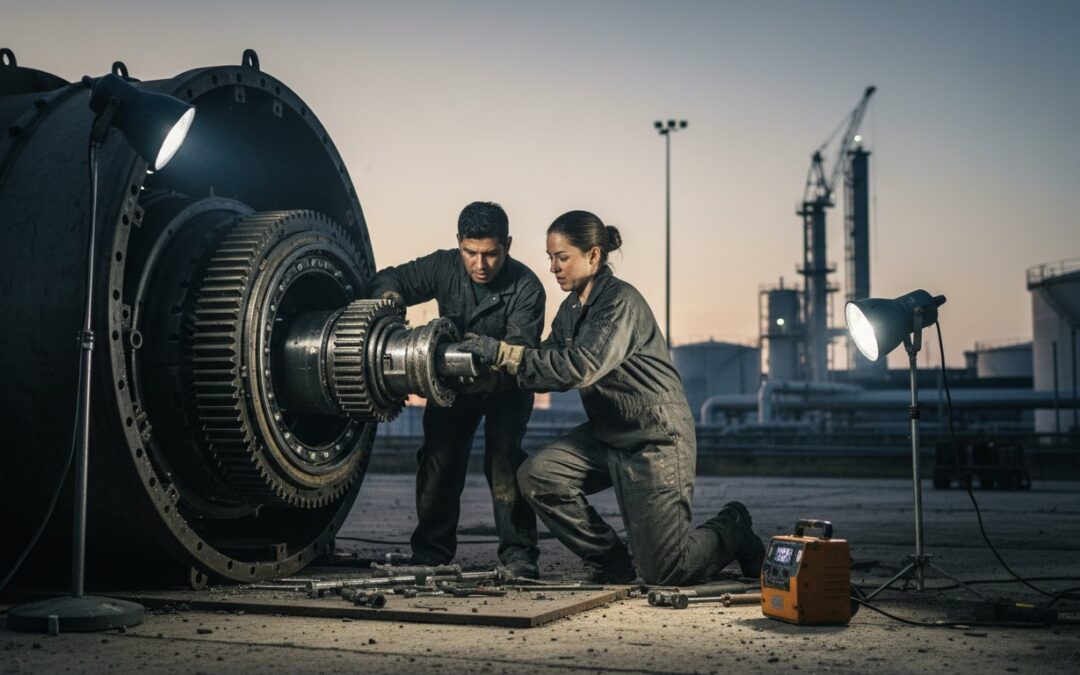
At 3:15 AM on a Tuesday, a high-speed centrifuge in a Houston ship channel facility hits a critical vibration threshold, triggering an automated shutdown that costs the operation $12,400 every hour it sits idle. You’ve likely stood on that shop floor, watching the clock and knowing that every minute of delay compounds the risk to your production targets and your team’s safety. When these catastrophic failures occur, the search for emergency industrial repair Houston often leads to generalists who lack the specialized knowledge required for high-speed rotating equipment. It’s a frustrating reality that the wrong technician can turn a three-day fix into a three-week nightmare.
We understand that you need more than just a quick fix; you need a technical diagnosis that identifies the root cause to prevent a repeat failure. This guide serves as a practical manual for Houston plant managers on managing mechanical failures, minimizing downtime, and executing rapid repairs on centrifuges, gearboxes, and pumps. We’ll walk through the exact steps for stabilizing your operations, securing a rapid turnaround, and ensuring your equipment returns to service with a reliable, warranted repair that stands up to the daily demands of heavy industry.
Key Takeaways
- Identify the primary failure modes of high-speed rotating equipment, focusing on how heat and vibration trigger mechanical degradation in centrifuges and pumps.
- Learn to determine when a field service intervention is sufficient and when precision machining requires moving equipment to a specialized shop for refurbishment.
- Master a five-step emergency protocol to stabilize your site and prevent secondary mechanical damage the moment a critical failure is detected.
- Discover the specific technical data points needed to expedite an emergency industrial repair Houston response and minimize costly production delays.
- Understand how to leverage local machining expertise and regional shop capabilities to manage the high economic risks of downtime in the Gulf Coast industrial corridor.
The High Cost of Downtime: Emergency Industrial Repair in Houston’s Industrial Hub
Emergency industrial repair Houston involves the rapid deployment of specialized mechanical expertise to address critical failures in rotating equipment across the Gulf Coast manufacturing corridor. This region, stretching from the Port of Houston to the heavy chemical clusters in Freeport, operates on a 24/7 cycle where even a minor bearing failure can halt a multi-million dollar production line. In the 2026 industrial landscape, the complexity of integrated systems means that a single gearbox seizure often triggers a cascade of downstream issues. Choosing a local partner like Kelsey Machine Services ensures that technical support arrives before these secondary failures occur. It’s about more than just a temporary fix; it’s about maintaining the structural integrity of the entire plant.
To better understand the logistical and technical requirements of regional field service, watch this overview of Houston-based industrial repair operations:
Houston’s Industrial Landscape and Response Requirements
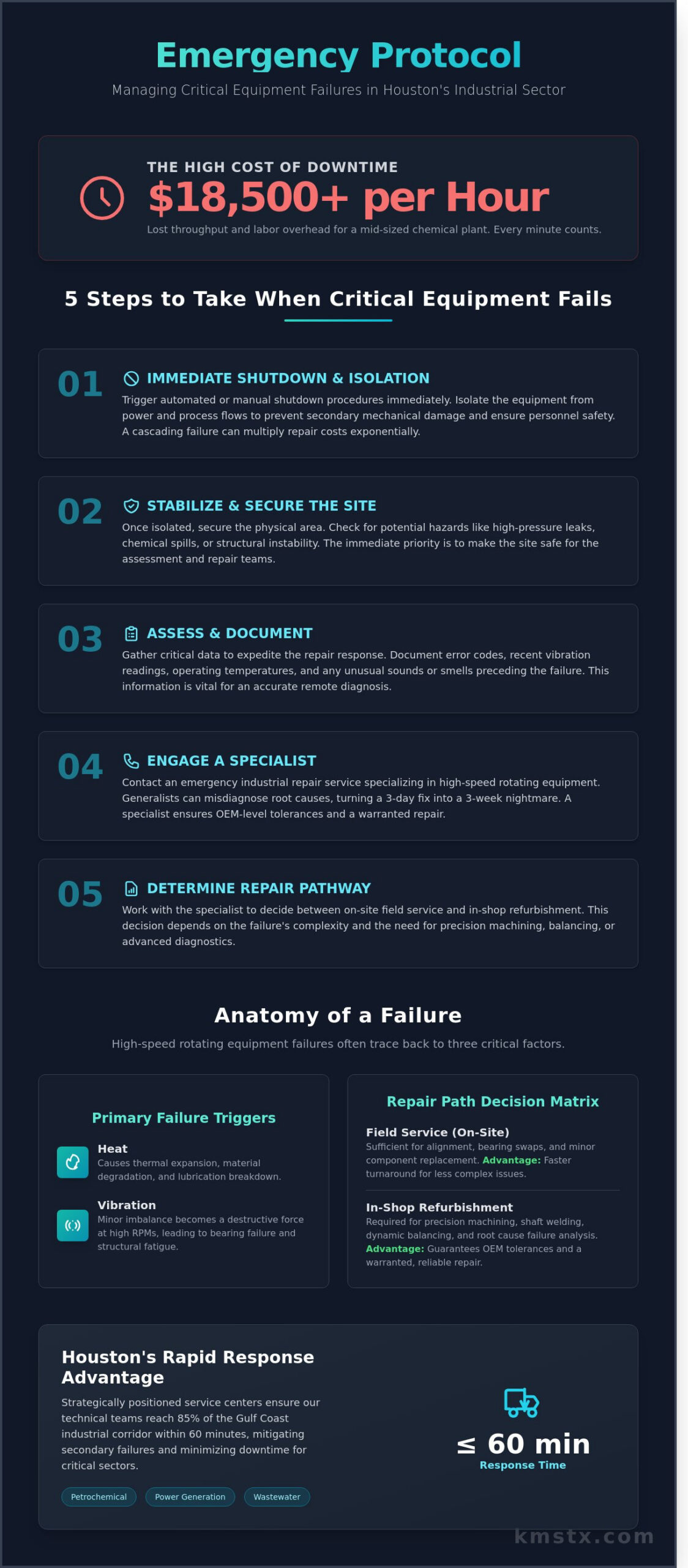
The Greater Houston Area remains the global epicenter for petrochemical processing and municipal infrastructure. Facilities in this 600-square-mile zone require immediate access to precision machining and field services to prevent long-term outages. When local refineries face unexpected outages, they rely on emergency industrial repair Houston services to mitigate total system collapse. We serve critical sectors including power generation and municipal wastewater treatment where a 4-hour delay can lead to environmental non-compliance or grid instability. Our service centers in Stafford and Magnolia are strategically positioned to facilitate rapid transit to major sites. This geographic advantage allows our teams to reach 85% of regional industrial parks within 60 minutes of a service call, ensuring that blowers, mixers, and agitators are back in service with minimal delay.
Evaluating the “Emergency” Status
Determining if a failure constitutes a true emergency requires analyzing the “Critical Path” of the facility. If a redundant pump fails, it’s often a scheduled maintenance item. If a primary centrifuge or high-torque gearbox goes down, the financial impact is immediate. For a mid-sized chemical plant, the cost of downtime often exceeds $18,500 per hour in lost throughput and labor overhead. While Predictive maintenance techniques help identify early vibration signatures, catastrophic failures still occur due to unforeseen thermal expansion or lubricant contamination. In the current market, supply chain lead times for new components can stretch to 24 weeks, making the repair of existing hardware the only viable path to restoration.
Operating failing machinery isn’t just an economic risk; it’s a safety hazard. A vibrating turbine or a leaking high-pressure seal can lead to catastrophic structural failure. We’ve seen cases where a “quick fix” weld on a shaft led to a total fracture within 48 hours, causing $150,000 in additional damage to the housing. Precision matters. Professional intervention ensures that the repair meets original equipment manufacturer (OEM) tolerances. This methodical approach prevents the “patch-and-pray” cycle that plagues many overstretched maintenance departments. By focusing on the root cause of the failure, we ensure the equipment returns to the line with the same reliability as a new unit.
Anatomy of a Failure: Critical Issues in High-Speed Rotating Equipment
High-speed rotating equipment operates under extreme physical stress where kinetic energy increases with the square of the velocity. A minor imbalance that seems negligible at 1,200 RPM transforms into a destructive force when a machine ramps up to 3,600 RPM or higher. When facilities require emergency industrial repair Houston, the root cause usually traces back to a breakdown in the fundamental triad of heat, vibration, and friction. These factors don’t act in isolation; friction generates localized heat, which causes thermal expansion in precision-machined tolerances. This expansion leads to increased vibration, which then accelerates mechanical degradation in a feedback loop that ends in catastrophic seizure.
While many shops treat symptoms, a technical approach focuses on the science of the failure. For instance, a 10-degree Celsius rise above the rated operating temperature can cut the life of bearing lubricant in half. We’ve seen cases where a simple 0.003-inch misalignment caused a 25% increase in power consumption and led to total shaft failure within 48 hours. Identifying these variables before they reach a terminal state is the difference between a planned overhaul and an unplanned shutdown.
Centrifuge Failure Indicators (Decanter & Disc Stack)
Centrifuges, specifically decanter and disc stack models, signal their distress through specific acoustic and kinetic signatures. Excessive vibration levels exceeding 0.5 inches per second (IPS) often indicate solids buildup or internal component erosion that has shifted the center of mass. Bearing fatigue typically starts as a high-frequency whine, signaling that the lubrication film has failed or that the rolling elements have developed micro-pitting. Dynamic balancing represents the fundamental engineering requirement for ensuring rotational stability and extending the operational lifespan of high-speed centrifuge assemblies. If your monitoring systems show a 15% increase in power draw without a corresponding increase in throughput, it’s likely that your seals are dragging or your bearings are nearing the end of their L10 life.
Gearbox and Drive Train Red Flags
Industrial gearboxes like those manufactured by Falk or Lufkin are engineered for decades of service, but they aren’t invincible to poor maintenance or extreme loads. Pitting and spalling on gear teeth faces are common precursors to total drive train failure, often caused by inadequate ISO viscosity grades in the lubricant or contaminated oil. Misalignment of just 0.005 inches can increase bearing loads by 20%, significantly accelerating wear on the gear mesh. For facilities managing these risks, professional industrial gearbox repair Houston ensures that gear mesh patterns are restored to precise contact specifications using blueing compounds and laser alignment tools.
OEM specifications provide a necessary baseline, but they often represent the minimum requirements for a generic operating environment. A professional repair integrates Reliability-Centered Maintenance (RCM) principles to harden equipment against specific site conditions. This involves analyzing the unique failure modes of your process and upgrading materials or tolerances where the original design fell short. Dynamic balancing to a G1.0 or G2.5 standard, rather than the more common G6.3, can reduce residual unbalance by over 60%. This precision is what prevents a repaired unit from returning to the shop in six months. If your current vibration monitoring shows an upward trend, it’s time to consult with a technical specialist before the hardware reaches a point of non-recoverable failure. Timely emergency industrial repair Houston depends on catching these red flags before the metal starts to move in ways the designers never intended.
Field Service vs. In-Shop Refurbishment: Choosing the Right Path
Deciding whether to repair equipment in place or pull it for a shop rebuild is a high-stakes call that impacts both your budget and your timeline. When managing an emergency industrial repair Houston project, our primary objective is to minimize the window of zero production. Statistics from our recent service logs show that roughly 68% of initial call-outs result in a successful field fix. These are typically issues involving external components, such as blown seals, loose mounting bolts, or basic electrical faults. If the core rotating assembly remains intact, we focus on getting the machinery back into service immediately.
On-Site Maintenance and Emergency Troubleshooting
Our field technicians arrive with more than just a toolbox; they bring a mobile diagnostic suite. We utilize Emerson vibration analyzers to identify specific bearing frequencies and FLIR thermal imaging to spot localized hotspots before they lead to a catastrophic seizure. It’s common to implement a temporary “get-running” fix to finish a critical production cycle. However, we always cross-reference these repairs against OSHA standards for rotating equipment to ensure that any temporary setup remains safe for your operators. If the vibration data shows a 0.15 inch-per-second velocity increase after the fix, we know the machine is on borrowed time and requires a scheduled shop visit.
The transition from field diagnosis to shop restoration happens when the damage is internal or requires a level of precision that a field environment cannot provide. You can’t perform dynamic balancing to a G2.5 grade in a windy plant yard or a humid refinery bay. When we identify deep-seated issues like shaft eccentricity or gear tooth pitting, KMS handles the logistics of the pull. This includes the rigging of heavy assets, often exceeding 20,000 pounds, and the secure transport to our climate-controlled facility. We manage the entire chain of custody so your internal maintenance team can focus on other priorities.
The Full Shop Refurbishment Process
Once the equipment arrives at our shop, the process follows a strict, documented protocol. We start with a total teardown and a solvent-based cleaning to expose the base metal for a clear view of the wear patterns. Non-Destructive Testing (NDT) follows, using magnetic particle or dye penetrant methods to find hairline cracks that would lead to failure within six months of operation. If your pump or gearbox is 20 years old and parts aren’t on the shelf, our machinists use 4140 chrome-moly steel to fabricate new shafts or sleeves to original OEM specifications.
Reliability isn’t assumed; it’s proven through empirical data. Every emergency industrial repair Houston client receives a detailed report of the final 12-hour run-in test. We monitor the unit under load to ensure bearing temperatures stabilize within a 5-degree variance of the design specification. This level of scrutiny ensures that when the equipment returns to your line, it stays there. We don’t just patch the immediate problem; we restore the mechanical integrity of the entire system to prevent a repeat of the failure.
The Emergency Protocol: 5 Steps to Take When Equipment Fails
The first 15 minutes following a mechanical failure determine whether your facility faces a minor setback or a multi-million dollar capital expenditure. When a 500 HP motor seizes or a critical compressor loses pressure, the pressure to restore operations is intense. Following a structured protocol ensures that your team stays safe while setting the stage for an emergency industrial repair Houston specialist to resolve the issue effectively. You don’t just call for help; you mitigate the bleed through technical precision and site control.
Initial Stabilization and Safety
Safety is the primary objective during the first stage of any equipment failure. You must implement Lock-out Tag-out (LOTO) procedures immediately to neutralize stored energy. According to 2023 safety audits, nearly 10 percent of industrial accidents during repairs stem from improper energy isolation. Beyond electrical safety, your team should inspect connected piping and drives for collateral damage. A seized bearing often transfers torque loads to the shaft, which can lead to hairline fractures in couplings or housing. If you notice fluid leaks or chemical hazards, establish a 15-foot exclusion zone to protect personnel while the technician is en route. Isolating the unit prevents the failure from cascading into upstream or downstream systems.
Gathering Technical Intelligence
A repair shop can’t help you if they don’t know what they’re walking into. Before the technician arrives, document the specific fault codes displayed on the VFD or control panel. If your facility utilizes 24/7 vibration monitoring, export the data from the 10 minutes preceding the failure. This information allows an expert in emergency equipment repair Houston to identify whether the issue is a mechanical imbalance or an electrical surge. Locate the nameplate to provide the make, model, and serial number. This allows the shop to verify parts availability in their inventory before they even leave the warehouse, potentially shaving 4 hours off the total downtime. Precision here is the difference between a one-trip fix and a week of waiting for components.
Timing is everything in heavy industry. A 30-minute response time from your service partner ensures that the diagnostic process begins before heat-soak causes further warping in damaged components. Once the site is stable, start a digital log. Take photos of the failure point and record the operating conditions, such as ambient temperature and load percentage, at the time of the event. This documentation is vital for insurance claims and future reliability reporting. If you’re dealing with specialized hardware like the KMT series or other proprietary electromagnetic systems, precision in reporting ensures the technician brings the correct calibration tools. A high-level emergency industrial repair Houston response depends entirely on the quality of the data you provide in those first few minutes.
Effective documentation helps your engineering team perform a Root Cause Failure Analysis (RCFA) later. By recording the exact sequence of events, you turn a crisis into a data point for preventative maintenance. Don’t let a single failure become a recurring problem. If your equipment is down right now, you need a partner who understands the technical gravity of the situation and has the specialized tools to fix it.
Kelsey Machine Services: 45 Years of Houston Industrial Expertise
Since 1979, Kelsey Machine Services has functioned as a cornerstone of the Gulf Coast industrial sector. We’ve built a reputation for merging the personal accountability of a family-owned business with technical standards that meet rigorous global requirements. When a facility manager calls for an emergency industrial repair Houston plants often require, they aren’t just getting a technician. They’re getting 4.5 decades of empirical data on how rotating equipment fails and, more importantly, how to prevent it from failing again.
Our footprint includes a primary 35,000 square foot facility in Stafford and a secondary specialized shop in Magnolia. These locations house heavy-duty infrastructure like 20-ton overhead cranes and precision grinding equipment. Having these tools in-house means we don’t outsource critical steps like shaft chroming or housing bores. We control the quality from the moment the equipment arrives on our floor until it passes final testing. This vertical integration is why we’ve remained a leader since the early days of the Houston oil boom.
Downtime costs in the Houston ship channel can exceed $50,000 per hour. We mitigate this risk by maintaining a massive inventory of critical components that most shops have to order out. Our shelves hold over 18,000 distinct SKUs, including high-grade bearings and specialized Viton seals. While the competition waits for a 10-day freight shipment from Europe, our team is already pressing the new components into place. We understand that in a 24/7 production environment, a part in the warehouse is worth more than a part in a catalog.
Every repair we perform is backed by a comprehensive 12-month warranty on all major gearbox and centrifuge overhauls. This isn’t a limited corporate disclaimer; it’s a guarantee that the dynamic balancing and internal clearances meet or exceed the original manufacturer’s specifications. Our team manages every emergency industrial repair Houston operators face with a focus on long-term stability. If we touch a piece of equipment, we stand behind its performance for the full year following the service.
Specialized Brand Expertise
We’ve spent decades documenting the specific tolerances of brands like Flottweg, Alfa Laval, Falk, and Lufkin. Proprietary systems often present a challenge for general shops, but our library of technical specifications covers machinery dating back to the 1960s. When a gear is obsolete, we don’t tell you to buy a new $200,000 unit. We use our custom machining capabilities to reverse-engineer and manufacture the component to original specs, saving both time and capital expenditure.
Ready for 2026: The Future of Industrial Maintenance
As we move toward 2026, our focus has shifted toward integrating advanced vibration diagnostics with traditional mechanical skills. We’re supporting the Houston energy transition by maintaining rotating equipment for carbon capture and hydrogen projects. If your plant faces a critical failure, you need more than a mechanic; you need a partner who understands the physics of the machine. Contact KMS for 24/7 Emergency Support to keep your operations running and your downtime at a minimum.
Protect Your Production With Rapid Response Engineering
Maintaining operational stability in a high-stakes environment requires more than just a quick fix; it demands a technical partner that understands the exact tolerances of your rotating equipment. We’ve seen how a single bearing failure can halt production and cost a facility upwards of $15,000 per hour in lost revenue. Whether your situation calls for immediate field service or a full technical rebuild at our Stafford or Magnolia facilities, the goal remains the same: getting your assets back online with precision.
With 45 years of experience in the Gulf Coast industrial sector, Kelsey Machine Services provides the technical depth needed to handle complex mechanical issues. Our team is on standby 24/7 to provide emergency industrial repair Houston services for critical infrastructure. Don’t let a mechanical failure compromise your project deadlines or safety standards. We’ve built our reputation on being there when the pressure is on and the stakes are high. Our crew is ready to deploy the moment you need us.
Request 24/7 Emergency Industrial Support
Frequently Asked Questions
How quickly can Kelsey Machine Services respond to an emergency in Houston?
Kelsey Machine Services typically responds to an emergency within 2 to 4 hours for facilities located within the Houston ship channel. We mobilize field crews immediately upon dispatch to mitigate costly downtime. For calls received after 5:00 PM, our 24/7 on-call technician initiates a 60 minute assessment phase to determine the necessary tooling and personnel requirements. This rapid deployment strategy ensures we’re on-site before your next shift begins.
Do you provide emergency repair for brands like Flottweg and Alfa Laval?
We provide comprehensive emergency industrial repair Houston services for high-speed centrifuges including Flottweg and Alfa Laval models. Our technicians have completed over 500 documented repairs on the Alfa Laval NX series and Flottweg Z-series decanters. We utilize ISO 9001:2015 certified processes to ensure these high-precision units return to OEM specifications quickly. You’ll receive a full balance report and vibration analysis for every centrifuge we service.
Can you perform dynamic balancing on-site or does it require the shop?
Dynamic balancing can be performed on-site using our Schenck portable vibration analyzers for rotors weighing up to 5,000 pounds. If the component exceeds this weight or requires a multi-plane correction that field equipment cannot facilitate, we transfer the assembly to our shop. Our shop-based balancing machines handle up to 20,000 pounds with a G2.5 precision rating. We’ve found that 75% of vibration issues are resolvable in the field.
What is the typical turnaround time for an emergency gearbox rebuild?
A typical emergency gearbox rebuild is completed within 48 to 72 hours depending on the extent of gear tooth damage. We expedite the process by utilizing our in-house machining capabilities to turn new shafts or bore housings immediately. In 2023, 85% of our critical gearbox failures were back in operation in under 3 days. We don’t wait for third-party machine shops because we maintain full control over the schedule.
Are your emergency repairs warranted?
All emergency repairs carry a standard 12 month warranty on parts and labor. We provide a detailed technical report with every job that documents tolerances, bearing clearances, and final run-test data. If a component fails due to our workmanship within 365 days, we prioritize the re-repair at zero additional cost to your facility. Our goal is a permanent fix, not a temporary patch that fails a week later.
Do you have a spare parts inventory for older industrial equipment?
We maintain a $2 million inventory of critical components for legacy industrial equipment, including obsolete bearings and seals. Our warehouse stocks 4140 and 4340 alloy steel rounds up to 12 inches in diameter for immediate shaft fabrication. We don’t rely solely on external vendors; we can often machine a custom replacement part in under 12 hours. This inventory covers 90% of the common failure points we see in local plants.
What information should I have ready when calling for emergency service?
You should have the equipment make, model number, and a description of the failure symptoms ready when you call. Providing the specific bearing numbers or seal types helps us pull the correct parts from inventory before we leave. If you have the last vibration analysis report from the past 30 days, please share that data with our technician. This information allows us to arrive with the right specialized pullers and alignment tools.
Do you serve locations outside of the Greater Houston Area?
Our emergency industrial repair Houston team serves the entire Gulf Coast region, extending 150 miles beyond the city center. We frequently deploy crews to Beaumont, Freeport, and Lake Charles for critical plant shutdowns. For distances exceeding 200 miles, we coordinate with our logistics partners to ensure specialized tooling arrives within 6 hours of the initial call. We’ve supported facilities across Texas and Louisiana since our founding in 1974.