
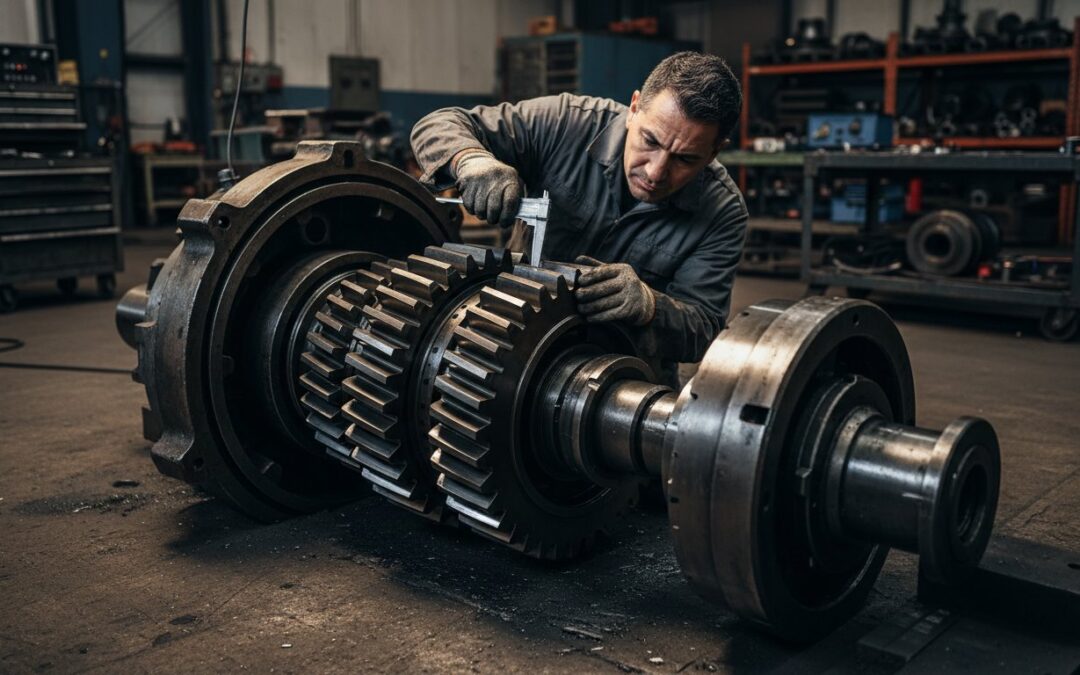
A 52-week lead time for a new OEM replacement isn’t just a logistical hurdle; it’s a direct threat to your plant’s 2024 production targets. You’ve likely seen how unplanned downtime can bleed a maintenance budget dry, especially when a critical drive fails without a backup on the shelf. It’s frustrating to feel stuck between an astronomical wait for new iron and the uncertainty of a low-quality patch job that might fail within months. Choosing a professional heavy duty gearbox refurbishment shouldn’t feel like a gamble on your facility’s reliability.
This guide breaks down the technical requirements and precision processes that return a worn unit to its original design specifications. You’ll see how a documented, warranted restoration provides the same performance as a new unit while typically saving 40% to 60% of the replacement cost. We’ll walk through the specific teardown protocols, non-destructive testing (NDT), and precision machining steps needed to restore your assets to peak operational efficiency and get your floor back to full capacity.
Key Takeaways
- Understand why a full restoration beats a simple “patch-up” job by returning your equipment to original OEM specifications or better.
- Analyze the significant CAPEX savings of heavy duty gearbox refurbishment compared to the high costs and long lead times of new unit procurement.
- Identify the critical “red flag” indicators and lubrication health issues that signal it’s time to pull a unit before a catastrophic failure occurs.
- Learn how to select a high-reliability repair partner by focusing on advanced diagnostic tools and comprehensive “as-built” documentation.
What is Heavy Duty Gearbox Refurbishment?
Heavy duty gearbox refurbishment is a high-level engineering overhaul that returns a unit to its original OEM specifications or, in many cases, exceeds them. It’s not a simple oil change or a quick bearing swap. This process involves stripping the entire assembly down to the bare housing to evaluate every internal component against precise tolerances. For plants operating 24/7, the gearbox is the mechanical heart of the system. When a primary drive fails in a cement kiln or a mining conveyor, the entire production line stops. A full refurbishment ensures that the unit can handle its rated torque and thermal loads for another decade of service.
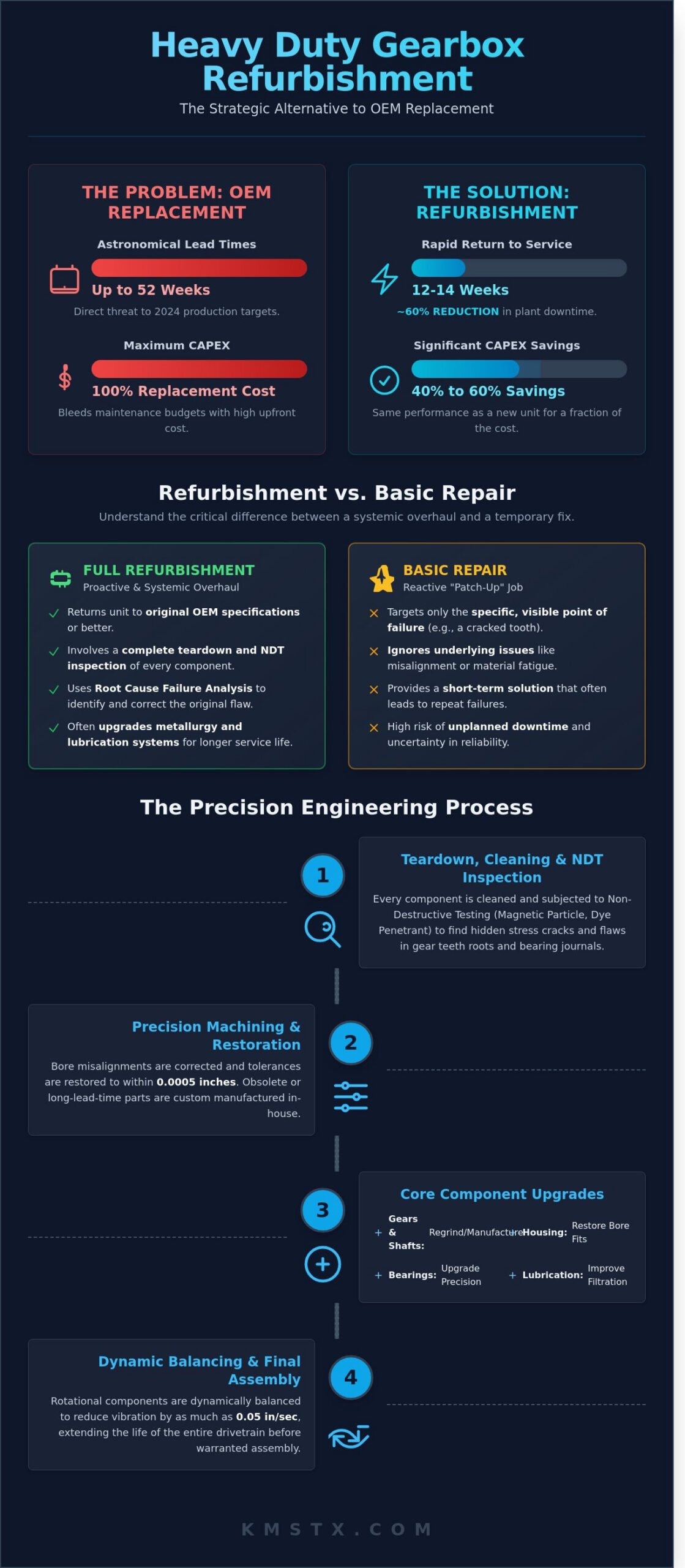
The 2026 industrial landscape has made this strategy more than just a cost-saving measure. Supply chain data shows that lead times for new custom gearboxes have increased to 40 or even 52 weeks for specialized units. By choosing heavy duty gearbox refurbishment, a facility can typically cut that downtime by 60 percent. Most plants see a return to service within 12 to 14 weeks. Beyond the time savings, refurbishing an existing housing costs roughly 40 percent less than purchasing a brand-new replacement of the same scale.
Refurbishment vs. Basic Repair
It’s easy to confuse a basic repair with a full refurbishment, but the technical depth is vastly different. A repair is a reactive “patch-up” that targets a specific failure point, like a cracked tooth or a leaking seal. Refurbishment is proactive and systemic. It starts with a total teardown followed by non-destructive testing (NDT), including magnetic particle and ultrasonic inspections. We don’t just fix what broke; we identify why it broke. This might involve correcting a housing bore that’s out of alignment by 0.0015 inches or upgrading metallurgy to prevent the same fatigue patterns from reappearing.
Core Components Addressed in the Process
The heavy duty gearbox refurbishment process scrutinizes four primary areas to ensure long-term reliability:
- Gears and Shafts: We inspect every gear for micro-pitting, scuffing, and subsurface fatigue. If a gear is worn, we can often regrind it to a new profile or manufacture a replacement using modern heat-treatment methods.
- Housing and Casings: Structural integrity is paramount. We check for hairline cracks and ensure that all mounting surfaces are flat. If a bearing bore is oversized, we use sleeve or plating techniques to restore the interference fit.
- Bearings and Seals: We don’t just use “off the shelf” replacements. Every bearing is selected based on current load data, often moving to higher precision grades to reduce vibration.
- Lubrication Systems: We often upgrade internal piping and filtration to meet ISO 4406 cleanliness standards, which weren’t always prioritized in older designs.
The Precision Engineering Behind Gearbox Restoration
The process of heavy duty gearbox refurbishment begins long before a single gear is replaced. It’s a methodical engineering exercise that demands strict adherence to AGMA 6006-A03 standards to ensure the unit returns to service with its original load-carrying capacity. We don’t just fix what’s broken; we utilize Root Cause Failure Analysis (RCFA) to determine why the failure occurred. This involves using advanced diagnostic tools such as borescopy and ultrasonic thickness gauges to find internal defects before they compromise the housing. This data-driven approach prevents the same 15% efficiency loss from recurring within the first year of operation.
Teardown, Cleaning, and NDT Inspection
A professional teardown involves more than just disassembly. It requires removing decades of industrial buildup, often using high-pressure steam or specialized chemical baths, to reveal the true state of the base metal. Once cleaned, every component undergoes Non-Destructive Testing (NDT). We use magnetic particle and dye penetrant testing to identify stress cracks that remain invisible to the naked eye. These flaws often hide in the root of the gear teeth or along the bearing journals. Every measurement is documented against original manufacturer blueprints, ensuring tolerances are held within 0.0005 inches to maintain proper backlash and contact patterns.
Precision Machining and Dynamic Balancing
When parts are obsolete or lead times stretch beyond 24 weeks, custom machining becomes the only viable path. We often correct bore misalignments that cause 60% of premature bearing failures in high-torque environments. A critical step in this restoration is precision dynamic balancing. Dynamic balancing is the process of aligning a component’s center of gravity with its axis of rotation to eliminate centrifugal force imbalances. By reducing operational vibration by as much as 0.05 inches per second, we extend the life of the entire drivetrain and the surrounding structural supports. If your equipment is showing signs of excessive heat or noise, a thorough expert mechanical assessment can identify these imbalances before they lead to a catastrophic seizure.
Economic Analysis: Refurbishment vs. OEM Replacement
Choosing between a new unit and a heavy duty gearbox refurbishment isn’t just a maintenance decision; it’s a strategic financial move. Most project managers recognize that a full rebuild typically costs 40% to 60% of the price of a brand-new OEM replacement. On a large-scale $300,000 drive, that represents $150,000 kept in your capital budget. Over a 10-year cycle, the Total Cost of Ownership (TCO) stays lower because you’re working with a known housing and proven mounting geometry. You aren’t paying for the engineering overhead or the structural modifications often required when a new model doesn’t quite match the old footprint.
Lead Time as a Critical Decision Factor
Looking ahead to 2026, the industrial supply chain remains brittle. Current market projections show that custom heavy-duty units carry lead times of 32 to 50 weeks. This is where the “Downtime Tax” becomes a reality. If a primary conveyor or mill stops, the daily cost of lost production can easily hit $18,500. Waiting 10 months for a new OEM unit results in a $5.1 million revenue loss. A comprehensive heavy duty gearbox refurbishment usually wraps up in 3 to 5 weeks. That speed protects your bottom line and keeps your crew productive while competitors wait for shipping containers to cross the ocean.
Performance Upgrades During Refurbishment
Refurbishing an older unit lets you integrate technologies that didn’t exist when the machine was first built. We don’t just replace parts; we improve the asset’s fundamental reliability. We often find that original designs from 15 years ago have clear paths for improvement.
- Advanced Sealing: We swap standard nitrile seals for Viton or labyrinth designs to handle 210-degree operating temperatures without hardening or leaking.
- Superior Bearings: We utilize modern bearings with 20% higher dynamic load ratings than the components originally specified in the 1990s.
- Material Science: Using case-hardened alloys and modern tooth-grinding profiles reduces friction and heat buildup during high-torque applications.
These technical adjustments mean the refurbished unit often runs cooler and exhibits higher mechanical efficiency than it did on its first day of service. By the time the process is complete, the gearbox isn’t just repaired. It’s evolved to meet the current demands of your specific environment.
Diagnosing Failure: When to Pull the Unit for Service
Deciding when to pull a gearbox for service is the difference between a controlled maintenance window and an unscheduled plant shutdown. You shouldn’t wait for a catastrophic seizure to take action. Data from field inspections shows that 75% of gear failures are preceded by detectable changes in heat, sound, or lubricant chemistry. If your unit is drawing 15% more amperage than its baseline or showing a sudden 20-degree Fahrenheit spike over ambient operating temperature, internal friction is already winning the battle. These red flags indicate that the internal tolerances have shifted, and continuing to run the equipment will likely turn a repairable unit into scrap metal.
Lubrication and Thermal Signatures
Oil is the lifeblood of the system, and its condition tells the story of the gear teeth. We look for ISO 4406 cleanliness codes to see if the lubricant is contaminated. If your lab report shows iron concentrations exceeding 100 ppm, it’s a clear sign that the hardened surface of the gears is wearing away. You can’t fix mechanical wear with a simple oil change; once the metal is in the oil, the geometry of the gear tooth is already compromised. We use thermal imaging to identify localized hot spots. A hot bearing housing usually points to a lack of lubrication or excessive preload, while a hot spot along the gear mesh line suggests misalignment that’s concentrating loads on a small fraction of the tooth surface.
Vibration and Acoustic Monitoring
Experienced operators often “hear” a failure coming, but we back those instincts with precision sensors. A high-pitched whine often points to gear tooth wear or incorrect backlash settings, while a low-frequency growl usually signals a failing bearing race. Integrating your gearbox inspections into a broader rotating equipment maintenance schedule allows you to track these trends over months rather than reacting to a sudden noise. High-frequency vibration often signals gear mesh issues, while low-frequency vibration typically indicates shaft or bearing misalignment. By capturing this data early, you can schedule a heavy duty gearbox refurbishment during a planned outage, which typically costs 40% less than an emergency replacement after a total mechanical breakdown.
Don’t let a small vibration turn into a total system failure. If you’re seeing these red flags, contact our technical team today to discuss a comprehensive diagnostic inspection and heavy duty gearbox refurbishment plan that fits your production schedule.
Implementing a High-Reliability Refurbishment Strategy
Selecting a partner for heavy duty gearbox refurbishment requires more than checking a box on a procurement list. You need a facility that handles 100,000 foot-pounds of torque with the same precision a lab uses for a microscope. A reliable partner provides an engineering partnership that can extend asset life by 15 to 20 years. Don’t settle for a shop that just replaces bearings; look for one that understands gear tooth geometry and metallurgical integrity at a granular level.
Documentation and Quality Assurance
Demand a comprehensive teardown report before any metal is cut. This should include coordinate measuring machine (CMM) data for housing bores and ultrasonic testing for stress fractures. We’ve seen 12% of refurbishments fail within months because a shop missed a hairline crack in a bearing carrier. Every replacement component requires a material traceability certificate. Final validation must happen on a test stand to ensure vibration levels stay below a 0.08 ips threshold.
The Kelsey Machine Services Approach
Our team brings 42 years of technical expertise to every rotating equipment challenge. We understand that a down gearbox can cost a facility $15,000 an hour in lost production. Our extensive spare parts inventory allows us to cut lead times by 30% compared to OEM channels. We don’t just fix what’s broken; we analyze failure modes to apply upgrades like improved labyrinth seals or higher-capacity bearings.
Every heavy duty gearbox refurbishment we execute includes a 12-month operational warranty. This commitment is backed by an “as-built” documentation package that serves as a new baseline for your maintenance team. When the unit returns to your site, update your reliability program immediately. Take a new vibration baseline during the first 8 hours of operation. Perform a lubricant analysis at the 500-hour mark to verify that the internal components are seating correctly. This methodical approach ensures your investment pays off in long-term uptime and predictable performance.
Maximizing Gearbox Longevity Through Technical Precision
Deciding between a full replacement and a heavy duty gearbox refurbishment often comes down to the hard data found during a teardown. When you catch gear pitting or bearing wear early, you’ll typically restore a unit to its original performance standards for 40% to 60% of the cost of a new machine. This technical strategy doesn’t just save capital; it bypasses the 30 plus week lead times currently plaguing the global supply chain. At Kelsey Machine Services, we’ve backed our work with 40 years of industrial mechanical expertise, ensuring every tolerance is met with shop-floor precision. We maintain a massive inventory of OEM and custom parts so your project doesn’t stall on a shipping dock. If your operations face a critical failure, our team provides 24/7 emergency support to minimize your downtime. It’s about keeping your assets reliable and your facility running at peak capacity.
Contact Kelsey Machine Services for a Technical Gearbox Inspection
Let’s get your equipment back in the fight with a restoration plan that makes sense for your bottom line.
Frequently Asked Questions
How long does a typical heavy duty gearbox refurbishment take?
Most heavy duty gearbox refurbishment projects take between 4 and 8 weeks to complete from the initial teardown. This timeline fluctuates based on whether we’ve got to custom-machine new gears or if off-the-shelf bearings are available. If a housing needs extensive line boring, you’re looking at the 8-week mark. For standard preventative overhauls on units like a Falk or Flender, we often hit a 25-day turnaround for our clients.
Can you refurbish a gearbox if the OEM is no longer in business?
We can absolutely refurbish gearboxes from defunct OEMs by utilizing reverse engineering and precision measurement tools. If the original manufacturer closed its doors back in 1995, we use 3D laser scanning to map the gear geometry and housing tolerances. We then manufacture replacement components that meet or exceed the original AGMA 12 specifications. This process ensures your legacy equipment stays operational without needing a full system redesign.
What is the difference between a gearbox rebuild and refurbishment?
A rebuild typically involves replacing standard wear items like bearings and seals, while a refurbishment restores the entire unit to its original factory performance or better. During a refurbishment, we inspect every gear tooth for micro-pitting and perform NDT testing on all shafts. We also address housing issues like bore misalignment. In contrast, a simple rebuild might ignore 40 percent of the potential failure points found in a full restoration.
Is it possible to increase the torque rating of my gearbox during refurbishment?
You can increase the torque rating by 15 to 20 percent by upgrading gear materials and heat treatment processes. During the heavy duty gearbox refurbishment process, we often replace standard through-hardened gears with case-carburized versions. We also use ground tooth profiles to reduce friction and heat. These technical upgrades allow your existing footprint to handle higher loads without the cost of installing a larger, more expensive drive unit.
How do I know if my gearbox is too far gone for repair?
A gearbox is generally considered beyond repair if the refurbishment cost exceeds 70 percent of a new unit’s price or if the main housing has catastrophic structural cracks. We’ve seen units with 50 percent of their gear teeth sheared off that were still viable for restoration. However, if the cast iron casing has suffered major fragmentation, the labor hours required for cold-stitching or welding often make a replacement the more logical financial choice.
What kind of warranty comes with a refurbished industrial gearbox?
Most reputable shops provide a 12-month or 18-month warranty on refurbished units, which starts from the date of installation. At our facility, we offer a 24-month warranty on all replaced components and labor. This matches the standard protection you’d get with a brand-new unit from the factory. We track every assembly step with 15 specific quality checkpoints to ensure the unit doesn’t fail under load within its first 5,000 hours.
Do you provide on-site gearbox inspections before removal?
We provide comprehensive field inspections using borescope cameras and vibration analysis before you pull the unit from the line. Our technicians use 4-channel vibration monitors to identify bearing frequencies and gear mesh issues while the machine is still running. This data allows us to pinpoint 90 percent of internal issues before the gearbox even hits the shop floor. It helps you plan for the specific parts needed and reduces total downtime.
What information is needed to get an accurate refurbishment quote?
You’ll need to provide the nameplate data, including the model number, ratio, and service factor, along with a brief history of the failure. Photos of the unit and any recent oil analysis reports from the last 6 months are also helpful. If you can provide the input RPM and the current motor horsepower, we can generate a preliminary estimate within 24 hours. This data ensures we quote for the correct internal components and labor.