
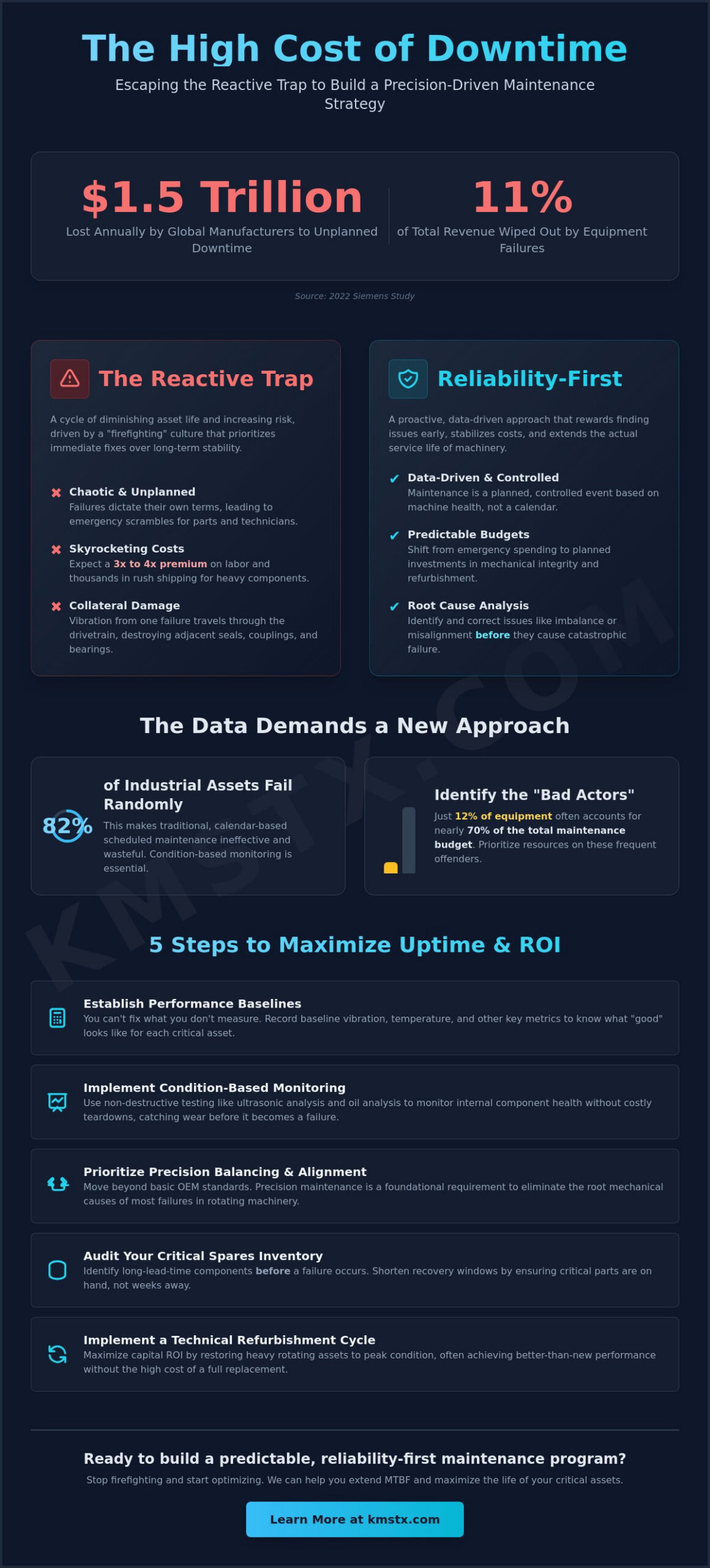
A 2022 study by Siemens found that unplanned downtime costs global industrial manufacturers nearly $1.5 trillion every year, which represents roughly 11% of their total revenue. It’s a staggering figure, but for anyone who’s stood on a shop floor watching a critical centrifuge seize up, the immediate loss of production revenue feels much more personal than a global statistic. You know that the scramble for emergency parts and the hunt for specialized technicians can blow a quarterly maintenance budget in a single weekend. Understanding how to reduce industrial equipment downtime isn’t just about fixing what’s broken; it’s about shifting your entire operational mindset.
We agree that the stress of unplanned outages and the high cost of emergency rush repairs can make your maintenance schedule feel like a series of crises. This guide teaches you how to transition from reactive repairs to a precision-driven maintenance strategy that maximizes the uptime of your heavy rotating machinery. We’ll explore the technical steps to extend your Mean Time Between Failures (MTBF) and build a predictable budget through improved mechanical integrity.
Key Takeaways
- Escape the “reactive trap” by quantifying the true cost of unplanned stops and shifting toward a reliability-first mindset.
- Pinpoint “bad actor” equipment early by establishing clear performance baselines and conducting rigorous asset audits.
- Discover practical strategies on how to reduce industrial equipment downtime by prioritizing precision balancing and alignment over basic OEM standards.
- Shorten your recovery windows by identifying long-lead-time components and auditing your critical spares inventory before a failure occurs.
- Maximize your capital ROI by implementing a technical refurbishment cycle that restores heavy rotating assets to peak condition without the cost of a full replacement.
Understanding the “Reactive Trap” and the Real Cost of Unplanned Stops
Understanding how to reduce industrial equipment downtime starts with a hard look at the difference between planned service and unplanned stops. Planned maintenance is a controlled event where parts and labor are staged. Catastrophic failure, however, is a chaotic event that dictates its own terms. Most facilities fall into the Reactive Trap, which is a cycle of diminishing asset life and increasing operational risk. This happens when teams prioritize immediate fixes over long-term reliability, essentially waiting for a machine to scream before giving it attention.
To better understand this concept, watch this helpful video:
Traditional scheduled maintenance often fails because it relies on the calendar rather than machine health. A 2022 report by the ARC Advisory Group indicates that 82% of industrial assets follow a random failure pattern. This means that changing a bearing every six months regardless of its condition is often a waste of resources. It might even introduce new faults through human error or “infant mortality” of new parts. To truly learn how to reduce industrial equipment downtime, you’ve got to move toward condition-based monitoring that identifies root causes like misalignment or imbalance before they trigger a shutdown.
The Hidden Costs of Emergency Repairs
The price tag of a breakdown goes far beyond the invoice for a new part. When a critical pump or compressor fails, you’re looking at a 3x to 4x premium on labor for 24/7 emergency response. Rush shipping for heavy components can cost thousands, but the collateral damage is often worse. For example, excessive vibration from a failing gearbox doesn’t stay localized; it travels through the drivetrain, destroying seals, couplings, and adjacent bearings. These unplanned stops also ripple through the supply chain. If you miss a delivery window for a 2024 contract, the liquidated damages and lost reputation can outweigh the repair costs by a factor of ten.
The Psychology of Maintenance Culture
Breaking the firefighting cycle requires a shift in how operators view their machines. In many plants, the maintenance team is rewarded for how fast they “put out the fire,” which reinforces reactive behavior. A “Reliability First” mindset shifts that focus. It rewards technicians for finding a loose mounting bolt during a routine check rather than replacing a shattered housing at 3:00 AM. Operators become the first line of defense, using their senses and basic tools to catch early warning signs. Moving away from a hero-culture of emergency repairs toward a methodical, data-driven approach is the only way to stabilize operational costs and extend the actual service life of your fleet.
Shifting from Scheduled to Condition-Based Maintenance Strategies
If you’re looking for how to reduce industrial equipment downtime, start by auditing your critical assets to identify the “bad actors” in your fleet. In most facilities, approximately 12% of rotating equipment accounts for nearly 70% of the total maintenance budget. By isolating these frequent offenders, you can prioritize resources where they actually impact reliability. This audit requires a deep dive into repair logs from the last 24 months to find patterns in mean time between failures (MTBF).
Establishing baseline performance is the next technical hurdle. You can’t identify a problem if you don’t know what “good” looks like for your specific centrifuges and pumps. For a high-speed decanter centrifuge, this might mean recording a baseline vibration level of 2.5 mm/s RMS and a bearing temperature of 145 degrees Fahrenheit under standard load. These benchmarks serve as the control group for all future diagnostic data.
Implementing non-destructive testing (NDT) allows you to monitor internal component health without a full teardown. Techniques like ultrasonic testing can detect sub-surface cracks in shafts, while oil analysis catches early-stage gearbox wear by identifying microscopic metal particles. If your spectrographic analysis shows a 15% increase in iron and chromium, you’ve caught a bearing race failing before it seizes. Utilizing these tools helps transition from arbitrary calendar dates to data-driven rotating equipment maintenance that targets specific failure modes.
The Role of Predictive Technology
Vibration analysis is the primary tool for identifying specific defects like inner race bearing fatigue or misaligned gear teeth. By using Fast Fourier Transform (FFT) signatures, technicians can see the exact frequency of a fault. However, data without a repair plan is useless; it’s just noise. You must integrate this predictive data directly into your work order system. When a vibration spike is detected at the 2x running speed frequency, a work order for laser alignment should trigger automatically. This proactive approach is the most effective way to understand how to reduce industrial equipment downtime across the entire plant.
Establishing Maintenance Triggers
Defining specific thresholds for temperature and vibration is what makes a program actionable. You need a standardized response protocol for “Alert” and “Alarm” states. For example, a centrifugal pump might enter an Alert state at 4.5 mm/s, requiring increased monitoring frequency. At 7.1 mm/s, it hits the Alarm state, mandating an immediate controlled shutdown for repair. Condition-based maintenance is the bridge between “too early” and “too late.” Using these triggers ensures full mechanical overhauls only happen when the equipment’s internal health actually demands it, rather than just because the calendar says so.
The Mechanical Foundation: Why Precision Balancing and Alignment are Non-Negotiable
Precision isn’t a luxury in heavy industry. It’s the baseline for survival. When we analyze how to reduce industrial equipment downtime, the conversation usually starts with rotating assemblies. The physics of failure are straightforward: centrifugal force increases with the square of the speed. A minor mass imbalance at 1,800 RPM becomes a destructive hammer at 3,600 RPM. This energy doesn’t just disappear; it’s absorbed by your bearings, housings, and foundations.
Most OEM specifications for rotating equipment are set at ISO G6.3. While this is acceptable for some general-purpose machinery, it’s often the minimum standard rather than the goal for high-speed assets. To achieve true reliability, aiming for G2.5 or even G1.0 tolerances is necessary. High-speed gearboxes and turbines require this level of technical rigor to prevent the micro-chatter that leads to premature fatigue. Utilizing specialized dynamic balancing services Houston experts offer is the most effective way to protect heavy rotating assets like centrifuge bowls from these hidden forces.
The Impact of Dynamic Imbalance
- Centrifugal Force Amplification: A 1-ounce unbalance on a 12-inch diameter rotor spinning at 3,600 RPM exerts roughly 110 pounds of centrifugal force on the bearings.
- Seal Longevity: High vibration levels are the primary cause of mechanical seal failure in industrial pumps. When a shaft oscillates by just 0.003 inches, seal faces can separate, leading to immediate leakage and contamination.
- Proven Results: In a 2022 reliability study, precision balancing of a decanter centrifuge reduced unplanned downtime by 40%. The stability allowed the unit to reach its scheduled 4,000-hour service interval without mid-cycle bearing replacements.
Precision Alignment Techniques
Laser alignment has largely replaced traditional rim-and-face dial indicators because it accounts for complexities like thermal growth. You can’t just align a machine at a 70-degree shop temperature and expect it to stay true when it hits an operating temperature of 185 degrees. Metals expand, and that expansion can shift a motor shaft out of tolerance by several thousandths of an inch. If you don’t calculate and program these offsets into your laser system, you’re essentially running an unaligned machine once it’s under load.
Another common culprit is “soft foot,” where the machine’s feet don’t sit flush on the baseplate. This creates a frame distortion that twists the internal bearing bores. We’ve found that precision machining of the mating surfaces is often required to ensure the foundation is as stable as the machine itself. Addressing these mechanical nuances is the most direct way to understand how to reduce industrial equipment downtime in high-stress environments. Short-cutting the alignment process might save four hours today, but it’ll cost you a week of production when the coupling shears next month.
Managing the “Spare Parts Crisis” to Accelerate Recovery Times
Lead times for critical components often account for 60% to 80% of the total Mean Time to Repair (MTTR) in heavy industry. If a facility waits 12 weeks for a proprietary bearing, the actual mechanical repair time of six hours becomes irrelevant to the bottom line. Understanding how to reduce industrial equipment downtime requires a shift from reactive purchasing to proactive inventory management. When a machine goes offline, the clock starts on lost revenue; every day spent waiting for a shipment is a day of zero productivity.
Conducting a critical spares audit is the first step in stabilizing operations. This process involves identifying components with lead times exceeding 16 weeks or those with high statistical failure rates based on historical run data. Maintaining a local industrial machine spare parts Texas inventory provides a strategic buffer against international shipping delays and customs bottlenecks. It’s about having the right part within driving distance rather than hoping for a fast flight from an overseas factory.
Developing a Spares Strategy
A spare parts strategy is an insurance policy against supply chain volatility. Parts should be categorized into two distinct groups to optimize capital allocation. Consumables like seals, gaskets, and standard bearings require high stock levels because their wear cycles are predictable. Capital spares, such as rotors, gearsets, or centrifuge bowls, represent a higher investment but are essential for preventing month-long outages.
An “Interchangeability Audit” often reveals that 15% of your inventory can serve multiple machines across different production lines. This reduces the total capital tied up in the warehouse while maintaining high availability. You should also work with a repair partner who stocks high-wear components for major brands like Falk or Flottweg. This collaborative approach ensures you don’t have to carry the full financial burden of every possible failure point yourself.
The Role of Custom Machining
OEM parts aren’t always the fastest or best option. If a machine was commissioned in the 1990s, the original manufacturer might have discontinued the part or gone out of business entirely. Custom machining allows a shop to restore obsolete equipment by fabricating components from scratch. This is a vital tactic for how to reduce industrial equipment downtime when the traditional supply chain fails.
Precision is the priority during fabrication. When machining replacement shafts or gears, the shop must ensure metallurgical compatibility. Using 4140 alloy steel or 316 stainless steel to match the original specs for hardness and tensile strength prevents premature failure. A custom-machined part can often be produced in 48 hours, whereas an OEM replacement might be backordered for months.
If you’re facing extended lead times for critical components, explore our procurement and machining solutions to get your operations back online faster.
Implementing a Technical Refurbishment Cycle for Heavy Rotating Assets
Choosing between refurbishment and replacement is a frequent crossroads for maintenance managers. While buying new equipment seems like a permanent fix, the capital expenditure often exceeds the cost of a precision overhaul by 50% to 70%. For heavy rotating assets, a structured refurbishment cycle is a primary method for how to reduce industrial equipment downtime because it addresses wear before it leads to catastrophic failure. High-speed machines, such as centrifuges, operate under immense centrifugal force, meaning even microscopic imbalances can shorten bearing life by 5,000 hours or more.
Opting for a professional industrial centrifuge repair Texas facility provides access to specialized restoration that goes far beyond simple cleaning. The process begins with a complete teardown and Non-Destructive Testing (NDT) to identify hairline fractures in the bowl or scroll that aren’t visible to the naked eye. Precision machining then restores critical tolerances on shafts and housings, often resulting in a 30% reduction in operating vibration compared to pre-service levels. This technical rigor ensures the machine returns to the floor in better-than-OEM condition, often with upgraded materials that resist corrosion better than the original parts.
Reliability isn’t just about the repair itself; it’s about the response when things go wrong. Accessing 24/7 emergency machine repair Gulf Coast services ensures that if a critical asset trips at 3:00 AM, a technical team is already mobilized. This rapid response capability minimizes the impact of unplanned outages on production schedules.
Defining the Refurbishment Scope
A “splash and dash” repair, where only external seals are replaced, is a recipe for a repeat failure. For high-speed equipment, a full teardown is the only way to inspect internal components for erosion and fatigue. We focus on restoring tolerances by machining housings and shafts back to exact OEM specifications, which effectively eliminates the vibration that causes premature bearing wear. Every unit must undergo a comprehensive final test run at operating speeds to verify balance and thermal stability before it leaves the shop. This step confirms the repair meets the performance requirements of the specific application.
Partnering for Long-Term Reliability
The quality of a repair depends entirely on the depth of the facility’s engineering capabilities. When selecting a partner, look for shops equipped with dynamic balancing stands, heavy-duty machining centers, and dedicated NDT bays. A shop’s technical credibility is often reflected in their warranty; a strong guarantee shows they trust their own precision. This level of expertise is a fundamental component of how to reduce industrial equipment downtime across the facility. It’s about building a relationship with experts who understand the nuances of rotating iron.
If your operation is dealing with recurring vibration issues or nearing a major maintenance interval, don’t wait for a breakdown. Contact Kelsey Machine Services for a technical audit of your rotating equipment to ensure your assets stay online and productive.
Mastering Your Reliability Strategy
Shifting your facility away from the reactive trap requires a disciplined approach to mechanical integrity. By prioritizing precision alignment and transitioning to condition-based monitoring, you address the root causes of vibration that lead to premature bearing failure. Managing a technical refurbishment cycle ensures your heavy rotating assets operate at peak efficiency rather than just surviving until the next shift. Understanding how to reduce industrial equipment downtime isn’t about luck; it’s about applying proven engineering standards to every piece of hardware on your floor.
Kelsey Machine Services brings over 40 years of specialized experience in heavy rotating equipment restoration to your site. Whether you need 24/7 emergency support for a sudden failure or a rapid field service response to prevent one, our team is equipped to handle the most demanding tolerances. We maintain an extensive inventory of critical spare parts for all major industrial brands, ensuring your recovery times are measured in hours, not weeks. Restore your equipment to OEM specifications with Kelsey Machine Services and get your operation back to full capacity today. It’s time to stop chasing fires and start running a more predictable, profitable shop.
Frequently Asked Questions
What is the most common cause of unplanned industrial equipment downtime?
Poor lubrication practices cause the majority of unplanned outages. Industry data from the Society of Maintenance and Reliability Professionals (SMRP) shows that 60% of mechanical failures stem from improper lubrication. This includes using the wrong grease or failing to keep contaminants out of the system. Mastering your lube routes is a direct way to learn how to reduce industrial equipment downtime.
How do I calculate the return on investment (ROI) for a preventive maintenance program?
You calculate ROI by subtracting the annual cost of the maintenance program from the total savings in avoided repairs and lost production, then dividing by the program cost. A 2022 study by the Department of Energy found that a well-executed program can yield a 10:1 return. You’ll need to track your mean time between failures (MTBF) for at least 12 months to get accurate data.
What is the difference between preventive and predictive maintenance in heavy industry?
Preventive maintenance follows a set schedule based on time or cycles, while predictive maintenance uses real-time data to determine when service is needed. Think of preventive as changing your oil every 5,000 miles and predictive as using vibration analysis to spot a bearing failure before it happens. Predictive methods can reduce maintenance costs by 25% according to Deloitte research.
How often should heavy rotating equipment like centrifuges undergo a full refurbishment?
Most heavy-duty centrifuges require a major overhaul every 10,000 to 15,000 operating hours. This frequency depends on the material processed and the G-force levels the machine sustains. If you’re running 24/7, that means a full teardown every 18 to 24 months. Skipping these intervals increases the risk of catastrophic basket failure by 40% based on historical field data.
Can dynamic balancing be performed on-site, or does the equipment need to be sent to a shop?
Dynamic balancing can be performed on-site for about 85% of industrial applications using portable vibration analyzers. Field balancing is often preferred. It accounts for the entire assembly, including the base and couplings. It’s faster than a shop trip and eliminates the 3-day transit time typically required for off-site service.
What are the first steps to take when a critical gearbox fails unexpectedly?
Your first step is to lock out and tag out the equipment, then secure a lubricant sample for laboratory analysis. Don’t drain the oil until you’ve checked for metal particles or water contamination. Analyzing the wear debris helps identify if the failure was a 1-time event or a systemic issue that’ll happen again in the next 90 days.
How does precision alignment impact the energy efficiency of industrial motors and pumps?
Laser alignment reduces power consumption by 3% to 10% by eliminating parasitic drag caused by shaft offset. When shafts aren’t aligned to within 0.002 inches, the motor works harder to overcome internal friction. This extra heat also degrades insulation. Motor life is shortened by 50% for every 10-degree Celsius increase in operating temperature.
Why do OEM spare parts often have such long lead times, and what are the alternatives?
OEM lead times often stretch to 26 weeks because of global supply chain consolidation and “just-in-time” manufacturing models. You can bypass these delays by using high-quality aftermarket components or reverse-engineering critical parts through a local machine shop. This approach can cut your wait time by 75% without sacrificing the goal of how to reduce industrial equipment downtime.