
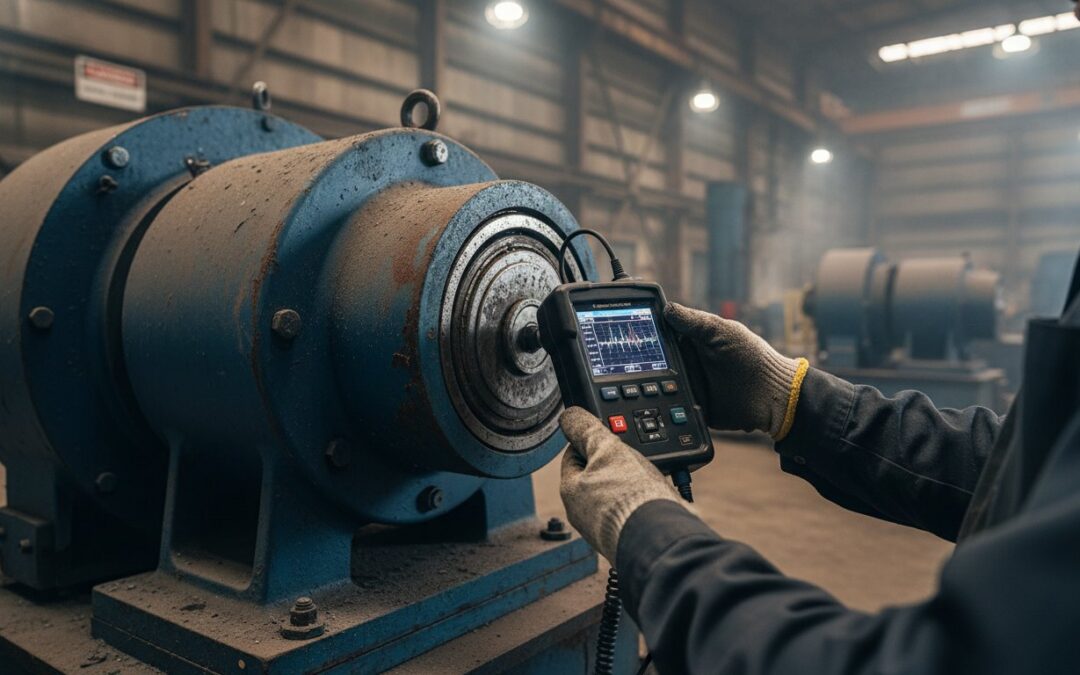
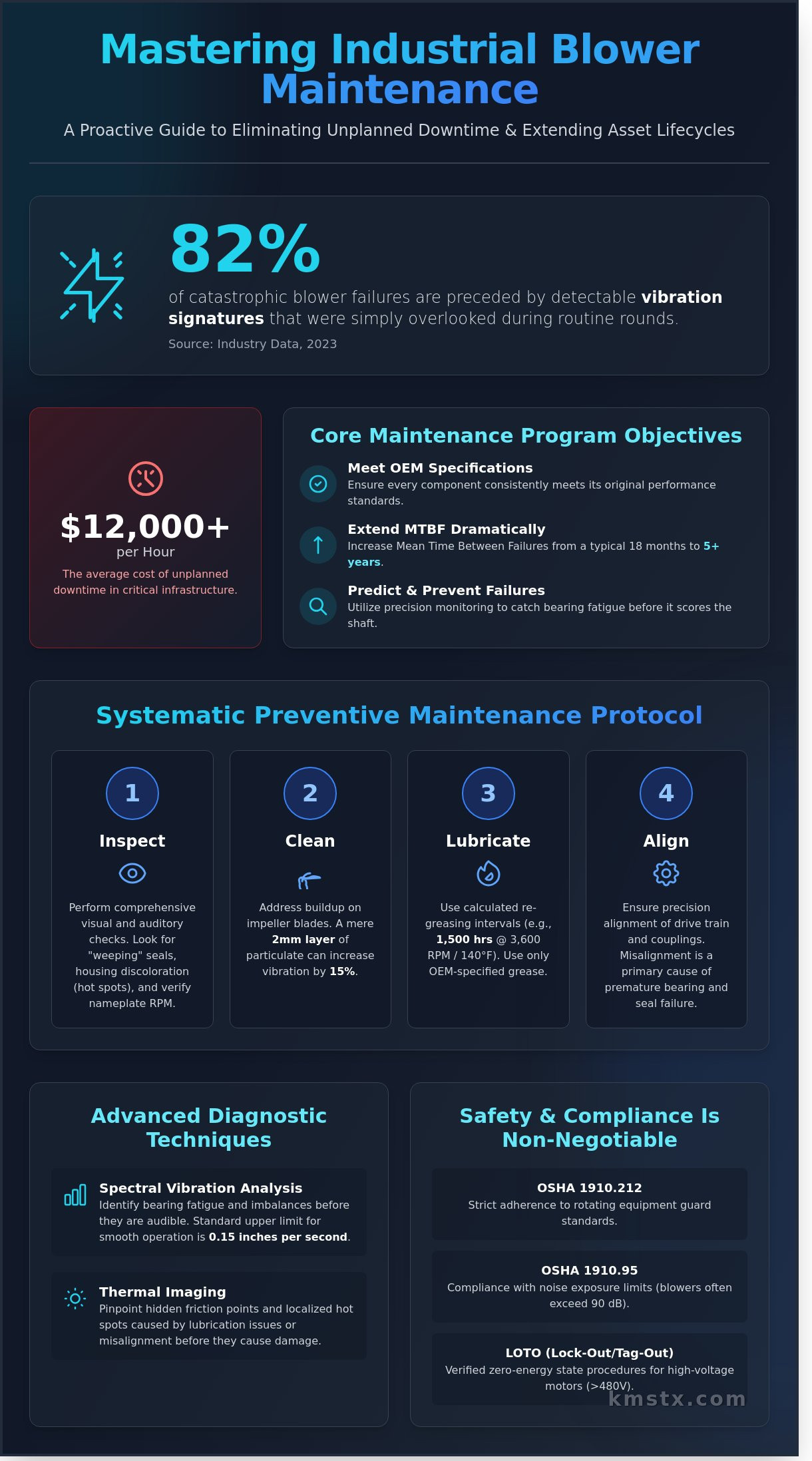
According to industry data from 2023, nearly 82% of catastrophic blower failures are preceded by detectable vibration signatures that were simply overlooked during routine rounds. You’ve likely seen it happen; a small rattle becomes a harmonic scream, and suddenly you’re dealing with three days of lost production and a frustrated plant manager. Effective industrial blower maintenance isn’t just about checking oil levels once a month. It’s about understanding the physics of your rotating assets and catching the subtle signs of bearing fatigue before they turn into a plant-wide headache.
We agree that nothing kills a maintenance budget faster than an emergency shutdown caused by a preventable mechanical issue. This technical guide will help you master systematic protocols to eliminate unplanned downtime and restore your equipment to strict OEM specifications. We’ll break down the specifics of vibration analysis, precision lubrication cycles, and the exact alignment tolerances you need to extend your asset lifecycle well beyond the standard 40,000-hour service interval.
Key Takeaways
- Understand the physics behind high-speed rotation and how a proactive approach to industrial blower maintenance can stop minor imbalances from turning into catastrophic failures.
- Learn to execute a systematic protocol for visual inspections and precision lubrication that keeps your rotating assets running within OEM specifications.
- Identify early-stage bearing fatigue and hidden friction points using advanced diagnostic techniques like spectral vibration analysis and thermal imaging.
- Navigate the technical “repair vs. replace” decision-making process to determine the most cost-effective path for restoring aging blower units.
- Discover how to incorporate specialized blower care into your overall reliability strategy to minimize downtime and secure support for critical infrastructure.
The Fundamentals of Industrial Blower Maintenance and Reliability
Industrial blower maintenance isn’t just a checkbox on a Saturday morning list. It’s a proactive engineering strategy designed to manage the extreme physics of high-speed rotation before they manage your budget. When an impeller spins at 3,600 RPM, even a small 5-gram imbalance creates massive centrifugal forces that chew through bearings and seals. This isn’t just theory; it’s the primary reason why machines that seem to be running fine on Tuesday can suffer a total catastrophic failure by Wednesday afternoon.
To better understand the practical side of these systems, watch this video on the basics of the maintenance process:
Different machines require different approaches. Whether you are dealing with a complex Centrifugal Fan Design, a tri-lobe positive displacement unit, or a regenerative blower, the underlying mechanics dictate your schedule. In critical infrastructure like municipal wastewater plants, unplanned downtime can cost upwards of $12,000 per hour in emergency repairs and regulatory fines. Regenerative blowers, while simpler in construction, still require precise thermal monitoring to prevent housing expansion and internal contact between the impeller and the casing.
The Core Objectives of a Maintenance Program
Success starts by establishing a baseline for operational vibration and thermal signatures. For most industrial units, a vibration velocity of 0.15 inches per second is the standard upper limit for smooth operation. We focus on three main goals:
- Ensuring every component meets its original OEM performance specifications.
- Extending the Mean Time Between Failures (MTBF) from a typical 18-month cycle to 5 years or more.
- Utilizing precision monitoring to catch bearing fatigue before it scores the shaft.
Regulatory and Safety Considerations
Safety isn’t optional in a high-pressure environment. We strictly follow OSHA 1910.212 for rotating equipment guards and 1910.95 for noise exposure limits, as blowers often exceed 90 decibels. High-pressure systems require relief valves calibrated to within 3% of the vessel rating to prevent explosions. Before any technician touches a wrench, lock-out/tag-out (LOTO) procedures must be verified for high-voltage motors, often exceeding 480V, to ensure a zero-energy state. Proper industrial blower maintenance keeps the floor safe and the inspectors away.
A Systematic Protocol for Preventive Blower Maintenance
Effective industrial blower maintenance doesn’t happen by accident. It requires a disciplined sequence of checks that go beyond just listening for a bad bearing. Start with a comprehensive visual and auditory baseline. Look for “weeping” seals or discoloration on the housing, which indicates localized hot spots. Use a handheld tachometer to verify the motor is hitting the specific nameplate RPM. If you hear a high-pitched whine or feel a rhythmic thrumming in the volute, you’re likely looking at an impeller imbalance or a bearing nearing the end of its L10 life.
Buildup on the impeller blades is a silent killer of efficiency. Even a 2-millimeter layer of particulate can throw the rotating assembly out of balance, leading to a 15% increase in vibration levels. Clean the volutes and check the filtration systems thoroughly. If your differential pressure across the filter exceeds 15 inches of water column, you’re starving the machine and forcing the motor to pull excessive amperage. Documenting these readings is vital. According to a 2023 internal reliability study, facilities that maintained a consistent industrial blower maintenance log reduced catastrophic failures by 22% over a 24-month period.
Lubrication Management and Bearing Integrity
Calculations are the backbone of a solid lubrication program. Don’t just pump grease until it squirts out the seals. You need to calculate re-greasing intervals based on the specific RPM and operating temperature. For a bearing running at 3,600 RPM in a 140-degree Fahrenheit environment, your interval might be as short as 1,500 hours. Always use the OEM-specified polyurea or lithium-complex grease; mixing incompatible bases leads to chemical breakdown. Utilizing precision monitoring tools ensures your bearing seals remain intact to block 99.9% of abrasive dust from entering the race.
Drive Train and Coupling Alignment
Alignment is where most shops lose efficiency and hardware. If you’re still using a straightedge and feeler gauges, you’re leaving money on the table. Use laser alignment tools to get your offset and angularity within a 0.005-inch tolerance. This precision reduces parasitic power loss and prevents premature coupling failure. Check your belt sheaves for the “shiny” wear patterns that signal slipping. If a belt shows glazing or cracked ribs, replace the entire set. Don’t mix old and new belts. The tension won’t be uniform, and you’ll end up replacing the whole drive within 90 days.
Advanced Diagnostics: Identifying Sub-Surface Mechanical Stress
Experienced technicians understand that what’s happening beneath the surface often dictates the lifespan of a system. Effective industrial blower maintenance requires moving beyond simple visual checks into the territory of spectral vibration analysis. This technique identifies bearing fatigue at the molecular level, long before a catastrophic failure occurs. By mapping frequency peaks, we can isolate whether a tremor originates from the inner race, outer race, or the rolling elements themselves. This level of precision prevents the unnecessary replacement of healthy components while highlighting the exact point of failure.
Thermal imaging provides a non-invasive look at motor windings and friction points. A delta of 15 degrees Celsius between motor phases often indicates an impending insulation breakdown or electrical imbalance. Similarly, acoustic monitoring tools detect ultrasonic frequencies produced by air leaks or internal mechanical rubbing. These sounds exist far above the human hearing range, yet they provide early warnings of seal degradation. For gear-driven units, analyzing oil samples for metal particulates larger than 5 microns helps pinpoint gear wear before the teeth lose their structural integrity. While blowers typically use grease lubrication, similar diagnostic principles apply to other rotating equipment like reciprocating compressor maintenance, where oil analysis for metal particulates becomes even more critical due to the higher mechanical stress and sliding contact points. Utilizing these diagnostic layers ensures that the mechanical health of the blower is verified by empirical data rather than guesswork.
Vibration Analysis and Harmonic Monitoring
Precision monitoring requires a grasp of three distinct metrics. Displacement measures the total distance of movement, which is critical for low-speed blowers. Velocity tracks the speed of that movement and serves as the primary indicator of overall machine health. Acceleration focuses on high-frequency changes, making it the go-to metric for detecting early bearing defects. When an impeller becomes unbalanced, it creates a 1X vibration signature; this means the vibration occurs once per revolution. Setting alarm thresholds according to ISO 10816 standards ensures the system triggers an emergency shutdown before the shaft deflects beyond recovery limits.
Predictive vs. Reactive Maintenance Models
Modern industrial plants are moving away from calendar-based schedules toward condition-based monitoring. This shift utilizes IoT sensors to provide real-time data on critical blower components. Instead of replacing a bearing every 12 months, teams monitor the data and perform industrial blower maintenance only when the vibration or heat signatures deviate from the baseline. According to a 2022 Department of Energy report, predictive maintenance programs can reduce maintenance costs by 25% to 30% and eliminate 70% of breakdowns. The initial investment in proprietary diagnostic software pays for itself by preventing the massive losses associated with unplanned downtime in high-volume production environments.
When Maintenance Isn’t Enough: The Path to Full Technical Restoration
Every machine eventually hits a wall where standard industrial blower maintenance can’t compensate for decades of metal fatigue or severe cavitation. Deciding between a total overhaul and a full replacement usually involves the 50% rule. If restoration costs exceed half the price of a new unit, replacement is often considered. However, in the current industrial climate, lead times for new heavy-duty blowers often stretch beyond 24 weeks. This makes a technical restoration the most viable path for minimizing operational gaps and avoiding extended downtime.
The restoration process starts with a complete teardown and forensic failure analysis. Technicians use non-destructive testing, such as dye penetrant or ultrasonic inspections, to identify micro-cracks that aren’t visible to the naked eye. When tolerances in the blower housing drift beyond 0.005 inches, custom metal fabrication is required to build up surfaces before precision machining returns the unit to its original geometry. This level of intervention goes far beyond routine industrial blower maintenance, effectively resetting the asset’s lifecycle clock.
The Precision Dynamic Balancing Process
Mechanical vibration is the primary killer of rotating equipment. When preventive measures fail to stabilize a unit, the impeller likely requires dynamic balancing to ISO 21940-11 standards. This process corrects mass distribution errors that cause harmonic resonance. Effective balancing reduces the load on bearings by as much as 85%, preventing premature failure of the entire drivetrain. For facilities in the Gulf Coast region, utilizing professional dynamic balancing services Houston ensures that heavy rotating assets operate within tight vibration limits, often below 0.10 inches per second.
Full Component Refurbishment and OEM Compliance
Restoring legacy systems requires a deep inventory of industrial machine spare parts that meet or exceed original equipment manufacturer specifications. Technicians often re-sleeve bearing housings and shafts to recover 0.0005-inch interference fits. After assembly, the blower undergoes a rigorous 4-hour mechanical run test. This validates seal integrity and thermal stability before the asset is re-commissioned into the production line. This methodical approach ensures the machine performs at its 1995 or 2005 design efficiency today.
Partnering for Reliability: Precision Engineering and Expertise
Effective industrial blower maintenance works best when it’s integrated into a comprehensive rotating equipment maintenance strategy. You shouldn’t treat a blower as a standalone asset. Its performance is fundamentally linked to the motors, couplings, and structural foundations that support it. When critical infrastructure fails at 3:00 AM, waiting for a scheduled shift can cost thousands in lost production. 24/7 emergency support is a necessity for high-stakes operations. Field service technicians bring precision diagnostics directly to your floor, using tools like laser alignment and vibration analysis to solve problems on-site. This immediate response can reduce downtime by 35 percent, keeping your process moving without the delay of traditional shipping and receiving.
Selecting a Technical Service Provider
Choosing a repair partner requires a close look at their technical capabilities. Don’t just ask if they can fix it; ask how they verify the fix. Evaluate their machine shop for specific equipment and standards, such as:
- Dynamic balancing capacity for high-speed rotors to eliminate harmonic vibration.
- Documented quality control that maintains machining tolerances within 0.001 inches.
- Comprehensive warranty coverage that stands behind the mechanical restoration.
A reliable provider always delivers a documented failure analysis report. This document is a forensic look at why the asset failed, pinpointing issues like impeller eccentricities or lubrication breakdown. There’s no substitute for four decades of experience in complex mechanical restoration. A team that’s spent 40 years in the trenches understands the nuances of different alloys and housing geometries that newer shops might overlook.
Next Steps for Maintenance Managers
Your first move should be scheduling a comprehensive site audit for all assets involved in your industrial blower maintenance program. This audit provides a baseline for your entire fleet, identifying which units are nearing the end of their mean time between failures. Use this data to develop a tiered maintenance plan based on asset criticality. Tier 1 blowers, which are essential for continuous operation, should have a rigorous schedule of oil analysis and vibration monitoring. Tier 2 and 3 assets can follow more traditional interval-based care. To get a professional perspective on your facility’s needs, Consult with Kelsey Machine Services. A technical evaluation of your rotating equipment is the most effective way to transition from reactive repairs to a culture of precision reliability.
Strengthen Your Operations with Technical Precision
Effective industrial blower maintenance requires more than a standard grease gun and a vibration probe. It demands a systematic approach to identifying sub-surface mechanical stress before it turns into a catastrophic failure. You’ve seen how routine protocols keep the floor running, but you also know that some assets eventually require a full technical restoration to hit their original performance curves. Balancing field diagnostics with shop-level engineering is the only way to ensure long-term reliability in a high-stakes environment.
Kelsey Machine Services brings over 40 years of industrial experience to every job, from minor adjustments to complete machine shop overhauls. We provide 24/7 emergency field support because we know that downtime doesn’t happen on a convenient schedule. Our facility is fully equipped for OEM-spec restoration, giving your blowers a second life that matches the quality of a new unit. Restore your critical assets with Kelsey Machine Services and get back to peak production levels. We’re here to make sure your equipment stays as tough as your workload.
Frequently Asked Questions
How often should I lubricate the bearings on my industrial blower?
Lubrication intervals typically fall between 1,000 and 2,000 hours of operation depending on bearing temperature and shaft speed. For a centrifugal unit running at 3,600 RPM in a 100 degree Fahrenheit environment, you’ll likely need to regrease every 3 months. Always check the manufacturer’s specific grease volume requirements. Over-greasing causes 70 percent of premature bearing failures by increasing internal friction and heat.
What are the most common causes of industrial blower failure?
Unbalance and misalignment account for roughly 80 percent of mechanical issues in industrial blower maintenance programs. When dirt builds up on the impeller blades or a coupling shifts by even 0.005 inches, vibration levels spike. This stress destroys bearings and seals quickly. Regular inspections of the inlet filters and housing can prevent these common failure modes before they trigger an emergency shutdown.
Can dynamic balancing be performed on-site, or does the blower need to be pulled?
Dynamic balancing is frequently performed on-site using portable vibration analyzers to save the 48 to 72 hours typically lost during transport. Technicians attach trial weights to the impeller while it’s in its own bearings to correct for “as-run” conditions. However, if the shaft is bent or the hub is severely worn, the rotor must be pulled for shop balancing on a dedicated machine.
How do I know if my blower needs a simple repair or a full refurbishment?
You’ll need a full refurbishment if internal clearances exceed the manufacturer’s spec by more than 15 percent or if there’s visible structural fatigue. A simple repair covers bearing swaps or belt tensions. If your vibration readings stay above 0.25 inches per second after a basic tune-up, it’s a sign of deeper internal wear. Refurbishment returns the unit to its original performance curve.
What is the ideal vibration threshold for a high-speed centrifugal blower?
An ideal vibration level for a high-speed centrifugal blower is 0.10 inches per second or lower when measured at the bearing housing. Once readings hit 0.15 inches per second, you’ve entered the “fair” range where monitoring should increase. If the velocity reaches 0.30 inches per second, the risk of catastrophic failure is high. Consistent data logging helps you spot these trends before they’re critical.
Is it possible to restore a blower that has suffered housing erosion?
Restoration is possible through specialized thermal spray coatings or high-performance epoxy resins that rebuild the internal surface. These methods can recover up to 0.125 inches of lost material in the volute or housing. It’s often 40 percent faster than waiting for a custom-cast replacement shell. You’ll just need to ensure the coating is compatible with the chemical makeup of the process gas.
What are the benefits of switching from reactive to predictive maintenance?
Switching to predictive maintenance can reduce your overall repair costs by 25 percent and cut unplanned downtime by nearly half. Instead of waiting for a bearing to seize, you’re using ultrasound or thermography to catch issues 6 months before they cause a crash. It lets your team schedule industrial blower maintenance during planned turnarounds. This shift moves your operation from a state of constant fire-fighting to controlled reliability.