
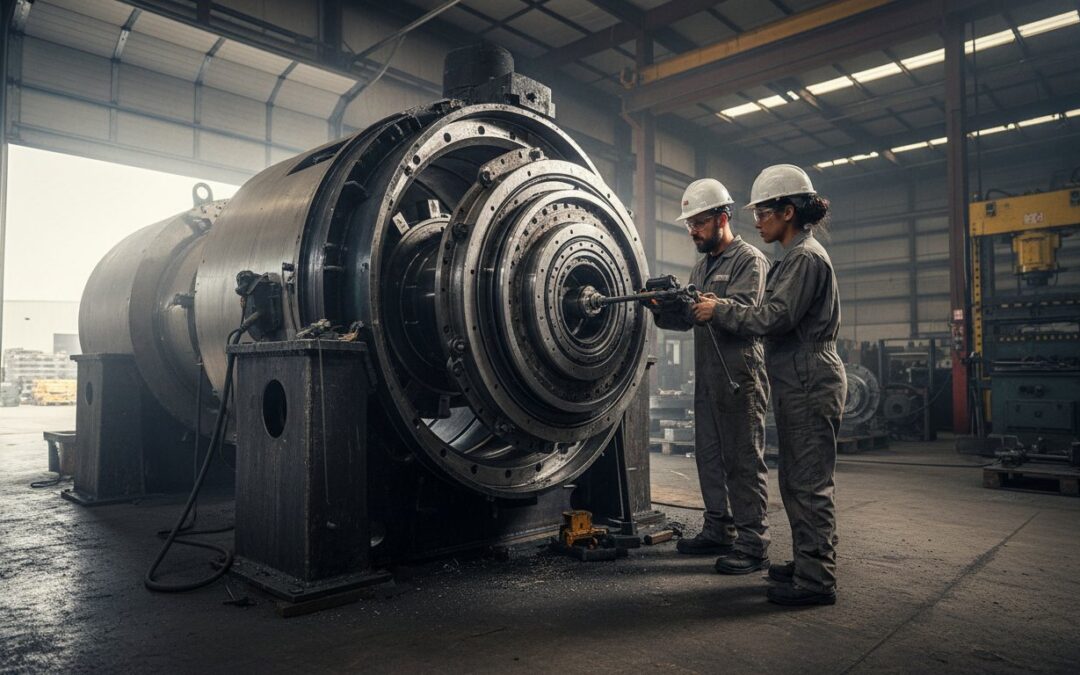
If you’re still running a heavy decanter on manual protocols, you’re already behind the 70% of the market that has transitioned to automated, data-driven maintenance as of 2026. We’ve all been there when a slight increase in vibration leads to a catastrophic bearing failure, leaving you with a massive repair bill and a production line that isn’t moving. It’s difficult to find specialized technicians who understand the tight tolerances of a heavy industrial centrifuge; the high cost of unplanned downtime can easily exceed a typical 10% to 15% emergency maintenance contingency budget.
This guide provides a technical deep-dive into heavy industrial centrifuge mechanics, maintenance protocols, and the precision repair processes required to eliminate downtime. You’ll learn how to restore operational efficiency through verified dynamic balancing and ensure your facility complies with the new January 1, 2026, EPA HFC restrictions for refrigerated process units. We’ll examine the specific mechanical restoration steps that extend equipment life and keep your high-speed operations running at peak performance through rigorous technical standards.
Key Takeaways
- Learn why heavy-duty separation requires a different mechanical approach than lab-scale equipment to handle massive solid-liquid loads.
- Identify the specific vibration and heat signatures that signal an impending bearing or gearbox failure before it stops your production line.
- Discover the step-by-step industrial centrifuge repair process, from full decontamination to meeting strict OEM dimensional specifications.
- Establish a maintenance routine centered on precise lubrication and flushing to prevent the common “solids-slugging” that ruins rotating assemblies.
- Understand why shop-based restoration is necessary for high-speed assets to achieve the tight tolerances that on-site field repairs simply can’t match.
What is an Industrial Centrifuge? Defining Heavy-Duty Separation
If you’ve spent any time in a wastewater plant or on a drilling rig, you know that a heavy-duty separator has nothing in common with the small benchtop units found in medical labs. While those small models spin test tubes at high RPMs, heavy industrial units are engineered to process thousands of gallons of slurry per hour. To grasp the basics of What is a Centrifuge in a commercial context, you have to look at the massive rotating assemblies that handle high-solids volumes. These machines utilize centrifugal force, often exceeding 3,000 Gs, to achieve rapid liquid-solid separation that would take days to occur naturally through gravity settling alone.
In sectors like oilfield processing and chemical manufacturing, the sheer rotating mass of these units creates immense mechanical stress. It isn’t just about speed; it’s about torque and the ability to move heavy solids continuously without seizing. This requires specialized engineering that accounts for dynamic loads and abrasive wear. With the global industrial centrifuge market reaching USD 10.28 billion in 2026, the demand for high-capacity separation has driven manufacturers to push the limits of metallurgy and automated control systems.
To see these principles in action on a practical level, watch this breakdown of common mechanical issues:
Decanter Centrifuges vs. Disc Stack Separators
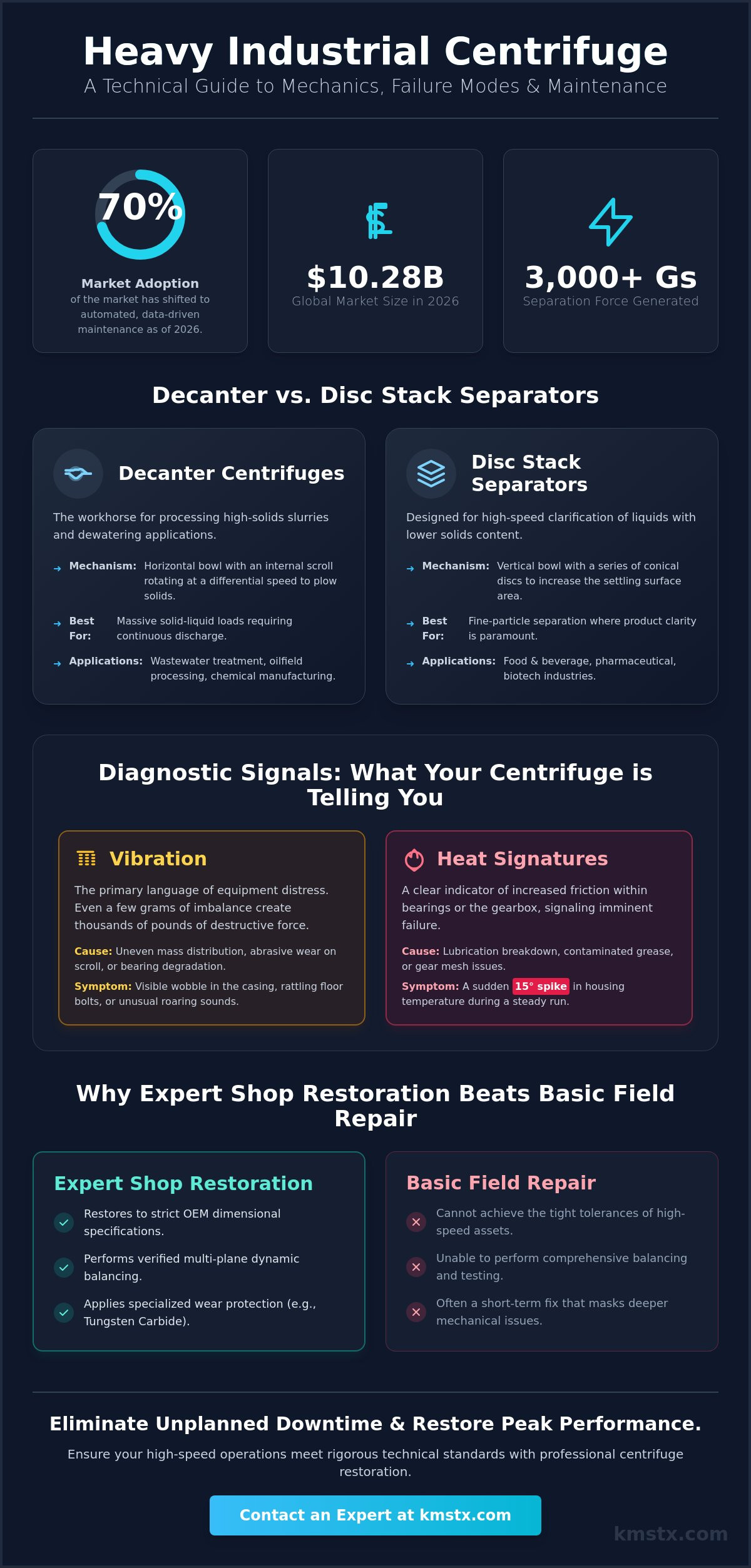
Choosing between these two configurations depends entirely on your feed material and the desired clarity of the final product. Horizontal decanters are the workhorses for high-solids slurries, using a continuous internal scroll to push dewatered solids out one end while clarified liquid exits the other. Disc stack separators operate vertically and are designed for high-speed clarification of liquids with much lower solids content. They utilize a series of conical discs to increase the settling area, which makes them ideal for fine-particle separation in food or pharmaceutical applications where precision is paramount.
The Critical Components of Rotating Assemblies
The heart of any decanter is the relationship between the bowl and the scroll. These two components rotate at slightly different speeds, a delta known as the differential speed, which allows the scroll to plow solids through the bowl toward the discharge ports. This movement is managed by planetary gearboxes and main bearings that must withstand constant heat and extreme vibration. Because these parts operate under such tight tolerances, a standard field fix often falls short. Professional industrial centrifuge repair focuses on restoring these rotating assemblies to their original OEM specifications. This often involves applying tungsten carbide wear liners or specialized tiling to protect the scroll from abrasive materials that would otherwise scour the base metal and cause an imbalance.
Common Failure Modes and Diagnostic Signals
Vibration isn’t just a nuisance; it’s the primary language your rotating equipment uses to tell you it’s dying. In a high-speed centrifuge, even a few grams of uneven mass distribution can generate thousands of pounds of force. This kinetic energy eventually finds the path of least resistance, usually through your bearings or the machine’s structural mounts. If your floor bolts are rattling or you’re seeing a visible wobble in the casing, the internal rotating assembly is likely already suffering from significant mass displacement.
Heat signatures are equally telling indicators of distress. Monitoring the temperature of main bearings and gearbox housings should be a standard part of any professional diagnostic routine. If you notice a sudden 15-degree spike in housing temperature during a steady-state run, it’s a clear signal that friction has increased. This is typically caused by lubrication breakdown, contaminated grease, or a gear mesh issue within the drive system. Ignoring these signals often leads to a seized assembly that requires a total rebuild rather than a simple bearing swap.
Feed consistency is another factor that operators often overlook until it’s too late. When the solids concentration in your feed fluctuates by more than 10%, the internal bowl dynamics change instantly. This can lead to “slugging,” where a dense mass of solids hits one side of the bowl, causing a momentary but violent imbalance. Adhering to OSHA safety requirements regarding vibration interlocks and machine guarding is essential here. These sensors are often the only thing preventing a catastrophic mechanical failure when the feed quality goes south.
Vibration Analysis and Dynamic Imbalance
It’s vital to distinguish between structural resonance, where the frame itself vibrates at a specific frequency, and true mechanical imbalance. If the vibration follows the RPM of the bowl precisely, you’ve got a mass distribution problem. We use precision dynamic balancing to correct these issues within microns. Operating outside of specified vibration tolerances for even a single shift can shave months off your bearing life and lead to unplanned downtime that costs thousands per hour.
Wear Patterns in High-Solids Applications
Abrasive slurries are the natural enemy of scroll efficiency. Over time, the leading edges of the scroll flights and the discharge ports will erode, leading to wetter cake and lower recovery rates. Seal failure is another silent killer. Once a mechanical seal fails, process fluid or abrasive fines can migrate directly into the main bearings, turning your lubricant into a grinding paste. Using Non-Destructive Testing (NDT) methods like dye penetrant or ultrasonic testing allows us to catch fatigue cracks before they turn into structural breaks. Catching these issues early ensures your centrifuge repair remains a manageable maintenance task rather than an emergency rebuild.
The Industrial Centrifuge Repair and Refurbishment Process
When a heavy-duty centrifuge arrives at the service center, the first 24 hours are critical for diagnostic accuracy. We don’t just pull it apart; we document the as-found state to understand the root cause of the failure. This involves a full teardown and decontamination of the rotating assembly because you can’t identify hairline fractures or fatigue points under layers of process scale. According to industry standards updated for 2026, a comprehensive shop inspection provides a level of detail that field services simply can’t match, especially when dealing with tolerances measured in the thousandths of an inch.
Decontamination is followed by a rigorous inspection of every critical surface. We look for specific wear patterns that tell a story, such as gear pitting in the planetary system or uneven erosion on the bowl wall. This isn’t just about cleaning parts; it’s about verifying that the metallurgy and geometry of the machine still meet the original design intent. If a machine has been running in an imbalanced state, the damage often extends far beyond the bearings, affecting the structural integrity of the entire frame and housing.
Teardown, Inspection, and NDT
Root cause analysis is the backbone of a successful refurbishment. We utilize Non-Destructive Testing (NDT) to see what the naked eye misses. Dye penetrant and ultrasonic testing are mandatory to verify the structural integrity of the bowl and scroll. If there’s a fatigue crack in a high-speed rotating mass, it’s a ticking time bomb. We also strip the gearbox to inspect bearing races and gear teeth for any signs of heat-related hardening or mechanical spalling that could lead to a catastrophic lock-up.
Precision Machining and Component Restoration
Restoration is often more cost-effective and faster than waiting on OEM lead times for new parts. We utilize custom machining to bring worn components back to their original specifications. For example, scroll flights are frequently hard-surfaced with tungsten carbide tiles or spray-on coatings to combat abrasive wear. If bearing fits have become wallowed out due to a spun bearing, we bore and sleeve those housings to restore the precise interference fits required for high-speed operation. Every individual component is checked for balance before it even touches the final assembly.
Final Dynamic Balancing and Shop Testing
The final phase is where the repair is proven. We perform full-speed dynamic balancing of the entire rotating assembly. A component that’s balanced individually might still vibrate when coupled with the rest of the drive train. We verify that the gearbox torque and differential speed control are functioning exactly as intended. This process concludes with a full performance report and warranty certification, giving you the confidence that the machine will run reliably once it’s back on your site. This level of verification is why shop-based repair remains the gold standard for heavy industrial assets.
Maximizing Reliability through Preventive Maintenance
Preventive maintenance isn’t just a clipboard exercise; it’s the difference between a machine that runs for ten years and one that fails in two. For high-speed bearings, lubrication is the lifeblood of the entire system. These components often spin at 3,000 RPM or higher, and a missed grease cycle leads to thermal expansion that can destroy a bearing race in minutes. We recommend a strict schedule based on actual operating hours rather than calendar days to ensure the grease stays fresh and the operating temperature stays within safe limits.
Flushing the system is just as vital for long-term health. If you shut down a decanter without a proper cleaning cycle, the remaining solids can settle and harden against the bowl wall. This is known as “solids-slugging.” When you restart, that hardened mass creates a massive imbalance that can shake the machine off its mounts. It’s also wise to pull oil samples from the gearbox every 500 hours. Monitoring for metal particulates or water contamination in that oil is like a blood test; it tells you exactly what’s happening inside the gear mesh before a tooth shears off.
Training your crew to listen to the machine is a high-value skill. A healthy unit has a consistent, low-frequency hum. If you start hearing high-pitched whistling or feeling a rhythmic thrum through the floorboards, something is wrong. Operators should be empowered to hit the E-stop before a small vibration turns into a major rebuild. With over 70% of industrial centrifuges moving toward automated monitoring by 2026, using smart sensors to back up your operators’ instincts is the smartest way to manage risk.
Operational Best Practices for Longevity
Managing your feed rate is the easiest way to prevent premature wear. Overloading the scroll doesn’t just lower your cake dryness; it puts excessive torque on the gearbox and drive motor. You should also keep a close eye on your polymer dosing. If your chemistry is off, the centrifuge has to work twice as hard to achieve the same separation. Following a structured rotating equipment maintenance plan ensures that these small operational details don’t snowball into a $6,000 emergency inspection fee.
Spare Parts Management and Inventory
You don’t want to be searching for a specific mechanical seal while your plant is at a standstill. We suggest keeping a “critical spares” kit on-site that includes seals, bearings, and discharge nozzles. Developing a proactive industrial machine spare parts strategy allows you to vet aftermarket versus OEM components before you’re in a crisis. For critical rotating components, always prioritize parts that meet or exceed original dimensional specifications to maintain the balance of the assembly. If your inventory is currently lacking, you can secure your supply chain by reviewing our spare parts inventory today.
Why Expert Restoration Beats Basic Field Repair
Field repairs are often tempting when you’re facing a production bottleneck, but they rarely address the root cause of a mechanical failure. When you’re dealing with a high-speed centrifuge, the physics of rotation don’t allow for shortcuts. A technician in the field might be able to swap a bearing or a seal, but they can’t verify the concentricity of the bowl or perform a full-speed dynamic balance on a gravel pad or a vibrating plant floor. These “quick fixes” often result in a machine that runs, but with a shortened lifecycle that leads back to the same failure point within months.
Choosing a shop-based industrial centrifuge repair ensures that every component is measured against OEM dimensional specifications in a controlled environment. At Kelsey Machine Services, we’ve spent over 40 years refining our restoration process for heavy industrial assets. We understand the financial pressure of unplanned downtime, especially since some companies charge up to $6,000 just for an initial inspection. Our goal is to provide a comprehensive restoration that justifies your 10% to 15% maintenance contingency budget by delivering a machine that performs like new.
Precision is the only way to eliminate the excessive vibration that leads to premature bearing failure. In our facility, we utilize specialized balancing equipment that can detect mass displacement that is invisible to the naked eye. This level of detail is what separates a basic repair from a true restoration. We don’t just get the machine spinning; we ensure it’s balanced to the tightest tolerances possible to protect your long-term operational efficiency.
The KMS Difference: Engineering Excellence
Our team brings a scientific approach to every teardown. We provide full-service capabilities for decanters, disc stack separators, and complex planetary gearboxes. By utilizing CNC machining and advanced diagnostic tools, we can create custom solutions for worn components that are no longer available from the manufacturer. Every repair is warranted and documented, ensuring that your equipment meets the rigorous standards required for the energy and chemical sectors. We prioritize technical credibility over marketing fluff because we know your facility relies on data, not promises.
Getting Your Equipment Back Online
When a critical failure occurs, every hour of lost production impacts your bottom line. We’ve structured our emergency machine repair services to provide 24/7 support for the Gulf Coast and beyond. From the moment you contact us, we coordinate the logistics for transport and initiate an immediate technical assessment. We provide clear, direct communication regarding the scope of work and the timeline for restoration. If you’re seeing signs of distress in your rotating assets, don’t wait for a total breakdown. Contact Kelsey Machine Services today for a technical consultation and let our experts restore your operational reliability.
Protecting Your High-Speed Separation Assets
Maintaining heavy-duty separation equipment requires more than just basic mechanical knowledge; it demands a commitment to precision and technical rigour. We’ve explored how identifying vibration signals early and adhering to shop-based restoration protocols can prevent the catastrophic failures that lead to expensive, unplanned downtime. By prioritizing dynamic balancing and utilizing in-house machining, you ensure your machinery meets the strict OEM tolerances necessary for continuous operation in the 2026 industrial landscape. Avoiding the $6,000 inspection fees associated with emergency calls starts with a disciplined approach to maintenance.
With 40+ years of rotating equipment experience and full 24/7 emergency response capability, Kelsey Machine Services is ready to handle your most complex mechanical challenges. Our comprehensive in-house machining and dynamic balancing services are designed to restore performance and extend operational lifecycles. Don’t let a minor imbalance turn into a major production loss. Request a technical consultation for your industrial centrifuge repair today. We’ll help you keep your facility running at peak efficiency with the steady reliability your operations demand.
Frequently Asked Questions
What is the difference between a decanter and a disc stack centrifuge?
Decanters are horizontal units engineered to handle high-solids slurries, often containing up to 60% solids, by using a continuous scroll to discharge dewatered material. Disc stack separators are vertical machines designed for clarifying liquids with low-solids concentrations, typically under 10%, at much higher rotational speeds. While the decanter excels at volume dewatering, the disc stack is the preferred choice for high-precision liquid clarification.
How often should an industrial centrifuge be balanced?
You should balance your equipment every time the rotating assembly is pulled for major maintenance or if vibration levels exceed 0.5 inches per second (ips). Industry data from early 2026 indicates that 70% of high-speed rotating assets require a precision balance after any scroll or bowl repair. Regular monitoring ensures that mass distribution remains uniform, which prevents the mechanical fatigue that leads to catastrophic failure.
What causes a centrifuge to vibrate excessively?
Excessive vibration is usually triggered by uneven solids buildup, worn main bearings, or significant erosion on the internal scroll flights. When the feed consistency fluctuates or a flush cycle is missed, “slugging” occurs, which creates an immediate and violent mass imbalance. External factors like loose foundation bolts or structural resonance in the mounting frame can also amplify these internal vibration signals.
Can a worn centrifuge scroll be repaired or must it be replaced?
Most worn scrolls are fully repairable through hard-surfacing and custom machining as long as the base metallurgy hasn’t suffered deep structural cracking. We typically restore the leading edges of scroll flights using tungsten carbide tiles or specialized spray-on coatings to enhance abrasive resistance. This restoration process is often 40% to 60% more cost-effective than ordering a new OEM replacement with a long lead time.
How long does a typical industrial centrifuge refurbishment take?
A comprehensive refurbishment generally takes between two and four weeks, depending on the extent of component wear and the availability of specialized seals or bearings. This timeframe includes the initial 24-hour diagnostic teardown, NDT integrity testing, precision machining, and final dynamic balancing. If custom parts need to be fabricated in-house, you should expect the process to take an additional seven to ten days.
What are the signs that my centrifuge gearbox is failing?
The primary indicators of gearbox distress are a sudden 15-degree spike in housing temperature or the presence of metal flakes in the oil. If you hear rhythmic grinding or notice the differential speed becoming unstable during operation, the planetary gears are likely suffering from spalling or fatigue. Catching these signs early through regular oil analysis prevents a total gear seizure that would require a complete drive replacement.
Why is dynamic balancing critical for centrifuges?
Dynamic balancing is critical because it neutralizes the massive kinetic forces that would otherwise destroy bearings and seals at high RPMs. A minor imbalance of just a few grams can generate thousands of pounds of force when the machine is spinning at 3,000 RPM. Proper balancing ensures the unit runs smoothly, which protects the structural integrity of the machine and extends the time between major service intervals.
Does Kelsey Machine Services provide 24/7 emergency centrifuge repair?
Yes, Kelsey Machine Services provides 24/7 emergency response for critical equipment failures throughout the Gulf Coast. We know that unplanned downtime can cost a facility thousands of dollars in lost production every hour. Our team is ready to coordinate immediate transport and begin the diagnostic teardown process as soon as your machine arrives at our facility.