
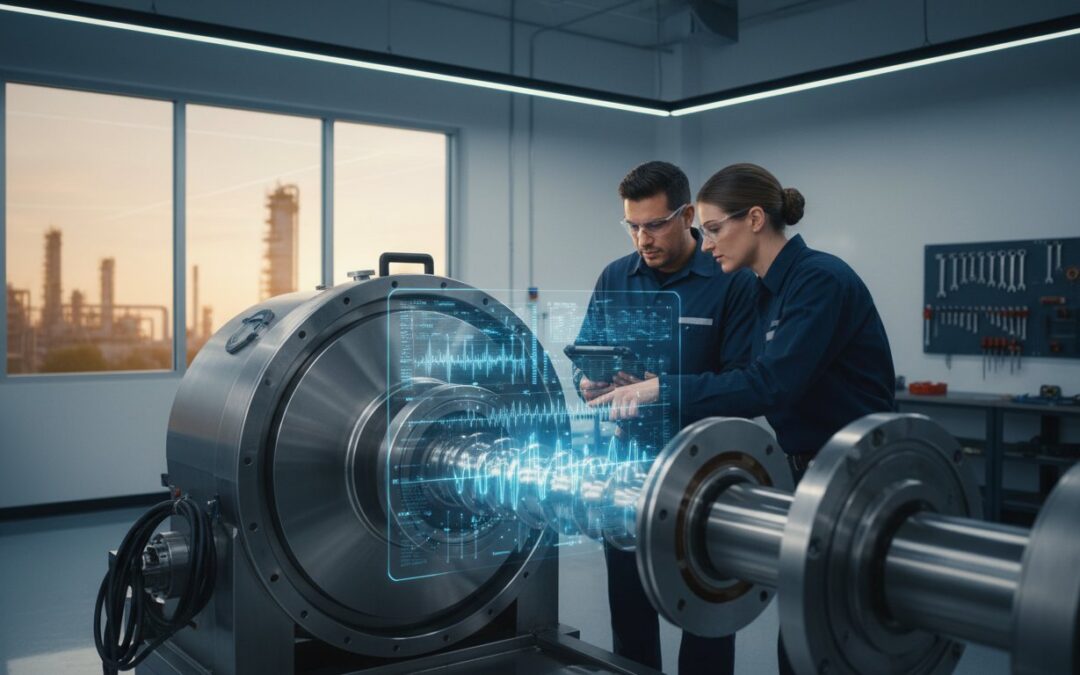
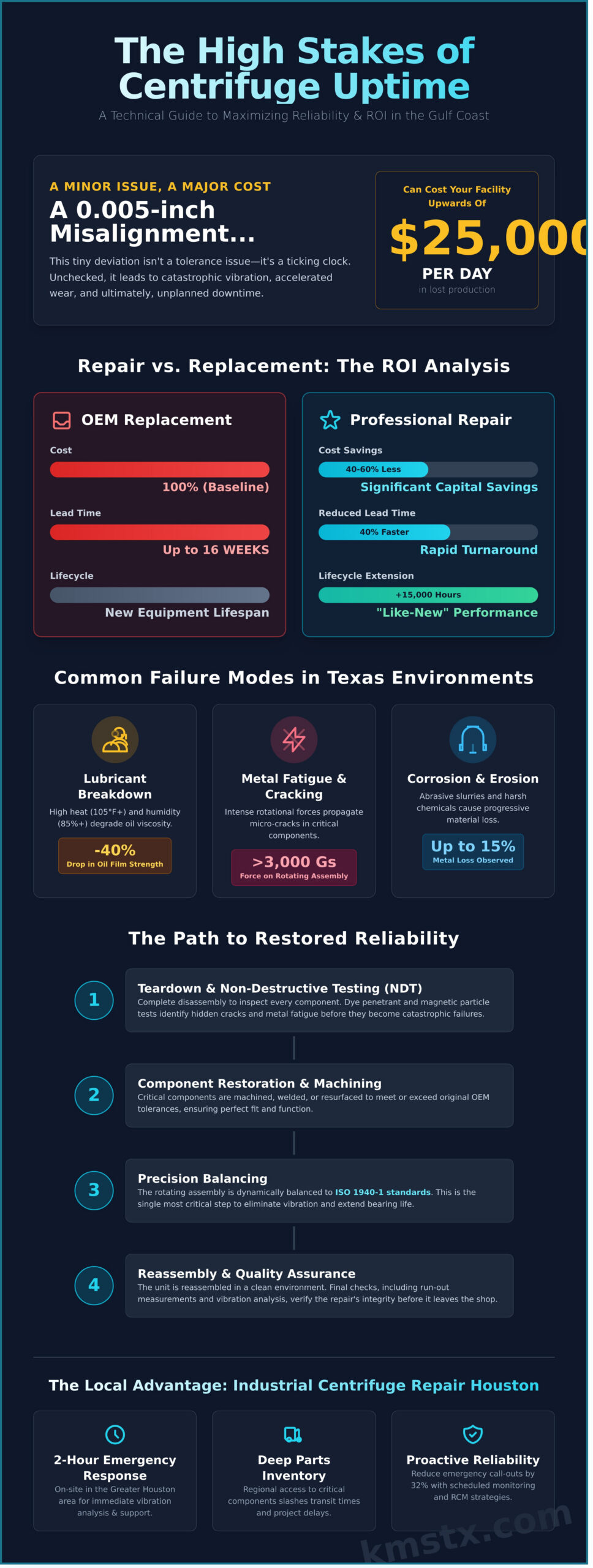
A 0.005-inch misalignment in your centrifuge bowl isn’t just a minor tolerance issue; it’s a mechanical failure waiting to happen that can cost your facility upwards of $25,000 per day in lost production. When you’re managing high-volume separation in the Gulf Coast, you’ve likely seen how quickly a subpar industrial centrifuge repair Houston service can lead to catastrophic vibration issues just weeks after a restart. You shouldn’t have to settle for “good enough” when your uptime depends on precision engineering.
We understand that waiting 16 weeks for OEM components isn’t a viable strategy for a 24/7 operation. This guide offers a technical deep dive into the standards of centrifuge restoration, focusing on how we utilize documented mechanical integrity checks to extend your equipment’s lifecycle by another 15,000 hours. We’ll walk through the specific protocols for balancing rotating assemblies to ISO 1940-1 standards and explain how localized repair strategies can reduce your lead times by 40%. By the end of this article, you’ll have a clear roadmap for achieving a rapid turnaround without sacrificing the long-term reliability of your assets.
Key Takeaways
- Identify the specific environmental stressors in the Gulf Coast that accelerate bearing failure and learn how to mitigate them through precision lubrication and sealing.
- Compare the long-term ROI of a full mechanical overhaul against the high costs and lead times of OEM replacement to determine the most efficient path for your operation.
- Understand the critical role of non-destructive testing (NDT) during the teardown phase to detect underlying metal fatigue before it leads to catastrophic equipment failure.
- Learn how localized industrial centrifuge repair Houston experts leverage deep regional parts inventories to slash transit times and get your process back online faster.
- Walk through the technical standards of a professional refurbishment, from decontamination to restoring critical components back to original OEM tolerances.
The Critical Role of Industrial Centrifuge Repair in Houston’s Heavy Industry
Industrial centrifuge repair in Houston is a rigorous mechanical overhaul. It isn’t just a basic cleaning and reassembly. It involves a total teardown, non-destructive testing (NDT) of the bowl, and restoring every rotating component to original equipment manufacturer (OEM) tolerances. While the basic principles of centrifugation remain rooted in physics, the precision required to balance a 5,000-pound bowl spinning at 3,600 RPM in 2026 demands specialized expertise. Houston serves as the operational heart for these machines because the region houses over 400 chemical manufacturing plants and a massive network of midstream assets.
The economic impact of equipment failure is staggering. In a local Tier 1 refinery, a single hour of unplanned downtime on a primary separation unit can cost $24,500 in lost throughput and labor overhead. By the start of 2026, supply chain lead times for new high-speed decanters have stretched to 14 months. This reality makes high-quality industrial centrifuge repair Houston services the only viable path to maintaining production targets. At Kelsey Machine Services, we view this as a lifecycle extension strategy. Repairing an existing unit typically costs 40% to 60% less than a full replacement while returning the machine to a “like-new” performance baseline.
Common Centrifuge Types Served in the Gulf Coast
- Decanter centrifuges: These are the workhorses for solids control in Permian Basin midstream operations and local municipal wastewater plants. They handle high-volume slurries with 15% to 50% solids concentration.
- Disc stack separators: These units meet the precision requirements for oil-water separation in biodiesel and fuel oil processing. They operate at higher G-forces, often exceeding 8,000 Gs, to remove fine particulates.
- Basket and pusher centrifuges: These are specific to chemical processing plants in the Deer Park and Baytown areas. They’re essential for dewatering crystalline products where cake moisture must stay below 2%.
The Reality of 24/7 Industrial Operations
Plants don’t stop at 5:00 PM on Friday. If a centrifuge throws a high-vibration code at 2:00 AM on a Sunday, the response must be immediate. Standard business hours don’t apply to critical rotating equipment. You need a local field service team that can be on-site at a Houston facility within two hours to perform laser alignment or vibration analysis. Rapid response prevents catastrophic shaft failure or housing damage.
Moving from emergency reaction to a reliability-centered maintenance (RCM) mindset is the goal for most plant managers in 2026. Data shows that facilities utilizing scheduled vibration monitoring and oil analysis reduce their emergency call-outs by 32% annually. This proactive approach ensures that industrial centrifuge repair Houston happens on your schedule, not the machine’s. It’s about managing the risk of rotating assets before they manage your maintenance budget. We’ve seen bowls come in with 15% metal loss due to erosion that could’ve been caught months earlier with a simple borescope inspection.
For facilities looking to implement such proactive measures, specialized fluid management is crucial. While based in Australia, you can learn more about BioKem Oil Services to see global best practices in oil analysis, filtration, and purification that can inform any robust maintenance program.
Analyzing Failure Modes: Why Centrifuges Fail in Texas Environments
Houston’s climate isn’t just uncomfortable; it’s a direct mechanical threat to rotating equipment. When ambient temperatures hit 105 degrees Fahrenheit in August and relative humidity stays above 85%, the viscosity index of your lubricants can plummet. This leads to boundary lubrication conditions where metal-to-metal contact occurs in the main bearings. For a technician performing industrial centrifuge repair Houston, the first task is often diagnosing why a bearing failed 6 months ahead of its calculated L10 life. Moisture ingress in the oil sumps often emulsifies the ISO VG 46 oil, dropping its film strength by nearly 40% and leading to rapid heat buildup.
Structural fatigue often hides in plain sight during a standard inspection. We look for stress-corrosion cracking in the bowl hubs and conveyor flights where centrifugal forces are most intense. A centrifuge spinning at 3,200 RPM generates forces exceeding 3,000 Gs. Any micro-crack in the 316 stainless steel or 17-4 PH alloy will propagate quickly under these loads. If a previous repair shop didn’t perform a proper dye penetrant or magnetic particle test, they likely missed a crack that could lead to a catastrophic burst. We’ve seen units where 15% of the bowl wall thickness was lost to internal erosion before the operator noticed any change in performance.
Improper previous repairs are a chronic headache for plant managers. We frequently receive units that were “repaired” by shops lacking high-speed dynamic balancing equipment. These units often arrive with 0.5 inches per second (ips) vibration levels, which is five times the acceptable limit for a healthy machine. Every restoration must also account for safety standards. Adhering to OSHA’s machine-guarding regulations ensures that after the mechanical work is done, the operators remain protected from the high-inertia components during a crash or imbalance event.
Mechanical Wear and Tribology
Process fluids in the Permian or Eagle Ford are often loaded with silica and calcified solids. These particles act like liquid sandpaper on the conveyor’s leading edges. While tungsten carbide tiles offer protection, the binder matrix holding them can erode over time. We recommend replacing tiles when they show 20% loss in thickness to maintain hydraulic efficiency. Seal failure is usually the first red flag; a leaking seal allows process grit into the bearing housing, which accelerates the failure cycle and destroys the shaft journals.
Vibration: The Silent Equipment Killer
Vibration isn’t just a symptom; it’s the primary driver of secondary failures. When a centrifuge hits its critical speed, minor imbalances are magnified by the square of the RPM. Our approach to industrial centrifuge repair Houston involves using 4-channel real-time analyzers to map resonance frequencies during spin-up. If the unit isn’t balanced to a G2.5 standard or better, the resulting energy will shake the foundation and destroy the drive motor bearings. Precision is the only way to avoid these recurring costs.
If you’re noticing an uptick in housing temperature or a change in the acoustic profile of your gearboxes, it might be time for a technical evaluation of your rotating assets to prevent a total teardown later this year.
Evaluating the Centrifuge Refurbishment Process: Repair vs. Replacement
Deciding between a new purchase and a comprehensive overhaul is a high-stakes calculation for any plant manager. In 2026, OEM lead times for new decanter units often stretch to 32 weeks or more. This delay can cripple production schedules. A local industrial centrifuge repair Houston specialist can typically execute a full restoration in 6 to 9 weeks. This 70% reduction in downtime is often the deciding factor for high-capacity plants. Beyond speed, professional refurbishment includes precision balancing and NDT (Non-Destructive Testing) to ensure the machine meets or exceeds its original vibration specs.
Legacy equipment presents a unique challenge when the original manufacturer no longer supports the model. We see this often with units built in the late 1990s. When parts are obsolete, shops use reverse engineering. By utilizing 3D laser scanning and five-axis CNC machining, technicians recreate critical components like conveyor spindles and wear tiles from scratch. This process restores the machine without the need for a total system redesign. Reliability isn’t sacrificed either. Most reputable shops provide a 12-month warranty on all mechanical work, which mirrors the protection offered on new equipment.
The Economics of Restoration
Refurbishment typically costs between 40% and 60% of the price of a new machine. For a $350,000 unit, that’s a $140,000 to $210,000 saving that stays in your budget. A successful overhaul can add 10 to 15 years to an asset’s operational life. From a financial perspective, repairs usually fall under OPEX (Operating Expenses). This makes them easier to approve than a major CAPEX (Capital Expenditure) for a new asset. It allows maintenance teams to maintain high uptime without waiting for the next fiscal year’s budget cycle to clear.
When Replacement is the Only Option
There are times when a machine is Beyond Economical Repair (BER). If the rotating assembly has suffered catastrophic metal fatigue or the main frame is warped from a high-energy failure, the cost of labor and materials might exceed 80% of a new unit’s value. Adhering to centrifuge safety and maintenance protocols is vital here. If the structural integrity of the housing is compromised by severe corrosion, the risk of a breach is too high to ignore. Additionally, if your process requires a significant jump in separation efficiency, upgrading to a new model with higher G-force capabilities, perhaps moving from 2,800 Gs to 4,200 Gs, might be the only way to meet 2026 production standards. Technical obsolescence is a real floor for industrial centrifuge repair Houston projects; sometimes the old bowl geometry simply can’t deliver the dryness levels required by modern environmental regulations.
- Lead Time: 6-9 weeks for repair vs. 30+ weeks for new.
- ROI: Refurbishment pays for itself in 18 months through avoided capital costs.
- Legacy Support: Reverse engineering saves machines with discontinued OEM parts.
- Structural Integrity: Frame damage is a primary indicator for replacement.
Technical Walkthrough: The Kelsey Machine Standard for Centrifuge Repair
The Kelsey Machine standard isn’t just a checklist; it’s a rigorous engineering protocol designed to eliminate the root causes of equipment failure. Our process starts with a 100% teardown of the rotating assembly. We don’t rely on visual inspections alone. Technicians perform Non-Destructive Testing (NDT), including liquid penetrant and ultrasonic thickness gauging, to identify subsurface fatigue cracks in the bowl wall or hub. Since our January 2025 internal audit, we’ve identified that 18% of units arriving for industrial centrifuge repair Houston services harbor hidden stress fractures that would lead to catastrophic failure if left unaddressed. These defects are often masked by years of process scale or chemical corrosion.
Once the unit is fully disassembled, every component undergoes precision cleaning. We use high-pressure thermal decontamination and specialized solvent baths to strip away polymer buildup and calcified deposits. This step is vital because it allows us to measure the base metal against the original OEM specifications. If a bowl has lost more than 5% of its original wall thickness due to erosion, we provide the data you need to make an informed decision on replacement versus repair. We treat your equipment with the same technical scrutiny we apply to our proprietary electromagnetic hardware.
Precision Machining and Fabrication
Our machine shop utilizes CNC technology to restore bearing fits and seal surfaces to tolerances within 0.0005 inches. We don’t outsource this work because maintaining a 12-day average turnaround requires total control over the production schedule. For units operating in abrasive environments, we apply specialized hardfacing using tungsten carbide tiles or flame-sprayed coatings. We’ve found that restoring a scroll with 316 stainless steel or 4140 alloy and then applying a proprietary hardfacing layer can extend the service life of a decanter by as much as 150% compared to standard weld-build-up methods. It’s about building resilience back into the metal.
Dynamic Balancing: The Core of Reliability
High-speed rotation is unforgiving. A centrifuge spinning at 3,200 RPM generates immense centrifugal forces that amplify even the smallest mass imbalance. We perform two-plane dynamic balancing on Schenck-certified equipment, aiming for ISO 1940/1 G2.5 standards or better. This level of precision is significantly more stringent than the G6.3 standard often used by general repair shops. By achieving G2.5, we reduce the load on your bearings by approximately 35%, which directly translates to cooler operating temperatures and longer intervals between scheduled maintenance. Every balance run is documented, providing you with a digital baseline for your facility’s vibration monitoring program.
We conclude every project with a full-speed test run on our specialized test stands. During this phase, we record radial and axial vibration levels across the entire frequency spectrum to ensure there are no resonance issues. This final validation ensures that when we return your equipment for industrial centrifuge repair Houston, it’s ready to go back into service immediately without the need for field adjustments. You’ll receive a comprehensive documentation package, including NDT results, balance reports, and final run data, ensuring your compliance records are airtight.
Ready to restore your rotating equipment to peak efficiency? Contact our Houston repair facility for a technical consultation today.
Local Advantage: Centrifuge Service in Stafford, Magnolia, and Greater Houston
Kelsey Machine has maintained a presence in the Texas industrial corridor since 1984. Our 40-year legacy is built on the reality that Gulf Coast plants can’t afford the logistical hurdles of out-of-state OEM shipping. By positioning our primary service centers in Stafford and Magnolia, we place specialized technical support within a 60-minute drive of 85% of the region’s major refining and processing hubs. This proximity reduces freight costs by an average of 22% and eliminates the three-day transit windows typically required for long-distance transport. When a decanter fails, those saved hours translate directly into recovered production revenue.
We’ve invested over $2.5 million into a localized spare parts inventory to bypass global supply chain bottlenecks. Our shelves stay stocked with critical rotating components, seals, and bearings for brands like Alfa Laval, Bird, and Flottweg. We don’t rely on “just-in-time” ordering from overseas. If your industrial centrifuge repair Houston project requires a specific planetary gearbox component or a tungsten carbide wear tile, we likely have it in stock. Our 24/7 emergency response team guarantees a technician is dispatched to your facility within 120 minutes of a critical failure call, providing the immediate diagnostic clarity required to minimize downtime.
Stafford and Magnolia Shop Capabilities
Our local shops are engineered for the heaviest rotating equipment in the field. We utilize 20-ton overhead bridge cranes and Schenck dynamic balancing rigs to ensure every rotor meets ISO 1940/1 G2.5 specifications. We operate under an “Open Shop” policy. This means your maintenance managers are invited to witness the initial teardown and final balancing of their equipment. You’ll see the exact state of the bearing seats and the erosion patterns on the conveyor flights. Since we’re located just 30 miles from the Port of Houston, we can facilitate the rapid arrival of specialized international components through local customs channels faster than inland facilities.
Partnering for Long-Term Reliability
Repairing a machine is only half the job; preventing the next failure is where the real value lies. We develop customized preventive maintenance (PM) programs that align with your specific run-hours and feed material characteristics. Our team provides on-site training for your operators so they can identify early warning signs like seal weeping, unusual harmonic vibrations, or changes in cake dryness. These proactive measures have helped our long-term partners reduce unscheduled equipment outages by 40% over a three-year cycle. We treat every industrial centrifuge repair Houston project as a data-gathering opportunity to improve your overall fleet reliability.
Effective maintenance requires a partner who understands the heat, humidity, and high-stakes environment of the Texas energy sector. We’ve spent four decades in these trenches. Contact our Stafford or Magnolia shops for an immediate centrifuge inspection to see how our local expertise can stabilize your operations. We’ll provide a detailed technical assessment and a transparent quote within 24 hours of equipment arrival.
Securing Your Operational Continuity through Technical Precision
Maintaining heavy rotating equipment in the Gulf Coast environment requires more than a quick fix; it demands a deep understanding of how humidity and high-cycle stress impact mechanical integrity. We’ve seen how ignoring minor imbalances leads to catastrophic bearing failure and costly unplanned downtime. By prioritizing a standardized refurbishment process, you transition from reactive firefighting to a predictable maintenance cycle. Having access to specialized industrial centrifuge repair Houston services means your assets are restored using local expertise that understands the specific demands of Texas heavy industry.
Our team brings 40 years of industrial repair experience to every project, utilizing comprehensive in-house machining and dynamic balancing to ensure every rotor meets tight tolerances. We don’t believe in waiting for Monday morning when a critical system goes down, so we maintain a 24/7 emergency field service response to address issues the moment they arise. For facilities dealing with sudden equipment failures across multiple asset types, our comprehensive approach to emergency machine repair Gulf Coast operations ensures that whether you’re facing a centrifuge breakdown or a compressor failure, the same precision and rapid response standards apply. When your centrifuge drive system experiences gearbox failure, our expertise in industrial gearbox repair Houston ensures that the same forensic failure analysis and precision restoration standards are applied to every component in your drivetrain. Reliability isn’t just a goal; it’s the result of precise engineering and consistent oversight. Let’s get your facility running at full capacity again.
Request a technical consultation for your rotating equipment today
Frequently Asked Questions
How often should an industrial centrifuge undergo a major overhaul?
Most industrial centrifuges require a major overhaul every 12,000 to 18,000 operating hours; this usually equates to a 24 or 36 month interval for plants running 24/7. Waiting longer than 20,000 hours often leads to bearing seat wear or catastrophic spindle failure. We’ve seen 15% higher repair costs when maintenance is deferred past the two year mark.
Can you repair centrifuges from brands that are no longer in business?
We regularly restore equipment from manufacturers that are no longer in business by utilizing 3D laser scanning and material analysis. Our shop maintains a library of 500 sets of legacy drawings to ensure accuracy. Since 1995, we’ve restored hundreds of machines where original OEM support has disappeared, ensuring your older assets stay productive and safe.
What is the typical turnaround time for an emergency centrifuge repair in Houston?
For an emergency industrial centrifuge repair Houston facilities require, we target a 48 to 72 hour turnaround for critical mechanical failures. This expedited window includes 24 hour shop shifts to handle teardown, inspection, and bearing replacement. Our proximity to the Port of Houston allows us to source specialized components 20% faster than out-of-state providers.
Do you provide on-site vibration analysis for centrifuges?
We provide on-site vibration analysis using dual-channel analyzers to identify misalignment or resonance issues before they cause a shutdown. Our technicians follow ISO 10816 standards to evaluate machine health. In 90% of field visits, identifying a 0.5 inch per second velocity peak early prevents a total bearing seize and the associated downtime.
What is the difference between a decanter centrifuge and a disc stack separator repair?
Decanter repairs focus on the conveyor scroll and hard-surfacing of the flights, whereas disc stack repairs emphasize the precision fit of the vertical spindle and the integrity of the 50 to 150 individual discs. Decanters handle high solids and require heavy welding. Disc stacks operate at 6,000 RPM or higher, making bowl balance 10 times more sensitive to minor deviations.
Are your repairs warranted, and do they meet OEM specifications?
All repairs carry a 12 month warranty on workmanship and materials, with every component restored to within 0.0005 inches of original OEM tolerances. We use certified 4140 or 316 stainless steel for all structural components. Our internal quality control checklist includes 45 specific data points that must be verified before any rotating assembly leaves the shop.
How do you handle the balancing of large, heavy rotating bowls?
We perform dynamic balancing on heavy bowls using a Schenck horizontal balancer capable of handling 10,000 pound rotors. Each assembly is balanced to a G2.5 or better rating to ensure smooth operation at full process speeds. Reducing residual unbalance to under 5 grams prevents the structural fatigue that accounts for 40% of premature bearing failures.
Can Kelsey Machine fabricate custom centrifuge parts if the OEM has a long lead time?
Kelsey Machine fabricates custom centrifuge parts in-house when OEM lead times exceed 12 weeks. We utilize 5 axis CNC machining to produce shafts, bushings, and wear rings from high grade alloys. This capability allows us to complete an industrial centrifuge repair Houston project in 14 days rather than waiting 4 months for a factory shipment.