
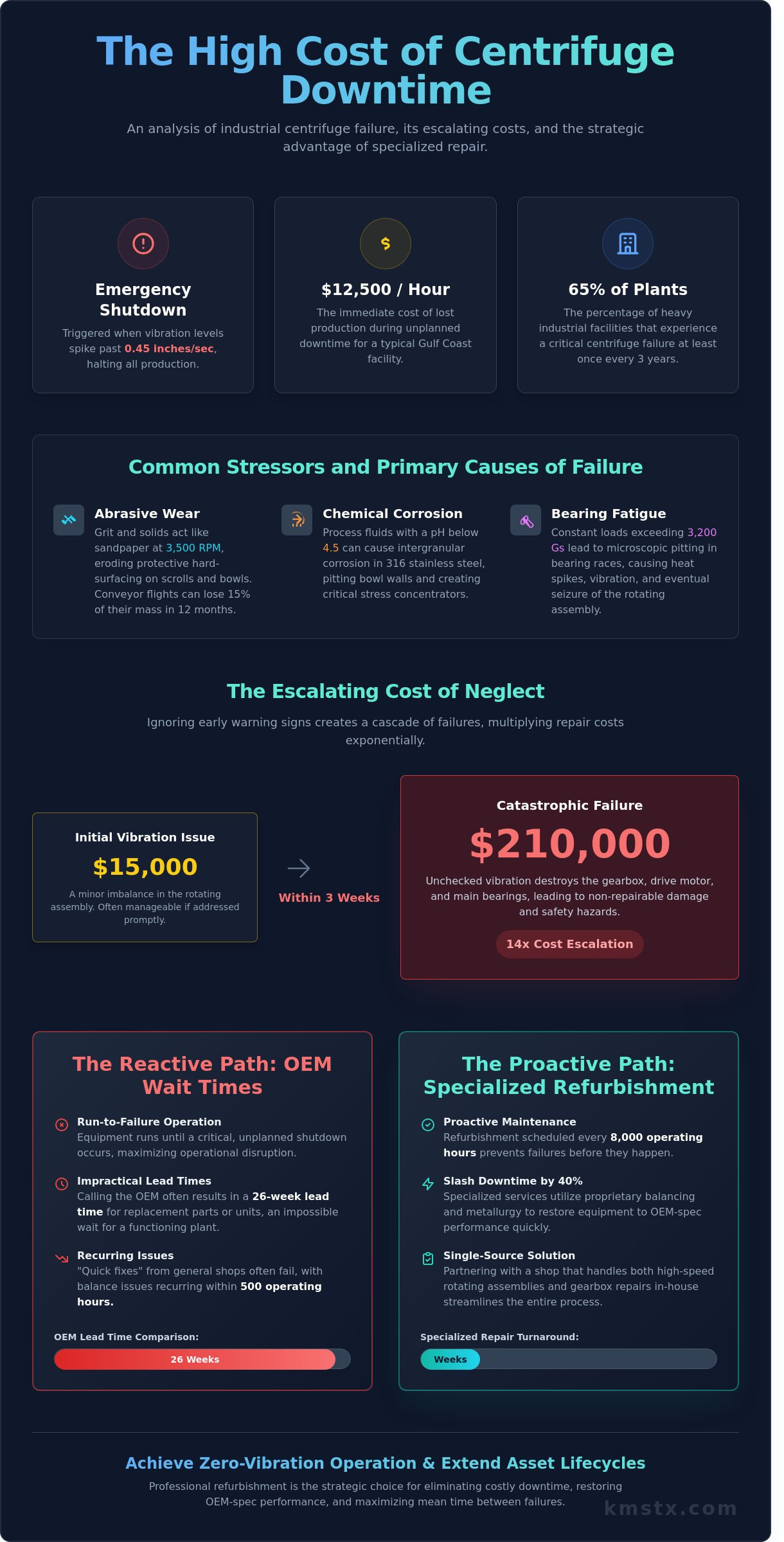
Last Tuesday, a facility manager in the Gulf Coast watched their primary decanter’s vibration levels spike past 0.45 inches per second, triggering an immediate emergency shutdown and halting $12,500 of hourly production. It’s a scenario that plays out in 65% of heavy industrial plants at least once every three years. While the standard reaction is to call the original manufacturer, the reality of 26-week lead times makes that option impossible for a functioning bottom line. This is where specialized industrial centrifuge repair services become the critical path for restoring operational stability.
You probably already know that a “quick fix” from a general machine shop often leads to recurring balance issues within 500 operating hours. We’ve seen it too. This guide explains how professional centrifuge refurbishment utilizes proprietary balancing protocols and high-grade metallurgy to restore your high-speed rotating equipment to OEM-spec performance. You’ll learn the specific steps required to achieve zero-vibration operation, slash your emergency downtime by 40%, and significantly extend the lifecycle of your most expensive assets.
Key Takeaways
- Learn why professional refurbishment is the most effective way to eliminate costly downtime and restore your equipment to its original high-speed specifications.
- Get an inside look at the technical teardown process-from initial vibration analysis to decontamination-to see how every component is inspected for maximum reliability.
- Compare the speed and value-engineered benefits of specialized industrial centrifuge repair services against standard OEM options to keep your operations moving.
- Find out how to maximize your equipment’s mean time between failures by mastering lubrication management and setting up a maintenance schedule based on actual run-hours.
- See the strategic advantage of partnering with a single-source shop that can handle both high-speed rotating assemblies and complex gearbox repairs in-house.
The Critical Role of Industrial Centrifuge Repair in Modern Operations
Industrial centrifuge repair is the methodical restoration of high-speed separation equipment to its original engineering tolerances. In sectors like municipal wastewater and oil and gas exploration, these machines are the primary drivers of facility throughput. When a decanter or disc-stack unit goes offline, the economic impact is immediate and severe. A 2023 analysis of mid-sized processing plants revealed that unplanned centrifuge downtime costs an average of $2,400 per hour in labor and lost production alone.
Most facilities are moving away from the old-school “run to failure” approach. They’ve realized that proactive refurbishment every 8,000 operating hours is far cheaper than an emergency rebuild. It’s the difference between hitting OEM-spec performance and settling for a “good enough” fix from a general machine shop. Relying on industrial centrifuge repair services that specialize in high-speed balancing ensures the machine returns to the line with minimal vibration. Technicians who understand fundamental centrifuge principles know that even a few grams of imbalance can lead to a total system failure at high velocities.
To see the complexity involved in these mechanical systems and how they’re handled in a professional shop, watch this breakdown of the repair process:
Why Centrifuges Fail: Common Stressors and Wear Patterns
Industrial separation is a high-wear environment where abrasive erosion is the most frequent culprit. In the bowl and scroll, grit and solids act like sandpaper, grinding down surfaces at speeds reaching 3,500 RPM. We’ve seen conveyor flights lose 15% of their mass in just 12 months of heavy service. Common stressors include:
- Abrasive Wear: Sand and silt erode the protective hard-surfacing on the scroll.
- Chemical Corrosion: If the process fluid pH drops below 4.5, it can cause intergranular corrosion in 316 stainless steel components.
- Bearing Fatigue: Constant loads exceeding 3,200 Gs lead to microscopic pits in the races, eventually causing heat spikes and seizure.
Structural integrity is non-negotiable. When corrosion pits the bowl wall, it creates stress concentrators that can lead to cracks. These aren’t just maintenance issues; they’re the precursors to mechanical failure that can take a machine out of service for months.
The High Cost of Neglect: Beyond Simple Downtime
Waiting too long for maintenance creates a ripple effect of mechanical damage. When a rotating assembly becomes unbalanced, the vibration doesn’t just stay in the centrifuge. It travels through the frame and destroys the gearbox and the drive motor bearings. A 2022 case study showed that ignoring a $15,000 vibration issue led to a $210,000 catastrophic failure within three weeks. Professional industrial centrifuge repair services catch these issues before they escalate.
Safety is the most critical factor. An unbalanced machine spinning at 4,000 RPM is essentially a collection of high-velocity projectiles waiting to be released. Catastrophic mechanical failure at these speeds is often non-repairable and puts every operator on the floor at risk. Regular inspections and adherence to vibration limits aren’t just about efficiency; they’re about maintaining a safe and predictable workspace for the entire team.
The Professional Refurbishment Process: From Teardown to Testing
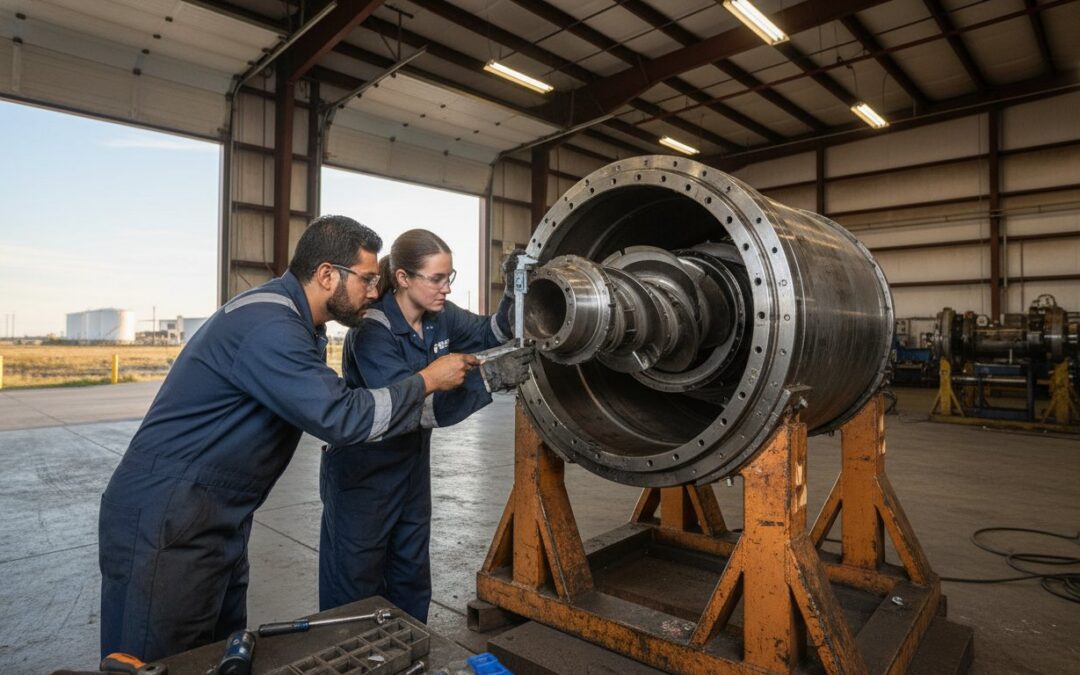
Refurbishing a high-speed rotating assembly isn’t just about cleaning parts; it’s a rigorous engineering workflow that restores a machine to its original design specifications. When a decanter or basket centrifuge arrives at the facility, the process begins with a documented incoming inspection. We perform an initial vibration analysis to capture the machine’s signature before any bolts are turned. This baseline data helps us understand the internal state of the bearings and the structural integrity of the frame. Once logged, the unit undergoes full decontamination. This step is critical for technician safety and aligns with established centrifuge safety guidelines that prevent exposure to hazardous chemical or biological residues.
The teardown is a precision operation where every component is tagged and tracked. We don’t just pull parts; we document the fit and finish of every mating surface. This methodical approach ensures that the eventual reassembly meets the tight tolerances required for equipment spinning at 3,500 RPM. Our industrial centrifuge repair services focus on extending the lifecycle of these assets by identifying wear patterns that lead to premature failure.
Non-Destructive Testing (NDT) and Inspection
The teardown reveals the internal health of the bowl and scroll, but many issues remain invisible to the naked eye. We utilize Non-Destructive Testing (NDT) to identify micro-fractures and structural fatigue. For stainless steel bowls, we apply dye penetrant testing to locate surface-level stress cracks that could lead to catastrophic failure under high G-loads. On carbon steel components, magnetic particle testing identifies subsurface flaws. We measure the runout on shafts and spindles to within 0.001 inches. If a spindle is bent even slightly, the entire system’s harmonic balance is compromised. Every measurement is recorded in a detailed digital log, providing you with a transparent repair history that’s essential for long-term maintenance planning and insurance compliance.
Precision Machining and Component Restoration
Restoring critical tolerances is where the technical expertise of the shop truly shows. We apply hard-surfacing materials, such as tungsten carbide tiles or flame-sprayed coatings, to the conveyor flights to resist future abrasion. In a study of units serviced in early 2023, these coatings increased the operational life of the scroll by 250% compared to untreated steel. When dealing with equipment manufactured before 1998, we often custom-machine obsolete OEM parts that are no longer available in the market. We also replace all high-precision bearings and seals as a standard practice. Bearing fits are machined to a tolerance of 0.0005 inches to ensure a perfect press fit, which eliminates the micro-movements that cause heat buildup and early bearing death.
The final phase of the refurbishment involves high-speed dynamic balancing. We spin the entire rotating assembly to its maximum rated speed to ensure vibration levels stay below the ISO 1940/1 G2.5 standard. Most shops stop at static balancing, but we know that dynamic forces change once the machine is under load. We run the unit for a continuous 4-hour test period while monitoring temperature and noise levels. This final verification ensures that when the machine returns to your floor, it’s ready for immediate production. Professional industrial centrifuge repair services aren’t complete until the equipment performs as well as, or better than, the day it left the factory. This level of detail is how we help you maintain maximum uptime in the most demanding environments.
OEM vs. Independent Specialized Repair: Making the Strategic Choice
Choosing between an Original Equipment Manufacturer (OEM) and an independent specialist isn’t just about the final bill. It’s about how fast you get back to 100% capacity. OEM bureaucracy often results in lead times stretching 18 weeks for basic rotating assembly overhauls. These delays stem from global supply chain layers and rigid production schedules that don’t prioritize your specific downtime. Independent shops usually operate with leaner administrative structures, allowing them to source materials and schedule floor time in under 26 days. This 75% reduction in wait time directly impacts your bottom line.
OEM pricing often reflects global marketing budgets and high corporate overhead. You’ll frequently see labor rates 35% higher than specialized independent shops. These independent outfits focus on value-engineered solutions; they’ll repair a spindle or a hub rather than forcing a $20,000 replacement part on you. They look for ways to extend the life of existing components through advanced thermal sprays or precision machining rather than simply checking a box for a new assembly. This approach often results in a total project cost that is 30% to 45% lower than the factory quote.
OEMs often suffer from “brand blindness.” They only know their own internal specs and legacy designs. A specialized shop handles everything from Bird and Sharples to Alfa Laval and Westfalia. This cross-platform experience means they’ve seen every failure mode imaginable across different industries. They can apply a solution from a chemical plant’s decanter to solve a recurring vibration issue in a wastewater facility. Reliable industrial centrifuge repair services must include 24/7 field support. If a decanter fails at 3:00 AM on a Tuesday, you need a technician on-site by the next shift. Waiting for an OEM rep to fly in from a regional hub can cost you $60,000 a day in lost production.
When OEM is Necessary (and When It Isn’t)
You’ll need the OEM if your equipment is still under its initial 12-month or 24-month warranty. Breaking that seal with an outside shop will void your coverage immediately. Factory intervention is also mandatory for proprietary control systems or encrypted PLC software that independent shops can’t access. However, for 90% of mechanical restorations, a dedicated machine shop is the superior choice. They have the latitude to use high-performance coatings or hardened tiles that the factory might not offer. Following a strict centrifuge preventive maintenance schedule can help you identify these mechanical needs before they become catastrophic factory-only failures.
The Independent Advantage: Customization and Speed
Independent shops excel at tailoring equipment to your specific site conditions. If your feed slurry has changed since 2019, a specialist can modify the scroll pitch or beach angle to optimize cake dryness. You get a single point of contact for the entire rotating assembly, from the gearbox to the bowl. Local inventory plays a massive role here too. Many independent industrial centrifuge repair services stock common bearings and seals for multiple brands. This inventory strategy can shorten your repair window by 12 days compared to waiting for an overseas shipment from an OEM warehouse. It’s about practical fixes that keep the plant running.
Operational Guidance: Maximizing Mean Time Between Failures (MTBF)
Reliability isn’t a happy accident; it’s the result of a rigorous preventative maintenance (PM) schedule. Most high-speed decanters require a primary inspection every 2,000 run-hours. This isn’t just a suggestion. Missing this window increases the risk of catastrophic failure by 35% according to industry benchmarks. While investing in industrial centrifuge repair services is only half the battle, the other half is internal discipline. You’ve got to track these hours like your production targets depend on them, because they do.
Lubrication management is your frontline defense against bearing failure. Using the wrong NLGI grade or over-greasing can lead to churning and high temperatures. Research shows that 48% of bearing replacements are avoidable through proper lubrication protocols. We recommend using a high-quality synthetic grease, specifically an NLGI 2 grade with extreme pressure additives, at intervals defined by the bearing manufacturer’s heat-load calculations. If you’re seeing grease purge that’s discolored or contains metal particulates, your internal components are already shouting for help.
Incorporating vibration monitoring provides a quantitative early warning system. Operators should watch for peaks exceeding 0.15 inches per second (ips). If levels hit 0.5 ips, the system needs an immediate shutdown to prevent the rotating assembly from becoming a projectile. Training your team on startup and shutdown is just as critical. A 10-minute water flush at the end of every shift prevents solids from hardening in the bowl. Hardened solids create a 1-plane imbalance that can’t be fixed without a full teardown. Consistency here saves you thousands in unnecessary repairs.
Early Warning Signs Every Operator Should Know
Detecting a “harmonic shift” is an essential skill. It’s a subtle change in the machine’s acoustic profile that often signals a loose component or a bearing cage beginning to fail. Watch the bearing housings closely; if they run above 180°F (82°C), you’re looking at a loss of lubrication or excessive load. Also, monitor your discharge consistency. If cake moisture increases by 5% or more suddenly, the scroll is likely worn or the differential speed is out of sync, requiring professional calibration.
Field Service and On-Site Troubleshooting
On-site balancing can often correct minor vibrations without pulling the unit. We target an ISO 1940-1 G2.5 balance grade to ensure smooth operation. However, if the rotating assembly shows pitting or structural cracks, it’s time for a full shop overhaul. The standard for industrial centrifuge repair services involves a 24/7 response model. Every hour of downtime in a refinery or processing plant can cost upwards of $15,000, so having a 4-hour response window for field technicians is the baseline for critical operations.
Schedule a technical consultation for your centrifuge systems today.
The Kelsey Machine Advantage: Integrated Rotating Equipment Expertise
Kelsey Machine Services has spent the last 41 years refining the technical precision required for heavy industrial mechanical overhauls. Since 1983, our team has recognized that a centrifuge is only as reliable as the components driving it. Most shops specialize in either the rotating assembly or the power transmission. We broke that mold by integrating industrial centrifuge repair services with comprehensive gearbox rebuilding under one roof. This eliminates the logistical friction of managing multiple vendors and ensures that the entire drivetrain is synchronized to OEM specifications or better.
Our commitment to quality is backed by a full warranty on all restoration work. We don’t just aim for “functional” status. We utilize rigorous testing protocols to ensure every machine leaving our floor can handle the high G-forces of 24/7 production. For operators across the Gulf Coast, uptime isn’t a luxury; it’s a requirement. That’s why we maintain a 24/7 emergency support structure. If a decanter fails at a refinery in the middle of the night, our technicians are ready to respond immediately to mitigate your financial exposure.
Comprehensive Shop Capabilities in Stafford and Magnolia
Our facilities in Stafford and Magnolia are equipped with high-precision CNC machining centers and dynamic balancing equipment capable of handling massive rotating masses. We maintain tolerances as tight as 0.0005 inches to prevent the harmonic vibrations that lead to premature bearing failure. Our inventory includes an extensive stock of critical spare parts, which allows us to reduce lead times by 30% compared to standard repair cycles. Beyond centrifuges, our shops regularly service:
- Large-scale industrial pumps and multi-stage units
- High-volume blowers and aeration systems
- Reciprocating and centrifugal compressors
- Complex planetary and parallel shaft gearboxes
A Partner in Reliability, Not Just a Repair Shop
We approach every project with a consultative mindset rooted in root-cause failure analysis (RCFA). If a bearing housing shows repetitive wear, we don’t just sleeve it; we investigate the lubrication flow, heat dissipation, and alignment issues that caused the failure. This scientific approach provides long-term value that goes beyond a quick fix. As a family-owned industrial expert, we prioritize the relationship over the transaction. We’ve spent four decades building trust through empirical data and mechanical integrity. You can contact Kelsey Machine Services for a technical consultation to discuss your specific equipment challenges and performance goals.
The technical demands of modern industrial centrifuge repair services require a partner who understands the intersection of metallurgy, physics, and field application. We’ve seen every failure mode imaginable since we opened our doors. We use that historical data to optimize your equipment for its specific environment. Whether you’re processing municipal sludge or high-density chemical slurries, our restoration process ensures your rotating equipment remains a predictable asset rather than a liability.
Protecting Your Production with Precision Maintenance
Maintaining peak performance in high-speed separation requires more than just reactive fixes. It demands a systematic approach to refurbishment that spans from the initial teardown to final performance testing. By prioritizing specialized industrial centrifuge repair services, you reduce the risk of catastrophic failure and extend the life of your critical assets. Choosing an independent partner often provides the technical flexibility and rapid turnaround that standard OEM channels lack.
Kelsey Machine brings 40 years of industrial experience to every project we handle. We operate full-service facilities in Stafford and Magnolia, Texas; these shops provide the infrastructure needed for complex mechanical overhauls. When downtime isn’t an option, our teams provide 24/7 emergency field service response to get your process back online. Reliability isn’t a happy accident. It’s the result of rigorous engineering and a commitment to shop-floor excellence. We’re ready to help you keep your operations running smoothly.
Get an Expert Quote for Your Centrifuge Repair
Frequently Asked Questions
How long does a typical industrial centrifuge repair take?
A standard industrial centrifuge repair typically takes between 14 and 21 days depending on part availability and the extent of wear. If you’re seeking industrial centrifuge repair services for a simple bearing and seal swap, we can often turn that around in 5 business days. When major components like the conveyor or bowl require machining, the timeline extends to accommodate precision grinding and balancing.
What is dynamic balancing and why is it critical for centrifuges?
Dynamic balancing is a precision procedure where we adjust the mass distribution of the rotating assembly to ensure the center of gravity aligns with the axis of rotation. This process is critical because even a 5 gram imbalance at 3,600 RPM generates over 400 pounds of centrifugal force. Our technicians use Schenck balancing machines to meet ISO 1940/1 G2.5 standards, which prevents premature bearing failure.
Can you repair centrifuges from any manufacturer, like Alfa Laval or Flottweg?
We provide comprehensive industrial centrifuge repair services for all major manufacturers, including Alfa Laval, Flottweg, and Bird. Our shop maintains a library of over 1,200 OEM technical specifications to ensure every tolerance meets original design requirements. Whether it’s a decanter or a disk stack, we treat the equipment with technical rigor. We’ve serviced over 450 machines from these brands since 2021.
Do you provide on-site centrifuge maintenance and troubleshooting?
Our field service teams provide on-site maintenance and troubleshooting within a 24 to 48 hour response window for emergency calls. We bring portable vibration analyzers and borescope cameras to your facility to diagnose issues without pulling the machine. Routine on-site service every 2,000 operating hours significantly reduces the risk of unplanned outages in high-demand environments like wastewater treatment or oil refining.
What are the most common causes of centrifuge vibration?
The primary causes of centrifuge vibration are uneven solids accumulation, worn main bearings, and eroded conveyor flights. Statistics show that 65 percent of vibration issues originate from improper lubrication schedules that lead to bearing race pitting. If your sensors record levels above 0.15 inches per second, it’s time to inspect the rotating assembly for material loss or damaged isolators before a failure occurs.
Is it possible to reverse-engineer obsolete centrifuge parts?
It’s possible to reverse-engineer obsolete centrifuge parts using high-resolution 3D scanning and Coordinate Measuring Machines (CMM). We’ve successfully recreated discharge ports and gearbox internal gears for machines built as far back as 1975. By utilizing 17-4 PH stainless steel or specialized tungsten carbide coatings, we often produce replacement parts that outlast the original components while maintaining identical fitment and performance.
How do I know if my centrifuge needs a full rebuild or just a minor service?
You’ll know a full rebuild is necessary when vibration exceeds 0.25 inches per second or when the machine reaches a 10,000 hour service interval. Minor services usually suffice for routine seal leaks or belt replacements. If our inspection reveals 15 percent or more metal loss on the conveyor tiles, we’ll recommend a full shop overhaul to restore the unit to its original efficiency.