

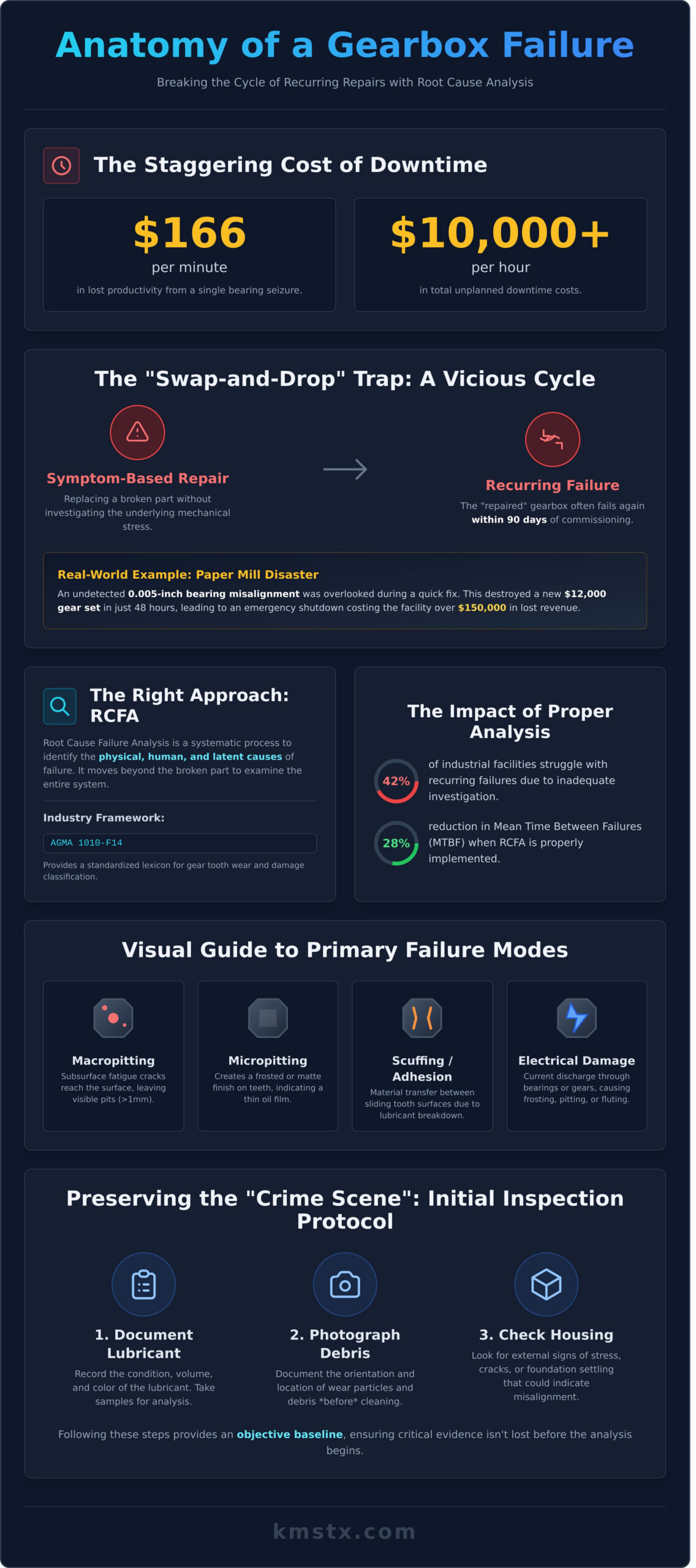
A single bearing seizure on a critical production line can bleed $166 per minute in lost productivity, often totaling more than $10,000 per hour in unplanned downtime. You’ve likely seen this cycle play out where a gearbox returns from a local machine shop only to fail again within 90 days of commissioning. It’s frustrating when standard overhauls treat the symptoms but ignore the underlying mechanical stress. Performing a rigorous industrial gearbox failure analysis is the only way to stop the revolving door of repairs and regain control over your maintenance schedule.
The same principles of stress and fatigue apply to the hydraulic systems that power much of this machinery. When facing breakdowns in the field, having access to a responsive mobile repair service is critical. For businesses operating in this demanding environment, specialized providers like Ms. Hydraulics LLC are essential for minimizing downtime on heavy equipment.
We’re providing an authoritative engineering perspective that moves beyond surface-level fixes to identify the true root cause of gear and bearing distress. This guide gives you the technical data needed to justify repair versus replacement decisions to management while establishing a long-term reliability strategy. We’ll walk through our proprietary forensic teardown protocols, metallurgical evidence, and the specific restoration steps required to ensure your equipment doesn’t end up back on the work bench next quarter.
Key Takeaways
- Understand why addressing the root cause of component failure is the only way to stop the cycle of recurring downtime and protect your maintenance budget.
- Gain a technical edge by identifying the specific visual markers of gear tooth and bearing degradation, from micropitting to electrical discharge damage.
- Explore the forensic teardown process, including how Non-Destructive Testing (NDT) techniques uncover hidden cracks and structural fatigue in heavy rotating equipment.
- Discover how to implement long-term fixes by correcting systemic issues like soft foot and upgrading to high-performance seals and synthetic lubricants.
- See how the KMS proprietary “Full Teardown and Inspect” protocol sets the standard for industrial gearbox failure analysis and rigorous equipment restoration.
The Fundamentals of Industrial Gearbox Failure Analysis
Performing a rigorous industrial gearbox failure analysis requires more than a casual glance at a damaged pinion. It involves Root Cause Failure Analysis (RCFA), a systematic process designed to identify the physical, human, and latent causes of a component’s demise. In the context of rotating equipment, RCFA isn’t a luxury; it’s a technical requirement. When a 500 HP drive unit seizes, the broken teeth are merely the final stage of a much longer story. We don’t just look at the metal. We look at the lubricant chemistry, the housing alignment, and the operational stressors that preceded the event. A 2023 study across heavy manufacturing sectors indicated that 42% of industrial facilities still struggle with recurring failures because they stop the investigation once the broken part is replaced.
The American Gear Manufacturers Association (AGMA) provides the necessary framework for this investigation through standards like AGMA 1010-F14. This document offers a standardized lexicon for gear tooth wear, classifying damage into categories like scuffing, pitting, and plastic deformation. Utilizing these standards allows us to bridge the gap between field observations and laboratory data. This is where the persona of the Expert Scientist becomes vital. By applying empirical data to the physical evidence found on the shop floor, we can translate a microscopic fracture pattern into a concrete operational adjustment. This scientific approach ensures that the solution is rooted in physics rather than guesswork, ultimately leading to a 28% reduction in mean time between failures (MTBF) when properly implemented.
The economic imperative for this level of detail is clear. Fixing a symptom without addressing the cause leads to a catastrophic loss of ROI. If a $45,000 gearbox fails, the replacement cost is often the smallest part of the bill. When you factor in the $18,000 per hour cost of lost production and the potential for secondary damage to coupled equipment, the “swap-and-drop” mentality becomes a high-stakes gamble that most operations can’t afford to lose.
The High Cost of Superficial Repairs
Calculating the true cost of failure requires looking at the entire ecosystem of the machine. A “swap-and-drop” strategy, where a technician simply replaces a damaged gear set without checking the underlying system, often results in a secondary failure within 90 days. For critical infrastructure, this is an unacceptable risk. Consider a real-world example from a paper mill in late 2022. An undetected bearing misalignment of just 0.005 inches was overlooked during a quick component replacement. That single oversight destroyed a brand-new, $12,000 gear set in exactly 48 hours. The resulting emergency shutdown cost the facility over $150,000 in lost revenue, proving that superficial repairs are often the most expensive option available.
Establishing an Objective Baseline
Before any teardown begins, we must preserve the “crime scene” to ensure the integrity of the data. This involves gathering operational logs, including 24-hour temperature trends, vibration signatures, and load history from the SCADA system. Applying Forensic engineering principles at this stage is crucial. On-site maintenance teams should follow strict initial visual inspection protocols before cleaning any components.
- Document the condition and volume of the lubricant.
- Photograph the orientation of debris and wear particles.
- Check for external signs of housing stress or foundation settling.
These steps provide the objective baseline needed for a successful industrial gearbox failure analysis, ensuring that the evidence isn’t washed away with a solvent tank before the real investigation starts.
Primary Failure Modes: Identifying the “Why” Behind the Breakdown
When you’re deep into an industrial gearbox failure analysis, you aren’t just looking at broken parts. You’re looking for the story of how that machine was treated. Most failures don’t happen overnight; they’re the result of specific mechanical or chemical stressors that eventually cross a threshold. We generally group these into gear tooth damage, bearing degradation, lubrication issues, and structural fatigue. Understanding these categories is the first step in moving from “it’s broken” to “here is how we fix the process.”
Gear tooth failures are usually the most visible. Macropitting occurs when subsurface fatigue cracks reach the surface, leaving pits larger than 1mm in diameter. If you see a frosted or matte finish on the teeth, that’s micropitting. It’s often a sign that the oil film was too thin for the load. Scuffing is more violent. It happens when the lubricant fails under high heat, leading to localized welding and tearing of the metal. If you’re seeing these signs, it’s time to evaluate your monitoring systems to catch these trends before they lead to a catastrophic lockup.
Bearings are the next most common failure point. Spalling starts when small flakes of metal break away from the raceway or rolling elements. Brinelling is different; it’s a permanent indentation caused by a massive static load or a sudden impact. In modern setups using Variable Frequency Drives, we also see electrical discharge damage. This creates “fluting” or tiny craters that look like frosted glass under a 10x magnifying glass. You can find more detail on these specific damage signatures in Rexnord’s guide to component failure, which is a solid resource for identifying wear patterns in the field.
Lubrication is where many problems start. Oil oxidizes when it gets too hot. For every 18 degree Fahrenheit increase above 140 degrees, the oxidation rate doubles. This creates sludge that blocks cooling lines. Particulate contamination is just as dangerous. If your ISO 4406 cleanliness level drops below a 18/16/13 rating, you’re essentially pumping liquid sandpaper through the gear mesh. Structural issues are rarer but more dangerous. Torsional fatigue can crack a housing or a shaft if the input and output components aren’t aligned within 0.005 inches.
Surface Distress and Tribology
The line between normal wear and accelerated degradation is defined by the lambda ratio. If your oil film thickness is less than 1.0 times the surface roughness, you’re in the boundary lubrication regime. This is where scuffing occurs. It’s a symptom of extreme pressure or a total cooling failure. Keeping your viscosity index within 5% of the design spec is the only way to maintain that critical protective barrier between metal surfaces. A thorough industrial gearbox failure analysis always looks at the lubricant’s remaining useful life to determine if the oil was the primary catalyst.
Fracture Mechanics and Fatigue
Tooth root bending fatigue is the primary killer of heavy-duty gears. It starts at the root fillet where stress is highest. You can tell a fatigue crack from an impact fracture by the “beach marks” on the metal surface. In Texas oilfield operations, shock loading often exceeds 300% of the rated torque during a single event. These sudden spikes accelerate material failure by turning tiny material inclusions into major fracture points that eventually shear the tooth off completely.
The Forensic Inspection Process: From Field Data to Shop Teardown
When a 5,000-horsepower unit arrives at the facility, the industrial gearbox failure analysis begins with a meticulous external audit. We don’t just pull it apart; we document the “as-found” condition, noting oil leak paths and bolt torque values that deviate from the 2018 ISO 1940-1 standards. Every component receives a unique identifier during the systematic disassembly. This ensures that the orientation of every bearing race and gear tooth is preserved for the final evaluation. Documentation includes high-resolution photography of the internal housing surfaces and the condition of the existing lubricant before any cleaning occurs.
Non-Destructive Testing (NDT) serves as the primary tool for detecting invisible flaws. We utilize Magnetic Particle Inspection (MPI) to find subsurface fatigue cracks in ferromagnetic components and Dye Penetrant Testing for non-magnetic parts. These methods reveal stress fractures that often precede catastrophic housing failure. Precision metrology follows, where we measure journals and bores to within 0.0005 inches using calibrated micrometers. We compare these figures against the original OEM specifications to identify if thermal expansion or structural warping has occurred over the last 10 years of service. If the metallurgy doesn’t match the original bill of materials, such as finding low-grade carbon steel where 4340 alloy was specified, we’ve identified a significant material defect.
The final stage of the teardown involves synthesizing this data into an actionable restoration plan. We don’t just list what’s broken. We provide a 48-hour turnaround report that correlates the physical damage with operational history. This report serves as a technical roadmap, detailing exactly which components need replacement and which proprietary coatings can be applied to extend the service life of the remaining parts.
Advanced Diagnostic Tools in the Shop
Modern shops rely on more than just visual checks. Dynamic balancing is vital; an imbalance of just 2.5 ounces on a high-speed shaft can lead to bearing failure within 400 hours of continuous operation. We use borescopes to inspect internal oil galleries and gear mesh without removing the entire housing, which is critical for maintaining the integrity of the factory seals. Vibration analysis provides the frequency spectrum needed to pinpoint faulty components. By interpreting the Fast Fourier Transform (FFT) data, we can distinguish between a bent shaft and a failing inner bearing race before the unit is fully dismantled.
Interpreting the “Evidence”
Every mark on a gear tooth tells a specific story about the machine’s life. This NREL presentation on gearbox failure highlights how specific wear patterns reveal shaft misalignment that might not be obvious during a static inspection. Wear patterns like macropitting or scuffing indicate that the lubricant film thickness failed to separate the metal surfaces under load. Our industrial gearbox failure analysis also focuses on seal integrity; roughly 70% of seal failures stem from improper installation or grit ingress. We adopt an “Expert Scientist” approach to oil analysis, where metal counts exceeding 50 parts per million (ppm) of iron or copper tell us exactly which gear or bushing is shedding material during the duty cycle.
Mitigating Recurring Failures: Beyond the Basic Repair
Repairing a unit is easy; making sure it stays in the field is the real challenge. If your industrial gearbox failure analysis points to systemic issues like misalignment or soft foot, simply swapping out gears won’t solve the problem. We often find that a 0.005-inch gap under a mounting foot can distort a housing enough to cut bearing life by 50%. Our team targets laser alignment tolerances within 0.002 inches for both offset and angularity to ensure even load distribution across the gear mesh. This precision prevents the localized stress that leads to premature pitting.
Upgrading internal components is another critical step for units operating in harsh conditions. We’ve seen a 40% reduction in lubricant contamination by replacing standard lip seals with bearing isolators. Switching to high-performance synthetic lubricants also makes a difference. These fluids maintain their viscosity index even when sump temperatures fluctuate by 60 degrees. We also recommend 3-micron desiccant breathers to stop moisture from entering the casing, which is a primary driver of oil film breakdown in heavy-duty cycles.
Environmental Stressors in Texas Industry
Plants along the Houston Ship Channel deal with brutal environmental variables. In August 2023, ambient temperatures at several local facilities hit 102 degrees Fahrenheit, causing massive thermal expansion in steel foundations. This movement can pull a perfectly aligned gearbox out of spec in hours. High humidity levels, often reaching 95% at night, lead to internal condensation as the gearbox cools after a shift. This moisture causes “standstill” brinelling on bearing races and rapid corrosion. We utilize proprietary epoxy coatings that provide a 10-year barrier against salt-air degradation in these coastal zones.
Design Optimization and Retrofitting
Sometimes the original equipment isn’t up to the task of modern production speeds. In a project from March 2024, we retrofitted a 1994 Lufkin gearbox that was struggling with a 22% increase in application load. By custom machining the housing to accept a larger spherical roller bearing and optimizing the gear geometry, we achieved a 15-degree drop in operating temperature. We also integrate patented heat-pipe technologies into the sump to facilitate better heat dissipation without the need for complex external cooling loops or additional pumps.
A reliable predictive maintenance (PdM) framework is the final piece of the puzzle. This strategy uses the data gathered during the initial industrial gearbox failure analysis to set new baselines for health monitoring. We recommend vibration analysis every 30 days and oil sampling every 500 operating hours. Tracking iron and copper particulates gives your team a 3 to 4 month lead time on potential issues. This proactive approach transforms an expensive emergency shutdown into a manageable, planned maintenance event during a scheduled window.
Stop the cycle of repeat equipment breakdowns and unexpected downtime. Contact us for a professional industrial gearbox failure analysis to identify the root cause and implement a permanent fix.
Professional Failure Analysis and Restoration at Kelsey Machine Services
Kelsey Machine Services brings more than 40 years of mechanical and geoscientific expertise to the Texas industrial sector. Since 1980, our team has focused on the hard data behind equipment performance. When a critical drive fails, a standard repair often just masks a deeper mechanical issue. You need a comprehensive industrial gearbox failure analysis to identify why the component failed in the first place. Our proprietary “Full Teardown and Inspect” protocol is the foundation of our forensic approach. We don’t just look for broken teeth; we analyze lubrication samples, check housing alignment, and measure tolerances to 0.0005 inches to find the exact origin of the mechanical breakdown.
We understand that downtime costs in high-output environments can exceed $15,000 per hour. To combat this, we maintain a 24/7 emergency response team ready for immediate deployment. Whether it’s a sudden seizure in a midstream pumping station or a chronic vibration issue in a cooling tower, our field technicians provide on-site troubleshooting to stabilize your operation. Every restoration handled in our shop comes with a guarantee to meet or exceed original equipment manufacturer (OEM) specifications. By utilizing modern metallurgy and advanced heat-treatment processes, we often return units with a 20% increase in load capacity compared to their original 1990s designs.
The KMS Shop Advantage
Our operations are centered in our Stafford and Magnolia, Texas facilities, which house over 50,000 square feet of specialized repair and machining space. We’ve invested in high-precision CNC machining centers that allow us to manufacture custom shafts and gears when lead times from original manufacturers stretch into months. Keeping a deep inventory of critical spare parts for Falk, Lufkin, and Flottweg systems means we frequently cut turnaround times by 30% compared to generalist repair shops. You can review the details of our gearbox refurbishment process to see how we handle high-torque applications with surgical precision.
Partnering for Reliability
Reliability isn’t a one-time fix; it’s a long-term strategy. We work directly with your maintenance teams to move beyond reactive “run-to-failure” cycles that bleed your maintenance budget. By analyzing historical wear patterns and vibration signatures, we help you implement proactive monitoring that can extend asset life by 8 to 12 years. If you’re currently dealing with a recurring vibration or heat issue that has baffled your internal team, requesting an industrial gearbox failure analysis is the first step toward a permanent solution. Contact Kelsey Machine Services for a forensic failure analysis today to get a definitive, data-driven answer on your equipment’s health.
Eliminating Downtime Through Root Cause Insight
Effective maintenance doesn’t just replace a chipped gear; it identifies exactly why that metal failed in the first place. Whether the issue is thermal instability, lubrication breakdown, or improper alignment, a detailed industrial gearbox failure analysis is the only way to stop the cycle of recurring downtime. We’ve spent 40 years in the shop and the field documenting every failure mode imaginable. It’s about examining the metallurgy and wear patterns to ensure the next repair actually lasts longer than the original factory build.
When a critical drive fails at 3:00 AM, you need more than a temporary patch. You need a partner that provides 24/7 emergency field service and a full restoration to OEM specifications. We don’t guess at the solution. We use hard data and forensic shop teardowns to get your operations back online. Don’t let a mystery failure eat into your production margins for another quarter. Request an Expert Gearbox Failure Analysis from our team today. We’ll help you solve the problem for good so you can keep your plant running at peak capacity.
Frequently Asked Questions
What are the most common signs of imminent gearbox failure?
Increased vibration levels exceeding 0.15 inches per second and internal oil temperatures spiking above 180°F are the most reliable indicators of trouble. You’ll often hear a distinct change in the gear mesh frequency or find metallic flakes on the magnetic drain plug. If your oil sample shows more than 5% metal volume by weight, the unit is likely within 72 hours of a total mechanical breakdown.
How long does a typical industrial gearbox failure analysis take?
A thorough industrial gearbox failure analysis generally requires 5 to 10 business days to complete from the time the unit arrives at the shop. This window includes a 48 hour period for teardown and cleaning, followed by metallurgical inspections of the gear teeth and bearing races. If we need to perform scanning electron microscopy to identify specific fatigue markers, the timeline can extend to 14 days to ensure the forensic report is accurate.
Can a gearbox be repaired if the housing is cracked?
You can often repair a cracked housing using cold-stitching or metal-locking methods if the damage covers less than 15% of the structural surface area. Welding is usually avoided because it introduces thermal stresses that can warp bearing bores by as much as 0.003 inches, which destroys internal alignment. If the crack penetrates a primary load-bearing seat, we typically recommend a full housing replacement to prevent a repeat failure.
Is it always cheaper to repair a gearbox than to replace it?
Repair is the more economical choice if the total cost stays below 60% of the price of a new unit. Lead times play a massive role here too; a new custom gearbox might have a 26 week lead time while a rebuild takes only 3 weeks. When downtime costs your facility $5,000 per hour, the faster repair turnaround provides much better value than waiting for a factory replacement.
What role does vibration analysis play in failure prevention?
Vibration analysis serves as an early warning system by identifying specific frequency peaks associated with inner race defects or gear misalignment. By tracking 1x and 2x running speeds, technicians can spot potential issues 3 to 6 months before they cause a shutdown. This data allows you to schedule a 12 hour repair during a planned outage instead of reacting to an unplanned 4 day catastrophic event.
How often should I perform lubricant analysis on my industrial gearbox?
You should pull oil samples every 500 to 1,000 operating hours to maintain a clear picture of the unit’s health. For critical equipment, a quarterly testing schedule ensures you stay within ISO 4406 cleanliness codes like 18/16/13. Regular checks catch moisture levels before they exceed 500 ppm, which is vital since excessive water can reduce bearing life by 75% in a single season.
What is the difference between pitting and spalling in gear teeth?
Pitting starts as microscopic craters less than 0.5 mm wide caused by surface fatigue, while spalling is the advanced stage where large chunks of metal break away from the tooth face. Pitting is essentially the early warning sign that the surface is failing. Once spalling covers 20% of the contact area, the gear’s profile is gone and the resulting impact loads will quickly destroy the remaining teeth.
Do environmental factors in Houston affect gearbox lifespan?
Houston’s average humidity of 75% and high salt content in the air near the Ship Channel significantly accelerate corrosion and oil oxidation. Gearboxes in this region often experience a 20% reduction in seal life due to constant thermal expansion from 100°F summer days and atmospheric contaminants. We suggest using desiccant breathers to keep internal moisture below 200 ppm to combat these specific Gulf Coast conditions.
Absolutely. While the scale is different, the core principles of identifying root causes—whether it’s lubrication failure, bearing wear, or contamination—are universal. Just as industrial systems require specialized care to prevent costly downtime, so do the complex transmissions in modern vehicles. For those dealing with automotive issues and looking for a service center that emphasizes thorough diagnostics over quick fixes, you can check out Sahara Motors for an example of a comprehensive approach to vehicle maintenance.