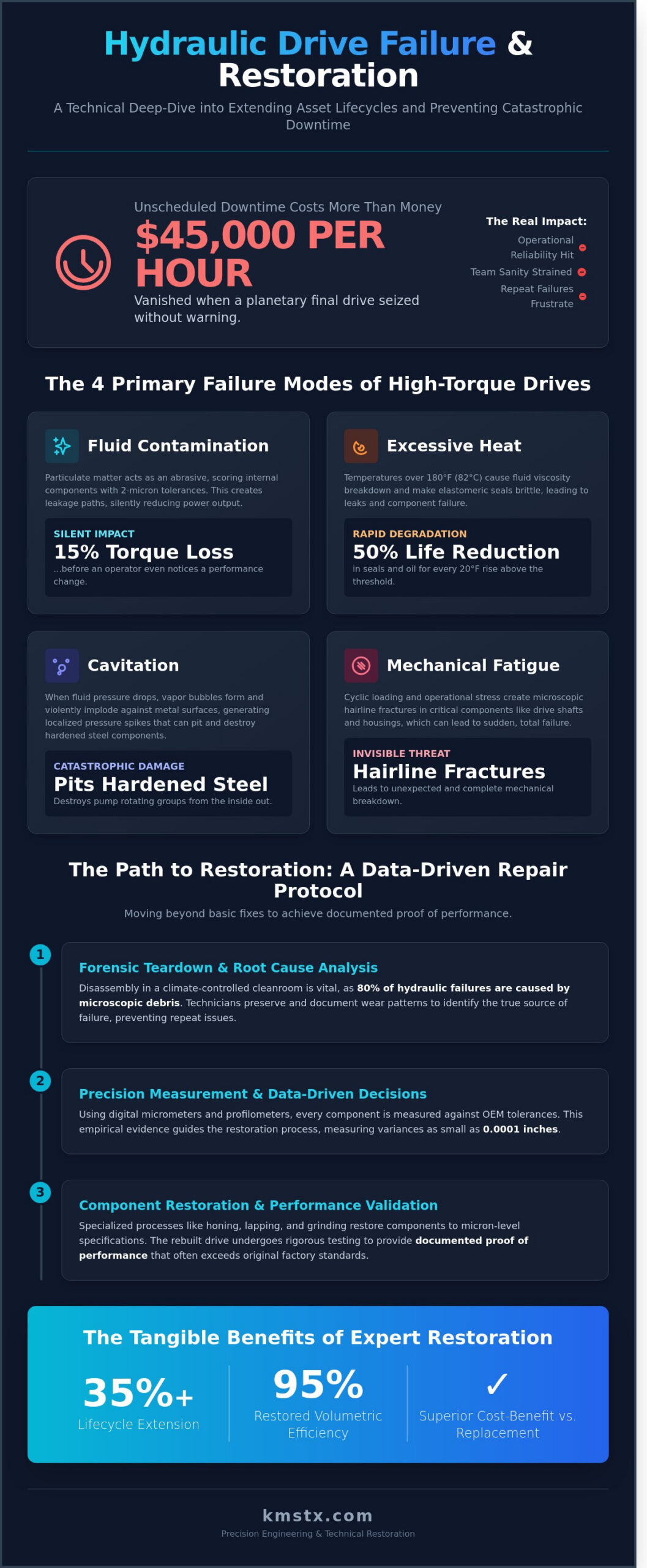
At 3:00 AM last Tuesday, a Tier 1 mining facility watched $45,000 per hour vanish when a planetary final drive seized without warning. You already know that unscheduled downtime isn’t just a line item on a budget; it’s a direct hit to your operation’s reliability and your team’s sanity. It’s frustrating when repeat failures occur because a previous fix lacked the transparency of a true root-cause analysis. Most maintenance managers realize that high-quality hydraulic drive repair services require more than just new seals and a coat of paint to survive another 10,000 hours of service.
This guide provides a comprehensive technical deep-dive into the diagnostics, teardown, and precision restoration of heavy-duty industrial drives. We’ll show you how to move beyond basic fixes to achieve documented proof of performance through rigorous testing and expert failure analysis. We’re going to break down the specific engineering protocols used to identify metallurgical fatigue and the restoration steps that can extend your asset’s lifecycle by 35% or more.
Key Takeaways
Identify the specific failure modes of high-torque drives by analyzing how pressure and flow dynamics impact your heavy rotating equipment.
Learn why a controlled forensic teardown is essential for comparing component wear against original OEM tolerances during professional hydraulic drive repair services.
Master a strategic cost-benefit analysis that weighs the total cost of ownership and lead-time penalties of new units against a technical overhaul.
Discover how to implement rigorous fluid analysis and filtration routines to detect internal wear and prevent catastrophic downtime in harsh environments.
Understand how precision engineering and superior materials can restore your hydraulic systems to specifications that often exceed original factory standards.
Understanding the Mechanics and Failure Modes of Industrial Hydraulic Drives
High-torque hydraulic drives serve as the primary power source for heavy rotating equipment, including decanter centrifuges and industrial conveyors. These systems are designed to convert hydraulic pressure into the massive rotational force required to move heavy loads at controlled speeds. The physics of these drives relies on a direct relationship where torque is determined by fluid pressure and motor displacement, while rotational speed is a function of flow rate. In a typical 5,000 PSI industrial environment, even a minor drop in pressure results in a significant loss of mechanical advantage.
Effective hydraulic drive repair services must look beyond the immediate symptom of a seized motor or a leaking seal. Most system degradations are rooted in four primary failure modes: contamination, cavitation, excessive heat, and mechanical fatigue. If a repair facility only replaces damaged internal components without identifying the source of the failure, the drive will likely fail again within 300 operating hours. Addressing the root cause is the only way to restore the 95% volumetric efficiency expected of a healthy unit.
The Impact of Fluid Contamination on Precision Components
Particulate matter acts as an abrasive medium that scores cylinder walls and valve plates. This internal damage creates “leakage paths” that allow high-pressure fluid to bypass the pistons, which silently reduces the system’s power output. You might lose 15% of your drive’s torque before an operator notices a change in performance. ISO 4406 cleanliness standards define the specific counts of microscopic particles allowed per milliliter of fluid to ensure that precision components with 2-micron tolerances don’t suffer from premature abrasive wear.
Cavitation and Thermal Stress in High-Demand Systems
Cavitation occurs when the fluid pressure drops below its vapor pressure, causing vapor bubbles to form and then implode against metal surfaces. These implosions generate localized pressure spikes that can pit hardened steel and destroy pump rotating groups. Heat is equally destructive; when operating temperatures exceed 180°F, the hydraulic fluid’s viscosity breaks down and elastomeric seals become brittle. A 20-degree rise above the recommended temperature threshold can reduce the service life of your seals and oil by 50%. Professional hydraulic drive repair services utilize thermal imaging and fluid analysis to identify these early warning signs before a catastrophic “thermal runaway” occurs.
Mechanical Fatigue: Look for hairline fractures in the drive shaft or housing caused by cyclic loading.
Seal Failure: Hardened or “charred” seals usually indicate a cooling system bypass or restricted return lines.
Noise Signatures: High-pitched whining often points to aeration or pump inlet restrictions.
The Technical Stages of Professional Hydraulic Drive Repair Services
High-quality hydraulic drive repair services don’t happen on a standard workbench. They require a climate-controlled environment where technicians can isolate the unit from external contaminants. Since microscopic debris causes roughly 80% of hydraulic failures, a cleanroom setting is vital for the forensic teardown. Technicians utilize precision measurement tools like digital micrometers and profilometers to compare component wear against original OEM tolerances, often measuring variances as small as 0.0001 inches. This data-driven approach ensures that every decision is based on empirical evidence rather than guesswork.
Forensic Teardown and Root Cause Analysis
The disassembly of high-pressure units is a methodical process designed to preserve the “evidence” of failure. Technicians document specific wear patterns on pistons, slippers, and barrel faces to generate a comprehensive failure report. A simple “inspect and replace” mentality is inferior because it ignores the underlying mechanics of the breakdown. By analyzing scoring patterns or discoloration, we can identify issues like fluid cavitation, aeration, or excessive heat. If you don’t solve the root cause, the new parts will simply fail in the same timeframe as the old ones.
Precision Machining and Component Restoration
Restoring a hydraulic drive to its original efficiency involves technical processes like honing, lapping, and specialized grinding. These techniques bring components back to micron-level specifications to ensure a perfect seal under 5,000 PSI or higher. It’s critical to utilize industrial machine spare parts that meet or exceed the original manufacturer’s metallurgical standards. When dealing with obsolete equipment or 20-week lead times, custom machining becomes a necessary strategy to salvage the assembly and get the line running again.
The final stage of the process involves dynamic balancing of the rotating group and performance validation. This isn’t a basic “spin test”; it’s a rigorous protocol of load testing and pressure cycling at the unit’s maximum rated capacity. We monitor case leakage and volumetric efficiency to confirm the drive will hold up in the field. If your operations are facing recurring equipment issues, you should reach out to our technical team to discuss a more robust maintenance and repair strategy. This methodical validation ensures that the drive arrives back at your facility ready for immediate, reliable service.
Evaluating Repair vs. Replacement: A Strategic Cost-Benefit Analysis
Deciding whether to scrap a heavy-duty drive or invest in hydraulic drive repair services is a high-stakes call for any plant manager. It isn’t just about the invoice price of the parts. You’ve got to look at the Total Cost of Ownership (TCO) and the immediate impact on your production schedule. A new OEM unit might look good on paper, but if the current lead time is 22 weeks and your line is down, that’s a massive penalty in lost revenue. Refurbishing existing iron often cuts that lead time by 75%, getting your operations back online in a matter of days rather than months.
Environmental impact is another factor that’s moving from the “nice to have” category to a core business requirement. Rebuilding a drive saves roughly 85% of the raw materials and energy compared to manufacturing a brand-new unit from scratch. It’s a practical way to meet sustainability targets while keeping high-quality steel in the loop. There’s a point of no return, though. If the main housing shows structural stress cracking or if the internal bores are worn more than 0.010 inches beyond the maximum tolerance, the mechanical fatigue usually makes a repair non-viable.
The 50% Rule in Industrial Equipment Maintenance
Most facilities use the 50% threshold as a baseline. If the quote for hydraulic drive repair services exceeds half the cost of a new unit, it’s time to pause. At this stage, you must review the rotating equipment maintenance history for that specific asset. If the drive has a recurring history of alignment issues or premature bearing failure, replacement is the smarter play. If the core is sound, a repair allows you to integrate modern seal technologies and hardened components that often exceed the original factory specifications from 15 years ago.
Performance Guarantees and Warranty Security
Reliability isn’t a guess; it’s a measurable data point. You shouldn’t accept a repaired drive without documented test stand results showing it held 100% rated load for a minimum of 4 hours without temperature spikes. While OEMs offer a standard 12-month warranty, many specialized shops now match that 1-year guarantee on the entire assembly. This level of security mitigates risk for critical path equipment. It ensures the unit won’t fail the moment it encounters peak operating torque in the field.
Best Practices for Extending the Service Life of Hydraulic Drive Systems
Reliability isn’t the result of luck; it’s the outcome of a disciplined maintenance strategy that targets the root causes of component wear. In heavy industrial environments, roughly 80% of hydraulic failures are directly linked to fluid contamination. When you’re managing high-torque applications, waiting for a visible leak or a total loss of pressure means you’ve already missed the window for cost-effective hydraulic drive repair services. True service life extension requires a shift from reactive fixing to data-driven oversight.
Proactive Fluid Management and Filtration
You can’t manage what you don’t measure. Establishing a baseline for fluid health starts with ISO 4406 cleanliness codes. For most high-pressure systems, maintaining a 16/14/11 particle count is the standard for protecting precision tolerances. We recommend scheduling fluid sampling every 500 to 1,000 operating hours to track trends in additive depletion and metallic debris. Using 3-micron or 5-micron high-efficiency filters with a high Beta ratio ensures that silt-sized particles don’t turn your hydraulic oil into a polishing compound. This level of fluid discipline is exactly how we integrate industrial pump repair protocols with drive longevity, ensuring the entire circuit remains free of abrasive contaminants that erode valve seats and piston bores.
Vibration Analysis and Preventive Monitoring
Modern diagnostic tools allow your team to “see” inside the gearbox or motor housing without pulling a single bolt. By utilizing portable FFT (Fast Fourier Transform) analyzers, you can track spectral data to identify specific frequency peaks associated with inner-race bearing defects or gear tooth pitting. A 0.1 in/sec increase in vibration velocity often signals an imminent drive failure caused by misalignment or mechanical looseness. Integrating dynamic balancing services during the assembly phase prevents these secondary vibrations from shaking the drive to pieces. Regular monitoring catches these shifts early, allowing for a scheduled swap rather than an emergency shutdown.
On-site teams should also be trained to recognize “soft” indicators of trouble. If a drive’s operating temperature jumps from its 140°F baseline to 165°F without a corresponding increase in load, internal bypass or aeration is likely occurring. Training your operators to listen for the high-pitched whine of cavitation or the rhythmic “thumping” of a damaged gear tooth can save $50,000 in catastrophic hardware costs. When these symptoms appear, it’s time to consult experts in hydraulic drive repair services to perform a formal teardown and inspection.
Ready to move from reactive maintenance to a reliability-centered approach? Contact Kelsey Machine Services to schedule a technical assessment of your drive systems.
Precision Engineering and Technical Restoration: The KMS Approach
Industrial operations don’t have time for repeat failures or “good enough” fixes. At KMS, we’ve spent 40 years refining the restoration of heavy rotating equipment. Our approach to hydraulic drive repair services focuses on more than just basic component replacement; we aim for “better than new” performance. By utilizing superior alloys and precision machining techniques, we often exceed the original manufacturer’s tolerances. Selecting the right partner for hydraulic drive repair services means choosing a team that understands the day-to-day realities of industrial operations. This technical foundation allows us to integrate hydraulic drive work into a complete rotating asset management strategy, ensuring every component in the drivetrain operates with total reliability.
Proprietary Processes and Quality Control
We utilize a strict 7-stage quality gate system. Every unit undergoes a comprehensive teardown inspection followed by advanced metrology using digital coordinate measuring machines. Our technical restoration center employs CNC technology to resurface critical components to within 0.0005 inches of specification. Every repair includes a detailed 15-page technical report and is backed by a 12-month operational warranty. We don’t guess; we verify every tolerance through final load testing on our 500-horsepower test stand before any equipment leaves the shop.
National Service Excellence for Heavy Industry
Our facility supports critical national infrastructure and large-scale manufacturing across the country. We maintain a $2.4 million inventory of critical spare parts to minimize lead times and bypass supply chain delays. When a system fails at 3:00 AM, our 24/7 emergency response teams provide the technical support needed to get your plant back online. We understand that downtime costs can exceed $50,000 per hour in some sectors, which is why our logistics network is optimized for rapid transit to and from our central hub.
Ensuring Long-Term Reliability for Your Industrial Assets
Maintaining peak operational uptime requires more than just reactive maintenance; it demands a deep understanding of component wear and technical restoration. By utilizing advanced dynamic balancing and large-scale precision machining, facilities can effectively extend the service life of their core assets. Choosing professional hydraulic drive repair services ensures that every component meets original OEM tolerances or exceeds them through modern engineering enhancements.
At KMS, we’ve spent over 40 years refining our technical approach to industrial restoration. We understand that a critical failure at any hour can halt an entire production line, which is why our 24/7 emergency support team stays ready to respond to critical failures. Whether you’re evaluating a complex rebuild or need high-precision machining to correct a tolerance issue, the right technical partner makes the difference between a temporary fix and long-term reliability.
Don’t let aging hardware compromise your facility’s output. You can Request a Technical Repair Quote to see how our engineering team can restore your critical drives to peak efficiency. We’re ready to help you secure your operation’s future.
Frequently Asked Questions
What are the most common signs that an industrial hydraulic drive requires repair?
Excessive noise levels exceeding 85 decibels or a 15% drop in operational cycle speed usually signal internal component wear. If your drive housing temperature exceeds 180 degrees Fahrenheit, the internal bypass is likely failing. These specific symptoms indicate that professional hydraulic drive repair services are necessary to prevent a total mechanical failure. Catching these signs early typically saves a facility 40% on total restoration costs.
How long does a typical industrial hydraulic drive repair take compared to ordering new?
A standard technical repair takes 7 to 14 business days, whereas ordering a new OEM unit currently carries a 24 to 36 week lead time. We’ve seen global supply chain delays push new unit deliveries out past 10 months for specific planetary models. Choosing to repair your existing hardware gets your machine back into production roughly 90% faster than waiting for a new unit to arrive.
Can a repaired hydraulic drive perform as well as a new OEM unit?
A properly restored drive performs at 100% of its original factory specifications. Technicians use precision grinding to restore internal tolerances within 0.0005 inches of the original OEM blueprint. Every unit undergoes a 4 hour dynamic load test on a 300 horsepower test stand. This rigorous process ensures the drive handles full torque without slipping or overheating before it’s reinstalled in your facility.
What is the difference between a simple seal kit replacement and a technical overhaul?
A seal kit only addresses external fluid loss, while a technical overhaul involves replacing internal rotating groups and damaged hard parts. Overhauls are required when internal components show wear deeper than 0.002 inches on the piston shoes or valve plates. While a seal kit might take 4 hours to install, a full overhaul involves 20 plus hours of machining and calibration to ensure long term reliability.
How does dynamic balancing improve the lifespan of a hydraulic drive?
Dynamic balancing eliminates centrifugal force imbalances that cause 60% of premature bearing failures in high speed drives. We balance rotating groups to a G2.5 ISO standard, which significantly reduces vibration during operation. This precision step often adds 15,000 hours to the service life of the drive compared to units assembled without secondary balancing. It’s a critical part of high quality hydraulic drive repair services.
What technical documentation should I expect after a drive repair is completed?
You’ll receive a comprehensive 6 page failure analysis report along with a signed test certificate for your records. This documentation includes digital pressure readings and flow rate charts captured during the final 2 hour load test. We also provide high resolution photos of the failed components. This data helps your team adjust maintenance schedules to prevent the same failure from occurring again in 12 months.
Is on-site troubleshooting available for hydraulic drive failures?
We offer on-site diagnostic support with a 24 hour response time for critical system failures. Technicians arrive with portable flow meters and thermal imaging cameras to pinpoint if the issue is in the drive, the pump, or the relief valves. Roughly 30% of reported drive failures are actually caused by external plumbing issues that we can fix on the shop floor without pulling the unit.
What brands of industrial hydraulic drives can be serviced by KMS?
KMS technicians service all major industrial brands including Bosch Rexroth, Hagglunds, Poclain, and Danfoss. We’ve completed over 450 successful rebuilds on Hagglunds Marathon and Viking series drives since 2018. Our facility stocks $250,000 in OEM spec parts for these specific brands. This inventory ensures we don’t get stuck waiting on international shipping during your critical repair window.