

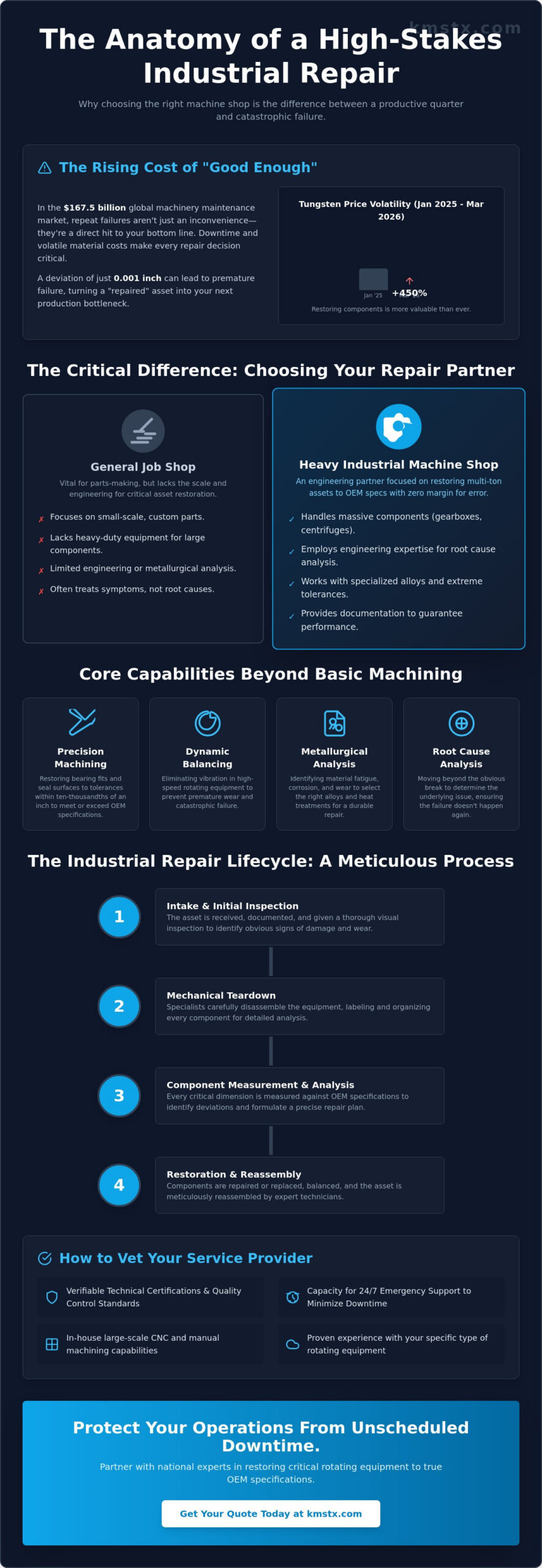
If you think the most expensive part of a gearbox failure is the repair bill, you haven’t accounted for the $167.5 billion global machinery maintenance market’s current volatility. With tungsten prices jumping 450% between January 2025 and March 2026, every botched repair or repeat failure is an expensive lesson in why “good enough” doesn’t cut it. Finding a reliable machine shop that can handle large-scale industrial components is about more than just finding a vendor with a lathe. It’s about finding an engineering partner who understands that a 0.001-inch deviation is the difference between a productive quarter and another round of unscheduled downtime.
You’ve likely dealt with the frustration of getting a pump or centrifuge back from a shop only to have it vibrate itself to death within weeks because the balancing was off. It’s a common pain point that leads to massive losses across the sector. This guide will show you how to evaluate a shop’s technical capabilities to ensure they can restore your rotating equipment to true OEM specifications. We’ll examine the critical benchmarks for gearbox, pump, and compressor repair, and explain why the right maintenance partner is your best defense against rising material costs and lost production time.
Key Takeaways
- Differentiate between a general job shop and a specialized heavy industrial machine shop to ensure your equipment receives the engineering expertise required for complex mechanical restoration.
- Identify the core technical capabilities, such as precision machining for bearing fits and dynamic balancing, that are essential for preventing repeat failures in high-speed rotating assets.
- Learn how to vet a service provider’s technical certifications and their capacity for 24/7 emergency support to protect your operations against extended downtime.
- Understand the full industrial repair lifecycle, from the initial intake and visual inspection to the meticulous mechanical teardown and component measurement process.
- Gain the criteria necessary to select a reliable maintenance partner capable of restoring critical gearboxes, pumps, and centrifuges to original OEM specifications.
What Defines a Heavy Industrial Machine Shop?
Walk into a typical Machine Shop and you’ll see small-scale lathes and mills producing custom brackets or replacement pins. These shops are vital for general manufacturing, but they lack the infrastructure and technical depth required for heavy industrial restoration. A specialized industrial service center is built for the high-stakes environment of the energy, construction, and manufacturing sectors. It’s a facility where the focus isn’t just on subtractive manufacturing, but on the precise engineering required to bring a multi-ton asset back to life with zero margin for error.
Engineering expertise is what separates a parts-maker from a restoration specialist. When a high-speed blower or pump fails, the fix isn’t as simple as turning a new shaft to match the old one. You have to analyze the metallurgy, identify the root cause of the wear, and ensure the new tolerances align with OEM standards. With raw material prices like tungsten increasing over 450% between January 2025 and March 2026, the value of restoring an existing component rather than buying a new one has never been higher. High-level shops provide the documentation and quality control needed to guarantee that a repaired asset won’t fail the moment it hits peak load.
To better understand the scale and precision of these facilities, watch this shop tour:
The Scope of Industrial Machining
An industrial machine shop is a facility focused on the restoration of critical mechanical assets. These centers manage the scale and complexity of components like centrifuge bowls, large gearbox housings, and massive hydraulic cylinders that small shops simply can’t fit on their tables. Precision requirements for these high-speed applications are extreme, often requiring tolerances within a few ten-thousandths of an inch. This level of accuracy is essential for specialized services like industrial centrifuge repair Texas, where rotational stability is the difference between operational success and a dangerous imbalance that could lead to catastrophic failure.
Materials and Tooling Requirements
Industrial environments demand materials that can survive extreme heat, pressure, and corrosion. We work with specialized alloys, duplex stainless steels, and heat-treated components that would chew up standard hobbyist tooling. This requires a combination of heavy-duty CNC centers for precision repeatability and massive manual lathes for custom, one-off repairs where a machinist’s touch is vital. Every cut must be calculated to maintain the integrity of high-tolerance fits, ensuring that bearings and seals seat perfectly every time. Without the right tooling and material knowledge, a repair is just a temporary patch that leads to more unscheduled downtime.
Core Capabilities: Beyond Basic Milling and Turning
While a standard machine shop handles basic turning and drilling, restoring heavy industrial assets requires a deeper understanding of mechanical tolerances and metallurgy. When a bearing fit is worn, you aren’t just looking for a smooth finish; you need to restore the exact interference or clearance fit specified by the OEM to ensure proper heat dissipation. Skilled Industrial Machinery Mechanics recognize that a seal surface off by even a few microns leads to immediate leakage and premature failure. This level of precision is why a simple repair in a high-quality industrial machine shop often requires a full engineering review before the first cut is even made.
A professional repair doesn’t just fix what’s broken; it identifies why it broke in the first place. A technical teardown involves measuring every critical dimension and looking for specific wear patterns, such as cavitation in pumps or fatigue in gearbox teeth. If you’re tired of seeing the same equipment failure every six months, consulting with a shop that prioritizes root cause analysis is the first step toward achieving long-term reliability and reducing your total cost of ownership.
Precision Dynamic Balancing
Balancing is the heart of rotating equipment longevity. If you’ve ever felt a blower house shake, you’ve seen the results of poor balancing. Static balancing might catch a heavy spot while the part is stationary, but dynamic balancing on a specialized machine accounts for centrifugal forces at operational RPMs. It’s a non-negotiable step for high-speed centrifuges and blowers. Precision balancing reduces vibration, which directly extends the life of your bearings and housings, preventing the kind of repeat failures that drive up maintenance budgets.
Custom Fabrication and Spare Parts
Global material shortages and supply chain shifts have made OEM lead times unpredictable. Between 2025 and 2026, many operators found that reverse engineering was the only way to keep a plant running when parts were backordered for months. We see this often when sourcing industrial machine spare parts Texas teams need for older, legacy equipment. If a part is obsolete or the price has spiked due to material shortages, a capable shop analyzes the metallurgy and fabricates a replacement that meets or exceeds the original’s performance standards.
How to Vet a Machine Shop for Rotating Equipment
Choosing a machine shop based on the lowest hourly rate is a gamble that usually ends in a second repair bill. When you’re vetting a facility for your rotating assets, you’re looking for a track record of technical precision. Start by asking for their inspection protocols. A shop that can’t provide a detailed digital report with before-and-after measurements isn’t a shop you should trust with a critical gearbox or blower. These reports should include non-destructive testing (NDT) results and dynamic balance certificates to prove the asset meets the required specifications.
The complexity of heavy equipment repair and maintenance requires a workforce that understands more than just how to read a micrometer. You need to know if their team has experience with your specific brand of centrifuge or pump. Check for quality assurance processes that mirror OEM standards. If a shop doesn’t offer a comprehensive warranty on their work, they don’t have enough confidence in their own engineering. Reliable shops stand behind their repairs because they’ve followed a rigorous, documented process from the moment the equipment arrived on the dock.
Service Center vs. General Job Shop
A general job shop is great for simple brackets, but they often lack the specialized tooling for high-speed assets. A dedicated service center focuses on rotating equipment maintenance, which involves understanding harmonic resonance and thermal expansion. These shops invest in specialized balancing stands and vibration analysis software that a generalist simply can’t justify. Because they see the same types of failures across different industries, they offer a faster turnaround on complex repairs because they aren’t learning on your dime.
Emergency Response and Field Service
Industrial failures rarely happen during business hours. When a critical blower goes down in the middle of a night shift, you need a partner capable of emergency machine repair Gulf Coast operators can count on. Vetting a shop means looking at their logistics chain. Can they handle the transportation of a 10,000-pound component? Do they have field technicians who can perform on-site troubleshooting before the equipment is even pulled? The best machine shop services integrate seamlessly with your plant’s maintenance team to minimize the time your equipment spends sitting idle.
The Industrial Repair Lifecycle: From Teardown to Reassembly
A professional repair doesn’t start with a wrench; it starts with a camera and a clipboard. When a piece of equipment arrives at the machine shop, the intake process sets the stage for everything that follows. We’ve seen too many shops skip the initial visual inspection, only to find out halfway through the build that a housing is cracked or a mounting foot is sheared. A standardized intake protocol ensures that the “as-found” condition is documented with high-resolution photos and initial run-out measurements, giving you a clear baseline before any metal is moved.
The real value comes when the shop’s teardown data is cross-referenced with field observations. If your field crew reported high bearing temperatures, the shop team needs to look for specific discoloration on the inner races. This integration between field diagnostics and machine shop floor measurement is what prevents you from putting a “repaired” asset back into service only to have it trip on high heat again. It’s a continuous feedback loop that ensures the repair scope addresses the environmental reality of your plant, not just the symptoms seen on the bench.
Inspection and Failure Analysis
Non-destructive testing (NDT) is non-negotiable for critical assets. We use dye penetrant and magnetic particle inspection to find the hairline fractures that the naked eye misses. By documenting these hidden defects early, we can develop a custom repair scope that actually addresses the root cause of the failure. For instance, if a shaft has chronic fatigue cracks, simply turning it down and sleeving it might not be enough. You need an engineering review to determine if the material choice or the operational load is the true culprit, ensuring the same failure doesn’t happen 30 days after reinstallation.
Precision Machining and Restoration
Restoration is about more than just making parts look new. It’s about hitting the exact tolerances required for industrial gearbox repair Houston plants rely on for 24/7 operations. We often see gear sets where the backlash and tooth contact patterns are just slightly out of spec. In a high-torque environment, “slightly out” means a catastrophic failure in six months. Every component is measured against OEM standards, and if those parts aren’t available, we use the data from our teardown to reverse-engineer a solution that maintains the unit’s mechanical integrity. Before the equipment leaves the floor, it undergoes final dynamic testing under simulated load to verify that the vibration and temperature levels are within acceptable limits.
If your current maintenance provider isn’t giving you this level of documented detail, contact Kelsey Machine Services today to discuss a more rigorous approach to your equipment reliability.
Kelsey Machine Services: National Experts in Rotating Equipment
Experience isn’t just a number on a resume when you’re dealing with a critical gearbox failure or a centrifuge that’s vibrating out of tolerance. It’s the difference between a repair that lasts five years and one that fails in five months. Kelsey Machine Services has spent over four decades refining the technical processes required for high-stakes industrial restoration. We’ve operated as a specialized machine shop since our founding, evolving from a local service provider into a national partner for the energy and manufacturing sectors. Our team doesn’t just look at a blueprint; we look at the operational history of your equipment to ensure our repairs solve the root cause of your downtime.
We’ve built our reputation on the reality that industrial plants don’t run on a 9-to-5 schedule. When a blower or pump fails at 2:00 AM on a Saturday, you don’t need a voicemail; you need a technician. Our commitment to 24/7 emergency availability is backed by a massive inventory of spare parts that we’ve curated over forty years. By keeping critical components in stock, we bypass the supply chain delays that often keep equipment sitting idle for weeks. We understand the pressure of unscheduled downtime, and we’ve aligned our entire shop workflow to provide the fastest possible turnaround without compromising on technical precision.
Specialized Centrifuge and Gearbox Knowledge
Our shop floor is equipped to handle the specific complexities of brands like Flottweg, Falk, and Lufkin. These high-speed assets require a level of care that generalist shops can’t provide. For example, our expertise in industrial centrifuge repair Texas operators depend on involves advanced dynamic balancing and precision machining that accounts for extreme centrifugal forces. Whether we’re restoring a complex industrial gearbox or a high-speed decanter, we utilize proprietary technical data and decades of hands-on experience to bring every component back to OEM-standard performance.
A Partner in Industrial Reliability
We don’t believe in “quick fixes” that lead to repeat failures. Our focus is always on the long-term performance of your assets. This commitment to reliability is reflected in our transparent reporting and the detailed technical documentation we provide with every project. You’ll receive a full breakdown of the work performed, including the measurements and test results that prove your equipment is ready for peak load. We treat every repair as an engineering project, ensuring that your machinery returns to the field better than when it arrived. If you’re ready to move beyond reactive maintenance, consult with our engineering team for your next repair project and let’s get your operations back on track.
Securing Long-Term Reliability for Your Rotating Assets
Selecting a heavy-duty machine shop is a decision that impacts your plant’s bottom line for years. The difference between a temporary patch and a permanent restoration lies in the shop’s ability to combine precise engineering with a rigorous teardown and inspection lifecycle. By prioritizing root cause analysis and dynamic balancing, you ensure that your gearboxes, pumps, and centrifuges return to the floor ready for the most demanding duty cycles without the risk of repeat failure.
With over 45 years of industrial engineering experience, Kelsey Machine Services understands the day-to-day realities of high-stakes production. We back our technical expertise with 24/7 emergency field service and a vast inventory of critical OEM and aftermarket spare parts to keep your downtime to an absolute minimum. Don’t let a minor vibration turn into a catastrophic failure. When you’re ready to partner with a team that values precision as much as you do, Contact Kelsey Machine Services for Expert Rotating Equipment Repair. We’re here to help you keep your operations running smoothly and reliably.
Frequently Asked Questions
What is the difference between a job shop and an industrial machine shop?
An industrial machine shop focuses on the complex mechanical restoration of heavy assets rather than the high-volume production of small parts. While a job shop might excel at milling simple brackets, an industrial facility has the heavy-duty infrastructure to handle multi-ton gearboxes and high-speed centrifuges. These specialized shops prioritize engineering depth and root cause failure analysis to ensure that critical rotating equipment returns to service with OEM-level reliability.
Can a machine shop repair obsolete equipment without OEM drawings?
Yes, we utilize reverse engineering and precision metrology to restore legacy equipment when original documentation is no longer available. By performing a detailed mechanical teardown and metallurgical analysis, our team can recreate exact specifications for worn components. This process allows us to fabricate replacement parts that meet or exceed the original performance standards, extending the lifecycle of assets that the manufacturer may no longer support.
How long does a typical industrial gearbox refurbishment take?
A standard gearbox refurbishment typically requires 2 to 4 weeks, though the timeline depends heavily on the extent of internal damage and part availability. If custom gear fabrication is necessary due to current material shortages, the process may take longer. We utilize our extensive spare parts inventory to minimize these delays, often providing 24/7 emergency turnarounds for critical failures that threaten plant production schedules.
Why is dynamic balancing necessary for all rotating equipment repairs?
Dynamic balancing is the only way to eliminate the centrifugal forces that cause destructive vibration at operational RPMs. While static balancing might identify a heavy spot on a stationary part, dynamic balancing on a specialized stand accounts for the weight distribution during high-speed rotation. Failing to balance a centrifuge or blower after a repair leads to immediate bearing wear and can cause catastrophic housing failure within hours of startup.
Do industrial machine shops provide on-site emergency services?
Many specialized shops provide 24/7 field service to perform on-site troubleshooting and equipment extraction. This field-to-shop integration is vital because it allows technicians to observe the equipment in its operational environment before it’s pulled. Identifying issues like base resonance or piping strain on-site ensures that the machine shop repair addresses the actual cause of the failure rather than just the visible symptoms.
What certifications should a reputable industrial machine shop hold?
A reputable shop should maintain ISO 9001:2015 quality management certifications and strictly adhere to OSHA safety standards, including the updated 2026 penalty guidelines. You should also look for verifiable Non-Destructive Testing (NDT) certifications and documented dynamic balancing protocols. These credentials prove the facility follows a rigorous, repeatable process and has the technical oversight necessary to handle high-stakes industrial repairs safely and accurately.
How does a machine shop ensure repair quality meets OEM standards?
Quality is ensured through a documented inspection lifecycle that tracks every measurement from intake to final testing. We use calibrated precision metrology tools to verify that bearing fits and seal surfaces align with the original manufacturer’s tolerances. Every repair concludes with a final run-test, often under simulated load, to verify that vibration levels and operating temperatures remain within the specified engineering limits before the asset leaves our floor.
Can you fabricate custom spare parts for centrifuges and pumps?
Yes, we use custom machining to fabricate critical components like shafts, sleeves, and wear rings when OEM lead times are too long. We maintain a strategic inventory of raw materials to bypass the 450% price spikes and shortages seen in materials like tungsten during early 2026. This allows us to reverse-engineer and manufacture compatible parts quickly, ensuring your pumps and centrifuges get back into production without waiting months for a factory shipment.