
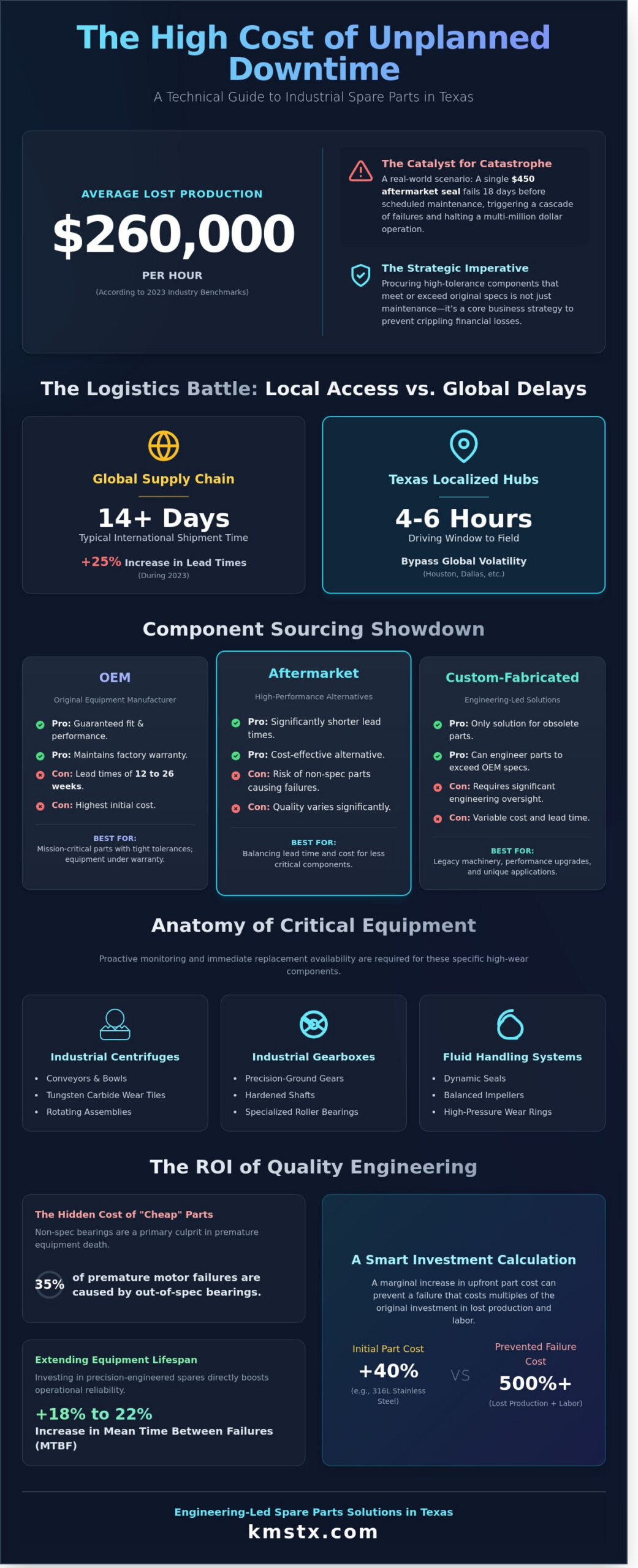
Imagine it’s 3:12 AM on a Tuesday when a critical centrifugal pump at a Houston refinery seizes because a $450 aftermarket seal failed 18 days before its scheduled maintenance interval. For many Gulf Coast facilities, this isn’t a hypothetical scenario; it’s a reality that contributes to an average of $260,000 in lost production per hour according to 2023 industry benchmarks. Sourcing reliable industrial machine spare parts Texas operators can trust shouldn’t feel like a high-stakes gamble against a backorder list. You’ve likely experienced how a six week delay for a proprietary OEM component is often as damaging to the bottom line as the mechanical failure itself. This guide provides the technical roadmap for procuring high-tolerance components that meet or exceed original design specifications. We’ll analyze the specific trade-offs between custom fabrication and OEM lead times. We’ll also explore engineering strategies to mitigate downtime by securing parts for legacy or obsolete machinery before the next catastrophic failure occurs.
Key Takeaways
- Learn why localized access to industrial machine spare parts Texas is the most effective strategy for mitigating the high costs of unplanned downtime in heavy rotating equipment.
- Understand the technical criteria for choosing between OEM reliability and high-performance aftermarket components to balance lead times with equipment longevity.
- Pinpoint specific high-wear components in centrifuges and gearboxes, such as conveyor tiles and discharge ports, that require proactive monitoring and immediate replacement availability.
- Master the “Critical Spares Audit” process to identify your facility’s most vulnerable machinery and secure necessary inventory before a failure occurs.
- Explore how an engineering-led approach to sourcing provides custom-fabricated solutions and high-spec alternatives for all major brands of heavy rotating machinery.
The Landscape of Industrial Machine Spare Parts in Texas
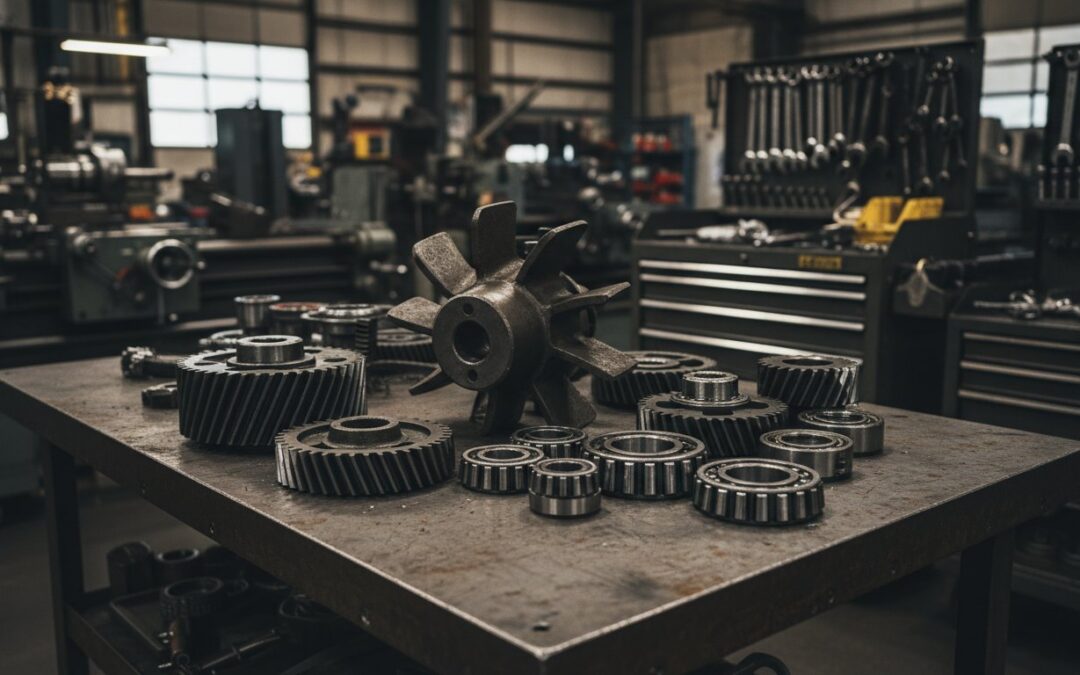
In the heavy industrial sectors of the Gulf Coast, industrial machine spare parts Texas operations rely on aren’t just inventory items; they’re the critical components that prevent total system failure. We define these parts as high-precision engineered elements necessary for maintaining heavy rotating machinery, including high-speed centrifuges, multi-stage pumps, and industrial gearboxes. While a standard hardware store carries bolts, a Texas-based industrial supplier stocks the specialized rotating assemblies that keep a $500 million refinery online.
Relying on a localized inventory in the Lone Star State is a strategic necessity for national operations. When a centrifuge bowl loses balance or a gearbox shaft shears, waiting for a 14-day international shipment isn’t an option. Localized hubs in cities like Houston and Dallas ensure that mission-critical components reach the field within a 4-to-6-hour driving window, bypassing the volatility of global shipping lanes that saw a 25% increase in lead times during 2023.
To better understand the variety and scale of these components, watch this helpful video:
It’s vital to distinguish between general MRO (Maintenance, Repair, and Operations) supplies and high-precision parts. MRO usually covers consumables like lubricants or safety gear. In contrast, the Original Equipment Manufacturer (OEM) or high-spec aftermarket parts we’re discussing are engineered to tolerances within 0.001 inches. The “just-in-time” delivery model, while efficient for automotive assembly, fails miserably for heavy rotating equipment. If a custom-ground gear set isn’t on a shelf in Texas when the vibration sensors trip, the facility faces an average downtime cost of $12,000 per hour.
Critical Categories of Rotating Equipment Parts
Centrifuge components demand the highest attention, specifically conveyors, bowls, and tungsten carbide high-wear tiles that withstand abrasive slurries. For gearboxes, the focus remains on precision-ground gears, hardened shafts, and specialized roller bearings rated for continuous 24/7 duty. Fluid handling systems require a steady supply of dynamic seals, balanced impellers, and wear rings to maintain the hydraulic efficiency of industrial pumps operating under high pressure.
The Economic Impact of Part Quality on Downtime
Cheap parts are an expensive mistake. A 2022 failure analysis showed that non-spec bearings cause 35% of premature motor failures. By investing in precision-engineered spares, plants can extend their Mean Time Between Failures (MTBF) by approximately 18% to 22%. Material science plays a massive role here. Selecting 316L stainless steel over standard carbon steel for corrosive environments might increase the initial part cost by 40%, but it prevents a catastrophic failure that could cost five times the original investment in lost production and emergency labor.
OEM vs. Aftermarket vs. Custom Fabricated Components
Choosing between OEM, aftermarket, or custom components isn’t just a matter of price; it’s a strategic decision based on lead times and machine criticality. While OEM parts offer a guaranteed fit, lead times for specialized components can stretch from 12 to 26 weeks. In Texas’s advanced manufacturing sector, where production downtime for a Tier 1 automotive supplier can cost upwards of $15,000 per hour, waiting six months for a factory shipment is rarely an option. Decisions must balance the risk of non-certified parts against the certainty of lost revenue.
When to Insist on OEM Spare Parts
You should prioritize Original Equipment Manufacturer (OEM) parts for mission-critical components where tolerances are tighter than 0.0005 inches. High-pressure hydraulic manifolds and proprietary control boards fall into this category. If your equipment was commissioned after 2022 and remains under a standard 3-year factory warranty, installing non-OEM parts will likely void your coverage. Reliable industrial machine spare parts Texas distributors maintain direct lines to these manufacturers to ensure you receive components that meet the exact metallurgical specs of the original build.
The Rise of Precision Aftermarket Solutions
Modern aftermarket engineering has moved far beyond simple replication. Many firms now use coordinate measuring machines (CMM) to reverse-engineer components, often identifying and correcting flaws in the original design. For non-critical systems like drive belts, standard bearings, or cooling fans, aftermarket solutions provide a 30% to 40% cost reduction. Before committing, always request a material test report (MTR) to verify the alloy’s integrity. These parts often meet or exceed ISO 9001 standards, making them a viable alternative for high-wear items.
Custom Machining for Obsolete Machinery
When a manufacturer ceases support for a 15-year-old legacy press, custom fabrication is the only way to keep the line moving. Local shops utilizing 5-axis CNC machining and manual lathes can often recreate a drive shaft or specialized gear in under 72 hours. We use 3D laser scanning to capture the dimensions of a failed part, ensuring the new component integrates perfectly with existing hardware. If you’re dealing with a total machine stoppage, exploring local fabrication options is usually faster than hunting for used parts on the secondary market.
Regardless of the part’s origin, dynamic balancing is a non-negotiable final step for any rotating component. Installing an unbalanced impeller or rotor creates harmonic vibrations that can lead to bearing failure within 500 hours of operation. Proper balancing protects your investment and maintains the structural stability of the entire machine assembly.
Sourcing Spare Parts for Industrial Centrifuges and Gearboxes
Centrifuges and gearboxes represent the most high-maintenance assets in the Texas oil patch and municipal wastewater sectors. When you’re sourcing industrial machine spare parts Texas, you have to prioritize the components that face the highest rotational stress and abrasive friction. Discharge ports and conveyor tiles are the primary failure points in decanter centrifuges. If you let a tungsten carbide tile wear down past its 3mm thickness safety margin, you’re looking at a potential $25,000 repair for the stainless steel scroll. It’s a massive risk for a part that costs less than 1% of the total machine value.
High-speed rotating environments also demand specialized sealing solutions. Standard gaskets won’t survive the 3,500 RPM speeds typical in modern separation equipment. You need FKM (Viton) seals rated for 400 degrees Fahrenheit to prevent thermal degradation during 24-hour operations. Using proprietary HVOF (High Velocity Oxygen Fuel) coatings on shafts can extend the service life of standard 4140 steel components by 300%, providing a significant buffer against unplanned downtime.
Centrifuge Spare Parts: Wear Protection and Balance
Operators in the Permian Basin usually stock at least two full sets of discharge inserts to avoid shipping delays. You should specify tungsten carbide tiles with a 6% cobalt binder for the best balance of hardness and impact resistance. Once you replace these wear items, the entire rotating assembly must undergo a precision balance to ISO G2.5 standards. A weight discrepancy as small as 5 grams on a 20-inch bowl will cause vibration levels to exceed 5.0 mm/s, which destroys your main bearings within 72 hours of startup.
Gearbox Parts: Precision and Power Transmission
Replacing a single gear in a planetary set is a common mistake that leads to premature failure. Gears develop unique wear patterns over 10,000 hours of run time; a new gear will create localized stress points on its older counterparts. Always source matched gear sets to maintain a 98% power transmission efficiency. Other critical considerations include:
- Bearing Internal Clearance: Standard bearings often lack the C3 or C4 clearance needed for thermal expansion in 105-degree Texas summers.
- Housing Integrity: Check for bore ovality exceeding 0.02mm before installing new bearings.
- Lubrication Paths: Verify that replacement seals don’t obstruct internal oil galleries designed for splash lubrication.
Procuring the right industrial machine spare parts Texas requires more than just matching a part number. You’ve got to account for the specific tolerances and metallurgy required for high-torque applications. Whether you’re rebuilding a Flottweg decanter or a Lufkin gearbox, the precision of the fit determines whether the machine lasts five years or five months.
Strategic Procurement: Minimizing Lead Times and Maximizing Reliability
Reliability isn’t accidental. It starts with a Critical Spares Audit to identify the 12% of components that are both high-risk and have lead times exceeding 14 days. If a motor fails and the replacement is six weeks out, your production line is a paperweight. Establishing a relationship with a local partner for industrial machine spare parts Texas ensures you aren’t waiting on international shipping during a crisis. Texas-based providers often stock deep inventories of legacy components that OEMs no longer prioritize. Utilizing 24/7 emergency repair services gives you immediate part access, often bypassing standard procurement delays by pulling from existing shop stock.
Deciding between a Direct Purchase and a Repair-and-Return model depends on the asset’s complexity. For a standard 50 HP motor, a direct purchase is usually the fastest route. However, for a proprietary gearbox or a custom hydraulic manifold, the Repair-and-Return model can save 40% on costs while ensuring the rebuilt unit meets original tolerances. Implementing a preventive maintenance schedule based on vibration analysis data helps you predict a bearing failure 90 days before it occurs, allowing for a planned purchase rather than an emergency scramble.
Building a Resilient Spare Parts Inventory
Stocking every nut and bolt is inefficient. Focus on high-wear items like seals, filters, and specialized sensors. For precision parts, environmental control is non-negotiable. Storing high-tolerance bearings in a humid warehouse leads to microscopic rust that causes failure within 500 hours of operation. Digital tracking across multi-site operations ensures that if a pump fails in Midland, you know exactly which shelf holds the replacement in your Houston facility.
Vetting Your Spare Parts Supplier
Don’t just look at the price tag. Ask if they provide dynamic balancing and onsite machining. A supplier with ISO 9001:2015 certification and documented QC processes reduces the risk of receiving a “new” part that’s actually a poorly refurbished core. Verify their engineering support; you need a partner who understands the physics of the application, not just a catalog number. For complex systems requiring specialized technical oversight, partner with KMS Technologies for high-level engineering solutions.
Kelsey Machine Services: Engineering-Led Spare Parts Solutions
Kelsey Machine Services (KMS) operates as a technical partner rather than a simple distributor. We’ve spent 40 years mastering the nuances of heavy rotating equipment, from high-speed centrifugal compressors to multi-stage steam turbines. This deep-seated mechanical knowledge allows us to curate a vast inventory of OEM and high-spec aftermarket components that satisfy the most demanding industrial machine spare parts Texas requirements. Our facility maintains a stock of critical components for major brands like Flowserve, Goulds, and Elliott, ensuring you aren’t left waiting on international lead times.
Beyond Simple Part Sales: The KMS Advantage
The KMS advantage lies in our refusal to treat a part replacement as an isolated event. Every installation is an opportunity for system optimization. We integrate dynamic balancing and precision machining into our workflow; this ensures that new components don’t just fit, but function with minimal vibration and heat generation. For facilities managing aging infrastructure, sourcing reliable industrial machine spare parts Texas can be a logistical bottleneck. Our engineering team specializes in the restoration of obsolete hardware, using proprietary refurbishment techniques to bring non-functional assets back to peak performance.
Every repair and part installation is backed by a 12-month warranty. We don’t just hand over a component; we provide a warranted solution that offers peace of mind for critical infrastructure. Our processes are designed to meet or exceed original equipment specifications, often improving the mean time between failures (MTBF) for equipment operating in harsh environments.
Partnering for Long-Term Operational Stability
Stability in heavy industry is built on preparation. We offer customized maintenance agreements that include prioritized part sourcing and 24/7 emergency support. For our national industrial clients, a 24-hour turnaround on critical machining can be the difference between a minor hiccup and a multi-million dollar loss. Our service model focuses on three core pillars:
- 24/7 Emergency Support: Rapid deployment of parts and technicians to minimize unplanned downtime.
- Technical Consultations: Expert advice on component modernization and equipment upgrades to extend asset life.
- Inventory Audits: Proactive identification of critical spares to ensure your warehouse is stocked for high-risk failure points.
Our goal is to extend the lifecycle of your infrastructure through smart component choices and expert oversight. Whether you’re dealing with a sudden mechanical failure or planning a scheduled turnaround, we provide the technical depth required to keep your operations running smoothly. Contact Kelsey Machine Services for an inventory audit or emergency part request to discuss your specific mechanical needs.
Strengthening Your Reliability Strategy
Reliable procurement isn’t just about finding a part; it’s about ensuring every component integrates perfectly with your rotating equipment. Whether you’re weighing the cost-benefits of OEM versus custom-fabricated parts or managing the tight tolerances of high-speed centrifuges, the goal remains the same: zero unscheduled downtime. Sourcing industrial machine spare parts Texas operations require demands a partner who understands both the grit of the field and the precision of the machine shop.
With 40 years of industrial mechanical expertise, Kelsey Machine Services provides the technical backbone needed to keep your facility running. We leverage in-house precision machining and dynamic balancing to ensure every component meets exact specifications before it reaches your floor. If a critical failure occurs at 2:00 AM, our 24/7 emergency field service and repair teams are ready to deploy immediately. Don’t leave your reliability to chance or settle for long-distance logistics that stall your production. Contact us today to secure the parts and technical support your facility deserves.
Request a Technical Consultation and Part Quote to keep your machines moving.
Frequently Asked Questions
How do I know if I should buy an OEM part or an aftermarket alternative?
Choosing between OEM and aftermarket parts depends on your specific tolerance requirements and budget constraints. OEM parts offer a guaranteed fit but often come with a 30% price premium and longer lead times. High-quality aftermarket alternatives, when engineered to exact specifications, provide identical performance for 25% less cost. If your machine is over 10 years old, aftermarket is often the only way to avoid the 12-week lead times common with legacy manufacturers.
What are the most common spare parts needed for industrial decanter centrifuges?
The most frequent replacements for industrial decanter centrifuges include main bearings, conveyor bearings, and discharge port wear liners. Seal kits and tungsten carbide tiles for the scroll are also high-turnover items. Since these machines often rotate at speeds exceeding 3,000 RPM, these components experience extreme centrifugal forces. Replacing these 5 critical wear items during scheduled 4,000-hour maintenance intervals prevents catastrophic rotating assembly failure that costs thousands in downtime.
Can you fabricate spare parts for machinery that is no longer supported by the manufacturer?
We can fabricate spare parts for machinery that is no longer supported by the original equipment manufacturer. Our team uses 3D laser scanning and coordinate measuring machines to reverse engineer components with a precision of 0.001 inches. This process allows us to produce high-performance industrial machine spare parts Texas facilities need to keep 20-year-old assets operational. We’ve successfully recreated over 500 unique legacy components for the oil and gas sector since 2015. For complex obsolete components requiring detailed technical analysis, our reverse engineering machine parts process can recreate components to OEM specifications when original drawings no longer exist.
How long does it typically take to source specialized gearbox parts in Texas?
Sourcing specialized gearbox parts in Texas typically takes between 24 and 48 hours for standard gear sets and bearings. If the component requires custom hobbing or heat treatment, the timeline extends to 10 or 15 business days. We leverage a network of 12 regional distribution hubs to minimize transit times. This localized approach ensures that 95% of our urgent orders reach the plant floor within 2 calendar days of the initial request.
What is the risk of installing a spare part without performing dynamic balancing?
Installing a rotating part without dynamic balancing risks immediate bearing failure and long-term structural fatigue. Even a 5-gram imbalance at high speeds can increase vibration levels by 400%, which destroys seals in under 100 operating hours. We balance all rotating components to ISO 1940/1 G2.5 standards to ensure smooth operation. Skipping this step often leads to a secondary repair bill that’s 3 times the cost of the initial part replacement.
Do you offer 24/7 emergency shipping for critical industrial spare parts?
We provide 24/7 emergency shipping for critical industrial machine spare parts Texas operations require during unplanned outages. For facilities within a 200-mile radius of Houston or Dallas, we offer 4-hour hot-shot delivery services. Our emergency response team has handled over 1,200 urgent shipments since 2018. This service is designed to mitigate the $5,000 per hour loss many plants face when a primary production line goes down unexpectedly.
What information do I need to provide to get an accurate quote for a replacement part?
To get an accurate quote, you’ll need to provide the manufacturer’s part number, the machine serial number, and the model year. Including 2 or 3 high-resolution photos of the worn part and its nameplate helps our engineers verify the exact revision. These 3 data points allow us to maintain a 99.8% accuracy rate on our quotes. Clear documentation prevents the 15% return rate often seen with incorrectly identified mechanical components in heavy industry.
How does Kelsey Machine Services ensure the quality of its aftermarket components?
Kelsey Machine Services ensures quality by subjecting every aftermarket component to a 12-point inspection process before it leaves the shop. We use Positive Material Identification (PMI) to verify that alloys meet or exceed the 4140 or 316 stainless steel standards required for heavy industry. Our QA lab tracks the performance of over 10,000 parts currently in the field. This rigorous testing protocol has maintained our 0.5% defect rate over the last 7 years of operation.