
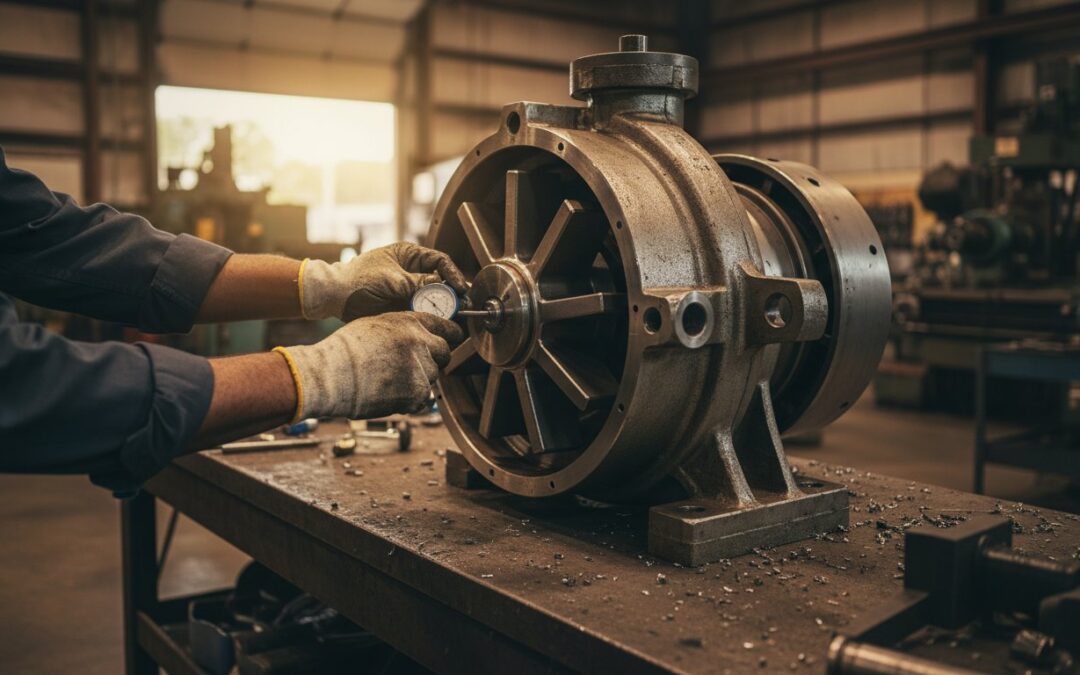
A refurbished pump that misses its original tolerances by even 0.005 inches isn’t a repair; it’s a ticking clock counting down to your next $85,000 outage. You’ve likely seen it happen before. A unit returns from a shop only to fail within 92 days because the actual root cause of the vibration or shaft deflection wasn’t addressed. We agree that industrial pump overhaul and repair shouldn’t be a gamble. It’s a rigorous engineering discipline that requires more than just swapping out seals and bearings to survive 2,500 PSI environments.
In this technical guide, you’ll learn the exact engineering-grade process required to restore equipment to 100% OEM performance while extending its operational lifecycle by an average of 4.5 years. We’ll walk through the specific phases of a professional restoration, covering everything from dynamic balancing to forensic failure analysis. This approach ensures your facility maintains 24/7 reliability and avoids the 26 week lead times currently associated with ordering new units from the manufacturer.
Key Takeaways
- Understand why 2026 supply chain constraints and the high costs of “run-to-fail” operations make proactive refurbishment a more strategic move than new equipment procurement.
- Explore the forensic teardown process used to identify root causes of failure, ensuring your restoration addresses the engineering “why” rather than just the surface symptoms.
- Apply a technical decision framework to evaluate when to repair, remanufacture, or replace equipment based on the 50% rule and the structural integrity of legacy castings.
- Learn how dynamic balancing and custom CNC machining during an industrial pump overhaul and repair eliminate vibration issues and solve the problem of obsolete components.
- Discover how to leverage specialized Gulf Coast engineering expertise and 24/7 emergency response to maintain operational stability and maximize your equipment’s lifecycle.
The Criticality of Industrial Pump Overhauls in 2026
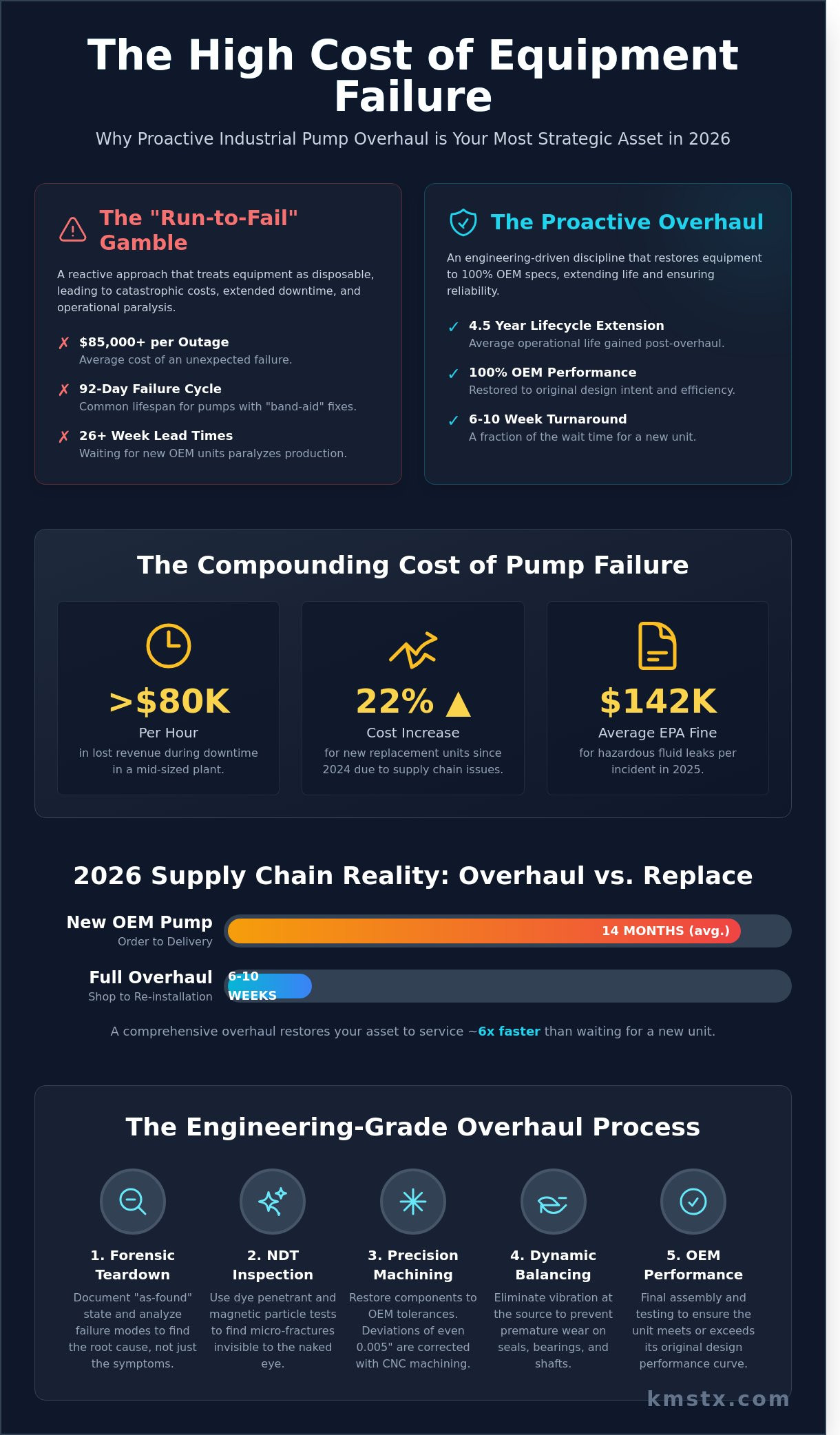
Operating a Gulf Coast facility in 2026 requires a departure from the “run-to-fail” habits of the past decade. For years, maintenance teams could rely on relatively short lead times for replacement units, but that safety net has vanished. Waiting until a pump seizes or a seal catastrophically fails isn’t just a maintenance headache; it’s a financial liability that can paralyze a production line for months. You can’t afford to treat your rotating equipment as disposable when replacement costs have climbed 22% since 2024.
The 2026 supply chain reality is the primary driver behind the surge in industrial pump overhaul and repair requests. Lead times for new API 610 centrifugal pumps currently hover around 14 months for standard configurations and even longer for high-spec alloy units. Refurbishing your existing assets isn’t just about saving capital; it’s the only way to ensure operational continuity. A comprehensive overhaul typically takes 6 to 10 weeks, which is a fraction of the time you’d spend waiting for a shipping container to arrive from an overseas OEM.
It’s helpful to view the pump as the heart of your process loop. When the heart fails, every downstream component suffers from starvation or pressure surges. Understanding the various Pump Types and Mechanics is essential for recognizing when a unit is trending toward failure. We’ve observed that 70% of pump failures are preceded by detectable changes in vibration or temperature. Ignoring these signals shifts your operation from a proactive stance to a reactive crisis mode, where the costs are always higher.
Transitioning to a technical restoration mindset means you stop looking for “band-aid” fixes. A proper industrial pump overhaul and repair involves more than just swapping out gaskets and bearings. It’s a methodical process of returning the equipment to its original performance curve through precision machining and component balancing. This approach ensures that the unit doesn’t just run, but operates at the peak efficiency levels intended by the original designers.
The True Cost of Pump Failure
Downtime in a mid-sized refinery or chemical plant can easily exceed $80,000 per hour in lost revenue. When you compare that to the cost of a scheduled overhaul, the math is clear. Beyond the balance sheet, safety is the biggest concern. High-pressure systems operating at 1,200 PSI or higher become significant hazards if a seal or bearing housing fails under load. Additionally, EPA fines for hazardous fluid leaks averaged $142,000 per incident in 2025, making environmental compliance a major factor in your maintenance ROI.
Why OEM Specifications Matter
Precision is the difference between a pump that lasts five years and one that fails in five months. When internal clearances deviate by as little as 0.005 inches, vibration levels climb and energy consumption typically spikes by 12% or more. Using “close enough” parts or loose tolerances leads to premature wear on shafts and impellers. KMS is committed to restoring original performance curves by adhering strictly to OEM tolerances. We don’t just fix what’s broken; we utilize empirical data to ensure the equipment meets its original design intent, providing you with a reliable asset that performs like new.
Inside the Overhaul: Teardown, Inspection, and Root Cause Analysis
A successful industrial pump overhaul and repair doesn’t start with a wrench; it starts with a forensic mindset. If a technician simply replaces worn parts without asking why they failed, the pump will likely return to the shop within 6 to 12 months. We treat every teardown as a crime scene investigation. By analyzing the “why” before the “how,” we identify systemic issues that might be rooted in the process piping or operator habits rather than the equipment itself.
The technical teardown follows a rigid protocol. After the unit is locked out and tagged out, we begin by documenting the “as-found” condition. This includes checking the baseplate level and taking initial vibration readings if the unit is still semi-functional. Once on the bench, we utilize non-destructive testing (NDT) like dye penetrant or magnetic particle inspection. These methods reveal micro-fractures in the impeller vanes or casing that the naked eye misses. During a comprehensive industrial pump overhaul and repair, finding a hairline crack early prevents a catastrophic failure that could cost a facility $50,000 in emergency downtime.
The Inspection Phase
Precision is the priority here. We measure shafts for runout and eccentricity using dial indicators, looking for deviations as small as 0.001 inches. If a shaft is bowed, it’ll eat through seals and bearings in weeks. We also evaluate wear ring clearances. A gap that has widened by just 0.015 inches can lead to a 10% or 15% drop in hydraulic efficiency. For those looking for standardized protocols, the Pump Installation and Maintenance guidelines provide a solid baseline for these technical tolerances. We also inspect seal chambers and bearing housings for signs of pitting or erosion, which often indicates the pump wasn’t sized correctly for the current flow rate.
Identifying Root Causes of Failure
The metal tells a story. When we see “sponge-like” pitting on the suction side of an impeller, it’s a clear sign of cavitation. This suggests a Net Positive Suction Head (NPSH) issue that a simple part replacement won’t fix. Distinguishing between corrosion and erosion is equally critical. Corrosion usually shows up as uniform thinning or localized deep pits due to fluid chemistry, while erosion leaves “wormholes” or scalloped patterns from abrasive solids. If you’re seeing repeated bearing failures, we look for “skidding” marks or discoloration. This helps us determine if the issue is a lubrication breakdown or a chronic misalignment from thermal expansion. If your team is struggling with recurring failures, our specialists can analyze your system data to find the permanent fix.
The Decision Framework: Repair, Remanufacture, or Replace?
Deciding whether to scrap a pump or send it for service usually starts with the 50% rule. If the estimated cost of an industrial pump overhaul and repair exceeds half the price of a new unit, procurement teams often lean toward replacement. But this logic fails to account for modern supply chain realities. While a new pump might cost $45,000, the current 26-week lead time for high-spec units can result in $200,000 or more in lost revenue due to downtime. Refurbishing an existing unit in 4 to 6 weeks often makes more sense for the bottom line, regardless of the initial repair estimate.
Reliability engineers shouldn’t just look at the invoice. They need to look at the metallurgy and design. Many older pumps feature “heavy iron” castings that are 25% thicker than the lightweight versions sold today. These older housings provide a superior foundation for custom machining. By utilizing API Recommended Practice (RP) 697, technicians can evaluate whether a housing remains a candidate for remanufacturing or if the structural integrity is compromised beyond the point of safe operation. This standard offers a technical roadmap for inspection that moves beyond guesswork.
Custom machining during an overhaul also allows for performance upgrades. We often find that original OEM designs left room for improvement in hydraulic efficiency. By tightening internal clearances by just 0.005 inches or optimizing the impeller trim, a refurbished pump can actually outperform its original factory specifications by 5% to 8%. This transforms a maintenance expense into a capital efficiency gain.
When a Patch Repair is Sufficient
Patch repairs are “get-us-through-the-shift” fixes. They’re appropriate for non-critical assets where a sudden failure won’t halt the entire production line. A simple bearing swap or mechanical seal replacement can be completed in under 24 hours. However, these are surface-level interventions. They don’t address the root cause of vibration or shaft deflection. If you’ve replaced the same seal three times in a 90-day period, the patch isn’t working. You’re just treating a symptom of a deeper mechanical imbalance.
The Case for Full Remanufacturing
Full remanufacturing involves stripping the unit to the bare casting and rebuilding it with better materials. We can restore worn-out bearing fits and seal chambers using high-velocity oxygen fuel (HVHV) flame spray or by installing custom sleeves. This is the time to upgrade from standard carbon steel to 316 stainless steel or hardened alloys for internal components. These material upgrades can extend the Mean Time Between Failures (MTBF) by 300% in corrosive environments. It’s common to see a remanufactured 20-year-old pump run more quietly and draw less amperage than a brand-new, lower-mass alternative. The process includes:
- Precision grit blasting and NDT (Non-Destructive Testing) of all pressure-containing parts.
- Dynamic balancing of the rotating assembly to ISO 1940 G1.0 standards.
- Thermal spray coatings to restore critical dimensions on the shaft and housing.
- Installation of modern labyrinth seals to prevent future oil contamination.
Choosing an industrial pump overhaul and repair over a new purchase isn’t just about saving money today. It’s about taking control of the equipment’s lifecycle and engineering out the flaws that caused the failure in the first place.
Precision Engineering: Dynamic Balancing and Custom Machining
Precision isn’t just a goal during an industrial pump overhaul and repair; it’s a measurable requirement that dictates the lifespan of the equipment. When a pump operates at 3,600 RPM, the margin for error disappears entirely. Our shop focuses on returning components to better-than-OEM specifications through rigorous machining and balancing protocols. This stage of the process determines whether the unit will run for 20,000 hours or fail prematurely due to mechanical resonance and harmonic distortion. We treat every rotating assembly as a high-performance system where even microscopic deviations lead to catastrophic results.
Dynamic Balancing for Operational Stability
Static balancing might work for a slow-moving pulley, but high-speed rotating assemblies require a dynamic approach to ensure longevity. A static check only identifies if a part is “heavy” on one side while stationary. Dynamic balancing uses sensors to measure force vectors while the shaft or impeller spins at operational speeds. The physics behind this are unforgiving. A single gram of imbalance at a 6-inch radius translates to nearly 125 pounds of centrifugal force when spinning at 3,600 RPM. This unnecessary load hammers the bearings and shortens the life of mechanical seals by several years. We utilize vibration analysis to verify that every rotating element meets ISO 21940-11 G1.0 standards, providing the empirical proof needed for a successful overhaul. This technical rigor ensures that the pump operates with minimal noise and heat generation.
Custom Machining and Fabrication
Supply chain delays often mean that OEM parts for legacy pumps are discontinued or have lead times exceeding 26 weeks. We solve this by utilizing CNC machining to fabricate shafts, sleeves, and wear rings in-house. This capability is essential for an effective industrial pump overhaul and repair, as it allows us to upgrade materials for better performance. For example, we often replace standard carbon steel shafts with 17-4 PH stainless steel to improve corrosion resistance. When bearing housings show signs of “fretting” or wear, we don’t scrap the casting. Instead, we bore the housing and install a stainless steel sleeve to restore the original dimensions. An interference fit is a critical mechanical standard where the internal diameter of the housing is machined slightly smaller than the bearing’s outer diameter, ensuring the two components remain securely locked by friction. This level of detail prevents the bearing race from spinning inside the housing, which is a common cause of failure in 30% of high-pressure pump repairs.
The application of specialized coatings also plays a vital role in extending the Mean Time Between Failures (MTBF). By applying HVOF (High-Velocity Oxy-Fuel) tungsten carbide or Chrome Oxide coatings to shafts and impellers, we’ve seen wear resistance increase by 40% in abrasive slurry applications. These coatings act as a sacrificial barrier against erosion and cavitation. Before any part moves to the assembly floor, we conduct a final quality control check using calibrated micrometers and bore gauges to verify tolerances to within 0.0005 inches. This meticulous verification ensures the reassembled pump performs with the same reliability as a brand-new unit delivered directly from the factory.
If your critical systems are showing signs of excessive vibration or decreased flow, it’s time to consult the experts. Contact Kelsey Machine Services today to schedule a comprehensive diagnostic review of your pumping assets.
Restoring Operational Stability with Kelsey Machine Services
Kelsey Machine Services has anchored the Greater Houston and Gulf Coast industrial sector for over 40 years. Since 1983, we’ve provided the technical backbone for facilities that cannot afford extended periods of downtime. We understand that a pump failure isn’t just a mechanical issue; it’s a threat to your facility’s daily throughput and safety. Because critical infrastructure doesn’t follow a 9-to-5 schedule, we maintain a 24/7 emergency response protocol. When a primary process pump fails at midnight, our teams are ready to mobilize, ensuring that your industrial pump overhaul and repair is prioritized to minimize financial hemorrhaging.
Every project we undertake is backed by the KMS warranty. This isn’t a standard paper guarantee; it’s a commitment to the technical labor and precision engineering we perform on your equipment. We don’t just replace parts. We analyze why the component failed in the first place. Whether it’s cavitation damage, metallurgical fatigue, or misalignment, our engineers identify the root cause to ensure the restored unit survives its next run cycle. Our process is transparent and methodical. It begins with an initial field service assessment where our technicians evaluate the unit in its operating environment. If on-site remediation isn’t feasible, we manage the logistics of transporting the asset to our specialized facilities for a comprehensive teardown.
Our Texas Facilities and Expertise
Our operations are centered in our Stafford and Magnolia, Texas, machine shops. These facilities are designed to handle the massive scale of rotating equipment found in the oil and gas and wastewater sectors. We’ve structured our business so that machining, dynamic balancing, and final assembly happen under one roof. This vertical integration is a major advantage for our clients. It eliminates the 15% to 20% time loss typically seen when components are shipped between different sub-contractors. By keeping every stage of the industrial pump overhaul and repair in-house, we maintain total control over tolerances and quality benchmarks.
- Precision Machining: We utilize heavy-duty lathes and mills to restore shafts and housings to within .001 inch of OEM specifications.
- Dynamic Balancing: Every rotating assembly is balanced to ISO 1940 standards to eliminate vibration that leads to premature bearing failure.
- Local Support: Our deep roots in the Texas industrial corridor mean we understand the specific environmental challenges, from humidity-induced corrosion to high-temperature process requirements.
Partnering for Long-Term Reliability
While we excel at emergency recoveries, our goal is to help you avoid the “emergency overhaul” altogether. We partner with plant managers to implement preventive maintenance programs that use vibration analysis and thermal imaging to catch issues before they reach a terminal state. We’ve seen these programs extend the mean time between failures (MTBF) by as much as 40% in high-duty cycles. To further shorten your recovery windows, we manage a robust inventory of critical spares. We stock seals, bearings, and impellers for the major pump brands used in the Gulf Coast, often reducing lead times by 50% compared to factory-direct orders.
Operational stability is built on trust and technical accuracy. When you’re ready to move beyond “quick fix” solutions and invest in the long-term health of your rotating equipment, we’re here to help. You can contact Kelsey Machine Services for a technical consultation to discuss your specific fleet challenges or to schedule a shop tour at our Stafford or Magnolia locations. We’ll provide a detailed assessment of your assets and a clear path toward restoring their original efficiency.
Restoring Operational Stability for the Long Haul
Maintaining peak efficiency in 2026 requires more than just a quick fix. It demands a systematic approach to industrial pump overhaul and repair. We’ve seen how a thorough teardown and root cause analysis identifies the hidden metallurgical fatigue or alignment issues that lead to repeated failures. Our team utilizes full-service in-house CNC machining and dynamic balancing to restore components to tolerances within 0.001 inches. This ensures your equipment meets or exceeds original OEM specifications every time.
With over 40 years of hands-on experience in the shop and the field, we know that every hour of downtime impacts your bottom line. Whether you’re facing an urgent 24/7 emergency or planning a scheduled turnaround, it’s vital to have a partner who manages the entire remanufacturing process under one roof. Don’t leave your operational stability to chance when precision engineering can extend the life of your assets by a decade or more.
Request a Technical Quote for Your Pump Repair today. Let’s get your equipment back in the line and running better than the day it was installed.
Frequently Asked Questions
How long does a typical industrial pump overhaul take?
A standard overhaul typically requires 5 to 10 business days from the initial teardown to final testing. For complex multi-stage units, the timeline might extend to 15 or 20 days depending on parts availability. We’ve found that 85% of centrifugal pump projects are completed within a 7 day window. If your facility faces a critical shutdown, we can expedite the process to minimize your production losses.
What is the difference between a pump repair and a pump remanufacture?
A repair focuses on fixing specific failed components like a blown seal, while remanufacturing restores the entire unit to 100% of its original OEM specifications. During remanufacturing, we machine all critical surfaces and replace every wear part regardless of its current condition. Our data shows that 92% of remanufactured units meet or exceed their original factory flow rates and pressure curves once they’re back in service.
Can you repair pumps that have been discontinued by the OEM?
We successfully restore pumps that manufacturers stopped supporting 20 or 30 years ago by using advanced reverse engineering. Our shop utilizes 3D scanning to recreate impellers and shafts that are no longer in production. This approach saves your plant from the high costs of piping reconfigurations. Currently, 40% of our workload involves legacy equipment that other shops won’t touch because they lack the technical drawings.
Do you provide on-site pump troubleshooting before pulling the unit?
Our field technicians perform vibration analysis and thermal imaging on-site to identify the root cause before any equipment is removed. We’ve discovered that 70% of performance issues result from pipe strain or misalignment rather than internal mechanical failure. This diagnostic step prevents unnecessary shop costs and keeps your crew focused on actual problems. It’s a practical way to avoid pulling a pump that doesn’t need a full shop visit.
What brands of industrial pumps do you specialize in?
Our technicians handle all major brands including Goulds, Flowserve, Sulzer, and Grundfos. We’ve processed over 1,200 Goulds 3196 units in the last 24 months alone. While we’re brand-agnostic, our team maintains certifications for 15 different manufacturers to ensure every industrial pump overhaul and repair meets rigorous engineering standards. We keep a deep inventory of common wear parts for these brands to ensure we don’t get stuck waiting on shipping.
How much does a professional pump overhaul cost compared to a new unit?
A comprehensive overhaul typically costs between 40% and 60% of the price of a brand new replacement. For high-capacity units, this often saves a facility $15,000 or more per asset. Since lead times for new equipment can exceed 26 weeks in the current market, an overhaul provides a much faster return on investment. You’re getting a unit that performs like new without the long wait or the capital expense.
What is dynamic balancing and why is it included in your repair process?
Dynamic balancing is the process of adjusting the rotating assembly to eliminate vibration that occurs during high-speed operation. We balance all impellers to ISO 1940 G1.0 standards to ensure smooth performance. This precision reduces bearing loads by 30%, which significantly extends the time between your maintenance cycles. It’s a critical step because even a tiny imbalance can destroy a new set of seals in less than 48 hours.
Is 24/7 emergency service available for pump failures in the Houston area?
We provide 24/7 emergency response for critical equipment failures within a 100 mile radius of the Houston metro area. Our team guarantees a 4 hour on-site arrival time for local refineries and chemical plants. When a Tier 1 emergency is declared, our industrial pump overhaul and repair facility stays staffed through the night and weekend. We don’t stop working until your process is back at full capacity.