
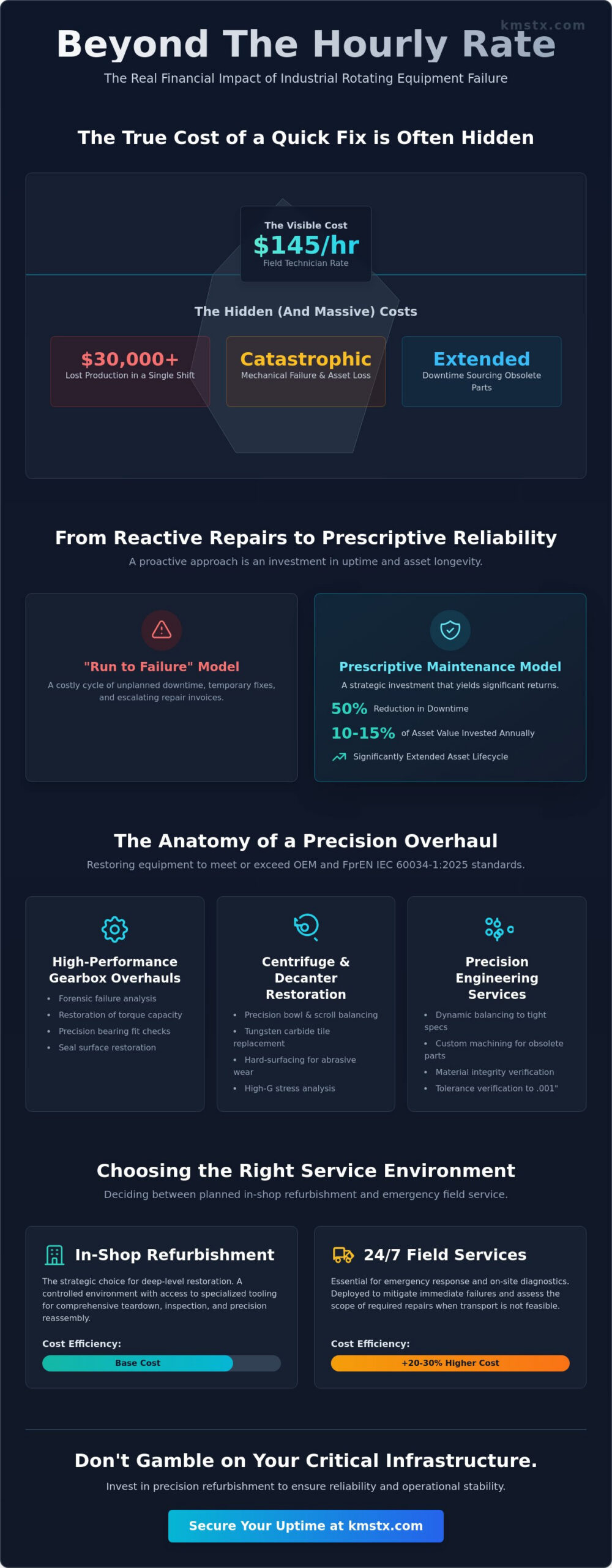
What if the $145 hourly rate you pay for a field technician is actually the least significant number on your repair invoice? With the global rotating equipment market projected to reach $90.1 billion by late 2026, the real financial impact isn’t the labor cost. It’s the $30,000 or more lost in a single shift when a critical pump or gearbox fails because the provided technical services didn’t meet the FprEN IEC 60034-1:2025 performance standards. You’ve likely felt the sting of unplanned downtime caused by variable repair quality or the headache of sourcing parts for obsolete machinery. We know that in a high stakes industrial environment, you can’t afford to guess about the mechanical integrity of your hardware.
This guide provides a comprehensive breakdown of the specialized technical work required to maintain and optimize heavy industrial rotating machinery for national operations. You’ll gain a clear understanding of the refurbishment process, from dynamic balancing to custom machining. We’ll show you how to move from simple repairs to a prescriptive maintenance model that can reduce downtime by 50% and significantly extend your asset’s lifecycle.
Key Takeaways
- Learn how technical restoration protocols for gearboxes and centrifuges prevent catastrophic failure and ensure long-term machine stability.
- Discover how precision dynamic balancing and machining services can restore obsolete equipment to OEM standards even when parts are no longer available.
- Determine when to deploy 24/7 field service teams versus opting for a full shop refurbishment based on your specific operational constraints.
- Gain a checklist for evaluating the technical competence and inventory capabilities of potential repair partners for your critical infrastructure.
Defining Industrial Rotating Equipment Services
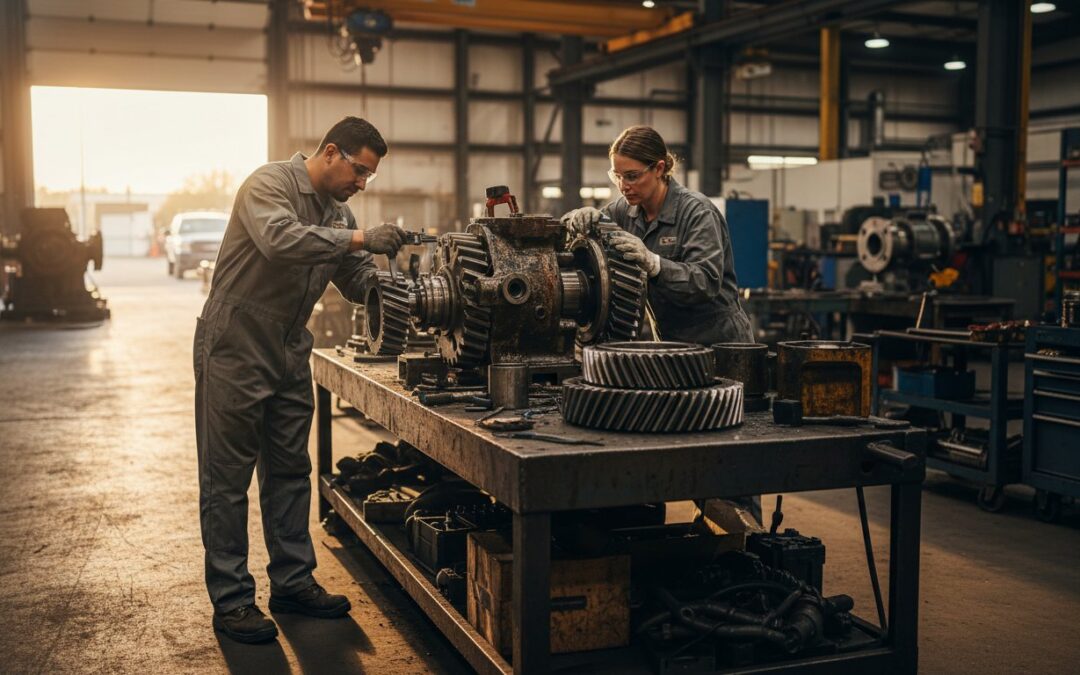
Most dictionaries define “service” as simple work performed for a fee, but in a heavy industrial setting, that definition doesn’t cut it. We’re talking about the technical restoration and maintenance of high-speed rotating assets to ensure operational stability. It’s the difference between a quick oil change and a precision overhaul that brings a machine back to its original engineering tolerances. These services are the frontline defense against catastrophic mechanical failure, which can easily cost a facility $30,000 or more in a single shift. While routine maintenance keeps things moving, technical refurbishment involves deep-level diagnostics to ensure every component aligns with original equipment manufacturer (OEM) specifications.
To better understand the depth of a professional teardown and the precision required during an overhaul, watch this helpful video showing a pump disassembly procedure:
The Scope of Technical Restoration
Real restoration goes far beyond a fresh coat of paint or a basic seal replacement. It requires a rigorous teardown and inspection (T&I) process where the engineering logic of the machine is evaluated. For example, when technicians work on a Rotary-screw compressor, they aren’t just checking if it turns; they’re verifying material integrity and measuring clearances in high-stress environments. Verifying tolerances down to a few thousandths of an inch is what separates a professional overhaul from a temporary fix. This level of detail ensures the machine can handle the thermal expansion and centrifugal forces it will face back on the line.
Economic Impact of Precision Services
You can’t just look at the hourly rate of $145 per technician; you have to look at the Mean Time Between Failures (MTBF). If a proactive restoration prevents a total plant shutdown, the ROI is immediate. Field service calls typically cost 20-30% more than in-shop work, making planned services a logical choice for the budget. Industrial equipment services are a strategic investment in asset reliability. By allocating approximately 10-15% of a machine’s value to annual maintenance, you move away from the “run to failure” cycle that kills productivity and eats into your bottom line.
Specialized Repair Services for Heavy Machinery
When you’re dealing with assets like high-speed centrifuges or multi-stage compressors, the technical requirements for services become incredibly specific. These aren’t just machines; they’re the heart of your production line. If a decanter fails or a planetary gearbox seizes, your operation stops. Restoration at this level means looking past the surface damage to understand why a component failed in the first place. Whether it’s restoring gear geometry or addressing hydraulic drive lag, the goal is always to return the unit to a state where it meets or exceeds its original design intent. With the rotating equipment service market estimated to reach $26.2 billion by late 2026, the demand for this level of precision has never been higher.
Centrifuge and Decanter Restoration
High-G operations put immense stress on every weld and bearing. In a decanter, the scroll and bowl must be perfectly synchronized. Effective restoration involves bowl and scroll balancing to precision levels that prevent vibration-induced fatigue. We often see units where abrasive wear has eaten through the flights. Strategies like tungsten carbide tile replacement and hard-surfacing are essential for longevity. For a deeper look at keeping these units running, you can review our guide on rotating equipment maintenance.
High-Performance Gearbox Overhauls
Gearboxes don’t just stop working; they usually give you a roadmap of the failure through pitting, spalling, or abnormal wear patterns. A proper overhaul starts with a forensic failure analysis of the planetary or parallel shaft sets. Restoring torque capacity requires more than just swapping gears. It involves checking precision bearing fits and restoring seal surfaces that have been grooved over years of operation. If you’re managing a fleet of critical drives, checking out our specialized industrial gearbox repair process can help you plan your next turnaround.
Beyond the big ticket items, your fluid handling systems depend on the reliability of pumps, compressors, and blowers. Addressing a blower failure or a compressor surge issue requires an understanding of the entire system’s pressure dynamics. It’s about ensuring the rotors are clear and the clearances are tight. If you’re struggling with a recurring mechanical issue, our team can help you evaluate your current repair protocols to find the root cause and implement a more reliable fix.
Precision Engineering: Machining and Dynamic Balancing Services
Repairing a machine is about fixing what’s broken, but restoration is about returning a component to its ideal engineering state. In the world of high-speed rotating equipment, the margin for error is non-existent. A rotor spinning at 3,600 RPM generates massive centrifugal forces that amplify even the smallest weight discrepancy. Precision engineering services bridge the gap between “running” and “running reliably.” By utilizing advanced diagnostics to identify specific vibrational signatures, technicians can pinpoint exactly where a machine is losing its stability before a catastrophic failure occurs. This data-driven approach moves us away from guesswork and toward a verified mechanical baseline.
The Role of Dynamic Balancing
Every high-speed rotor, whether it’s in a large blower or a decanter centrifuge, suffers from some level of force or moment imbalance. If left uncorrected, these imbalances translate directly into heat and vibration, which are the primary killers of bearings and seals. Correcting these issues requires sophisticated balancing rigs that can detect milligram-level deviations. By achieving precision balance, you drastically reduce the load on your bearings and lower the noise floor of your operation. For facilities in the Gulf Coast region, utilizing specialized precision dynamic balancing services is a standard requirement for protecting critical high-value assets against premature wear.
Technical Machining for Industrial Assets
When a shaft is scored or a housing is wallowed out, you don’t always have the luxury of ordering a new part from a warehouse, especially for older units. This is where custom machining becomes the only viable path for maintaining legacy assets. Using CNC technology, a shop can fabricate high-tolerance replacement parts that meet or exceed the original FprEN IEC 60034-1:2025 performance benchmarks. Common techniques include:
- Journal Repair: Grinding and polishing bearing surfaces to restore the proper fit.
- Shaft Straightening: Using thermal or mechanical methods to correct run-out issues that cause vibration.
- Boring and Sleeving: Restoring oversized bearing housings to their original dimensions to ensure a tight, secure fit.
These services don’t just patch a hole; they rebuild the mechanical integrity of the machine. When you combine modern CNC precision with traditional machining expertise, you can often produce a component that’s more durable than the one it replaced. This level of technical restoration is what keeps a plant running during supply chain disruptions or when dealing with equipment that the OEM no longer supports.
Field Services vs. In-Shop Refurbishment
Deciding whether to pull a machine for a shop visit or fix it on the floor usually comes down to one thing: the severity of the failure. Field services are built for speed and stabilization. If a bearing is running hot or a pump is vibrating outside of its baseline, you need eyes on it immediately to prevent a total meltdown. However, field work has its limits. While field service calls typically cost 20-30% more than shop work, the $189 per hour travel rate, effective April 1, 2026, is a small price to pay to keep a critical line from going dark. When the damage is internal or requires precision machining, moving the asset to a controlled environment is the only way to ensure a verified mechanical restoration.
On-Site Troubleshooting and Maintenance
Field technicians specialize in rapid diagnostic assessments. They’re the ones who show up at 2:00 AM with thermal imagers and vibration analyzers to figure out why a blower isn’t reaching its rated speed. Most on-site work focuses on minor component replacement, lubrication, and laser alignment. It’s about getting the machine back into a safe operating window without the logistics of a full removal. For plants in high-demand zones, having access to emergency machine repair means you have a 24/7 technical fallback when things go sideways. Safety is paramount here, as technicians must integrate seamlessly with your site-specific protocols and OSHA standards to manage risks in live environments.
The Shop Overhaul Process
The shop is where the heavy lifting happens. Unlike the field, a shop offers a decontaminated, climate-controlled space where a full teardown can occur without environmental interference. The process is methodical:
- Decontamination: Every part is cleaned and stripped to its base metal to reveal the true condition of the substrate.
- Non-Destructive Testing (NDT): Technicians use dye penetrants or magnetic particle testing to find cracks or structural fatigue that the naked eye would miss.
- Load Testing: Before the unit leaves, it’s run up to speed to verify performance against OEM benchmarks.
Shop restoration allows for the use of advanced diagnostic tooling that simply isn’t portable. It’s the only place where we can perform a full dynamic balance of a large rotor or use CNC equipment to sleeve a wallowed housing. If your equipment has reached its MTBF limit, you can schedule a shop inspection to get a clear picture of the restoration path forward. Choosing the right delivery model ensures that your services are both cost-effective and technically sound.
Selecting a Service Partner for Critical Infrastructure
Choosing a partner for rotating equipment services shouldn’t feel like a gamble. When you’re managing assets that drive national operations, you need more than a generic repair shop. You need a partner that understands the nuances of the FprEN IEC 60034-1:2025 performance standards and the day-to-day realities of a high-demand plant. Technical competence isn’t just a buzzword; it’s visible in the depth of a provider’s documentation and their ability to handle complex failures that leave others scratching their heads. A reliable partner doesn’t just swap parts. They provide a forensic look at why a component failed and how to prevent it from happening again.
Engineering Credibility and Experience
Multi-brand expertise is a non-negotiable requirement for critical infrastructure. A technician who understands the torque curves of a Falk or Lufkin gearbox and the fluid dynamics of a Bird or Alfa Laval centrifuge brings a broader perspective to the repair bench. This “shop-first” mentality is vital. It means the provider prioritizes finding the root cause through a full teardown rather than just treating the symptoms. You should expect to see detailed inspection reports that include non-destructive testing results and verified tolerance measurements. If a provider can’t show you the data behind their repair strategy, they aren’t providing a restoration; they’re providing a patch.
The KMS Advantage in Industrial Services
Kelsey Machine Services has spent 45 years refining the balance between rapid turnaround and engineering precision. We know that every day your machine is in our shop is a day of lost production for your facility. To mitigate this, we maintain a massive industrial machine spare parts inventory. Having these components on hand allows us to bypass the supply chain delays that often plague third-party repairs. Our services are backed by comprehensive warranties on mechanical labor, which is our way of standing behind the mechanical integrity of every unit we ship.
Reliability is built on technical transparency and a steady, methodical approach to restoration. We’ve seen how unplanned downtime costs can spiral, and we’re here to help you move toward a more predictable maintenance cycle. Don’t wait for a catastrophic failure to find a partner you can trust. Our engineering team is ready to help you optimize your maintenance schedule and extend the life of your rotating assets. Contact our engineering team today for a technical consultation on your critical infrastructure and let’s get your equipment back to its peak performance.
Securing Your Operational Stability through Technical Restoration
Maintaining heavy industrial assets requires a shift from reactive patching to methodical restoration. We’ve explored how technical services that prioritize dynamic balancing and precision machining can extend a machine’s lifecycle and drastically reduce the risk of a $30,000 shift loss. By aligning your maintenance strategy with the latest FprEN IEC 60034-1:2025 standards, you ensure that your gearboxes, centrifuges, and pumps operate at peak efficiency.
Whether you need a rapid response on the floor or a full teardown in a controlled shop environment, the right expertise makes the difference between a temporary fix and long-term reliability. Kelsey Machine Services brings over 45 years of industrial engineering experience to every project. With our 24/7 emergency field service availability and a massive inventory of OEM and aftermarket spare parts, we’re equipped to handle your most complex mechanical challenges.
Don’t let unplanned downtime dictate your operational schedule. Partner with Kelsey Machine Services for your next mechanical restoration and gain the technical transparency your facility deserves. It’s time to get your equipment back to work with confidence.
Common Questions About Industrial Rotating Equipment Services
What are industrial rotating equipment services?
Industrial rotating equipment services involve the technical restoration and maintenance of high-speed mechanical assets like gearboxes, centrifuges, and pumps to ensure they meet the FprEN IEC 60034-1:2025 performance standards. This goes beyond basic repair by utilizing engineering diagnostics to return a machine to its original design tolerances. These specialized work scopes focus on preventing catastrophic failures that often result in repair costs exceeding $30,000 for heavy machinery.
How do I choose between field service and a shop repair?
Choose field service for rapid stabilization, lubrication, or minor component replacement when you need to keep a line running. Field service labor rates are approximately $145 per hour per technician; however, travel time is billed at $189 per hour as of April 1, 2026. If the equipment requires deep decontamination, non-destructive testing, or precision dynamic balancing, a full shop refurbishment is the only way to ensure a verified mechanical restoration.
What is included in a standard equipment refurbishment service?
A standard refurbishment includes a full teardown and inspection (T&I) to identify the root cause of failure. Our services involve stripping the unit to the base metal, performing non-destructive testing for structural fatigue, and replacing all wear components like seals and bearings. The process concludes with final assembly and load testing to verify that the unit meets its original torque and speed specifications before it returns to your facility.
Can you repair obsolete industrial machinery with custom machining?
Custom machining is the primary path for maintaining legacy assets that the original manufacturer no longer supports. By using CNC technology, technicians can fabricate high-tolerance replacement parts like shafts and sleeves that meet or exceed the original equipment’s performance benchmarks. This capability allows plants to bypass the difficulty of sourcing obsolete parts and prevents the need for a total and expensive system replacement.
How often should rotating equipment receive professional maintenance services?
Experienced contractors typically budget 10-15% of a machine’s total value annually for professional maintenance to prevent unplanned downtime. While specific intervals depend on your operational hours, a comprehensive inspection should happen at least once every 12 months. Utilizing prescriptive maintenance can reduce these costs by up to 40% by identifying root causes before they trigger a mechanical failure. Professional services ensure your asset reaches its full projected lifecycle.
What is the typical lead time for a major centrifuge or gearbox overhaul?
Lead times vary based on the extent of the internal damage and the availability of specialized components. Having access to an extensive spare parts inventory can reduce the turnaround time by several weeks compared to shops that must order every seal and gear. A standard overhaul usually follows a methodical schedule of decontamination, inspection, machining, and final testing to ensure the machine is technically sound before shipping.
Are your mechanical services covered by a warranty?
Yes, all mechanical services performed during a restoration are backed by a comprehensive warranty on labor. This coverage provides peace of mind that the engineering restoration was performed to the highest technical standards. We stand behind our work because every unit undergoes rigorous quality checks and performance verification before it leaves the shop floor. This commitment to quality helps build long-term trust with our partners in the energy and industrial sectors.
Do you provide 24/7 emergency support for critical failures?
We provide 24/7 emergency field support to address critical failures that threaten your operational stability. Technicians are available to deploy for rapid diagnostic assessments and on-site repairs during regular hours and weekends. Emergency calls are subject to the verified 2026 travel rates and mileage charges of $0.62 per mile. Our team is ready to respond immediately to minimize the financial impact of unplanned downtime at your facility.