
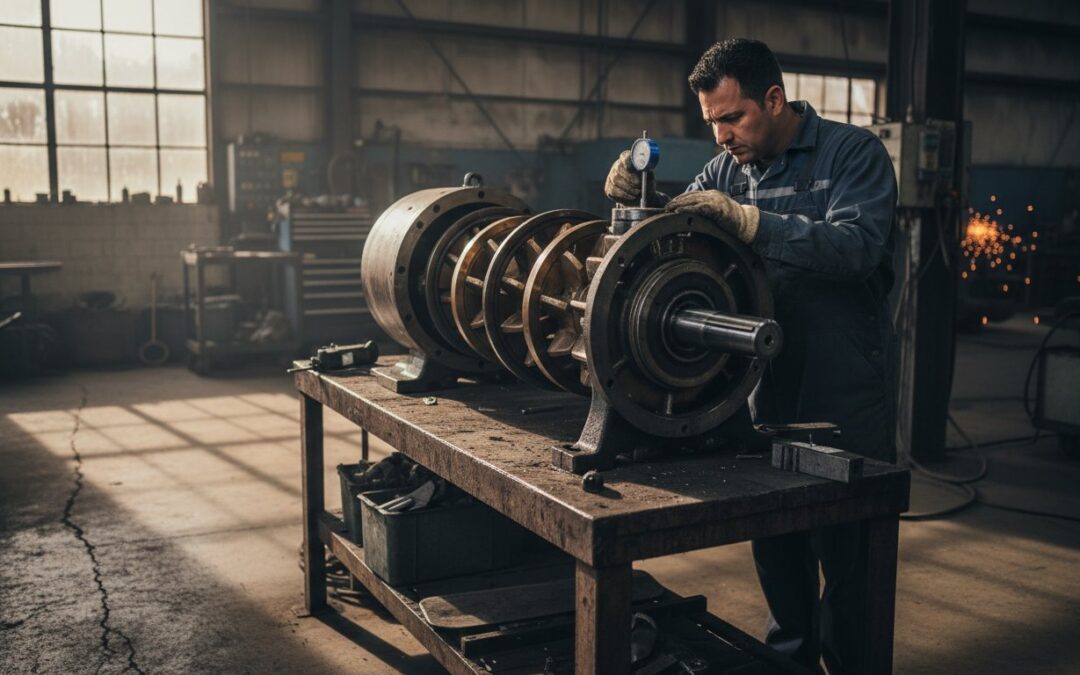
On a Tuesday at 3:00 AM, a maintenance supervisor at a Texas refinery watched a critical feed pump hit vibration levels exceeding 0.18 inches per second, triggering an immediate system trip. It’s a scenario that results in nearly $25,000 of lost production every hour the line stays down. When these high-pressure units fail, a quick fix won’t suffice. Professional multi-stage pump repair services must utilize precision engineering and empirical data to address the root cause, ensuring the asset returns to service with the same reliability as a new installation.
We understand that dealing with inaccurate balancing and the challenge of sourcing parts for a 20-year-old pump makes your job harder than it needs to be. This guide details how expert refurbishment restores your equipment to original OEM specifications for maximum uptime. You’ll see how documented precision alignment and specialized balancing techniques extend the mean time between failures by as much as 35% while providing the 24/7 technical support your facility requires.
Key Takeaways
- Learn how thorough teardowns and NDT inspections identify the hairline fractures and wear patterns that lead to unexpected failures.
- Spot the early warning signs of axial thrust imbalance and cavitation to protect your bearings and maintain shaft integrity.
- Evaluate providers of multi-stage pump repair services by verifying their use of specialized hydraulic tools and access to local spare parts.
- See how precision dynamic balancing and empirical data can eliminate vibration and extend the service life of your rotating assets.
- Understand why restoring the internal geometry of diffusers and volutes is essential for getting your pump back to peak efficiency.
Understanding the Complexity of Multi-Stage Pump Systems
The architecture of a multi-stage pump is defined by the integration of multiple impellers onto a single shaft to achieve hydraulic heads that exceed the capabilities of single-stage designs. This series-based arrangement facilitates the accumulation of pressure as fluid transitions through successive stages. In the context of multi-stage pump repair services, technical precision is required to maintain the tight clearances between the rotating elements and the stationary wear rings. Each stage acts as an independent pressure vessel, where the cumulative discharge pressure is the sum of the head generated by each individual impeller.
To better understand the internal flow dynamics and assembly of these units, watch this helpful video:
The stationary diffusers or volutes within the casing serve as the primary mechanism for energy conversion. These components are engineered to decelerate the fluid velocity, thereby converting kinetic energy into static pressure before the flow is redirected into the suction eye of the subsequent stage. This design is essential for high-pressure applications such as boiler feed water systems, where pressures often exceed 2,000 PSI, and reverse osmosis desalination plants that require consistent membrane feed pressure. Utilizing a multi-stage centrifugal pump allows operators to reach these high-pressure targets without the excessive footprint of separate pump stations.
The Mechanics of Increased Head Pressure
Pressure accumulation is achieved through the sequential routing of fluid from the discharge of one stage to the suction of the next. This internal channel routing necessitates a robust mechanical design to handle the resulting axial thrust. Engineers must account for the trade-off between high-pressure output and the increased potential for mechanical wear. The utilization of balance drums or specialized thrust bearings is mandatory to counteract the cumulative hydraulic forces that would otherwise compromise the structural integrity of the shaft assembly.
Vertical vs. Horizontal Orientations
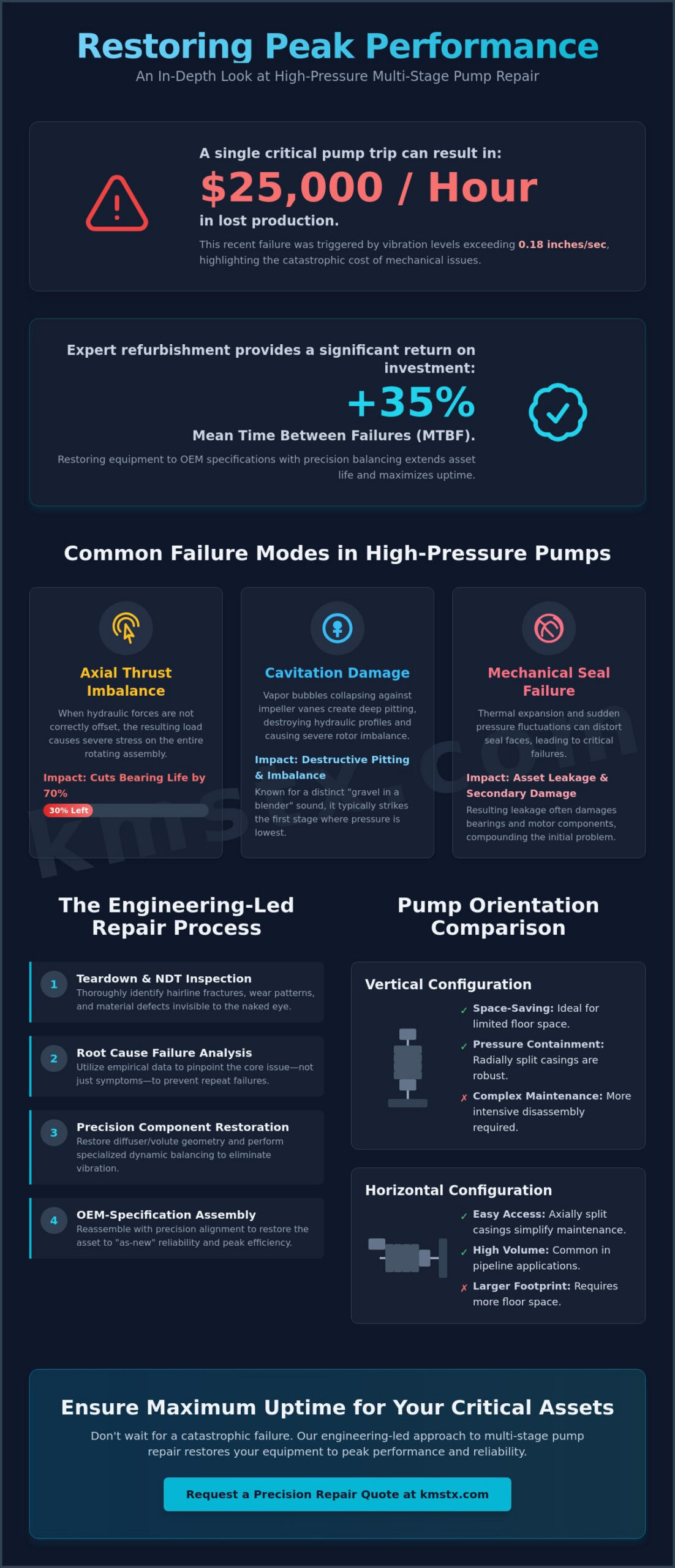
Space constraints in industrial facilities frequently dictate the orientation of the pump system. Vertical multi-stage configurations are preferred in environments with limited floor space or where the fluid must be extracted from a deep sump. These units often feature radially split, segmented casings that offer superior pressure containment but require a more intensive disassembly process during restoration. Vertical units also place unique loads on the motor-end thrust bearings, as they must support the weight of the entire rotating assembly. Horizontal orientations, conversely, are typically utilized in high-volume pipeline applications. Maintenance planning for horizontal units often leverages axially split casings, which allow technicians to access the rotating assembly without disconnecting the suction or discharge piping. Identifying whether a unit is axially or radially split is a foundational step in scoping multi-stage pump repair services for a specific site.
Common Failure Modes in High-Pressure Multi-Stage Pumps
Operating high-pressure equipment leaves little room for error. When you’re dealing with pressures exceeding 1,000 PSI, small mechanical issues quickly turn into catastrophic failures. Axial thrust imbalance is often the primary culprit. If the balance drum or disc doesn’t offset the hydraulic force correctly, the resulting load can cut bearing life by 70% in a matter of weeks. This puts immense stress on the shaft, leading to deflection and eventual fatigue. Professional multi-stage pump repair services prioritize the inspection of these balancing components because they’re the first line of defense for the entire rotating assembly.
Cavitation usually strikes the first stage where suction pressure is at its lowest. It creates a distinct “gravel in a blender” sound that signals vapor bubbles collapsing against the impeller vanes. Over time, this creates deep pitting that destroys hydraulic profiles and throws the rotor out of balance. Mechanical seals also struggle in these units. Thermal expansion during a cold start or sudden pressure fluctuations can cause seal faces to distort. When seals fail, the resulting leakage often damages the bearing housings, significantly compounding the repair scope. Internal diffusers and wear rings aren’t safe either. High-velocity fluid causes erosion-corrosion, especially if the process fluid contains even 1% abrasive solids.
Hydraulic Instability and Vibration
Mechanical imbalances that seem minor in a single-stage pump are amplified significantly in multi-stage configurations. At speeds of 3,600 RPM, a few grams of imbalance can generate hundreds of pounds of centrifugal force. This vibration often stems from internal recirculation. When the pump operates too far left of the Best Efficiency Point (BEP), the fluid begins to swirl within the stages rather than moving through them. Specialized multi-stage pump repair services use vibration analysis to identify stage-specific frequencies. This data helps us determine if the issue is a bent shaft or a localized hydraulic blockage without a full teardown.
Wear Ring Clearances and Efficiency Loss
Precision is everything in high-pressure stages. Wear ring clearances are typically set between 0.010 and 0.015 inches depending on the metallurgy and operating temperature. If these clearances double due to wear, internal bypass increases. This means the pump has to work harder and consume more power to maintain the same discharge pressure. Understanding the Pump Life Cycle Costs is vital here, as energy consumption can account for 90% of total ownership costs when efficiency drops. Volumetric efficiency is the ratio of the actual liquid delivered to the pump discharge versus the total liquid handled by the impellers, directly reflecting the health of the internal wear ring seals. Maintaining these tight tolerances is a core focus of our precision restoration workflows to ensure your equipment returns to OEM specifications.
The Engineering-Led Repair and Refurbishment Process
High-quality multi-stage pump repair services begin with a forensic teardown rather than a simple disassembly. Every component is logged and cleaned to its base metal to ensure that inspection data is untainted by scale or process residue. We utilize non-destructive testing (NDT) to identify hairline fractures in high-stress areas like the discharge head and interstage diaphragms. These flaws are often invisible to the naked eye but can lead to catastrophic casing failure under high-pressure cycles. Our technicians measure all bores, fits, and shaft runouts against original OEM specifications, often working within tolerances of 0.001 inch to ensure the stack-up remains within design limits.
Precision is the baseline for reliability. We perform dynamic balancing of the entire rotating assembly to ISO G1.0 or G2.5 standards. This step is non-negotiable because it eliminates the harmonic vibrations that lead to premature seal failure and bearing fatigue. The process concludes with a final assembly where every bolt is tightened using precision-calibrated torque tools. We verify the internal clearances at every stage to prevent galling during the initial startup. This methodical approach ensures the pump returns to service with a reliability profile that matches or exceeds its original commissioning state.
Decontamination and Inspection Protocols
The restoration starts with bead blasting and chemical cleaning of all impellers and casing interiors. This removes buildup that causes hydraulic drag and masks underlying metal fatigue. We then employ dye penetrant and magnetic particle inspection to locate stress cracking in the vane roots. Every project includes a detailed failure report. This document analyzes the root cause of wear, whether it is cavitation, corrosion, or misalignment, providing the data needed to prevent future unplanned outages.
Precision Machining and Component Restoration
Restoration often requires more than just replacing parts; it requires custom machining to correct years of operational wear. We frequently machine oversized wear rings to restore factory clearances, which is a critical factor in maintaining hydraulic lift. Industry research on pump system assessments shows that maximizing component efficiencies through tight clearances is one of the most effective ways to lower operational costs. We also perform shaft straightening and journal repair using specialized CNC equipment. Integrating these repairs into a broader plan for rotating equipment maintenance ensures that the pump functions as a reliable asset within the larger industrial system.
Key Performance Indicators for Evaluating Pump Repair Partners
Selecting a provider for multi-stage pump repair services requires a rigorous audit of their technical infrastructure. These systems operate under extreme pressures, often exceeding 1,000 PSI; any deviation in internal clearances can lead to rapid efficiency loss or catastrophic seizure. You can’t rely on a shop that treats a multi-stage unit like a simple end-suction pump. Evaluation starts with verifying specialized disassembly tools, such as hydraulic pullers and induction heaters, which ensure components aren’t damaged during the breakdown process.
Reliable partners maintain a robust supply chain to minimize downtime. Having immediate access to industrial machine spare parts Texas allows a facility to bypass the 8 to 12-week lead times common with OEM backorders. Beyond parts, look for these specific indicators:
- In-house dynamic balancing: High-speed rotating elements must meet ISO 21940-11 standards to prevent vibration-induced bearing failure.
- Documented QC: Every repair should include a comprehensive report detailing “as-found” and “as-left” clearances.
- Warranty coverage: A professional shop stands behind its labor with a minimum 12-month warranty on workmanship.
Technical Capability and Shop Equipment
General machine shops often fail at multi-stage tolerances because they lack the specialized equipment for long-shaft stability. Industrial pumps require large-scale lathes with 30-foot beds and vertical boring mills to ensure concentricity across multiple stages. If a shop can’t hold a 0.001-inch tolerance over the length of a shaft, the pump won’t survive its first month of service. It’s also vital to confirm their experience with high-pressure alloys and protective coatings like HVOF (High-Velocity Oxygen Fuel) which extend the life of wear rings in abrasive environments.
Emergency Response and Field Support
Downtime costs in the energy sector can exceed $50,000 per hour, making rapid mobilization a non-negotiable KPI. Assessing emergency machine repair Gulf Coast availability ensures that technicians can be on-site within hours of a critical failure. The best partners offer on-site troubleshooting and vibration analysis before the pump is even removed from its base. This data-driven approach identifies whether the issue is internal or related to pipe strain or cavitation, potentially saving days of unnecessary shop time. A 24/7 support structure directly impacts the total cost of ownership by preventing minor mechanical seal leaks from turning into full-scale rebuilds.
Precision Restoration for Critical Rotating Assets
Restoring a multi-stage unit requires more than just a standard overhaul. The KMS approach relies on empirical data to drive every decision during multi-stage pump repair services. We don’t just replace parts; we analyze why they failed by measuring tolerances against original equipment manufacturer (OEM) specifications. This methodical process ensures the mechanical integrity of the asset is fully restored to its designed state.
High-speed rotation in multi-stage units makes vibration the primary enemy of longevity. Utilizing dynamic balancing services Houston ensures that the rotor assembly operates within tight G1.0 or G2.5 balance grades. By correcting even minor mass imbalances, we reduce the load on radial and thrust bearings by as much as 35 percent. This stability is vital for preventing premature seal failure and shaft deflection.
Our team recently handled a 6-stage boiler feed pump that showed a 22 percent drop in head pressure and excessive heat at the outboard bearing. Through precision machining and stack-up height corrections, we returned the pump to 98 percent of its original performance curve. Final testing protocols are rigorous. Every pump undergoes a hydrostatic test at 150 percent of the maximum allowable working pressure. We also verify vibration signatures and flow rates to ensure the unit meets the required performance curves before it leaves our floor.
Beyond Fixing: Optimizing Pump Performance
Repair cycles offer a perfect window to improve the pump’s design. We look for opportunities to upgrade materials, such as replacing standard cast iron components with 316 stainless steel or duplex alloys to better handle corrosive fluids. Applying specialized epoxy coatings can also reduce internal friction and extend the life of the casing. Our engineers consult on system-wide improvements, like adjusting piping supports or NPSH availability, to reduce the overall stress on the pump during operation.
Partnering for Long-Term Reliability
Moving away from reactive “run-to-fail” cycles is the only way to manage a fleet effectively. We help facilities transition to proactive maintenance schedules based on vibration analysis and thermal imaging data. Detailed technical documentation is provided for every repair, creating a historical record that helps identify recurring issues across your plant. This data-driven strategy reduces the likelihood of unplanned outages and extends the mean time between failures (MTBF). You can request a technical consultation for your next multi-stage overhaul to see how our precision restoration process protects your bottom line.
Securing Long-Term Reliability for Critical Assets
Restoring multi-stage pumps requires more than just replacing worn seals and bearings. It’s about understanding the hydraulic balance and tight mechanical tolerances that keep these high-pressure systems running under extreme conditions. When you’re managing critical infrastructure, unplanned downtime isn’t just an inconvenience; it’s a major operational risk. That’s why choosing a partner with deep technical roots is vital for your bottom line. With over 40 years of industrial rotating equipment expertise, our team has addressed nearly every failure mode in the field. We utilize full in-house CNC machining and dynamic balancing to ensure every refurbished component meets or exceeds precision standards. We also provide 24/7 emergency support because we know your operations don’t follow a standard clock. Investing in professional multi-stage pump repair services means you’re getting a machine that’s often more reliable than its original factory configuration. It’s time to move past temporary fixes and focus on engineering-led restoration that lasts. Let’s get your equipment back into the field with the confidence it’ll perform when it matters most.
Request a Technical Repair Consultation for Your Multi-Stage Pump
Frequently Asked Questions
What is the difference between a single-stage and a multi-stage pump?
The primary difference lies in the pressure capability; a single-stage pump utilizes one impeller for lower head applications, while a multi-stage pump stacks multiple impellers to reach pressures exceeding 1,500 PSI. Single-stage units usually top out around 150 to 200 feet of head. Multi-stage designs are essential for boiler feeds or high-pressure water injection where you need to move fluid against 500 PSI or more of resistance.
How often should industrial multi-stage pumps undergo a full inspection?
You should schedule a comprehensive inspection every 18 to 24 months for pumps in continuous service. Waiting longer often leads to catastrophic failure of internal components. Our multi-stage pump repair services team recommends tracking run hours, aiming for a full teardown at the 12,000-hour mark. This proactive approach prevents the 30 percent increase in repair costs typically seen when a pump fails unexpectedly during a production run.
Can a multi-stage pump be repaired if the casing is cracked?
Repairing a cracked casing is possible through cold-casting techniques or precision welding if the structural integrity remains within 85 percent of original specifications. We use NDT methods like dye penetrant or ultrasonic testing to map the crack’s depth. If the crack penetrates the high-pressure volute section, replacement is usually safer. Most shops follow AWS D1.1 standards to ensure the weld holds under 2,000 PSI hydrostatic test pressures.
What are the signs that my pump’s internal wear rings need replacement?
You’ll notice a drop in discharge pressure of 5 to 10 percent and a corresponding increase in motor amperage when wear rings need replacement. When clearances double from the initial 0.010-inch setting, fluid recirculates back to the suction side. This bypass reduces total flow and creates internal turbulence. We check these tolerances against API 610 tables during every inspection to ensure your pump hits its intended performance curve.
Is dynamic balancing necessary for every multi-stage pump repair?
Dynamic balancing is a non-negotiable step in the restoration process for any rotor assembly spinning over 1,800 RPM. We balance individual impellers and the complete shaft assembly to ISO 1940 G2.5 standards. Even a 2-gram imbalance at the outer diameter can create centrifugal forces that destroy bearings in under 500 hours. Proper balancing extends the mean time between failures by up to 40 percent in high-speed applications.
How long does a typical multi-stage pump refurbishment take?
A typical multi-stage pump overhaul requires 14 to 28 days depending on the availability of replacement parts and the extent of internal erosion. The process involves 48 hours for cleaning and inspection, followed by a week for machining and three days for final assembly. If we’re manufacturing custom shafts or sleeves, the timeline might extend by 10 days. We provide a detailed project schedule within 48 hours of the initial teardown.
What causes a multi-stage pump to lose discharge pressure over time?
Pressure loss is usually the result of increased internal clearances or cavitation damage on the impeller vanes. If the interstage bushings wear down by just 0.015 inches, the internal leakage significantly cuts the output. In systems running for 5 years without service, it’s common to see a 15 percent reduction in total dynamic head. Regular maintenance stops this gradual decline and keeps your energy costs from spiking due to inefficiency.
Can you repair multi-stage pumps from any manufacturer?
Our facility handles multi-stage pump repair services for all major brands including Flowserve, Sulzer, and Byron Jackson. We don’t rely solely on OEM parts; we use 3D laser scanning to reverse engineer components that are no longer in production. This capability allows us to restore 30-year-old pumps to their original factory specifications. We’ve documented over 500 successful restorations across 12 different manufacturer lines in the last decade alone.