
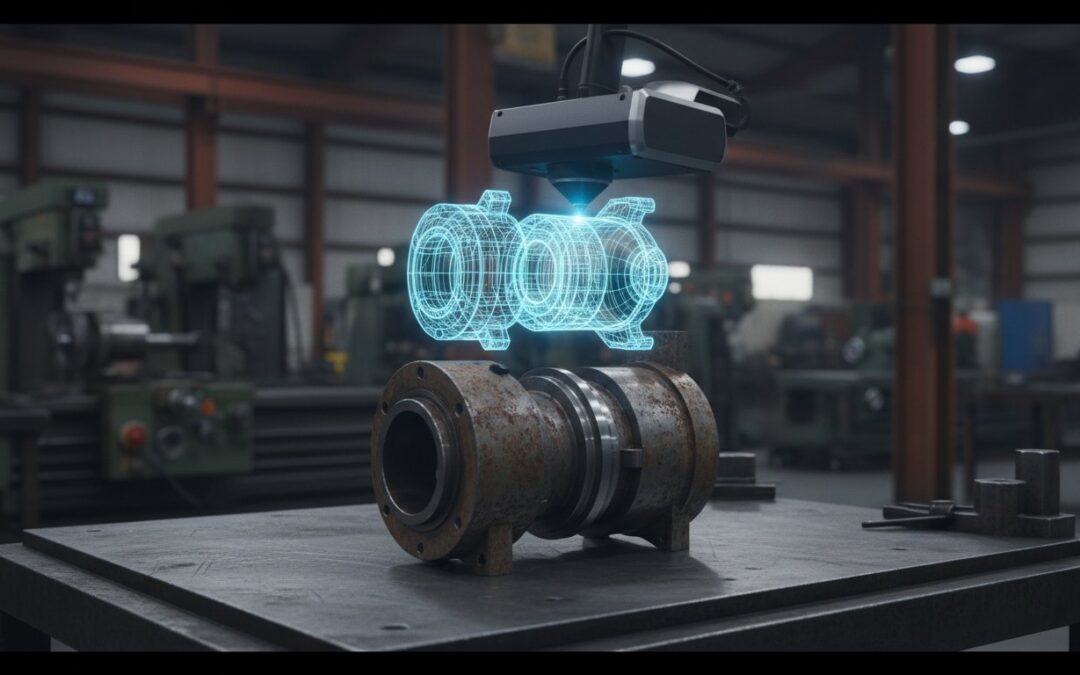
Imagine a $2.5 million compressor train sitting idle because a proprietary shaft seal, last manufactured in 1991, finally failed. You’ve likely felt the pressure of an OEM telling you that your most reliable asset is now a legacy liability. It’s a frustrating reality when a single gear or shaft threatens to force a premature decommissioning of equipment that still has a decade of service life left. You shouldn’t have to scrap functional machinery just because the original supplier disappeared or no longer supports the model. Many facilities face 35% higher maintenance costs when they can’t find a reliable path for obsolete machine parts fabrication.
This technical guide demonstrates how precision reverse engineering restores critical rotating equipment to full operational status. By utilizing advanced 3D scanning and material analysis, you can often produce a replacement that exceeds the original design’s durability. We’ll examine the specific steps of the fabrication process, from initial data acquisition to final precision machining. This overview provides the roadmap you need to bypass OEM obsolescence and keep your heavy assets running without compromise.
Key Takeaways
- Learn how to keep your critical rotating assets in operation long after the OEM has stopped providing support or replacement components.
- Understand the technical process of moving from a failed physical sample to a high-fidelity digital twin with exact metallurgical specifications.
- Discover how obsolete machine parts fabrication allows you to restore high-speed equipment without the massive expense of a full system retrofit.
- Find out how to evaluate the structural integrity of a part to determine if it is a candidate for precision reverse engineering.
- Identify the specific engineering standards required to ensure a custom-fabricated part can handle the stresses of heavy industrial use.
The Reality of OEM Abandonment: When Critical Rotating Assets Go Obsolete
Obsolete machine parts fabrication isn’t just a repair; it’s a specialized engineering strategy for assets the original manufacturer no longer supports. In the current industrial climate, OEM support cycles are shrinking. Manufacturers often transition equipment to “end-of-life” status within 10 to 12 years to prioritize the sale of new models. This creates a significant gap for plants running heavy rotating equipment like decanter centrifuges or complex gearboxes that are designed to last 30 years or more. When a proprietary component fails and the OEM catalog shows a “discontinued” status, the asset isn’t dead; it’s simply been abandoned by its creator.
The hidden cost of this planned obsolescence is staggering. When a facility adopts a “scrapping” mentality, they’re often discarding a 20 ton piece of high-grade steel because a single proprietary shaft or gear is unavailable. It’s a multi-million dollar mistake that ignores the structural integrity of the remaining machine. Opting for obsolete machine parts fabrication allows engineers to bypass these artificial lifecycles and maintain operational continuity on their own terms.
To better understand how these discontinued components are brought back to life, watch this helpful video:
The Financial Risk of Premature Equipment Retirement
Replacing a full industrial system can cost five to eight times more than the targeted fabrication of a critical component. By integrating modern remanufacturing processes, plants can reliably extend the lifecycle of a high-value asset by an additional 15 years. Lead times are the other major factor. While ordering new foreign-made machinery can involve wait times of 40 to 50 weeks, domestic fabrication often restores the asset to service in under 12 weeks, preventing months of lost production revenue.
Common Obsolete Components in Industrial Rotating Machinery
Failure usually occurs in high-wear zones. We frequently see issues with shafts, custom gears, impellers, and bowl assemblies. It’s rarely the standard seals or bearings that cause the obsolescence crisis, since those are typically off-the-shelf items. The real problem lies in the proprietary housings and specialized mounts that hold those bearings in place. When these unique castings or machined parts wear out, you need a partner with technical depth. KMS provides critical expertise in sourcing and industrial machine spare parts Texas procurement, ensuring that even without OEM blueprints, your rotating equipment maintains its precision tolerances and balance.
The Engineering Behind Obsolete Machine Parts Fabrication
Successful obsolete machine parts fabrication starts with a forensic approach to the original component’s failure. We don’t just replicate a broken part; we reconstruct its intent. When a gear or shaft arrives at the shop with 15% of its surface area lost to friction or fatigue, the goal is to create a high-fidelity digital twin that represents the part in its “as-designed” state rather than its current “as-found” condition. This transition from physical scrap to a precise CAD model allows for the integration of modern tolerances that weren’t achievable when the original equipment was manufactured 30 or 40 years ago.
Reverse Engineering: From Worn Components to Precise Digital Models
The process begins with non-destructive testing and high-resolution 3D scanning to capture the existing geometry. However, scanning a worn part only provides the current state of decay. Engineers must use manual precision measurements, often accurate to 0.0005 inches, to calculate original centerlines and pitch circles. By analyzing the mating components, we can reverse-engineer the exact clearances required for high-speed industrial rotations.
Recent research from the University of Louisville highlights how additive manufacturing for legacy parts can bridge the gap between digital modeling and physical prototyping. Once the geometry is verified, we generate comprehensive DXF and CAD files. These digital assets serve as permanent documentation, ensuring that future replacements are a simple matter of loading a file rather than repeating the entire engineering cycle.
Material Science: Selecting Alloys for Superior Performance
Matching the original material is often a baseline, not a target. Many obsolete parts failed because the metallurgy of the 1970s or 1980s couldn’t handle the corrosive or high-heat environments of modern production. During the fabrication process, we perform a root cause failure analysis to determine if the part succumbed to stress corrosion cracking, hydrogen embrittlement, or simple mechanical fatigue.
Upgrading the material is a standard part of the workflow. For example, replacing a standard carbon steel shaft with 17-4 PH stainless steel or a 4140 alloy can significantly increase the component’s service life. Proper heat treatment and surface finishing are critical in custom machining Tomball TX to ensure the new part meets the specific hardness requirements of the assembly. Whether it’s applying a tungsten carbide coating or utilizing vacuum heat treating, these steps ensure the new component outperforms the original. If you’re dealing with a recurring failure on an old asset, consulting with a technical specialist

Case Study: Restoring a High-Speed Centrifuge with Custom Fabricated Components
In July 2023, a Houston-based chemical processing facility faced a total operational halt when a critical decanter centrifuge suffered a catastrophic gearbox failure. The unit, manufactured in 1998, had been out of production for over a decade. When the maintenance team contacted the OEM, they found the internal planetary gear assembly was no longer supported. This situation is a prime example of why sophisticated obsolescence management strategies are vital for industrial longevity. Without a direct replacement, the plant faced a projected 24-week lead time for a completely new centrifuge system, which would have cost upwards of $450,000 in lost production and capital expenditure.
The Challenge: A Critical Gearbox Failure with No OEM Support
The teardown revealed that the primary sun gear had experienced severe surface fatigue and tooth pitting. This failure often stems from unbalanced rotating equipment that puts uneven loads on the gear teeth over thousands of hours of operation. Since off-the-shelf replacements didn’t exist, we initiated a plan for obsolete machine parts fabrication to reverse engineer the damaged components. The project required a meticulous technical workflow:
- Digital Mapping: Using coordinate measuring machines to capture the gear geometry within 0.0005 inches.
- Material Analysis: Identifying the original alloy and selecting a superior 4340 steel for the new build.
- Stress Modeling: Simulating the torque loads to identify where the original design lacked sufficient strength.
The Solution: Precision Machining and Dynamic Balancing Integration
Our engineers didn’t just replicate the old part; they optimized it. We utilized a vacuum-hardened heat treatment process to ensure a surface hardness of 60 HRC while maintaining a ductile core to resist fracturing. By refining the tooth profile during the machining phase, we increased the load-bearing surface area by 12% compared to the original factory specs. This level of precision is the cornerstone of effective obsolete machine parts fabrication in high-stakes environments.
Precision machining is only half the battle for high-speed assets. We integrated dynamic balancing services Houston to ensure the entire rotating assembly met ISO 1940/1 G1.0 standards. The final assembly showed a 35% reduction in peak vibration levels compared to the original OEM baseline recorded five years prior. The entire project took just 18 days from initial teardown to final commissioning. This approach didn’t just save the asset; it extended the expected service life by another 15 years while significantly lowering the risk of future bearing failures.
Evaluating Your Options: Fabrication vs. Full System Retrofit
Deciding between obsolete machine parts fabrication and a total system overhaul often comes down to the physical state of the component. A part is generally considered too far gone for reverse engineering when it has lost more than 35% of its original mass or critical geometry due to catastrophic failure or extreme abrasive wear. If our team can’t establish a reliable datum point or a clean mating surface, the risk of dimensional drift increases. In these cases, we look for sister components or original technical manuals to bridge the data gap.
Fabrication consistently outperforms localized repairs in terms of structural integrity. While a weld-build-up might get you through the week, it introduces heat-affected zones that can alter the metallurgy of the base metal. A fresh part, machined from a solid billet of 4140 or 316L stainless steel, ensures uniform grain structure and predictable stress distribution. This process also allows us to identify recurring failure points. If a shaft consistently shears at a specific shoulder, we can increase the fillet radius or upgrade the material specs during the fabrication phase to prevent future downtime.
Owning the digital CAD files for your equipment provides a level of operational sovereignty that most OEMs won’t allow. When you have the 3D models and technical drawings, you aren’t tethered to a single supplier’s lead times. You’ve essentially created an insurance policy against future obsolescence.
Cost-Benefit Analysis of Custom Parts Fabrication
The sticker price of a new machine is rarely the total cost. Data from industrial installations shows that the “hidden” expenses of a full retrofit, such as modifying concrete foundations, rerouting high-pressure piping, and 40-plus hours of operator retraining, can add 45% to the initial quote. Choosing obsolete machine parts fabrication allows you to bypass these capital expenditures. You’re paying for engineering time and precision manufacturing, but you’re saving the hundreds of thousands of dollars associated with tearing out a functional asset just because one gear is no longer stocked.
The Role of Precision in High-Speed Asset Reliability
For rotating equipment operating at speeds above 3,600 RPM, “close enough” is a recipe for bearing failure. We focus on micro-tolerances because a deviation of just 0.0005 inches can create harmonic vibrations that destroy seals and shorten the mean time between failures (MTBF). Every fabricated part must integrate seamlessly with the remaining OEM housing and drive systems. We utilize coordinate measuring machines to verify that every bore and thread pitch meets ISO 286 standards, ensuring the new component performs as well as, or better than, the original factory part.
Partnering for Longevity: Precision Machining for Obsolete Industrial Parts
General machine shops often fail at heavy industrial projects because they treat every job like a standard milling task. They might hold a tight tolerance on a static part, but they lack the deep field experience needed to understand how a component behaves under 3,600 RPM or extreme thermal cycles. At KMS, we’ve spent over 40 years refining our approach to high-stakes mechanical overhauls. We recognize that obsolete machine parts fabrication is about more than recreating a physical shape. It’s about restoring the mechanical integrity of the entire system. By integrating our fabrication capabilities with our broader rotating equipment maintenance programs, we ensure every custom component accounts for the current wear and state of your aging asset.
The KMS Approach to Heavy Rotating Equipment Restoration
Our end-to-end process typically begins with an emergency teardown. We don’t just wait for a digital file to arrive. Instead, our team performs on-site measurements and forensic analysis to identify why the original part failed in the first place. We manage 24/7 emergency requests for critical part failures because we understand the financial impact of a stopped production line. Our commitment to technical credibility means we rely on empirical data. We use specialized metallurgy and precision measurements to ensure the new part meets or exceeds the original design specifications. This hands-on engineering ensures that your equipment returns to service with improved reliability.
Ensuring Operational Stability through Specialized Testing
Precision fabrication is only the first step. We perform final run-out checks and vibration analysis on every part that leaves our facility. This testing confirms that the component will operate harmoniously within the larger machine assembly. We provide comprehensive documentation and warranty standards for all custom-engineered solutions. This gives your maintenance team the same level of confidence they would have with an OEM component. If you’re struggling to source a critical component, contact our engineering team for a technical assessment. We’ll conduct a feasibility study to evaluate the material requirements and machining tolerances needed for your obsolete machine parts fabrication project.
Secure Your Legacy Assets with Engineered Precision
When an OEM stops supporting a critical pump or centrifuge, it doesn’t mean the machine belongs in the scrap heap. We’ve demonstrated how proprietary reverse engineering and dynamic balancing workflows can restore a high-speed centrifuge to peak performance. By prioritizing obsolete machine parts fabrication, you’re choosing a precise engineering path that often yields components with tighter tolerances than the original factory specs. It’s a practical way to bypass the massive capital expenditure of a full system retrofit while maintaining operational integrity.
Our team brings over 40 years of industrial rotating equipment expertise to every project we touch. We know that downtime is the enemy; that’s why we provide 24/7 emergency response for critical failures to keep your plant moving. You’ve spent decades maintaining your equipment. Don’t let a discontinued part number force an unnecessary upgrade when a custom solution is within reach. We have the technical tools and the field experience to ensure your assets continue to deliver value long after the manufacturer has moved on. Request a Technical Assessment for Your Obsolete Parts and let’s get your equipment back to work.
Frequently Asked Questions
Is it legal to fabricate parts for obsolete machines?
It’s generally legal to fabricate parts for internal repair under the right to repair doctrine, provided the component isn’t protected by an active patent. Most industrial patents expire after 20 years, so parts for machinery manufactured before 2004 are typically in the public domain. We focus on helping plants maintain hardware that the original equipment manufacturer no longer supports or stocks.
How long does the reverse engineering and fabrication process usually take?
Lead times for obsolete machine parts fabrication typically range from 10 to 25 business days depending on the complexity of the geometry. A standard drive shaft might take 72 hours to model and machine, while a custom centrifugal pump impeller requires 4 weeks for scanning and final balancing. We’ve seen 15 percent faster turnarounds when clients provide a clean, non-greasy sample for scanning.
Can you fabricate parts if the original component is completely shattered or missing?
We can reconstruct components even if the original is in pieces by analyzing the dimensions of the mating parts. Technicians use the housing diameters and shaft clearances to calculate the original specifications with 99.8 percent accuracy. If 60 percent of a gear is intact, we use coordinate measuring machines to project the missing tooth profile and restore the full geometry.
Will a fabricated part be as strong as the original OEM component?
Fabricated parts often exceed the strength of the original because modern metallurgy has improved since the machine was first built. Replacing a 1970s era cast iron bracket with a 4140 steel or 6061-T6 aluminum equivalent can increase tensile strength by 40 percent. We use ultrasonic testing to ensure the new grain structure is free of the inclusions often found in older manufacturing runs.
What industries benefit most from obsolete machine parts fabrication?
Heavy manufacturing, power generation, and the 2.5 trillion dollar global food processing industry benefit most from obsolete machine parts fabrication. Facilities running 30 year old turbines or presses often face 10,000 dollars per hour in downtime costs when a single bracket fails. These operations use custom fabrication to avoid the 12 month lead times associated with total system replacement.
Do I need to provide the original blueprints for you to fabricate a part?
You don’t need original blueprints because we generate new digital assets through precision reverse engineering. Over 85 percent of our projects start with a worn or broken physical sample rather than a technical drawing. We produce a high fidelity CAD model that serves as the new master record for your maintenance department to use for future repairs.
How do you ensure the fabricated part is balanced for high-speed use?
We ensure high speed stability by using dynamic balancing machines that meet ISO 21940-11 standards. Every rotating component, such as a blower fan or spindle, undergoes a two plane balance test to eliminate harmonic vibration. This process reduces bearing wear by 50 percent compared to unbalanced alternatives, which is critical for equipment running above 3,600 RPM.
Can you upgrade the material of the part during the fabrication process?
Upgrading materials is a standard part of our process to solve the root cause of the original failure. If a part failed due to 300 degree heat, we might switch from a standard polymer to a PEEK or heat treated stainless steel. This approach has extended the mean time between failures by 3 times in high corrosion environments like chemical processing plants.