
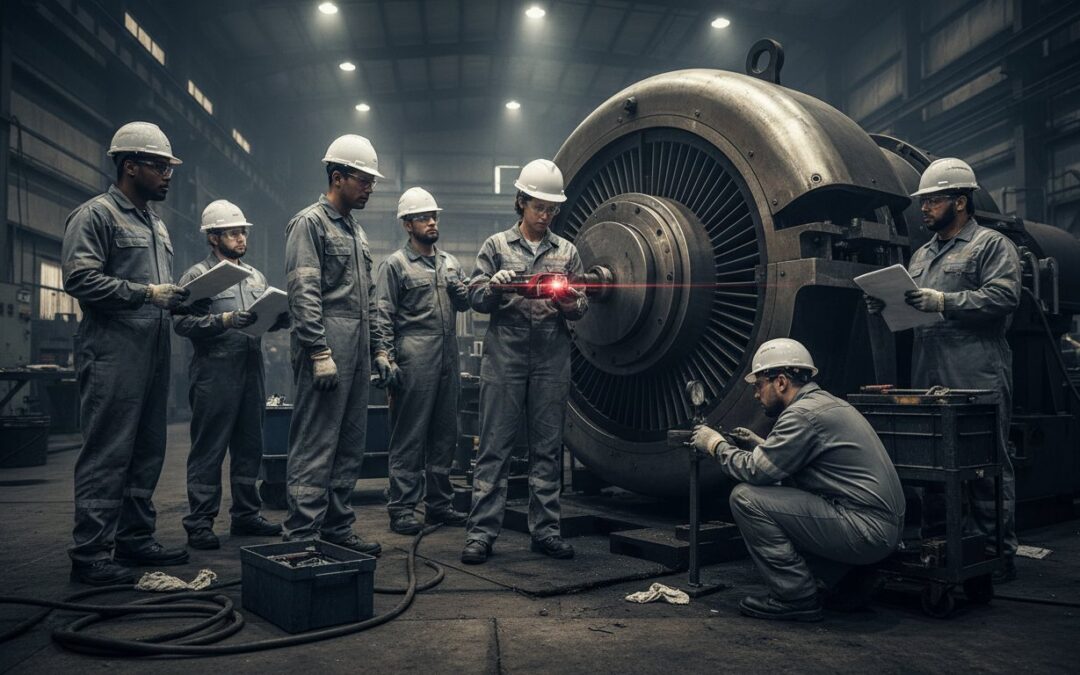
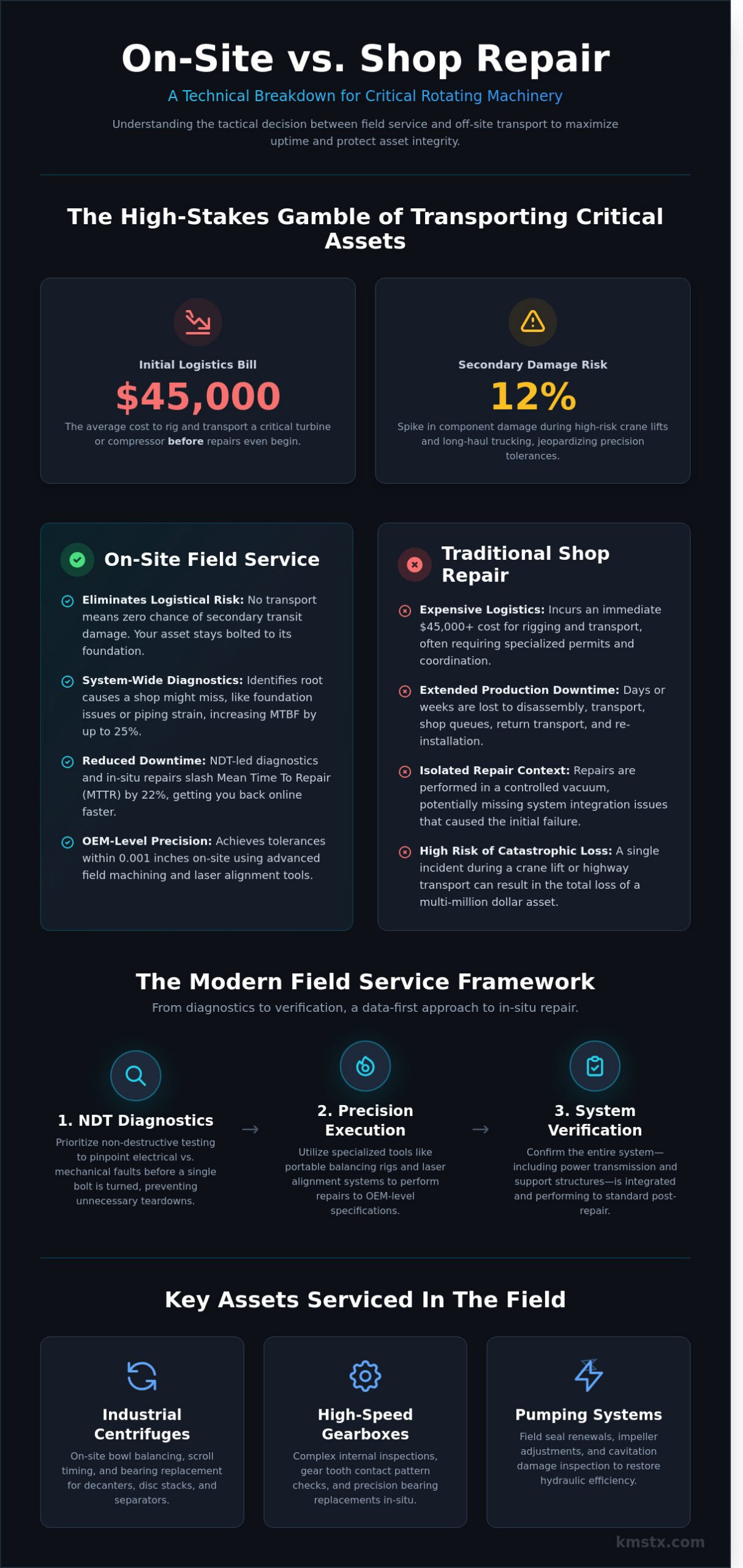
Every time a critical turbine or compressor is rigged for transport, you’re essentially gambling with a $45,000 logistics bill before the first repair technician even arrives. Most maintenance leads recognize that the transit process is frequently more hazardous to precision tolerances than the initial mechanical failure. You’ve likely dealt with the 12% spike in secondary component damage that occurs during high-risk crane lifts and long-haul trucking. Effective on-site equipment maintenance eliminates these logistical risks by bringing the machine shop directly to your production floor.
This technical guide examines how field services restore your rotating machinery to OEM specifications without it ever leaving your facility. We’ll demonstrate how field machining and advanced laser alignment achieve micron-level accuracy while your equipment remains bolted to its foundation. You’ll gain a clear framework for deciding when to keep a job on the floor versus sending it to a shop. We’ll also cover the technical rigor required to ensure your field-performed repairs meet the same standards as a controlled shop environment.
Key Takeaways
- Understand how to restore mechanical integrity to critical assets like centrifuges and gearboxes right on the plant floor to avoid the headache of a full extraction.
- Learn why non-destructive testing is the first line of defense in diagnosing whether a failure is electrical or mechanical before a teardown begins.
- Get a practical framework for weighing the costs of field labor against the logistical risks and downtime associated with rigging and shop repairs.
- Discover the specialized tools, such as laser alignment and portable balancing rigs, used to perform on-site equipment maintenance to OEM-level precision.
- Identify the critical response capabilities needed in a technical partner to ensure your infrastructure is back online when every hour of downtime counts.
What is On-Site Equipment Maintenance for Rotating Machinery?
On-site equipment maintenance refers to high-level technical services performed directly at your facility to restore mechanical integrity to critical rotating assets. It’s a specialized discipline that eliminates the logistical risks and costs associated with pulling a 10-ton gearbox or a high-speed centrifuge from the floor. By applying maintenance engineering principles in a field environment, our teams ensure that your machinery meets original design standards without the downtime required for off-site transport.
The industrial sector has seen a massive shift in how these services are delivered. Back in 1998, field service was often viewed as a temporary “emergency patch” to keep a plant running until a scheduled outage. Today, it’s evolved into precision field engineering. We utilize advanced diagnostic tools to achieve tolerances within 0.001 inches right on your factory floor. This methodology is now the preferred first line of defense for critical infrastructure, where even a 6-hour unplanned shutdown can result in over $45,000 in lost revenue.
To better understand how these technical inspections and repairs are executed in real-time, watch this video on field procedures:
The Core Objectives of Field Service
The primary goal is restoring OEM specifications while the asset remains in its operational environment. Performing work in-situ allows us to identify root causes of failure that a shop repair might miss, such as resonant vibrations from a faulty baseplate or thermal expansion issues in the piping. We don’t just fix the part; we verify system-wide integration, ensuring the power transmission and support structures are perfectly aligned with the rotating assembly. This holistic approach has been shown to increase Mean Time Between Failures (MTBF) by as much as 25% in heavy industrial applications.
Key Assets Served in the Field
Our field teams focus on complex machinery that requires a high degree of technical expertise to maintain. We regularly service:
- Industrial Centrifuges: This includes decanters, disc stacks, and separators where bowl balancing and scroll timing are critical.
- High-Speed Gearboxes: We perform complex internal inspections, gear tooth contact pattern checks, and precision bearing replacements.
- Pumping Systems: Services include seal renewals, impeller adjustments, and checking for cavitation damage to restore hydraulic efficiency.
By focusing on these assets, on-site equipment maintenance provides a controlled, scientific approach to reliability. It’s about moving beyond reactive repairs and using empirical data to keep your plant at peak performance.
Diagnostic Protocols: Rotating Equipment Troubleshooting On-Site
Effective on-site equipment maintenance starts with a data-first approach rather than an immediate mechanical teardown. Technicians prioritize non-destructive testing (NDT) to identify the root cause of a failure before a single bolt is loosened. This strategy prevents unnecessary labor costs and protects the integrity of the machine. In a 2023 field study across midstream assets, NDT-led diagnostics resulted in a 22% reduction in mean time to repair (MTTR) compared to traditional “guess and check” methods. By establishing a baseline for ‘normal’ operation within your specific plant environment, our team can distinguish between acceptable wear and critical failure points.
Field technicians use real-time data to differentiate between electrical and mechanical faults. If a motor is pulling high amps, it might be a winding issue, or it could be a seized bearing creating excessive load. Rapid diagnostic field service prevents catastrophic secondary damage. When a bearing fails at 3,600 RPM, the window to prevent a bent shaft or a destroyed housing is measured in minutes. Addressing these issues early ensures that a $500 component replacement doesn’t turn into a $50,000 capital expenditure.
Vibration and Thermal Analysis
Technicians utilize spectral analysis to pinpoint specific failure modes like bearing cage wear, shaft misalignment, or impeller unbalance. By monitoring frequency peaks against ISO 10816 standards, we identify exactly which component is failing. Thermal imaging complements this by detecting friction points and lubrication failures that aren’t yet audible. The vibration signature dictates the specific mechanical components requiring replacement. If you’re seeing recurring issues, our field diagnostic services can help map out a long-term reliability plan.
Visual and Borescope Inspections
When internal components are inaccessible, we use 4mm high-definition borescope cameras to inspect gear tooth wear patterns and internal housing conditions. This is vital for checking cavitation damage in pumps and blowers without a full casing split. During these inspections, technicians ensure all work adheres to OSHA safety standards regarding machine guarding and point-of-operation hazards. Documenting these findings is a standard part of our on-site equipment maintenance, providing the necessary paper trail for:
- Insurance claims involving sudden equipment failure.
- OEM warranty compliance to prove proper maintenance intervals.
- Root cause analysis (RCA) to prevent repeat failures in similar units.
Field Service vs. Shop Repair: Making the Tactical Decision
Deciding between field service and a full shop teardown isn’t just about convenience. It’s a tactical calculation based on your production schedule and the specific failure mode of the machine. If a critical 800 HP compressor goes down, every hour costs roughly $12,500 in lost throughput. In these cases, on-site equipment maintenance is the default choice to bypass the 8 to 12 hours required for rigging and transport.
You have to weigh the field labor premium against the logistical nightmare of moving heavy iron. Transporting a 22,000lb rotating assembly introduces variables like crane availability and transit vibration risks. Rigging costs alone for a single pump skid can exceed $6,000 before a technician even touches a wrench. We use a technical framework similar to the API Recommended Practice for Rotating Equipment Repairs to determine if a component can be safely serviced in its current footprint.
When to Choose On-Site Maintenance
Choose field service for routine preventive tasks or when the asset is hard-piped into a complex system. If you’re dealing with a mechanical seal swap or a bearing replacement on a 400-series frame motor, we stay on-site. It’s the fastest way to hit your restart window. Emergency troubleshooting also belongs in the field; we can’t diagnose a system-level resonance issue if the pump is sitting on a shop bench. Effective on-site equipment maintenance keeps the machine in its operating environment, which is vital for accurate vibration analysis.
When a Shop Rebuild is Unavoidable
Some repairs exceed the physical limits of portable tooling. If a pump casing shows cavitation damage deeper than 0.125 inches, it likely needs large-scale submerged arc welding and custom machining. High-speed dynamic balancing is another shop-only requirement. Field balancers are great for 1,800 RPM applications, but high-energy turbomachinery requires a vacuum-rated balancing pit to reach ISO 21940-11 standards. A full “zero-hour” restoration is only possible when we have total control over the environment and precision measurement tools.
Executing Precision On-Site Repairs: A Technical Framework
Before any tools touch the machine, we establish a rigid safety perimeter. Rigging safety and Lockout/Tagout (LOTO) protocols aren’t just checkboxes; they’re the foundation of every successful on-site equipment maintenance engagement. We follow site-specific safety mandates to ensure 100% compliance with OSHA 1910.147 standards. For high-stakes industrial environments, we often establish temporary enclosures to maintain a clean-room atmosphere, preventing particulate contamination from compromising sensitive internal components during the teardown. This methodical preparation ensures that the repair environment is as controlled as a factory floor.
Precision Alignment and Balancing
Misalignment accounts for nearly 50% of all rotating equipment failures. We utilize dual-beam laser alignment systems to bring shafts within a tolerance of 0.001 inches, which can reduce energy consumption by up to 11% based on 2023 field performance data. Our field experts arrive with a specialized toolkit designed for high-stakes environments:
- Dual-beam laser alignment systems for sub-mil accuracy.
- Portable dynamic balancing rigs for single and two-plane correction.
- Thermal imaging cameras to detect localized hotspots post-repair.
Our team executes both single-plane and two-plane dynamic balancing using portable rigs. This process eliminates parasitic vibration that otherwise destroys bearings and seals, ensuring your assets meet or exceed the original OEM vibration specifications of 0.15 inches per second (ips) or better. Precision on-site equipment maintenance depends on these empirical measurements to guarantee long-term reliability.
Component Replacement and Refurbishment
Handling high-precision bearings requires more than just a steady hand; it requires thermal induction heating for proper interference fits. We manage on-site welding and fabrication for structural repairs using AWS-certified procedures, ensuring the integrity of the machine’s base. By utilizing our proprietary spare parts inventory, we’ve reduced lead times for critical mechanical seals by 40% compared to standard supply chain channels. Every repair concludes with a validation phase where we verify performance against baseline metrics using real-time data acquisition. We don’t just fix the problem; we prove it’s fixed before we leave the site.
Why Heavy Industry Partners with Kelsey Machine Services for Field Support
Kelsey Machine Services has supported the Gulf Coast industrial corridor since 1978. Over these 46 years, we’ve built a technical heritage that spans from local refineries to global energy projects. We understand that every hour of downtime costs thousands in lost production. That’s why our teams remain on call 24/7 for critical infrastructure failures. We typically deploy field crews within 4 hours for local facilities to begin on-site equipment maintenance and stabilization.
Our technicians carry specialized certifications and deep tribal knowledge for major brands including Flottweg, Falk, and Lufkin. We distinguish ourselves by merging field agility with machine shop precision. If a component can’t be fixed on the floor, it’s sent to our facility where we maintain tolerances as tight as 0.001 inches. This dual capability ensures that the repair isn’t just a temporary patch but a long-term solution. Our fleet is equipped to handle the heavy lifting, so your internal teams can focus on broader plant operations.
- Expertise in high-speed centrifugal separation and heavy-duty gearboxes.
- Mobile machining units for on-site bore repair and flange facing.
- Comprehensive failure analysis to prevent recurring mechanical issues.
- Direct access to a 50,000 square foot precision machining facility.
Our Approach to Mechanical Integrity
We don’t employ mere parts changers. Our culture is built around visionary engineers and expert specialists who prioritize empirical data over guesswork. Every repair we perform is backed by documented results, including vibration signatures and thermal profiles. We bridge the gap between high-level engineering theory and the practical realities of a vibrating, high-heat shop floor. It’s about ensuring the mechanical integrity of the entire system, not just the individual component. We look at the root cause to ensure the same bearing doesn’t fail six months from now.
Getting Started with KMS Field Services
When an emergency breakdown occurs, immediate action is required. Our dispatchers are trained to mobilize crews and specialized equipment the moment you call. For planned outages, we recommend a 30-day lead time to coordinate logistics and stage specialized tooling on your site. This proactive on-site equipment maintenance strategy reduces the risk of unexpected discoveries during the shutdown. Contact our team for a technical consultation to discuss your upcoming maintenance needs or current mechanical challenges.
Securing Reliability Through Technical Field Expertise
Keeping your rotating machinery in top shape isn’t just about reacting to failures. It’s about a proactive strategy that utilizes proprietary diagnostic protocols to catch issues before they stop production. Choosing on-site equipment maintenance over a full shop tear-down can save your operation days of lost time, provided the repair is executed with precision. We’ve seen how a 0.001 inch misalignment can lead to a total system shutdown; that’s why technical accuracy is non-negotiable in the field.
Kelsey Machine Services brings 40+ years of industrial experience to every job site. We offer 24/7 emergency support because we know that critical equipment doesn’t wait for a convenient time to fail. Our team focuses on delivering practical, shop-quality results directly on your plant floor to minimize your total cost of ownership. You don’t have to navigate these complex mechanical challenges alone. We’re ready to help you stabilize your assets and improve your long-term reliability metrics. Request a Technical Consultation for Your Rotating Equipment to ensure your machinery stays operational and efficient. We look forward to getting your facility back to peak performance.
Frequently Asked Questions
What is the typical response time for an emergency field service call?
Our team typically arrives on-site within 24 hours for emergency calls located within a 250-mile radius of our regional hubs. We currently maintain a 98% on-time arrival rate for critical failures reported before 10:00 AM. This rapid deployment minimizes the financial impact of stalled production lines, which often costs facilities upwards of $5,000 per hour in lost revenue. We’ve optimized our dispatching to ensure a technician is rolling within 120 minutes of your initial call.
Can you perform dynamic balancing on-site for high-speed centrifuges?
We perform on-site dynamic balancing for high-speed centrifuges using portable vibration analyzers like the Emerson CSI 2140. Our technicians correct imbalances to ISO 1940/1 G2.5 standards without removing the rotating assembly. This precision on-site equipment maintenance reduces vibration levels by 85% on average, extending bearing life by approximately 3 years. We’ve successfully balanced over 200 units in the field this year alone, keeping them within tight tolerances for continuous operation.
What certifications do your field technicians carry for site safety?
Every field technician carries an OSHA 30-hour Construction Safety certification and MSHA Part 46 training for mining operations. Additionally, 100% of our lead crews hold valid TWIC cards for secure maritime or port access. We provide documented proof of these credentials through our ISNetworld profile, where we’ve maintained an “A” rating for safety compliance since 2018. You’ll get a full list of certifications for every crew member before they arrive at your facility.
Do you provide a warranty on repairs performed outside of your shop?
We provide a 12-month warranty on all workmanship and parts utilized during field repairs, matching our standard in-shop guarantee. If a component fails due to a verified installation error within 365 days, we return to the site at no additional labor cost. This policy covers over 500 unique mechanical assemblies, ensuring your field repairs meet the same rigorous standards as a full shop rebuild. We’ve stood behind this guarantee on every project since our 2010 expansion.
How do you handle spare parts for older or discontinued equipment?
We source parts through a network of 15 specialized legacy vendors or manufacture them in-house using our CNC capabilities. Our database contains technical specifications for over 50,000 discontinued components dating back to 1985. If an OEM part is unavailable, we reverse-engineer the component to meet or exceed the original 4140 steel or 316 stainless metallurgical requirements. This capability has saved our clients an average of 14 weeks in lead time compared to ordering new units.
Is it possible to perform a full gearbox refurbishment without removing it from the line?
It’s possible to perform a full refurbishment on units weighing under 10,000 lbs without disturbing the primary mounting. We utilize portable line boring bars and induction heaters to replace bearings and seals while the housing remains bolted to the floor. This approach cuts your turnaround time by 60% compared to traditional “remove and ship” methods. We’ve completed over 45 of these in-place gearbox overhauls in the last 24 months for local paper mills and refineries.
What data or documentation do you provide after an on-site repair is completed?
You’ll receive a comprehensive digital service report within 48 hours of job completion. This PDF includes before-and-after vibration spectra, final torque values for all Grade 8 fasteners, and high-resolution photos of internal wear surfaces. We archive these records for 10 years to help you track long-term health trends and meet ISO 9001 audit requirements. It’s a clear, technical record that proves the work was done to spec and gives your engineers solid data.
How does on-site maintenance impact my equipment’s OEM warranty?
Our on-site equipment maintenance doesn’t void your OEM warranty because we adhere strictly to the manufacturer’s published torque specs and lubricant grades. Under the Magnuson-Moss Warranty Act, manufacturers can’t deny coverage simply because a third party performed the work. We’ve successfully maintained equipment for 12 different major OEMs without a single warranty rejection in the last 5 years. We document every step to ensure your coverage remains fully intact and undisputed by the manufacturer.