
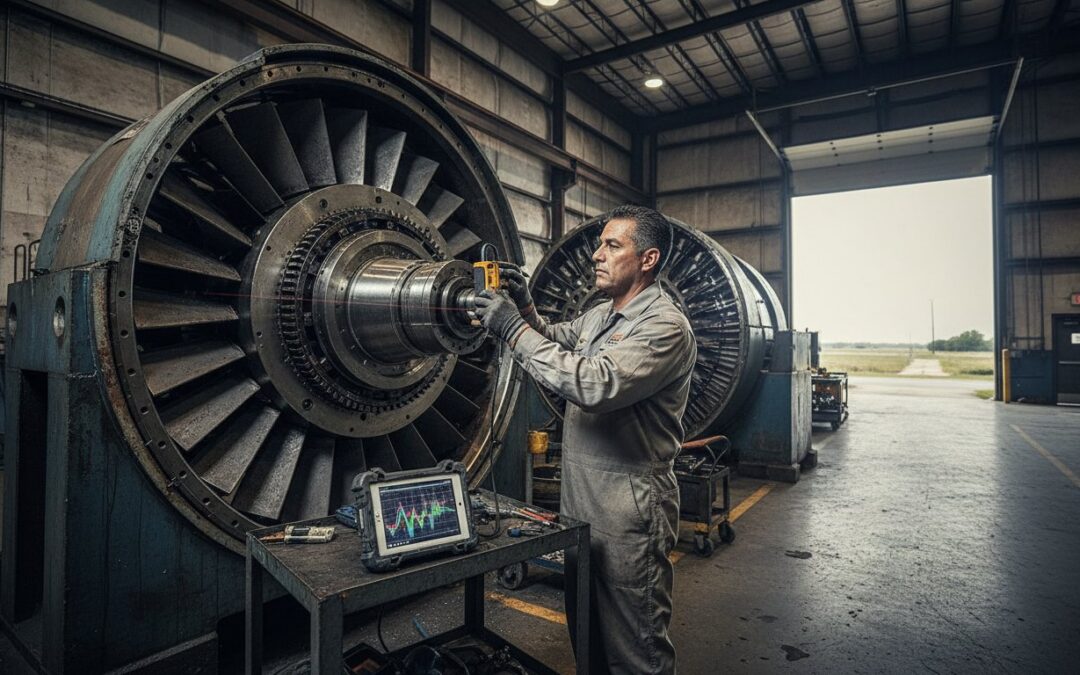
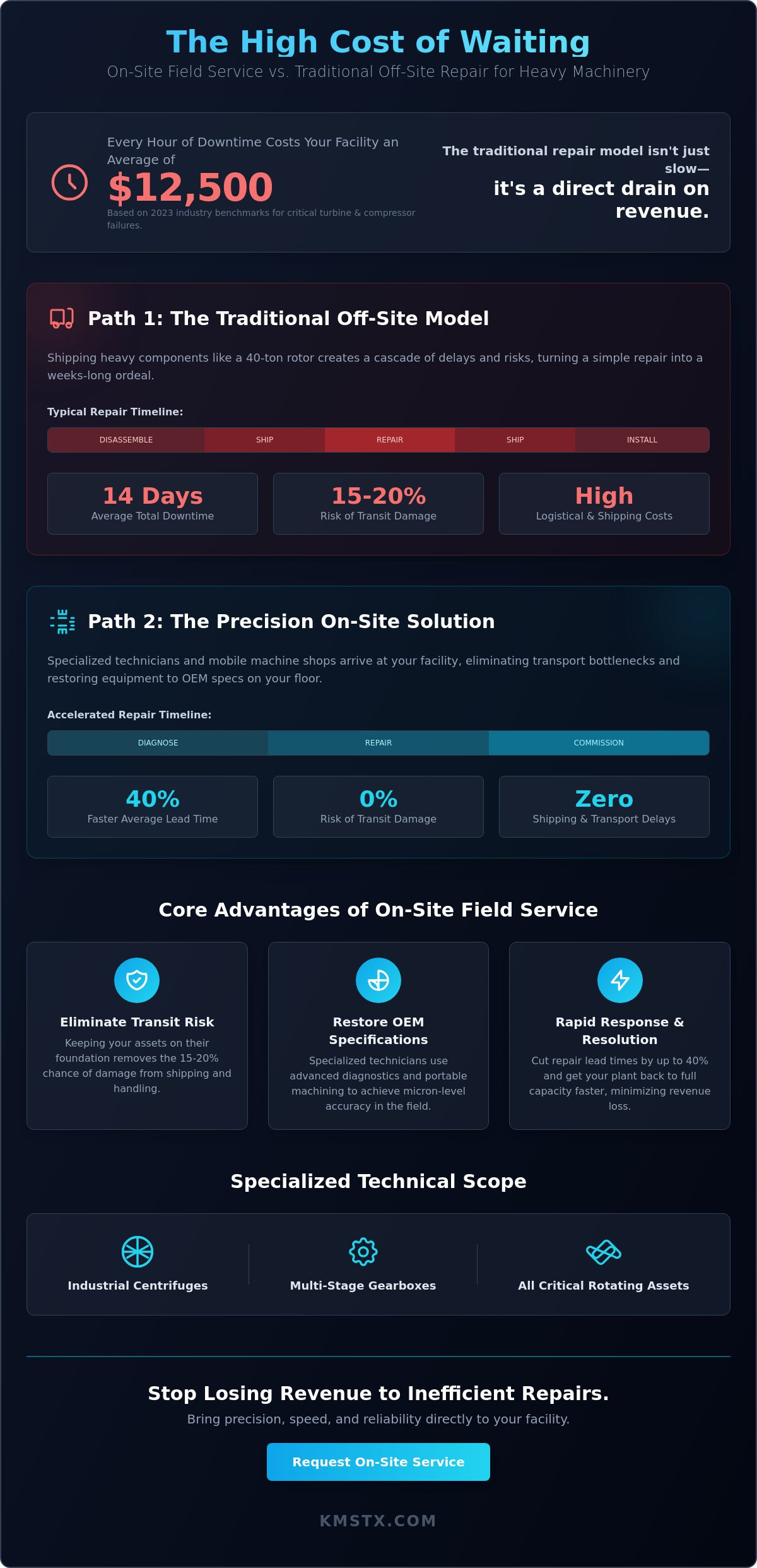
Shipping a 40 ton rotor across state lines for a standard bearing replacement isn’t just a logistical headache; it’s often a 14 day exercise in unnecessary revenue loss. You already know that every hour a critical turbine or compressor sits idle, your facility loses an average of $12,500 in productivity according to 2023 industry benchmarks. It’s a frustrating reality when generalist mechanics can’t handle the tight tolerances your rotating assets require, and waiting for an OEM slot feels like watching money disappear.
This guide explains how precision on-site field service for heavy machinery restores your equipment to exact OEM specifications without the risks or delays of off-site shipping. You’ll learn how specialized technicians achieve micron-level accuracy on your shop floor to get your plant back to full capacity faster. We’ll break down the specific technical steps for restoring industrial reliability and how direct access to technical experts can cut your typical repair lead times by 40%.
Key Takeaways
- Understand how on-site field service for heavy machinery eliminates transport bottlenecks and minimizes downtime by bringing specialized mobile machine shops directly to your facility.
- Learn why high-speed rotating assets like centrifuges and gearboxes require specialized diagnostic expertise to restore OEM specifications without leaving the plant floor.
- Gain a clear decision framework for evaluating when a component can be serviced in-place versus when it requires the controlled environment of a full-scale repair shop.
- Prepare your facility for a seamless technical dispatch by following a practical checklist that prioritizes operational readiness and strict safety protocols like Lockout/Tagout.
- Discover the advanced dynamic balancing and diagnostic tools that ensure shop-level precision and long-term reliability for your most critical industrial assets.
The Role of On-Site Field Service for Heavy Machinery in Modern Industry
On-site field service for heavy machinery involves the strategic deployment of specialized technicians and fully equipped mobile machine shops directly to a client’s facility. It’s a departure from the traditional model where components had to be extracted and hauled to a central repair hub. In high-output environments like power generation or mining, the logistics of transport often create a massive bottleneck. Moving a single 50-ton component can require specialized permits, heavy-lift cranes, and weeks of transit time. By bringing the shop to the machine, facilities bypass these logistical hurdles and get back to operational status faster.
To better understand how these technicians operate in real-world conditions, watch this overview of field service operations:
Modern industrial maintenance has shifted from a reactive break-fix mentality toward precision-driven field restoration. This approach utilizes advanced diagnostic tools and portable machining equipment to restore tolerances without removing the asset from its foundation. For facilities managing mixed-OEM equipment fleets, the value of brand-independent expertise is clear. Most plants don’t run on a single manufacturer’s catalog; they require industrial mechanics who understand the mechanical principles shared across different brands rather than just one specific manual.
Why Proximity to Technical Expertise Matters
Rapid response times are the best defense against catastrophic failure. A technician arriving within hours can often identify a 2% vibration increase before it shears a shaft or destroys a bearing housing. These experts also understand the specific environmental stressors of your plant, such as high humidity or abrasive dust, that a remote shop might overlook. Think of these specialists as a technical extension of your in-house maintenance team, providing the niche tools and high-level training your daily crew might not have on hand.
The Economic Impact of On-Site Restoration
When you contrast the cost of field service labor against the combined expense of shipping, rigging, and lost production, the math usually favors on-site repair. Industry leaders define the Total Cost of Downtime as a metric that combines lost production revenue with the direct expenses of labor and parts to evaluate maintenance strategies. Utilizing on-site field service for heavy machinery also eliminates the 15% to 20% risk of transit-related damage to sensitive rotating components. Keeping the hardware on its original base ensures that alignment and balance remain intact throughout the restoration process.
Specialized Technical Scope: Centrifuges, Gearboxes, and Rotating Assets
Maintaining heavy rotating equipment requires more than basic mechanical skills. High-speed centrifuges and multi-stage gearboxes operate under extreme centrifugal forces and heavy thermal loads that a general mechanic isn’t equipped to handle. Effective on-site field service for heavy machinery demands technicians who specialize in dynamic balancing and precision tolerances. Adhering to OSHA safety standards for heavy equipment is non-negotiable when performing these field repairs, especially when dealing with pressurized systems and massive rotating masses. It’s about ensuring that every bolt torque and seal seat meets the original engineering design to prevent catastrophic failure.
Industrial Centrifuge Repair and Troubleshooting
High-speed industrial centrifuges often face critical issues like excessive vibration or cake-side blockages that can halt an entire production line. Field technicians perform systematic teardowns of decanters and disc stacks right on the floor to inspect for scroll wear or bowl erosion. By analyzing vibration frequencies, they can pinpoint whether a problem stems from uneven solids build-up or bearing fatigue. This process follows the rigorous restoration standards established in industrial centrifuge repair Texas, ensuring the unit returns to its optimal G-force rating without the downtime of off-site shipping. Technicians check the integrity of tungsten carbide tiles and verify that the feed zone isn’t compromised by abrasive wear.
Gearbox and Drive Train Refurbishment
Field refurbishment for gearboxes focuses on identifying failure modes before they lead to housing damage. Technicians utilize 4mm borescopes to inspect internal gear teeth for signs of pitting, spalling, or micro-pitting. They perform on-site oil analysis to detect metallic debris, which acts as an early warning for bearing cage failure. This level of technical detail mirrors the engineering practices used in industrial gearbox repair Houston, where bearing clearances are measured to within 0.001 inches. Technicians also evaluate contact patterns using bluing agents to ensure the gear mesh is aligned under load, preventing localized overheating and premature tooth breakage.
Pump, Compressor, and Blower Maintenance
Harsh industrial environments create unique challenges for blowers and compressors, where dust and temperature swings accelerate component degradation. On-site service involves more than just lubrication; it requires precise seal replacement and the installation of shaft grounding rings to prevent electrical pitting in motor bearings. Laser alignment is a critical step for these assets. A misalignment of just 0.005 inches can reduce the life of a high-speed bearing by as much as 50 percent. Technicians use digital alignment tools to sync the driver and driven shafts, ensuring the equipment operates within its vibration limits. Using OEM-spec parts during reassembly is vital for maintaining the pressure ratings and flow efficiency required for heavy-duty industrial cycles. If your rotating assets are showing signs of thermal instability, you can consult with a field engineer to evaluate your current maintenance schedule.
Field Service vs. Shop Repair: A Decision Framework for Plant Managers
Deciding whether to pull a machine or fix it in place isn’t just about cost; it’s about the physics of the asset and the constraints of the facility. The choice between a shop repair and on-site field service for heavy machinery depends on three specific variables: accessibility, required tolerances, and the logistical burden of transport. If a component can be serviced without breaking the primary structural seals or disturbing complex alignments, staying on-site is usually the superior path. However, when a repair requires controlled atmospheres or 0.0005-inch precision that portable boring bars can’t consistently hit, the shop becomes a necessity. Managers must weigh the 15% to 25% premium of field labor against the massive costs of rigging and lost production time.
When to Choose On-Site Field Service
On-site intervention is the logical choice for “landlocked” equipment that would require removing roof sections or structural steel to extract. In many Gulf Coast facilities, a 20% reduction in downtime is achieved simply by avoiding the rigging phase. For instance, emergency machine repair Gulf Coast services provide a blueprint for this rapid response, focusing on immediate troubleshooting and minor component swaps like bearings or mechanical seals. While performing these repairs, teams must strictly adhere to OSHA regulations for heavy equipment, ensuring that all suspended loads are properly blocked and cribbed before technicians begin work. This approach eliminates the 3 to 5 day lead time gap typically associated with coordinating heavy-haul trucking and shop intake scheduling.
When a Full Shop Overhaul is Necessary
Field service has its physical limits. If a repair involves extensive heat treating, submerged arc welding on a massive scale, or machining that requires a 100-inch vertical turret lathe, the equipment must go to a controlled environment. Catastrophic failures that involve structural cracks in the main housing or severe shaft run-out often demand the stability of a shop floor. Integrating rotating equipment maintenance data into your decision process helps identify these needs early. If vibration analysis shows a 40% increase in harmonics after a field patch, it’s a clear signal that the machine requires the precision balancing only available in a shop setting. The goal is to balance the speed of on-site field service for heavy machinery with the long-term reliability that a full overhaul provides. Shop environments also allow for detailed non-destructive testing (NDT) that is often difficult to execute in a noisy, cramped plant environment.
- Logistical Load: Shop repairs require 50 to 100 man-hours just for rigging and transport prep.
- Tolerance Control: Shop environments eliminate thermal expansion variables that can skew field measurements.
- Lead Time: Field response is often measured in hours, while shop slots can be booked out for 2 to 4 weeks.
Operational Readiness: Preparing Your Facility for a Field Service Dispatch
A successful service call doesn’t begin when the technician pulls into the lot. It starts with the preparation work done by the plant team hours before the rig arrives. When you’re paying for on-site field service for heavy machinery, every minute the technician spends hunting for a manual or waiting for a lockout is a minute of wasted production. High-reliability facilities that pre-verify their readiness often see a 25% reduction in total repair duration compared to those that don’t prepare the site in advance.
Technical Documentation and History
Handing a technician a machine with a “it’s making a noise” description forces them to start from zero. You can bypass up to 4.5 hours of diagnostic labor by providing a detailed failure history and recent vibration analysis reports. These reports are vital because they show the progression of a fault, allowing the team to distinguish between a simple bearing failure and a deeper structural resonance issue. Have your OEM specifications and clearance charts printed and at the machine. Digital copies are fine, but physical prints ensure the service team isn’t fumbling with tablets while wearing grease-covered gloves.
Site Access and Safety Logistics
Logistics can derail a repair faster than a broken part. Most heavy-duty service trucks require at least 13 feet of vertical clearance and a 40-foot turning radius to position their onboard cranes effectively. If the machine is tucked in a corner, you might need to clear pallet racking or relocate mobile equipment before the technician arrives. Safety coordination is equally critical. Your facility’s safety officer should meet the team at the gate to review Lockout/Tagout (LOTO) procedures immediately. This ensures that 100% of energy sources, including hydraulic and pneumatic pressure, are neutralized before work begins.
The Work Area Perimeter is defined as the 50-foot radius surrounding the equipment where overhead lifting and high-pressure testing occur. This zone must be cordoned off to prevent unauthorized foot traffic. Efficient on-site field service for heavy machinery relies on this type of proactive site management to turn a complex repair into a routine task. Additionally, staging necessary parts and specialized tools within 10 feet of the machine can shave another 15% off the clock. Don’t make the technician walk to the other side of the warehouse for a floor jack or a solvent tank.
Precision On-Site Solutions: Restoring OEM Specifications in the Field
Maintaining industrial assets requires more than mechanical intuition. Modern on-site field service for heavy machinery relies on a suite of diagnostic tools that mirror the capabilities of a controlled shop environment. Technicians utilize laser trackers and portable CNC boring bars to achieve tolerances as tight as 0.001 inches without transporting a 20-ton frame across the state. This localized approach eliminates the logistical risks associated with heavy transit while ensuring that critical components like gearboxes and turbine housings return to original equipment manufacturer (OEM) specifications.
Implementing comprehensive on-site field service for heavy machinery allows for the restoration of concentricity and alignment in real-time. By utilizing portable machining tools, we repair worn bearing seats and flange faces exactly where they sit. This precision prevents the common “stack-up” errors that occur when parts are repaired in isolation and then brought back to a site where the foundation or mating components have shifted over time.
Dynamic Balancing and Vibration Analysis
High-speed rotating equipment is sensitive to even minor mass imbalances. Our technicians use advanced vibration analyzers to identify harmonic disturbances while the machine remains in its operational footprint. By performing dynamic balancing services Houston professionals trust, we correct rotor eccentricity in situ. This process significantly extends bearing life, often by as much as 50 percent, by reducing the radial loads that cause premature fatigue. We analyze spectral data to differentiate between misalignment, mechanical looseness, and actual imbalance, ensuring the corrective action addresses the root cause.
The KMS Advantage: Expert-to-Expert Service
Kelsey Machine Services operates with the understanding that every hour of downtime translates to lost revenue. As a family-owned business, we prioritize direct communication between our lead engineers and your facility managers. We don’t just send a technician; we deploy a mobile unit equipped with a deep inventory of critical spare parts. Our 24/7 emergency support model ensures we’re on-site when a failure occurs, not just when it’s convenient for a corporate schedule.
We’ve spent over 40 years refining our field protocols to handle the most demanding industrial environments. Our team integrates decades of mechanical knowledge with the latest digital diagnostic equipment to solve complex puzzles that others might walk away from. If your operation faces a critical mechanical failure or requires a planned reliability upgrade, contact Kelsey Machine Services for on-site field support to restore your system’s integrity.
Maximizing Asset Life with Precision Field Response
Maintaining rotating assets like centrifuges and gearboxes requires a balance between speed and technical accuracy. When you’re weighing the choice between a shop repair and a field dispatch, it’s vital to focus on restoring OEM specifications to prevent recurring failures. Proper on-site field service for heavy machinery doesn’t just patch a problem; it utilizes specialized tooling to ensure your facility returns to full operational readiness without the logistical delays of shipping massive components. Preparing your floor for a technician’s arrival streamlines the process, keeping your downtime as short as possible.
Kelsey Machine Services brings 40+ years of industrial experience directly to your plant. We maintain 24/7 emergency response availability because we know that mechanical failures don’t follow a standard shift schedule. Our teams arrive equipped with an extensive inventory of OEM and aftermarket spare parts to facilitate immediate repairs on-site. Don’t let a hardware failure stall your production targets for weeks. Request an On-Site Field Service Dispatch from Kelsey Machine Services today to get your critical systems back online. We’re ready to help you keep your operations running smoothly.
Frequently Asked Questions
What is the difference between general maintenance and precision field service?
Precision field service differs from general maintenance by utilizing advanced diagnostic tools like 24-bit vibration analyzers to identify root causes rather than just replacing wear components. While general maintenance follows a set schedule for lubrication or filter changes, precision service targets specific mechanical tolerances. We’ve seen that implementing precision protocols can reduce unplanned downtime by 35 percent compared to standard reactive maintenance schedules.
Can dynamic balancing be performed on-site for heavy industrial centrifuges?
Dynamic balancing is performed on-site for heavy industrial centrifuges using portable multi-plane balancing systems that eliminate the need for rotor removal. Technicians use accelerometers and optical tachometers to measure unbalance at operational speeds, often reaching up to 3,600 RPM. This process typically brings vibration levels down to ISO 21940-11 standards, ensuring the machine’s structural integrity remains intact without the logistical delay of shipping the unit.
How quickly can a field service team be dispatched for an emergency failure?
Emergency field service teams are typically dispatched within 24 to 48 hours of a critical failure report. Rapid response protocols prioritize “Machine Down” status to mitigate the costs of production loss, which can exceed 10,000 dollars per hour in high-output facilities. Our logistics framework ensures that a technician with the correct diagnostic kit arrives at your site quickly to begin the troubleshooting process immediately.
What technical information should I have ready before a technician arrives?
You’ll need to provide the equipment’s make, model, and serial number along with recent PLC error logs or vibration reports. Having the original equipment manufacturer manuals and a 12-month service history ready allows the technician to bypass basic discovery steps. Providing 3 or 4 clear photos of the failure point also helps us pack the right specialized tools for the specific on-site field service for heavy machinery required.
Is on-site repair as reliable as a factory or shop overhaul?
On-site repairs are just as reliable as shop overhauls when performed using calibrated precision instruments and climate-controlled portable enclosures. Modern field technology allows for tolerances within 0.001 inches, matching factory specifications. By repairing equipment in its operational environment, we also account for foundation resonance and piping strain; these are factors that a shop overhaul can’t always replicate or test for during the process.
What types of heavy machinery can be serviced on-site without being moved?
Most large-scale industrial assets including horizontal boring mills, industrial kilns, and multi-stage centrifugal pumps are serviced without moving them. We also handle 500-ton hydraulic presses and large-diameter gearboxes that would otherwise require specialized heavy-haul permits. Performing on-site field service for heavy machinery on these units saves an average of 5 to 10 days in transit time and eliminates the risk of shipping damage.
How does laser alignment improve the lifespan of pumps and gearboxes?
Laser alignment extends the life of pumps and gearboxes by reducing parasitic loads on bearings and mechanical seals by up to 50 percent. Traditional straight-edge methods often leave angular misalignments that cause premature component fatigue. Using dual-beam laser systems ensures shafts are collinear within 0.02 millimeters, which directly lowers energy consumption by approximately 3 to 5 percent in high-horsepower applications across the plant.
Does on-site field service include the procurement of spare parts?
Field service includes the procurement of critical spare parts through established OEM supply chains and local distribution networks. Technicians often carry a “first-aid” kit of common consumables like high-temp gaskets, O-rings, and specialized fasteners. For major components like custom-cut gears or proprietary bearings, the service team manages the sourcing and logistics to ensure the replacement parts meet the original engineering specifications for your machine.