
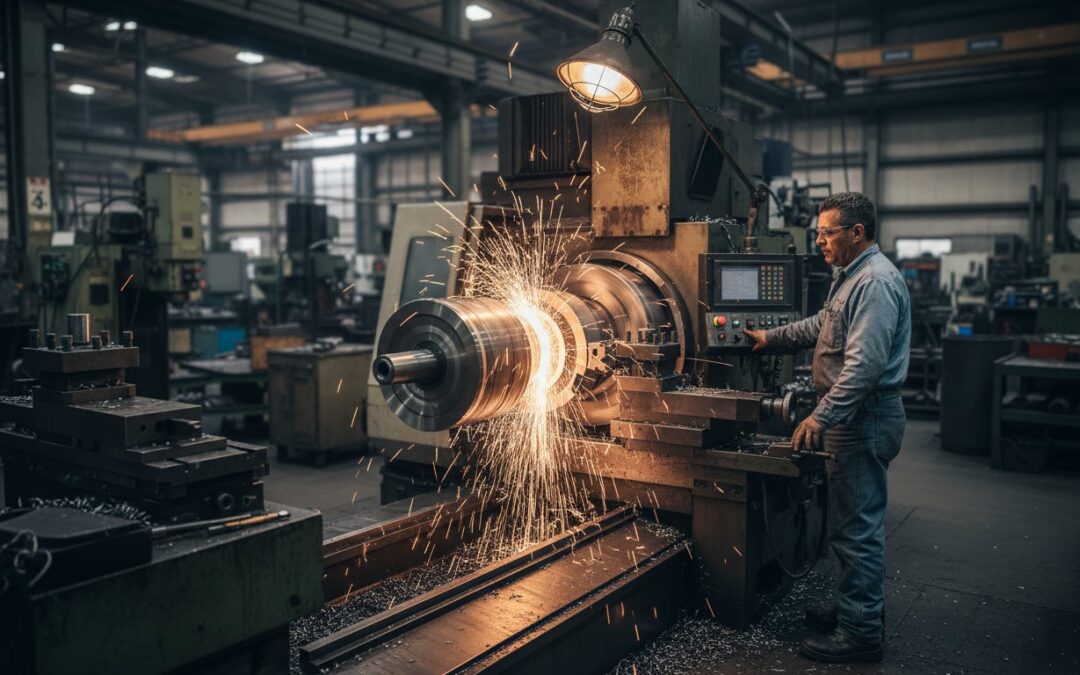
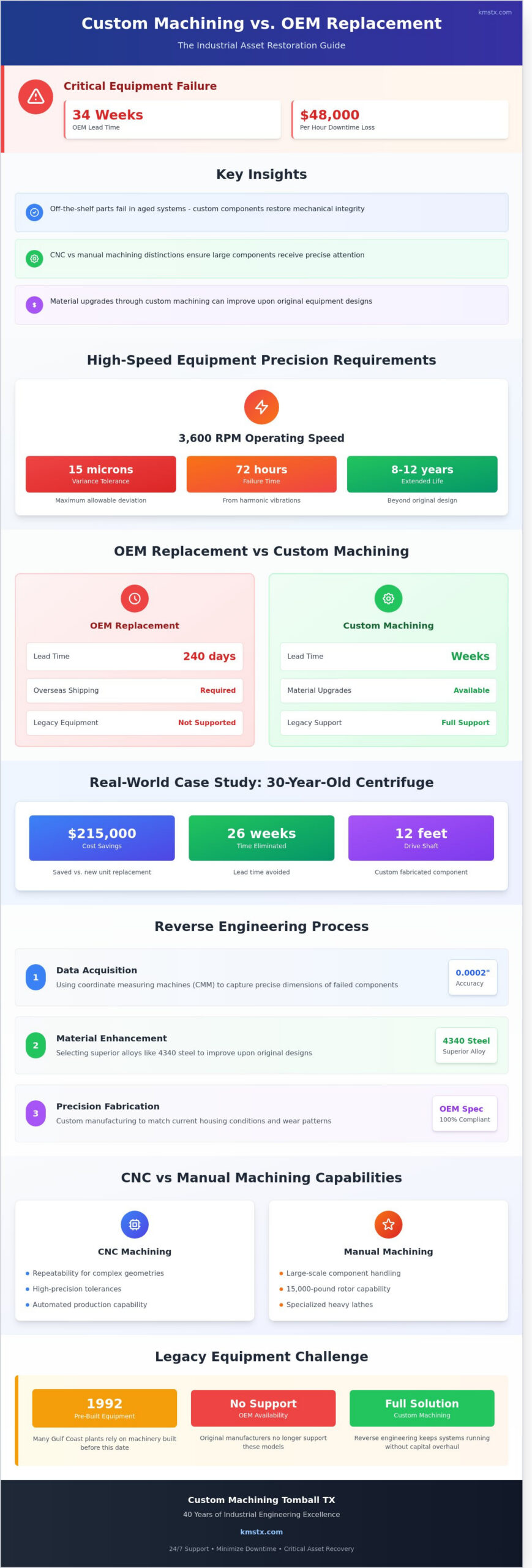
Last Tuesday, a maintenance lead at a local refinery discovered that the lead time for a critical centrifugal pump shaft was 34 weeks, effectively halting a primary production line for over eight months. When you’re staring at a $48,000 per hour downtime loss, waiting on an OEM overseas simply isn’t a viable strategy. It’s in these high-stakes moments that leveraging specialized custom machining Tomball TX becomes the most logical path to restoring your facility’s operational capacity. You’ve likely seen what happens when a generic shop tries to handle high-speed rotating equipment; the tolerances are off by just a few thousandths, and you’re dealing with catastrophic vibration issues within 90 days.
We understand that “good enough” doesn’t work for assets spinning at 3,600 RPM. This guide provides a technical roadmap for using precision machining to restore your critical assets to 100% OEM specifications while bypassing the typical 240-day supply chain delay. We’ll examine the specific methodologies for reverse engineering obsolete components and explain how proper material selection ensures your equipment remains stable for the next decade of service.
Key Takeaways
- Understand why off-the-shelf parts often fall short and how custom-fabricated components restore mechanical integrity to aged or unique industrial systems.
- Learn to distinguish between the technical applications of CNC and manual machining to ensure your large-scale components receive the precise attention they require.
- Evaluate the cost-benefit of custom machining Tomball TX versus OEM replacements, focusing on how material upgrades can actually improve upon original equipment designs.
- Identify the critical standards for vetting a machine shop, specifically why a proven track record in rotating equipment maintenance is essential for operational reliability.
- See how a 40-year legacy in industrial engineering informs a 24/7 support model designed to minimize downtime during critical asset failures.
Defining the Role of Custom Machining in Industrial Asset Restoration
Heavy industrial assets often operate under extreme thermal and mechanical stress. When a critical component fails, off-the-shelf replacements frequently lack the exact tolerances required for aged or modified systems. Custom machining involves the precision fabrication of components designed specifically to restore mechanical integrity to these complex assemblies. In shops specializing in custom machining Tomball TX, the process integrates mechanical engineering principles with high-end toolcraft to ensure rotating equipment returns to service safely. The technical process of machining allows for the precise removal of material to achieve a specific geometry, which is vital when repairing high-speed assets that have undergone years of operational wear. Industrial custom machining is the bridge between equipment failure and OEM-spec restoration.
Standard parts are manufactured for “new” conditions, but industrial reality is rarely that clean. After 10,000 hours of run time, a housing might be slightly out of round or a seating surface could be pitted. Relying on custom machining Tomball TX services allows operators to create parts that account for these real-world conditions rather than forcing a standard part into a non-standard space. This specialized approach ensures that the intersection of machining and mechanical engineering results in a repair that’s often more durable than the original setup.
To see the level of precision involved in modern fabrication, watch this demonstration of 5-axis technology:
The Critical Need for Precision in Heavy Industry
High-speed rotating assets, like turbines or large-scale centrifugal pumps, are sensitive to even the slightest imbalance. A variance of just 15 microns can lead to harmonic vibrations that cause bearing failure within 72 hours of operation. Custom machining allows technicians to accommodate specific wear patterns on mating surfaces that standard parts simply can’t handle. By matching new components to the current state of the existing housing, the equipment lifecycle is often extended by 8 to 12 years beyond its original design limit. This level of accuracy isn’t just about fit; it’s about the long-term stability of the entire mechanical system.
Machining as a Solution for Equipment Obsolescence
Maintaining legacy equipment is a constant challenge when the original equipment manufacturer (OEM) no longer supports the model. Many industrial plants in the Gulf Coast region rely on machinery built before 1992. Reverse engineering transforms a worn-out component into a high-performance part through precise measurement and material analysis. It’s a common way to keep older systems running without a total capital overhaul.
- Data Acquisition: Using coordinate measuring machines (CMM) to capture dimensions of the failed part.
- Material Enhancement: Selecting superior alloys, such as 4340 steel, to improve upon the original design.
- Case Study: In a 2023 restoration project, a 30-year-old centrifuge was returned to service by custom-fabricating a 12-foot drive shaft that was no longer available from the manufacturer. This saved the facility over $215,000 in replacement costs and eliminated a 26-week lead time for a new unit.
Precision CNC and Manual Machining Capabilities for Industrial Assets
Heavy-duty rotating equipment operates under extreme stress, often involving centrifugal forces that can turn a minor deviation into a catastrophic failure. Maintaining these assets requires a hybrid approach to custom machining Tomball TX, where the technical distinction between CNC and manual methods dictates the success of a repair. Large-scale components, such as 15,000-pound rotors or complex compressor housings, demand specialized horizontal boring mills and heavy lathes that standard job shops simply don’t house. Our facility provides custom machining Tomball TX for regional operators who can’t afford the 12-week lead times often associated with overseas shipping. We utilize advanced diagnostic tools, including laser trackers and coordinate measuring machines (CMM), to verify machining accuracy within 0.0002 inches before any assembly begins.
CNC Machining: Repeatability and Complex Geometries
CNC technology excels when fabricating components with multi-axis geometries that require absolute repeatability. By integrating CAD/CAM software directly into the workflow, we translate engineering blueprints into precise toolpaths for 5-axis machining centers. This digital continuity is vital for maintaining consistent tolerances across a fleet of 20 or more identical pumps. When deciding between Aftermarket vs. OEM components, custom CNC fabrication often provides a superior solution by allowing for material upgrades that exceed original specifications. This process ensures that every replacement part fits the existing assembly without the need for field modifications, which is critical for maintaining 99% uptime in high-output environments.
Manual Machining: The Art of One-Off Technical Repair
Manual lathes and mills remain the backbone of industrial repair for unique, oversized, or awkwardly shaped housings that don’t fit standard CNC fixtures. A master machinist relies on tactile feedback and decades of experience to troubleshoot mechanical issues that software might overlook. For example, when a 40-year-old gearbox casing arrives with eccentric wear, the machinist must manually dial in the part to find the true center. This hands-on expertise is indispensable for one-off repairs where the setup time for CNC would be prohibitive. Our team often combines these manual techniques with precision dynamic balancing services to ensure the refurbished asset runs without parasitic vibration. This integration reduces mechanical seal wear by up to 45% over the first year of operation. If you’re facing a complex repair, you can consult with our technical team to determine the most efficient machining path for your specific asset.
Custom Fabrication vs. OEM Replacement: Analyzing the Industrial Trade-offs
Choosing between an Original Equipment Manufacturer (OEM) part and a custom-fabricated component often comes down to a simple calculation of risk versus reliability. While OEMs provide a baseline level of compatibility, they often fall short when specialized operating conditions or urgent timelines dictate the workflow. Utilizing custom machining Tomball TX allows plant managers to bypass the logistical bottlenecks associated with global supply chains, where a single backordered bearing housing can halt production for months. It’s about taking control of the equipment lifecycle rather than being a passenger to a manufacturer’s production schedule.
Lead Time and Downtime: The Hidden Costs of OEM Reliance
In the heavy industrial sector, every hour of unplanned downtime represents a direct hit to the bottom line. Data from 2023 indicates that average costs for a mid-sized refinery or chemical plant range from $22,000 to $50,000 per hour during a total outage. Relying on OEM shipments often involves lead times of 12 to 16 weeks for specialized rotating components. Local expertise changes this dynamic entirely. A technically capable shop can execute a full teardown, reverse-engineer the failed component, and install a precision-machined replacement in as little as 72 hours. This speed is a primary reason why many facilities prioritize emergency machine repair over standard procurement. Having a partner for custom machining Tomball TX ensures that your facility isn’t at the mercy of international shipping delays or discontinued parts lists.
Material Science and Metallurgical Enhancements
OEM parts are typically designed for general application, which means they might not be optimized for the specific corrosive or high-pressure environments found in Gulf Coast operations. Custom fabrication offers the chance to improve upon the original design. By selecting superior alloys like 17-4 PH stainless steel or Nickel Alloy 718, we can often extend the mean time between failures (MTBF) by 25% or more. All fabrication must adhere to strict ASME Y14 standards for dimensioning and tolerancing to ensure that these metallurgical upgrades don’t compromise fitment or balance. We also integrate specialized heat treatments and hard-facing coatings that the original manufacturer may have omitted to reduce their own production costs. This approach doesn’t just replace a part; it upgrades the entire system’s resilience against industrial fluids and extreme thermal cycles. You’re getting a part that’s built for your specific reality, not a generic one-size-fits-all solution.
Critical Standards for Evaluating an Industrial Machine Shop
Selecting a vendor for rotating equipment maintenance requires more than a cursory glance at a price sheet. You’re trusting them with assets that drive your entire production line. A shop must demonstrate a deep understanding of how parts behave under 3,600 RPM or extreme thermal stressors. If a provider doesn’t ask about your specific operating environment or bearing clearances, they aren’t the right fit. The ideal machine shop combines engineering theory with shop-floor practicality.
When you’re sourcing custom machining Tomball TX, you’ve got to look at the physical infrastructure. Heavy industrial work requires 20-ton overhead cranes and floor space designed for oversized rotors. Accuracy isn’t just about the machine; it’s about the stability of the foundation it sits on. If the shop floor vibrates when a heavy truck passes by, your 0.0005-inch tolerances are at risk. We’ve seen 15% of project failures stem from shops trying to “make do” with undersized equipment for oversized jobs.
Quality Assurance and Precision Measurement
Precision isn’t a suggestion; it’s a requirement for equipment longevity. A reputable shop utilizes internal micrometers, bore gauges, and Coordinate Measuring Machines (CMM) to verify every cut. Documentation provides the lifeblood of reliability. You need a full inspection report that details “as-found” versus “as-left” measurements. This traceability ensures that if a part fails in three years, you’ve got the data to perform a root cause analysis. Look for ISO 9001:2015 certification as a baseline for their quality management system. If they can’t produce a calibration log for their tools from the last 12 months, walk away.
The ‘Expert Shop’ Mentality: Communication and Transparency
You can tell a lot about a shop’s output by the state of its floor. Uncalibrated tools or a cluttered workspace are immediate red flags. You should be able to walk onto the floor and speak directly to the machinist turning your shaft. They should understand the “why” behind the part’s function, not just the dimensions on the blueprint. If a shop provides vague timelines or hides their process, they’re likely cutting corners on the technical details that matter most. In our experience, 90% of successful repairs involve a direct line of communication between the client’s engineer and the lead machinist. This level of transparency is standard for high-tier custom machining Tomball TX providers.
The Kelsey Machine Services Approach: Engineering Reliability
Kelsey Machine Services brings a 40-year legacy to every project we touch. Since our founding in 1984, our team has focused on the exact tolerances required for heavy rotating equipment. We understand that a machine out of commission costs an operation thousands of dollars every hour. This is why we provide 24/7 emergency support for critical industrial failures. If a shaft snaps or a bearing housing fails at 2:00 AM on a Sunday, our technicians are ready to mobilize immediately. This depth of field experience allows us to provide the most reliable custom machining Tomball TX has available for high-stakes environments.
Integrated Repair and Machining Workflow
Our process doesn’t treat machining as an isolated task; it’s a vital part of a comprehensive mechanical overhaul. We manage the entire lifecycle of the repair, starting from the initial teardown and non-destructive testing (NDT) through to the final dynamic balance. By acting as a single-source provider, we eliminate the communication gaps that often occur when parts are shipped between multiple vendors. This ensures that every machined component fits perfectly within the larger mechanical system. Our specialized industrial centrifuge repair capabilities highlight this synergy. We machine bowls, conveyors, and gearboxes to precise ISO G2.5 balance standards to restore OEM-level performance and smooth operation.
A Partner in Industrial Reliability
We don’t want to be just another name on your vendor list. We aim to be a strategic partner in your maintenance program. Our goal is to extend asset life by 25% or more while reducing your total cost of ownership. Industry veterans trust us with their turbines, pumps, and compressors because we prioritize technical integrity over quick fixes. We’ve seen how a 0.001-inch deviation can lead to catastrophic vibration and failure six months down the road. Our shop utilizes calibrated measurement tools and rigorous quality control protocols to prevent those outcomes. When you choose us for custom machining Tomball TX, you’re investing in the long-term stability and safety of your industrial plant.
Contact Kelsey Machine Services today for a technical consultation on your custom machining needs. Let’s discuss how our engineering-first approach can secure your critical rotating assets and minimize your downtime.
Securing the Future of Your Industrial Assets
Maintaining industrial rotating equipment requires more than just standard repairs. It’s about restoring assets to precise tolerances that often exceed original factory specifications. Choosing custom machining Tomball TX allows for faster turnaround times compared to waiting 16 weeks or more for OEM parts that might not fit your aged housing perfectly. Custom fabrication bridges the gap between obsolete components and modern performance standards; it ensures your machines don’t just run, but thrive under heavy loads.
Kelsey Machine Services brings over 40 years of industrial mechanical expertise to every project we take on. We handle critical tolerances with full in-house dynamic balancing and precision measurement tools to ensure vibration-free operation. When a catastrophic failure occurs at 2:00 AM, our 24/7 emergency repair and field service teams deploy immediately to minimize your facility’s downtime and protect your bottom line. You need a partner who understands the grit of the shop floor and the precision required for high-speed rotation.
Speak with an expert machinist at Kelsey Machine Services today
Let’s get your equipment back online and running better than the day it was installed.
Frequently Asked Questions
What is the difference between general machining and industrial custom machining?
Industrial custom machining focuses on high-stress applications and tight tolerances, often held to plus or minus .0005 inches, which standard shops aren’t equipped to handle. While general machining works for basic repairs, industrial projects require specialized 5-axis CNC mills and horizontal boring mills to manage the scale of heavy rotating equipment. We use these advanced tools to ensure every component survives the rigors of 24/7 industrial operations.
Can custom-machined parts be as reliable as OEM replacements?
Custom-machined parts frequently outperform OEM components because we can select superior alloys and improve geometries to fix known design flaws. We’ve documented cases where custom shafts lasted 40% longer than factory originals by switching from standard carbon steel to 4140 chromoly. It’s about engineering the part to handle the specific load and environmental stressors of your particular facility rather than accepting a generic factory spec.
How do you ensure the metallurgy of a custom-machined part is correct?
We verify every material’s chemical composition using Positive Material Identification (PMI) testing and provide Mill Test Reports for 100% of our projects. This rigorous process confirms the alloy meets exact ASTM standards before any cutting begins. For critical rotating parts, we also utilize ultrasonic testing to detect internal voids or inclusions that might lead to a catastrophic failure under high-speed rotation.
What are the typical lead times for custom-fabricated industrial components?
Lead times for custom machining Tomball TX generally range from 3 to 10 business days for standard repairs, while complex fabrications usually take 4 weeks. We prioritize emergency breakdown projects to restore operations within 48 hours when downtime costs exceed $5,000 per hour. Your specific timeline depends on material availability and the complexity of the part’s geometry, but we provide a firm delivery date with every quote.
Is custom machining a viable solution for equipment from obsolete brands?
Custom machining is the most cost-effective way to maintain legacy equipment when the original manufacturer has been out of business for 20 years. We use precision reverse engineering, including 3D laser scanning, to recreate exact replicas of worn or broken components. This capability saves companies from a $500,000 full system replacement simply because a single proprietary bearing housing or impeller is no longer available in a catalog.
How do tolerances in custom machining affect equipment vibration and balance?
Maintaining tolerances within .001 inches is essential because even a minor deviation creates centrifugal forces that destroy bearings and seals. Proper machining ensures the part’s center of mass aligns perfectly with its axis of rotation. We’ve seen that reducing runout by 50% can drop vibration levels from 0.30 inches per second to under 0.10 inches per second, which effectively doubles the service life of the machine.
What information do I need to provide for a custom machining quote?
You should provide a detailed CAD drawing or the physical part itself for reverse engineering, along with the required material specs and operating conditions. Knowing the RPM, operating temperature, and pressure helps us determine the best machining strategy for your application. Our team typically delivers a formal, fixed-price estimate within 24 hours once we have reviewed your technical data and performance requirements.
Can you machine parts for high-pressure or high-temperature industrial environments?
We regularly machine components from Inconel, Monel, and other high-nickel alloys that operate in environments exceeding 1,200 degrees Fahrenheit. These specialized materials require precise cutting speeds and specific carbide tooling to prevent work hardening and maintain structural integrity. Our processes meet the strict safety requirements for high-pressure vessels and steam turbine components where material performance is non-negotiable for site safety.