
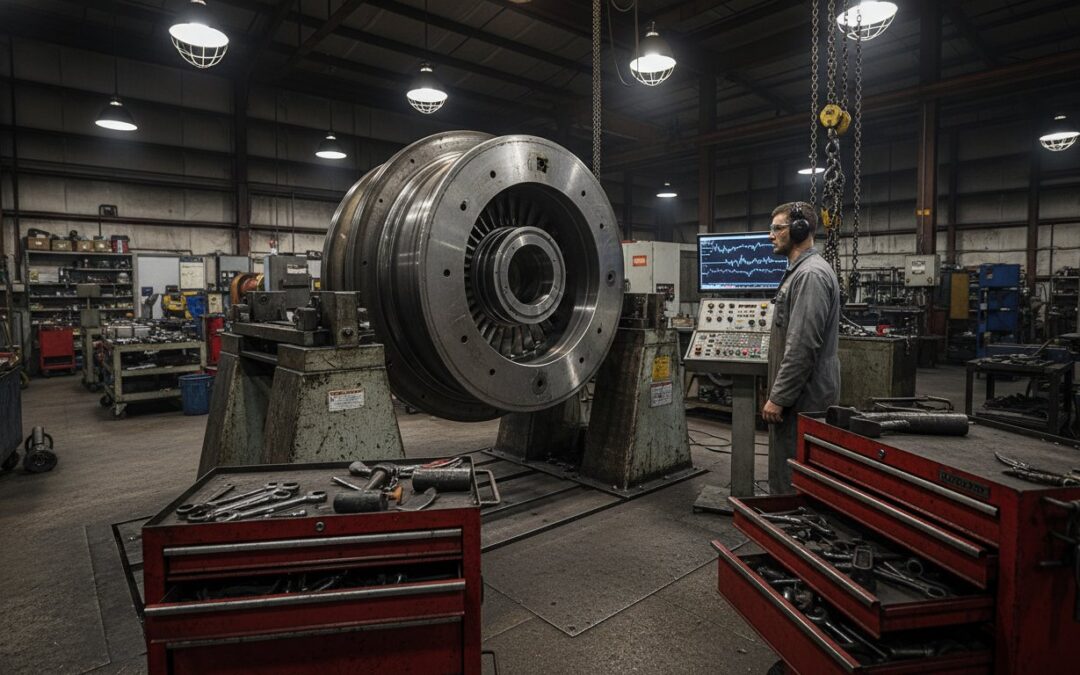
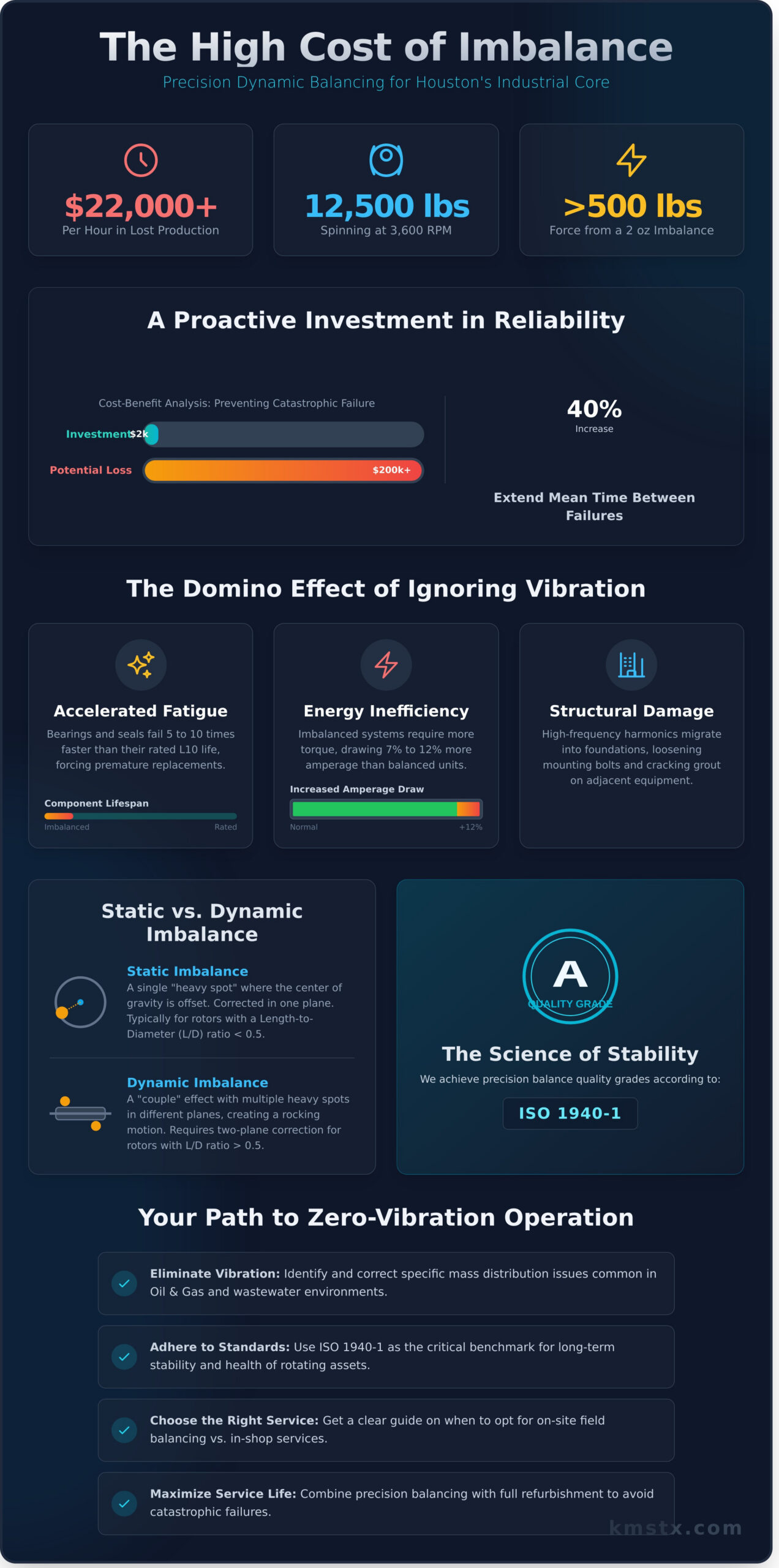
A single rotor weighing 12,500 lbs spinning at 3,600 RPM isn’t just a piece of machinery; it’s a financial liability that can cost your facility upwards of $22,000 per hour in lost production if its internal forces aren’t perfectly aligned. You’ve likely seen how even a minor imbalance in a heavy-duty turbine or industrial fan eventually shreds expensive bearings and forces a premature seal replacement. It’s a frustrating cycle of reactive maintenance that most teams struggle to break, especially when local shops lack the specialized stands for high-mass components. By utilizing precision dynamic balancing services Houston, you can eliminate these destructive harmonic frequencies before they trigger a catastrophic failure.
This guide demonstrates how expert balancing secures a zero-vibration operation and extends your Mean Time Between Failures (MTBF) by as much as 40%. You’ll discover the exact steps required to achieve compliance with ISO 1940-1 balance quality grades for assets exceeding 10,000 lbs. We’ll cover the diagnostic tools used in 2026 to ensure your rotating equipment runs smoother and lasts longer than originally specified by the OEM.
Key Takeaways
- Identify how specific mass distribution corrections can eliminate the vibration issues common in Houston’s demanding Oil & Gas and wastewater environments.
- See why adhering to ISO 1940-1 standards provides a critical benchmark for the long-term stability and health of your rotating assets.
- Get a clear guide on when to opt for on-site field balancing versus sending your equipment to professional dynamic balancing services Houston.
- Walk through the essential steps of a precision balance, including the mechanical checks on bearings and shafts that ensure a reliable fix.
- Learn how combining precision balancing with full gearbox and centrifuge refurbishment helps you avoid catastrophic failures and maximize service life.
Understanding Dynamic Balancing in the Houston Industrial Landscape
Dynamic balancing isn’t just a routine maintenance task; it’s a precision engineering requirement for any high-speed rotating component. At its core, the principles of dynamic balancing involve the correction of mass distribution within a rotor so that the centrifugal forces remain within acceptable ISO 21940-11 tolerances during operation. In the Houston industrial corridor, where 40% of the nation’s petrochemical capacity is concentrated, equipment like multi-stage centrifugal pumps, cooling tower fans, and high-speed turbines operates under extreme thermal and mechanical stress. When these components lose their balance, the resulting vibration doesn’t just rattle the floor. It systematically destroys the mechanical integrity of the entire machine train.
Facilities seeking dynamic balancing services Houston often deal with hardware that’s been pushed beyond its original design life. In the local Oil & Gas and wastewater sectors, a single imbalanced rotor can trigger a chain reaction of failures. For example, a 500 HP induction motor with an imbalance of just 2 ounces can generate over 500 pounds of centrifugal force when spinning at 3,600 RPM. This force translates directly into heat and friction. The economic reality is stark. A precision balancing job costing $2,000 can prevent a catastrophic failure that might result in $200,000 of repair costs and lost production. A refinery in the Houston Ship Channel recently documented that a single unplanned pump failure cost upwards of $18,500 per hour in lost throughput. Spending a few hours on a balancing stand is a small price to pay to avoid that level of exposure.
Static vs. Dynamic: Which Does Your Equipment Need?
Static imbalance is the simplest form of the problem. It occurs when the center of gravity is offset from the geometric axis of rotation, creating a “heavy spot” that will always fall to the bottom if the rotor is placed on frictionless rollers. This is typically corrected in a single plane. Dynamic imbalance is more complex. It involves a “couple” effect where two or more heavy spots are located in different planes and are often 180 degrees apart. This doesn’t show up when the rotor is at rest, but it creates a violent rocking motion at high speeds. Field technicians use the length-to-diameter (L/D) ratio to decide the method. If the rotor’s L/D ratio is less than 0.5, static balancing might suffice. If it’s greater than 0.5, two-plane dynamic balancing is required to ensure the equipment won’t tear itself apart at 3,600 RPM.
The Consequences of Ignoring Vibration
Ignoring a vibration increase as small as 0.15 inches-per-second (ips) leads to rapid, measurable degradation across the system. The damage isn’t always immediate, but it’s guaranteed. We see these three primary issues in the field every day:
- Accelerated Fatigue: Bearings and mechanical seals fail 5 to 10 times faster than their rated L10 life when subjected to constant imbalance forces.
- Energy Inefficiency: An imbalanced rotor requires more torque to maintain its velocity. Data shows that imbalanced systems can draw 7% to 12% more amperage than a balanced unit.
- Structural Damage: High-frequency harmonics don’t stay in the machine. They migrate into the concrete foundations and can loosen mounting bolts or crack grout on adjacent, healthy equipment.
Reliability engineers in Houston don’t have the luxury of “waiting and seeing.” With the humidity and high ambient temperatures found in Texas gulf coast plants, equipment already runs hot. Adding the friction of vibration to the mix is a recipe for a 2:00 AM emergency call. Utilizing professional dynamic balancing services Houston ensures that your rotating assets remain within the “Good” or “Smooth” operating ranges defined by the Vibration Severity Chart, protecting your bottom line and your crew’s safety.
The Science of Stability: ISO Standards and Vibration Analysis
Rotating equipment doesn’t just spin; it reacts to every gram of offset mass. At Kelsey Machine Services, we don’t guess at stability. We rely on ISO 1940-1. This international standard provides the mathematical framework for balance quality, allowing us to calculate the exact amount of mass that must be removed or added to reach a specific performance grade. It’s a common misconception that a rotor can be perfectly balanced. Physics doesn’t allow for zero residual imbalance. Instead, our dynamic balancing services Houston focus on achieving a precision state where vibration levels fall well within the tolerances required for long term mechanical integrity.
The reality of the shop floor is that every rotor has a “heavy spot.” Even a microscopic void in a casting or a slight variation in bolt torque creates an offset center of gravity. ISO 1940-1 acknowledges this by defining “permissible residual imbalance.” We typically aim for the lower 10% of the allowed tolerance range. This extra margin of safety accounts for thermal growth and operational loads that occur once the machine leaves our facility and returns to the field. By hitting these precise targets, we reduce the centrifugal forces that would otherwise destroy bearings and seals over time.
Decoding ISO 1940-1 G-Ratings
The “G” in G-rating stands for the grade of balance quality. It represents the product of the specific residual imbalance and the angular velocity of the rotor at its maximum operating speed. For most industrial applications, such as large centrifugal pumps or standard electric motors, a G6.3 rating is the benchmark. This level ensures that 92% of general machinery operates without premature bearing wear. When we provide dynamic balancing services Houston, we verify these ratings against the actual operating RPM of your specific unit.
When we move to high performance hardware, the requirements tighten significantly. A G2.5 rating is often mandatory for components like high speed turbines or centrifuges spinning at 10,000 RPM or higher. Selecting the wrong grade is a costly mistake. Aiming for G1.0 on a standard cooling tower fan is an over-engineered waste of resources; conversely, settling for G6.3 on a precision spindle will likely lead to a mechanical failure within 500 hours of operation. Our team helps you determine the correct rating based on your equipment’s frame size and service class.
Vibration Analysis: Finding the Root Cause
Balancing is only half the battle. You can’t fix a rotor if the problem is actually a bent shaft or a loose housing. We utilize 24-bit high resolution accelerometers to capture data across a wide frequency spectrum. By performing vibration analysis, we can isolate specific fault frequencies before we even start the balancing process. This diagnostic step ensures that we aren’t just treating a symptom of a deeper mechanical issue.
Our technicians use Fast Fourier Transform (FFT) analyzers to break down complex signals into individual components. This allows us to distinguish between a 1X frequency, which indicates imbalance, and a 2X or 3X frequency, which usually points to misalignment or mechanical looseness. Every job we complete includes a detailed report documenting the “Before” and “After” vibration signatures. This empirical evidence proves the 15% to 20% reduction in peak velocity that our process typically achieves. If your equipment is showing signs of increased resonance, you should schedule a diagnostic session to baseline your current performance levels before a small vibration becomes a total system shutdown.
Field Service vs. In-Shop Balancing: Making the Right Call
Deciding whether to balance a rotor in place or haul it to a specialized facility often depends on the ISO 21940-11 standards and the physical footprint of the asset. For many operators requiring dynamic balancing services Houston, the logistical hurdles of disassembly dictate the path forward. If you’re dealing with a 15 foot cooling tower fan or a fixed mount blower, pulling the unit might cause more downtime than the balance job itself. We’ve seen cases where a simple field correction saved a plant $12,000 in rigging costs alone.
Environmental conditions in East Texas play a massive role in data accuracy. Houston’s relative humidity levels frequently exceed 85% during the summer months, which can lead to moisture accumulation or “clinging” debris on fan blades. This added mass, even if it’s just 15 or 20 grams of particulate, can skew field readings by 12% to 18%. Our technicians account for these variables by performing thorough pre-balance cleanings and utilizing thermal imaging to ensure moisture isn’t trapped in hollow blade profiles before we ever place a sensor.
Shipping a rotor is a major commitment. When you’re managing a 24/7 industrial operation, the cost of an outage can range from $8,000 to $45,000 per hour. Field balancing typically wraps up in a single shift, usually 4 to 6 hours from setup to final run. However, if the shaft is scarred or the bearing journals show more than 0.002 inches of wear, a field fix is just a bandage. In those situations, moving the work to a controlled environment is the only way to ensure the asset survives the next fiscal quarter.
Specialized shop facilities in Kelsey Machine Services and Magnolia offer capabilities that portable kits can’t match. These locations utilize heavy duty hard bearing machines that handle rotors up to 25,000 lbs. Because these machines are decoupled from the plant’s floor vibrations, we can achieve a level of sensitivity that detects imbalances as small as 0.001 ounce-inches. This is critical for high speed equipment where even a 3 gram error can lead to a catastrophic bearing failure within 90 days of operation.
Production schedules often dictate the final choice. While dynamic balancing services Houston are available for rapid response, shop work requires a 48 to 72 hour window when you factor in transport and overhead crane availability. It’s a calculated trade-off between the absolute precision of a shop environment and the immediate mechanical availability provided by a field crew.
On-Site Field Balancing Services
Field work is the standard for cooling tower fans and large blowers where transport is impossible. It eliminates the $3,000 shipping fee and the risk of “brinelling” bearings during transit. Most importantly, it balances the machine within its own bearings and support structure. This approach accounts for the 10% of vibration caused by structural resonance that a shop balance would never detect.
Precision In-Shop Balancing
Critical components like multi-stage gearboxes or high speed centrifuge bowls require the sub-micron accuracy found at our Magnolia facility. We utilize machines with a 20,000+ lb capacity to isolate the rotor from external interference. This controlled setting is vital for assets spinning above 3,600 RPM, where we can guarantee a G1.0 balance grade that is physically impossible to achieve on a plant floor.
The Precision Balancing Process for Heavy Industrial Rotors
Precision isn’t just a buzzword in a machine shop; it’s a mechanical necessity for the longevity of your equipment. When a 5,000-pound turbine component or a high-speed fan arrives for dynamic balancing services Houston, the process starts with a rigorous physical audit. Technicians examine bearing journals for taper or out-of-roundness exceeding 0.0005 inches. We inspect keyways for wallowing and shafts for runout using calibrated dial indicators. If the mechanical foundation is compromised, no amount of weight correction will stabilize the system during operation.
Once the rotor is secured on the balancing machine, an initial vibration run establishes the baseline. This step captures the current amplitude and phase angle at specific operating speeds, often 1,800 or 3,600 RPM. Reliable dynamic balancing services Houston providers rely on these baseline runs to distinguish between actual mass unbalance and external factors like structural resonance or loose foundations. This data tells us exactly how the mass center deviates from the geometric center before any changes are made.
We then apply a known trial weight at a specific angular position. By measuring the system’s response to this known change, we calculate the rotor’s sensitivity. We use vector calculus and specialized software to determine the exact magnitude and location of the required correction. Every gram matters when you’re aiming for ISO G2.5 tolerances. A final verification run ensures the residual imbalance falls below the calculated limit, often reducing vibration levels by 90% or more compared to the intake state.
Step-by-Step Execution
Cleaning the rotor is the first non-negotiable step. A mere 2 ounces of dried process buildup on a 48-inch fan impeller can create hundreds of pounds of centrifugal force at 1,750 RPM. After debris removal, we calculate the correction using software-assisted placement to avoid “hunting” the balance. Permanent correction methods depend on the rotor’s application. We typically use welding for heavy structural components like pump impellers, while precision drilling or bolting weights is preferred for high-speed machined components to maintain aerodynamic integrity and material strength.
Reporting and Documentation
Your final balance report serves as a technical birth certificate for the repaired asset. It shouldn’t just be a “pass” or “fail” sticker. A comprehensive report includes the initial and final unbalance amounts, expressed in gram-inches or ounce-inches. We track residual imbalance and phase angles to ensure the rotor won’t excite resonance frequencies during startup. These 12-page reports provide a 100% verifiable trail of equipment health. Facility managers use these documents for their preventive maintenance (PM) records to track asset degradation over time and satisfy insurance or ISO 21940-11 audit requirements.
If your machinery is showing signs of excessive vibration, don’t wait for a catastrophic bearing failure. Learn more about our precision balancing capabilities and how we can extend the life of your industrial assets.
Why Houston Chooses Kelsey Machine Services for Rotating Equipment
Kelsey Machine Services began serving the Texas Gulf Coast in 1982. Over those 42 years, we’ve built a reputation for handling the most complex rotating equipment challenges in the region. We aren’t just a shop that runs a balancing machine; we’re a team that understands the high-stakes environment of refineries and chemical plants. When a critical blower or turbine fails at 2:00 AM on a Tuesday, waiting until Monday morning isn’t an option. That’s why we maintain a 24/7 emergency response protocol. We’ve seen how a 0.05 in/sec vibration can escalate into a catastrophic failure within hours. Our goal is to return equipment to OEM specifications, backed by a full warranty on all labor and parts.
Beyond Balancing: A Full-Service Machine Shop
Precision balancing is often the final step in a much larger repair cycle. If we find that a rotor is out of tolerance due to a worn bearing fit or a bent shaft, we don’t have to outsource the fix. Our facility provides comprehensive Centrifuge Repair and industrial Gearbox Refurbishment under one roof. We handle specialized tasks like shaft sleeving and custom bushing fabrication using high-grade 4140 or 4340 steel alloys. By keeping these processes internal, we maintain total control over the mechanical tolerances. This integrated approach ensures that the dynamic balancing services Houston operators rely on are supported by sound mechanical foundations. We’ve found that 85% of balancing issues actually stem from underlying structural or component wear that a standard “balance-only” shop might miss. We use thermal spray and grinding to restore surfaces to within 0.0005 inches before the final balance is even attempted.
Stafford and Magnolia: Serving the Greater Houston Area
Our footprint includes strategic facilities in Stafford and Magnolia. This dual-location setup allows us to deploy field technicians to any site in the Greater Houston area within 90 minutes. These shops are equipped with heavy-duty overhead crane capacities reaching up to 50 tons. This means we can handle the massive decanter centrifuges and multi-stage pumps common in the local energy sector without logistical bottlenecks. We also maintain a $2 million inventory of critical spare parts to avoid the typical 12-week lead times found elsewhere. Having direct access to precision bearings, seals, and specialized gaskets means your equipment gets back into production faster. We don’t just provide a service; we act as a technical partner for your maintenance team. Reliability is built on experience, and after four decades in the Houston dirt, we’ve learned exactly what it takes to keep the Gulf Coast rotating. Our dynamic balancing services Houston team is ready to respond whenever your vibration levels exceed safe operating limits.
Securing Long-Term Reliability for Your Rotating Equipment
Maintaining heavy industrial rotors requires more than just a quick fix; it demands a technical approach rooted in precision and 45 years of Gulf Coast industrial experience. By adhering to ISO 21940-11 standards and utilizing advanced vibration analysis, you’re not just fixing a shake, you’re extending the operational life of your most expensive assets. Whether you require on-site field corrections or complex in-shop repairs, selecting the right partner for dynamic balancing services Houston remains the most effective way to prevent catastrophic failure in 2026.
Kelsey Machine Services ensures your equipment meets exact tolerances before it ever spins back up. Every job we complete includes full ISO-compliant documentation, providing a clear data trail for your maintenance records. If an unexpected vibration threatens your production schedule, our team provides 24/7 emergency support to get your facility back online without delay. When critical equipment failures occur, having access to emergency machine repair Gulf Coast specialists who understand complex gearbox tolerances and high-load cycles can mean the difference between a quick fix and a catastrophic shutdown. Don’t leave your machine health to chance when specialized expertise is a phone call away. Request an Expert Balancing Quote Today and keep your operations running smooth.
Frequently Asked Questions
How much does dynamic balancing cost in Houston?
Pricing for dynamic balancing services Houston depends on the rotor’s mass and the required ISO tolerance grade. For a standard pump impeller weighing under 50 pounds, you’ll typically see costs ranging from $350 to $600. Large industrial rotors exceeding 5,000 pounds or those requiring specialized fixtures often command prices between $2,200 and $4,500 per unit.
Can you balance a centrifuge bowl without removing it from the site?
Yes, field balancing is a standard procedure for heavy centrifuge bowls using portable vibration analyzers. Technicians perform a two-plane balance while the equipment remains in its own bearings, which accounts for the entire rotating assembly’s dynamics. This process typically reduces vibration levels by 85% and eliminates the 72-hour downtime associated with transporting the bowl to a shop.
What is the difference between static and dynamic balancing?
Static balancing corrects the heavy spot on a single plane while the part is stationary, which is often sufficient for thin discs like narrow pulleys. Dynamic balancing happens while the part rotates at operational speeds, identifying centrifugal force imbalances across multiple planes. Industry data shows that 92% of high-speed industrial rotors require dynamic correction to prevent bearing failure caused by couple unbalance.
How often should industrial rotating equipment be balanced?
Critical machinery should undergo a vibration analysis every 6 months, with a full balance check performed at least once every 2 years. If you’ve replaced a component like a seal or a bearing, you need to re-verify the balance immediately. A 10% increase in unbalance can decrease bearing life by 15%, so staying on a strict 12-month preventive maintenance schedule is a smart move for your equipment’s longevity.
What ISO balance grade does my gearbox require?
Most industrial gearboxes and high-speed pumps require an ISO 21940-11 grade of G2.5 for smooth operation. General machinery like large fans or standard electric motors usually operates reliably at a G6.3 grade. If your equipment runs at speeds exceeding 3,600 RPM, aiming for a G1.0 grade is often necessary to prevent long-term structural fatigue in the casing.
Does dynamic balancing fix vibration caused by misalignment?
No, dynamic balancing only corrects mass distribution issues within the rotor itself. While unbalance and misalignment both cause vibration, they’re different mechanical problems with different solutions. However, many vibration issues initially attributed to unbalanced rotating equipment are actually caused by structural resonance or soft foot conditions. Statistics from field repairs indicate that 45% of vibration issues are actually caused by shaft misalignment, which requires laser alignment tools rather than weight correction to resolve.
How long does a typical in-shop balancing job take?
A standard in-shop job usually takes between 24 and 48 hours from the time the rotor arrives at the facility. If the part requires significant pre-machining or custom mounting mandrels, the timeline might extend to 4 or 5 business days. Most Houston shops offer 12-hour emergency turnarounds for critical path equipment that’s causing an unplanned plant outage.
What information do I need to provide for a balancing quote?
You’ll need to provide the rotor’s total weight, the maximum operating RPM, and the shaft dimensions for mounting. Mentioning the current vibration readings in inches per second helps the shop determine the initial state of the equipment. Providing the specific ISO grade requirement ensures the quote reflects the precision level your application demands for dynamic balancing services Houston.