
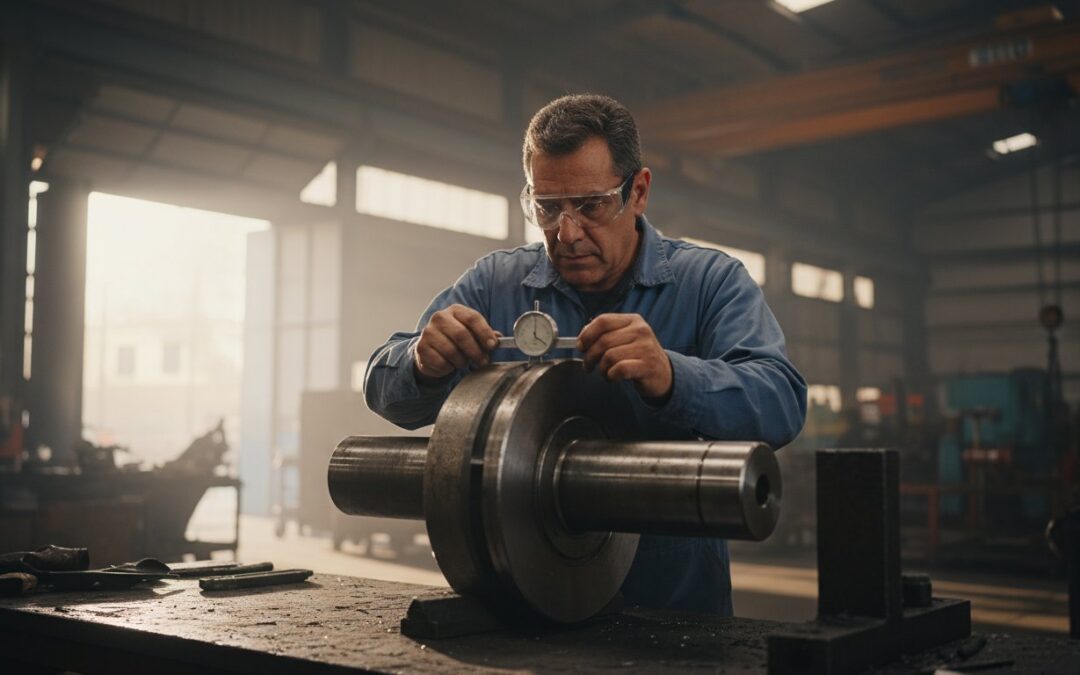
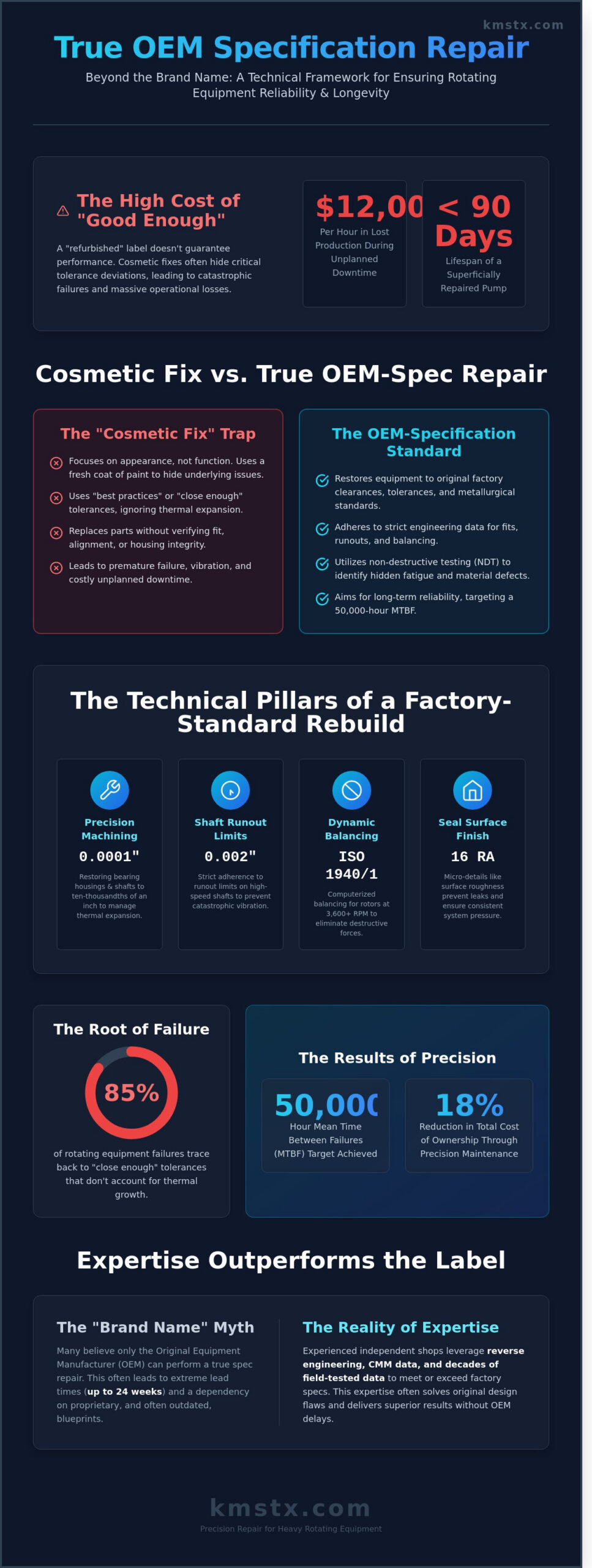
A brand-new box from the factory doesn’t guarantee your rotating equipment will hit its 50,000-hour mean time between failures target. Most plant managers have experienced the frustration of a “refurbished” pump failing just 90 days after installation because the shop’s definition of quality was purely cosmetic. True oem specification repair isn’t about the logo on the shipping crate. It’s about strict adherence to original engineering tolerances, such as a 0.002-inch runout limit on a high-speed shaft. You already know that cutting corners on the front end leads to catastrophic vibration and unplanned downtime. This can cost upwards of $12,000 per hour in lost production.
In this guide, we’ll strip away the vague marketing jargon and provide a technical framework for evaluating repair standards. You’ll learn exactly what it takes to restore heavy equipment to factory-standard rebuild levels to ensure your machinery operates at peak efficiency. We’ll examine the specific metrics that facilitate reliability and help you optimize your total cost of ownership by 18% through precision maintenance and verified technical tolerances.
Key Takeaways
- Learn why a true oem specification repair is defined by restoring original factory clearances and metallurgical standards, not just using a brand-name box.
- Identify the technical benchmarks, like ISO 1940/1 balancing and precision machining to ten-thousandths, that separate a quick fix from a reliable restoration.
- Navigate the “brand-name” myth to understand when proprietary parts are essential and when specialized engineering can deliver factory-standard results faster.
- Explore the rigorous inspection process, including documented teardowns and non-destructive testing, used to catch hidden fatigue before it causes a catastrophic failure.
- Discover how deep application knowledge and independent expertise can often outperform OEM lead times without sacrificing precision or performance.
Defining OEM Specification Repair for Heavy Rotating Equipment
In the world of heavy rotating machinery, an oem specification repair isn’t just a basic fix. It’s a rigorous process of returning a piece of equipment to its original factory-intended clearances, tolerances, and metallurgical standards. When a Original Equipment Manufacturer (OEM) designs a turbine or a high-speed pump, they calculate every dimension down to the micron to ensure stability under thermal expansion. A standard repair might replace a worn bearing, but an OEM-spec repair ensures that the bearing fit, housing bore, and shaft runout all align with the technical manuals and service bulletins issued during the machine’s initial build.
To better understand how these standards impact the longevity of your machinery, watch this helpful video:
Achieving this level of precision requires deep access to technical data. While some shops rely on “best practices,” true oem specification repair utilizes specific baseline data points from refurbishment manuals. This is vital because high-speed equipment often operates at 3,600 RPM or higher. At these speeds, even a 0.005-inch deviation in a seal gap can cause turbulent flow, leading to localized heating and eventual catastrophic failure. You don’t necessarily need an OEM-certified badge on the door to hit these marks. Experienced independent shops often utilize precise reverse engineering machine parts and 30 years of field data to meet or even exceed the original factory benchmarks.
The Performance Baseline: What Are We Measuring?
We focus on the critical fit and finish of bearings and seals. For instance, maintaining a 0.002-inch clearance on a journal bearing is non-negotiable for proper oil film thickness. If the design intent for fluid dynamics or heat dissipation is ignored, the machine will suffer from premature vibration. In 85% of rotating equipment failures, the root cause traces back to “close enough” tolerances that didn’t account for the 200-degree thermal growth seen during peak operation.
Proprietary vs. Public Domain Specifications
Independent shops have shifted toward utilizing open standards and decades of accumulated field data. This movement aligns with the broader “Right to Repair” trend in industrial maintenance. While proprietary blueprints are valuable, field-tested modifications often solve design flaws that the original factory missed. In 2023, many facilities found that utilizing high-quality digital scans and CMM data allowed them to rebuild equipment to 100% factory specs without the 24-week lead times often associated with factory-only service centers.
The Technical Pillars of Factory-Standard Refurbishment
Precision machining isn’t just about making parts fit; it’s about restoring the exact clearances that allow for thermal expansion during heavy operation. Restoring a bearing housing or a shaft to within 0.0001 inches ensures that the assembly doesn’t bind when it reaches operating temperatures exceeding 200 degrees Fahrenheit. If these tolerances are missed by even a fraction, the lubrication film breaks down, often leading to a catastrophic seizure within the first 50 hours of service. This level of accuracy is the baseline for a successful oem specification repair.
Beyond the visible dimensions, “invisible” specs like seal surface finishes and lubrication path clearances dictate the asset’s lifespan. A seal surface with a Roughness Average (RA) of 16 provides a significantly different wear profile than a standard 32 RA finish. These micro-details prevent fluid bypass and ensure that pressure remains consistent across the entire system. When handling complex OEM refurbishment and repair projects, ignoring these subtle requirements usually results in premature leaks and unplanned downtime.
Dynamic Balancing and Vibration Analysis
High-speed rotors spinning at 3,600 RPM or higher generate massive centrifugal forces. We use computerized balancing stands to hit the ISO 1940/1 standards required by the original manufacturer. Achieving a G2.5 rating means the residual unbalance is low enough to prevent the harmonic resonance that destroys bearings and seals. Post-repair vibration testing serves as the final validation. If the velocity readings stay below 0.1 inches per second during a full-load test, it confirms the oem specification repair was executed correctly. Professionals looking to stabilize their high-speed assets should evaluate their current vibration profiles against these factory benchmarks.
Metallurgy and Component Fabrication
The wrong alloy choice can be a death sentence for equipment in corrosive environments. Using a standard 316 stainless steel when the spec calls for a proprietary Duplex alloy can result in stress corrosion cracking in less than 180 days. Our process focuses on three metallurgical priorities:
- Material Matching: Verifying chemical compositions to ensure the replacement part handles the same chemical and thermal loads as the original.
- Heat Treatment: Utilizing induction hardening to a depth of 0.050 inches on high-wear surfaces to maintain surface integrity.
- Custom Fabrication: Using 5-axis CNC machining to replicate the complex geometry of obsolete impellers or gears that are no longer stocked by the factory.
By maintaining these strict metallurgical standards, the refurbished component often matches the 20-year fatigue life expected of a brand-new part. This technical rigor ensures the equipment returns to the field ready for another full service cycle without the risk of material failure.
OEM vs. Aftermarket: Navigating the Parts and Procedures Debate
The industry often operates under a misconception that a repair only meets standards if the parts arrive in a branded box. This de-facto ban on non-branded components ignores the reality of modern manufacturing. High-quality results depend on meeting the actual engineering requirements; the logo on the packaging is secondary. While an oem specification repair remains the baseline for critical tolerances, specialized shops frequently replicate or exceed these metrics using the same Tier 1 suppliers that the original equipment manufacturers utilize.
OEM parts remain vital for components featuring patented internal geometries or proprietary alloy blends. If a pump impeller has a specific vane curvature protected by a patent, an aftermarket copy might fail to move fluid at the 5,000 GPM rate the system requires. In these instances, the risk of cavitation or mechanical failure outweighs any upfront savings. Evaluating the total cost of ownership requires looking beyond the invoice to the 15% to 20% increase in energy costs that an inefficient, non-standard part can cause over a 10,000-hour service interval.
Evaluating Component Sourcing
Identifying Tier 1 suppliers serves as the primary safeguard for reliability. Many OEMs outsource production to specialized foundries. If you source a bearing directly from an ISO 9001:2015 certified supplier like SKF or Timken, you’re getting the same metallurgical integrity as the factory part. Avoid “will-fit” components that lack a Material Test Report (MTR). Without an MTR, there’s no way to verify if a bolt is Grade 8 or a brittle imitation. Verification should include a 100% dimensional inspection against the original housing to ensure a proper interference fit.
The Hybrid Approach to Reliability
A hybrid strategy often yields the best total cost of ownership. You can utilize an oem specification repair for the core assembly while upgrading wear surfaces with modern materials. For example, adding tungsten carbide tiling to a conveyor screw can extend its service life by 300% compared to the original factory carbon steel. Many factory specs were written over 10 years ago. A specialized shop can integrate 2024-era metallurgy to solve recurring vibration or heat issues that the original design didn’t account for, ensuring critical infrastructure uptime during peak production cycles.
The Step-by-Step Process of an OEM-Level Overhaul
An overhaul isn’t just a parts swap; it’s a forensic investigation. When a component enters the shop, the process starts with a documented teardown. We map the failure before a single bolt is cleaned. Technicians record “as-found” conditions, looking for 0.002-inch deviations that signal deeper structural issues. This data is vital for a successful oem specification repair because it establishes the baseline for all subsequent machining and engineering decisions.
We utilize Non-Destructive Testing (NDT) to find hidden fatigue that visual inspections miss. This process includes several specialized steps:
- Dye Penetrant: This highlights surface-level stress fractures in housings and non-ferrous parts.
- Magnetic Particle Inspection: We use this to detect subsurface defects in rotating elements like shafts and gears.
- Engineering Review: Our team compares every measurement against the original master specification to confirm the component still meets the design intent.
Inspection and Failure Analysis
The teardown phase is the most critical part of the entire repair. We don’t just look at what broke. We identify the root cause. If a bearing failed due to stray electrical current or lubrication starvation, simply replacing it ensures a repeat failure within 6 months. By using dye penetrant and magnetic particle inspection, we find microscopic defects before they lead to catastrophic field failures. This forensic approach prevents the “parts-changer” mentality that plagues lower-tier shops.
Testing and Quality Assurance
Before shipping to the field, every machine undergoes a rigorous shop-test or “dry run.” We record final run-outs and monitor bearing temperatures to ensure they stay below a 160-degree Fahrenheit threshold. This data creates a “birth certificate” for the repaired machine. It provides a baseline for your maintenance team to track future performance and vibration levels over the next 5 to 10 years of service.
Precision reassembly utilizes specialized tooling and press-fits to guarantee alignment that exceeds standard field repairs. This methodical approach is the only way to achieve a true oem specification repair that provides long-term reliability. If you want to ensure your critical assets meet original factory standards, explore our technical repair services.
Why Precision Expertise Outperforms a Brand Name Label
An OEM label provides a sense of security, but it doesn’t always guarantee the best outcome for a specific operating environment. Many factory service centers focus on volume and standard replacement, which often misses the nuances of how a centrifuge or pump performs under the intense heat and humidity of the Gulf Coast. A specialized shop prioritizes the application over the part number. We analyze wear patterns and tolerances to ensure every oem specification repair addresses the root cause of failure rather than just the symptoms.
Lead times represent the most significant gap between factory service and independent expertise. While an OEM might quote a 24-week lead time for a standard gearbox rebuild, an independent specialist can often complete the same scope in 6 to 8 weeks. For critical operations where downtime costs can exceed $40,000 per day, that 16-week difference directly impacts the bottom line. Reliability requires more than a brand name; it requires 24/7 support and a partner who answers the phone when a critical component fails at 3:00 AM.
Warranty terms are the ultimate indicator of a shop’s confidence. We don’t just match the standard 12-month factory warranty. In many cases, our precision machining and assembly allow us to offer an 18-month warranty on major overhauls, providing a level of protection that exceeds the original manufacturer’s terms.
The Kelsey Machine Services Advantage
With over 42 years of experience, we’ve refined the process of restoring centrifuges, gearboxes, and pumps to peak operational status. Our facilities in Stafford and Magnolia utilize dynamic balancing and precision machining to bridge the gap between a “standard repair” and true “OEM excellence.” We understand that 85% of rotating equipment failures stem from improper balancing or alignment, so we hold our tolerances to levels that often surpass the original factory requirements.
Ready for a Reliability Upgrade?
Don’t let 20-week lead times or recurring downtime dictate your production schedule. It’s time to plan your next overhaul with experts who prioritize your uptime. Contact us for a technical consultation on your rotating equipment to see how we can extend your mean time between failures. Request a Quote for OEM Specification Repair to get started today.
Protecting Your Operational Lifecycle with Precision Engineering
Restoring heavy rotating equipment requires more than a standard patch job; it demands a return to the original design tolerances that keep your plant running. An oem specification repair isn’t just a luxury, it’s a technical necessity for avoiding the recurring vibration and heat issues that lead to catastrophic failure. At Kelsey Machine Services, we’ve backed our work with over 40 years of hands-on industrial expertise, ensuring that every overhaul meets or exceeds factory standards. We don’t just swap parts. Our team utilizes full precision machining and dynamic balancing to ensure your assets operate with the same reliability they had on day one.
Reliability doesn’t punch a clock, which is why we provide 24/7 emergency field service support to handle critical issues as they arise. Whether you’re managing a planned turnaround or an unexpected breakdown, our shop’s capabilities are designed to minimize your downtime and maximize equipment longevity. It’s about getting the job done right so you don’t have to do it twice. Get an Expert Quote on Your Equipment Repair today and let’s keep your operations moving forward.
Frequently Asked Questions
Does using an independent shop for OEM specification repair void my warranty?
No, utilizing an independent facility for an oem specification repair doesn’t legally void your warranty under the Magnuson-Moss Warranty Act of 1975. Manufacturers can’t require you to use their proprietary services to maintain a warranty unless they provide those parts or services for free. We ensure all tolerances match the original 0.001-inch requirements to maintain equipment integrity. You’ll keep your coverage as long as the work meets the documented engineering standards.
How do you verify that a repair truly meets OEM specifications?
We verify repairs using calibrated precision instruments like FaroArms or micrometers that measure within 0.0001 inches. Every critical dimension is compared against the original manufacturer’s technical data sheets. If a bearing fit calls for a 0.002-inch interference, we document that specific measurement during the 100 percent inspection phase. This data-driven approach ensures the component functions exactly as the original designers intended before it leaves our shop.
Can an independent shop improve upon the original OEM design?
Yes, independent shops often identify recurring failure points that the original manufacturer overlooked during initial production. We can upgrade material grades, such as swapping 4140 steel for 17-4 PH stainless to increase corrosion resistance by 40 percent. By analyzing wear patterns from your specific site environment, we modify seal configurations or surface coatings. These engineering adjustments often extend the mean time between failures by 18 to 24 months.
What is the difference between “refurbished” and “repaired to OEM specs”?
Refurbishing usually involves cleaning and replacing 20 percent of the most visible worn parts to make a unit functional. An oem specification repair is a total restoration where every single component is measured against its original factory tolerance. We don’t just fix what’s broken. We ensure the entire assembly meets 100 percent of the factory-new standards. This process eliminates the 15 percent performance loss often seen in basic refurbished units.
Why is dynamic balancing so important for rotating equipment repair?
Dynamic balancing is critical because a 2-ounce imbalance at 3,600 RPM generates over 500 pounds of centrifugal force. This force destroys bearings 5 times faster than normal operation. We balance rotating assemblies to ISO 21940-11 G1.0 standards to ensure smooth running. Reducing vibration levels below 0.05 inches per second significantly extends the life of your seals and internal gears, preventing 2024 budget overruns from premature failures.
What documentation should I expect after an OEM-level overhaul?
You should receive a comprehensive 15-page data package following any major overhaul. This includes 100 percent of the “as-found” and “as-left” dimensional measurements, material test reports for new components, and final dynamic balance certificates. We also provide NDT reports, such as dye penetrant or magnetic particle inspection results. This documentation acts as a vital baseline for your next 5 years of preventative maintenance and reliability tracking.
How does Kelsey Machine Services handle obsolete equipment with no available OEM data?
When OEM data is missing for 30-year-old machines, we use coordinate measuring machines to reverse engineer machine parts. We perform 3D laser scanning to capture geometry within 0.005 millimeters. Our team also conducts spectrographic analysis to identify the exact alloy composition of the original casting. This allows us to manufacture a replacement that matches or exceeds the 1990s-era performance specifications without needing the original blueprints from the manufacturer.
What are the typical lead times for an industrial gearbox or centrifuge repair?
Typical turnaround for a standard industrial gearbox repair ranges from 14 to 21 days. If we’re handling a complex centrifuge that requires custom gear cutting or specialized heat treating, lead times move closer to 8 or 10 weeks. We provide a firm schedule within 48 hours of the initial teardown and inspection. This transparency helps you manage your maintenance schedule and minimizes the cost of unplanned facility downtime.