
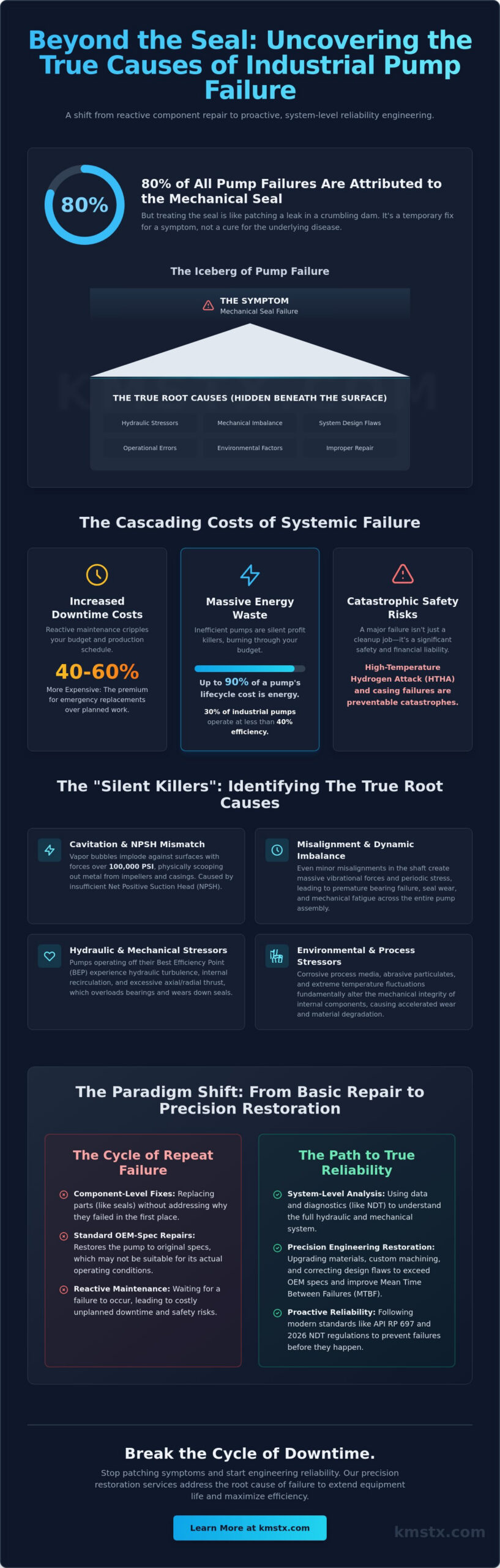
When 80% of all pump failures are attributed to mechanical seal issues, it’s easy to assume the seal itself is the problem. However, treating the seal is usually just masking the deeper, systemic causes of industrial pump failure that lead to repeat downtime. With emergency replacements costing 40% to 60% more than planned work in 2026, you can’t afford to keep patching symptoms. You’ve likely noticed that standard OEM repairs often fail to improve your Mean Time Between Failures (MTBF), especially when 30% of industrial pumps are currently running at an efficiency of less than 40%.
This guide moves beyond the surface to identify the physics of failure and explain how precision engineering restoration prevents these recurrent cycles. You’ll learn how to apply the new API RP 697 standards for pump repair and utilize 2026 NDT regulations to identify issues like High Temperature Hydrogen Attack before they cause a catastrophe. We will walk through the transition from component level fixes to system level efficiency, helping you reduce energy costs that can account for 90% of your equipment’s total lifecycle expense.
Key Takeaways
- Move beyond basic part replacement by understanding how hydraulic and mechanical stressors interact to shorten your equipment’s lifespan.
- Identify the true causes of industrial pump failure by analyzing the physics of vapor bubble formation and axial play in mechanical seals.
- Learn to detect “silent killers” like internal dynamic imbalance and shaft misalignment before they lead to catastrophic component failure.
- Establish a data-driven troubleshooting baseline to help your team spot the early warning signs of hydraulic turbulence and mechanical fatigue.
- Explore why precision engineering restoration and custom machining often provide better long-term reliability than standard OEM-spec repairs.
The Physics of Premature Industrial Pump Failure
In a high-stakes industrial environment, we often define failure as a pump that simply won’t turn. For an engineer or a maintenance lead, that definition is too narrow. True failure is any deviation from the optimal hydraulic and mechanical parameters the system was designed to maintain. When a pump drifts off its performance curve, it isn’t just a technical glitch; it’s a precursor to a breakdown. Understanding the underlying causes of industrial pump failure requires looking at the pump as a precision instrument rather than just a piece of iron. Whether it’s a shift in head pressure or a slight increase in vibration, these deviations signal that the physics of the system are working against you.
Most causes of industrial pump failure are rooted in how the equipment interacts with its environment. When we analyze common Centrifugal pump problems, we see that environmental stressors like extreme temperature fluctuations, corrosive process media, and abrasive particulates don’t just cause wear; they fundamentally alter the mechanical integrity of the internal components. If you’re constantly “repairing to run” by swapping out seals without addressing these stressors, you’re essentially subsidizing a cycle of repeat downtime. Precision restoration is about correcting the root imbalance so the pump can survive its specific operating conditions.
To better understand this concept, watch this helpful video:
The Hidden Cost of Unplanned Downtime
The economic impact of a low Mean Time Between Failures (MTBF) is staggering. Beyond the immediate repair bill, you’re looking at lost production capacity and safety risks. A catastrophic seal or casing failure isn’t just a mess; it’s a liability. Energy efficiency degradation is another silent profit killer. Since energy costs can account for as much as 90% of a pump’s total lifecycle cost, a pump running at poor efficiency is burning through your budget long before it actually seizes. In 2026, with energy prices and regulatory pressures mounting, operating a pump at less than 40% efficiency is no longer sustainable.
Reliability Engineering and Failure Mode Analysis
Moving from reactive maintenance to precision reliability engineering involves using empirical data to spot degradation patterns. We don’t guess; we measure. This is where modern diagnostics come in. For example, the new 2026 regulations for Non-Destructive Testing (NDT) now require enhanced screening for High-Temperature Hydrogen Attack (HTHA) in certain high-pressure systems. By utilizing NDT and historical operational data, we can identify internal component fatigue before it leads to a total system blowout. This shift toward a scientific failure analysis allows for technical refurbishments that actually extend the life of the machine beyond its original OEM expectations.
Hydraulic and Mechanical Stressors: The Science of Wear
Wear isn’t a mystery; it’s a measurable physical process. While we know mechanical seals account for 80% of causes of industrial pump failure, the seal is often just the first component to yield under hydraulic stress. If your process fluid chemistry changes or your suction pressure drops, the pump’s internals are subjected to forces they weren’t machined to handle. Identifying these mechanical stressors is key to diagnosing the causes of industrial pump failure before they result in a total plant shutdown.
Cavitation and Net Positive Suction Head (NPSH)
Cavitation is the rapid formation and collapse of vapor bubbles that creates localized shockwaves. It’s not just noise. When these bubbles implode against the impeller surface, they exert pressures exceeding 100,000 PSI. This micro-jetting literally scoops out chunks of metal, leading to the pitted look you’ve likely seen during teardowns. You’ve got to maintain a healthy margin between Net Positive Suction Head Available (NPSHa) and Net Positive Suction Head Required (NPSHr). If NPSHa drops too low, you’re essentially turning your pump into a rock crusher. Internal recirculation and discharge cavitation are often the results of running too far to the left or right of the Best Efficiency Point (BEP).
Tribology and Lubrication Failure
Bearings don’t just go bad. They fail when the lubricant film thickness, which should be between 0.1 and 1.0 micrometers, is compromised. Moisture is the most common thief here. Even 0.01% water contamination in your oil can reduce bearing life by nearly 50%. When that film breaks down, you move from hydrodynamic lubrication to metal-on-metal contact. That’s when rolling element wear accelerates toward a catastrophic seizure. Signs of lubricant oxidation or thermal breakdown, like darkening oil or a burnt smell, mean the pump is already in trouble.
Mechanical seals are incredibly sensitive to axial play and temperature spikes. If your shaft has more than 0.002 inches of end play, the seal faces can’t maintain their critical flat mating. This leads to the premature leakage that plagues so many plants. If you’re seeing repeat seal failures, it’s worth looking into precision engineering restoration to correct the underlying shaft runout instead of just swapping parts. Finally, consider fluid chemistry. Abrasive particulates in the flow act like a sandblaster on the impeller vanes, and when combined with corrosive media, the structural integrity of your rotating components can vanish in weeks.
Misalignment and Dynamic Imbalance: The Silent Killers
While seal leaks and bearing noises are easy to spot, misalignment and dynamic imbalance are the underlying causes of industrial pump failure that usually go undetected until it’s too late. These issues are often lumped together, but they’re different mechanical problems. Misalignment is a geometric issue where the centerlines of the pump and motor shafts don’t meet. Dynamic imbalance, on the other hand, is an internal mass distribution problem within the rotating assembly itself. Both generate excessive vibration that hammers your bearings and seals into early retirement.
The physics of centrifugal force explains why these issues are so destructive. Centrifugal force increases with the square of the rotational speed. If you’ve got an impeller that’s slightly out of balance and running at 3,600 RPM, it’s generating four times the destructive force of a pump running at 1,800 RPM. We use vibration analysis to tell them apart. A high 1x peak in the frequency spectrum usually indicates imbalance. If we see a 2x peak, we’re likely looking at misalignment. Structural resonance and “soft foot” also play a role. If one of your pump’s feet doesn’t sit flat on the baseplate, tightening the bolt twists the casing, which ruins your internal clearances before you even hit the start button.
Precision Dynamic Balancing for Pump Longevity
Every time you refurbish an impeller or replace a shaft, dynamic balancing is non-negotiable. ISO 21940-11 standards (which replaced the old ISO 1940-1) define the balance quality grades required for industrial equipment. For high-speed assets, we typically aim for a G2.5 or even a G1.0 grade to ensure smooth operation. Utilizing precision dynamic balancing services is the only way to mitigate the mechanical stress that leads to repeat failures. It’s about making sure the mass center of the rotating assembly perfectly matches the geometric center of the shaft.
Laser Alignment and Couplings
The days of relying on a straightedge or a dial indicator are mostly behind us. Dial indicators are prone to “bar sag” and human calculation errors that can lead to missed tolerances. Modern laser alignment systems provide the sub-thousandth accuracy needed for today’s high-efficiency systems. You also have to account for thermal growth. A pump handling fluid at 300°F is going to expand significantly as it reaches operating temperature. If you don’t calculate that growth and offset your cold alignment accordingly, you’ll be out of spec the moment the system gets hot. While flexible couplings can handle a tiny bit of movement, they aren’t a substitute for precision alignment. They’re meant to protect the equipment, not mask a poor installation job.
A Technical Framework for Industrial Pump Troubleshooting
Methodical troubleshooting is the difference between a permanent fix and a recurring headache. You’ve likely seen “parts changers” who simply swap a seal and walk away, only to have the pump back on the bench three weeks later. To truly address the causes of industrial pump failure, you need a framework that treats the equipment as a dynamic system. It starts with establishing a baseline. If you don’t know what the pump looked like when it was healthy, you can’t accurately judge its current state of decay. We look at historical trends in flow rates and discharge pressure to spot the gradual onset of internal wear before it triggers a vibration alarm.
Visual and auditory inspections still have their place, but they’re just the starting point. Detecting the early signs of hydraulic turbulence or high-frequency sounds that mimic “pumping gravel” can tip you off to the cavitation issues we discussed earlier. For a deeper look, we utilize advanced diagnostics like ultrasonic leak detection to find seal bypass issues and thermographic imaging to map heat distribution across bearing housings. In many cases, a bearing running just 20°F above its baseline is an early warning of lubricant oxidation or improper fit that will eventually lead to seizure.
Step-by-Step Failure Analysis Process
A reliable failure analysis follows a strict three-phase sequence to ensure no evidence is destroyed during the repair process:
- Phase 1: External Data Collection. Before the pump is pulled, we record vibration signatures, temperature gradients, and flow rates. This “live” data is critical because once the pump is apart, the operating context is lost.
- Phase 2: Full Mechanical Teardown. This involves a component-level inspection where we measure every critical dimension. We’re looking for evidence of shaft runout, housing out-of-roundness, and wear ring clearances that have opened up beyond spec.
- Phase 3: Root Cause Identification. We use metallurgical and mechanical evidence to connect the dots. A blue-tinted shaft tells a story of heat, while specific erosion patterns on an impeller point to suction-side issues.
Verifying OEM Specifications
Don’t assume that just because a part is “standard” it’s right for your specific application. We often find that current clearances have drifted far from original design tolerances, or that the OEM spec itself includes design flaws like inadequate stiffening or poor material choice for corrosive media. Integrating a rigorous program of rotating equipment maintenance ensures you’re not just restoring a pump to a mediocre baseline, but improving its long-term stability. If you’re ready to stop the cycle of repeat repairs and unplanned downtime, contact our engineering team to perform a comprehensive failure analysis on your most problematic assets.
Engineering Restoration: Beyond Basic Pump Repair
When you’re dealing with recurring causes of industrial pump failure, buying a brand-new unit isn’t always the smartest move. With 2026 MSRPs for industrial equipment rising by up to 5% across major manufacturers, refurbishment isn’t just a budget-friendly alternative; it’s often a technical upgrade. An off-the-shelf OEM pump is designed for a generic performance curve. In contrast, engineering restoration allows us to modify the unit for your specific fluid chemistry and pressure requirements. We aren’t just replacing a worn impeller; we’re often upgrading to superior alloys or specialized seal materials that the original manufacturer skipped to keep their production costs down.
True restoration requires correcting the physical geometry of the pump. If your housing is out-of-round or your shaft has excessive runout, a new seal will fail within weeks regardless of how clean your oil is. We use precision machining to bring these components back to within 0.001 of an inch of their ideal specs. This process involves dynamic testing and balancing post-reassembly to verify that the internal forces are neutralized. It’s the final step in ensuring that the pump doesn’t just run, but runs reliably for years rather than months. By the time the pump leaves the shop, it should outperform its original “new” condition in both efficiency and MTBF.
The Role of Custom Machining in Restoration
Basic repair shops usually just swap parts, but a restoration mindset focuses on structural integrity. If a shaft is pitted or worn, we don’t just toss it. We can often fabricate oversized sleeves or specialized bushings to restore the proper fit. This approach requires a deep inventory of industrial machine spare parts and the ability to machine them to exact tolerances. We prioritize concentricity and perpendicularity in every machined surface; if the seal face isn’t perfectly square to the shaft, you’re going to have leaks. Custom machining allows us to correct these factory-level design flaws and adapt the pump to handle the abrasive particulates or corrosive media in your specific process.
When to Call for Emergency Technical Support
Not every failure can wait for a scheduled turnaround. If you’re facing a total system shutdown or a safety-critical seal breach, you need emergency machine repair that goes beyond a quick fix. Critical infrastructure downtime can cost thousands of dollars per hour, making 24/7 field service a necessity rather than a luxury. The goal of emergency support isn’t just to get the fluid moving again; it’s to stabilize the asset so you can transition into a long-term reliability partnership. By identifying the systemic causes of industrial pump failure during the emergency response, we can plan the eventual engineering restoration that ends the cycle of reactive maintenance for good.
Moving Beyond Component Swaps to Systemic Reliability
Solving the persistent causes of industrial pump failure requires more than a simple seal change; it demands a shift toward precision engineering restoration. We’ve seen that when you address underlying hydraulic stressors and dynamic imbalances, you can significantly extend your Mean Time Between Failures (MTBF) and reduce the energy costs that typically make up 90% of a pump’s total lifecycle expense. By utilizing modern standards like API RP 697 and 2026 NDT regulations, your facility can move from a reactive “repair to run” cycle to a proactive reliability model.
With 40+ years of heavy rotating equipment expertise, our team doesn’t just patch symptoms. We perform a full engineering teardown and inspection as a standard on every project, utilizing proprietary dynamic balancing and precision machining to restore your assets to better-than-new condition. It’s about finding the physics-based root cause so you can stop seeing the same pump back in the shop every few months. If you’re ready to stabilize your most critical systems, Request a Technical Failure Analysis for Your Industrial Pumps today. You’ve got the tools and the data to turn your maintenance department into a reliability powerhouse.
Frequently Asked Questions
What are the primary indicators that an industrial pump is nearing failure?
Increased vibration, elevated bearing temperatures, and noticeable deviations from the pump’s performance curve are the most reliable indicators of trouble. Specifically, a 10% drop in discharge head or a 15% increase in power consumption without a change in process parameters suggests internal wear. Monitoring these metrics allows you to catch issues before they turn into the catastrophic causes of industrial pump failure that halt production.
How does cavitation actually damage a stainless steel impeller?
Cavitation destroys stainless steel through the rapid implosion of vapor bubbles that create localized micro-jets with pressures exceeding 100,000 PSI. These shockwaves hit the impeller surface with enough force to fatigue the metal at a molecular level. Over time, the surface develops a characteristic pitted or “sponge-like” appearance as chunks of the alloy are literally blasted away by the collapsing bubbles.
Is it better to repair an old industrial pump or buy a new one?
Repairing is often the superior choice when you opt for precision restoration, especially since 2026 MSRPs for new units have increased by 1% to 5%. A standard new pump is built to generic factory tolerances. By choosing a technical refurbishment, you can upgrade components with superior alloys and correct OEM design flaws, often resulting in a pump that’s more reliable than the original unit.
What is the most common cause of mechanical seal failure in high-pressure pumps?
Excessive axial play and shaft runout are the leading causes of industrial pump failure when it comes to mechanical seals. If the shaft moves more than 0.002 inches axially, the seal faces can’t stay flat against each other. This creates a gap that allows high-pressure fluid to escape, which quickly erodes the seal faces and leads to a total breach of the containment system.
How often should dynamic balancing be performed on industrial pump rotors?
You should perform dynamic balancing during every major overhaul or whenever you replace an impeller or shaft. Following ISO 21940-11 G2.5 standards ensures that the mass center of the rotating assembly aligns with the shaft’s geometric center. Skipping this step allows centrifugal forces to hammer your bearings, which can reduce their service life by as much as 50% depending on the RPM.
Can vibration analysis predict exactly when a pump will fail?
Vibration analysis can’t give you a specific date and time, but it can identify failure patterns up to three weeks in advance. By analyzing specific frequency peaks like 1x or 2x, technicians can distinguish between a bent shaft and a failing bearing. This early warning window gives you enough time to transition from a reactive emergency to a planned, lower-cost maintenance event.
What role does shaft misalignment play in bearing failure?
Misalignment forces the bearing’s rolling elements to run at an angle, which creates a parasitic load the component wasn’t designed to support. This extra stress thins the lubricant film, which should ideally be between 0.1 and 1.0 micrometers thick. Once that film breaks down, you get metal-on-metal contact that generates heat and leads to the rapid fatigue and eventual seizure of the bearing.
How do I determine the root cause of repeated pump clogging?
Repeated clogging is usually a sign that the impeller design doesn’t match the actual percentage of solids in your process fluid. You need to perform a teardown and compare the “as-found” solids size against the pump’s original clearance specifications. If your process has changed and now carries larger particulates, you’ll likely need to upgrade to a vortex or non-clog impeller to maintain flow.