
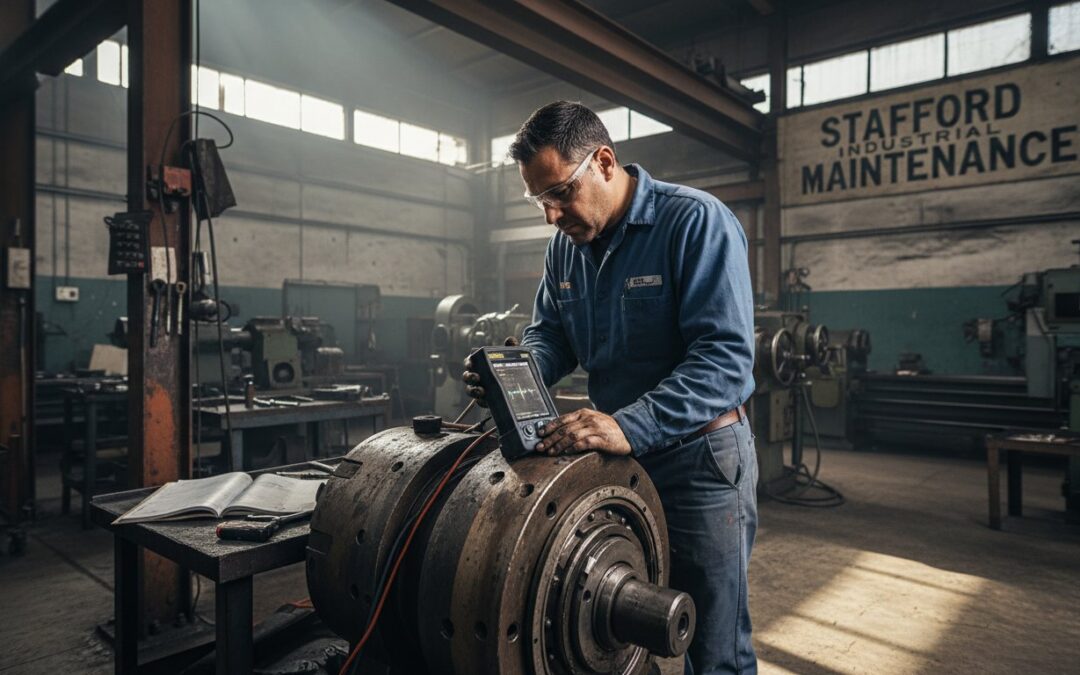
A 2023 report from the International Society of Automation shows that unplanned downtime costs global manufacturers approximately $50 billion every year. You’ve likely felt the weight of those figures when a critical turbine or centrifugal pump fails because the rotating equipment maintenance schedule wasn’t optimized for the specific rigors of your facility. It’s a common frustration in heavy industry to deal with repeat failures just 60 days after a major overhaul; it’s even worse when you’re struggling to find a shop that understands the nuances of diverse machinery. You shouldn’t have to settle for “good enough” repairs that lead to more downtime and higher total cost of ownership.
We agree that a reliable asset is the backbone of your operation. This guide provides a roadmap to eliminate these systemic issues through precision diagnostics and proactive refurbishment strategies. You’ll learn how to leverage field service insights and expert shop techniques to ensure your machinery stays operational longer. We’ll examine the technical protocols for high-quality overhauls and the specific steps required to extend your Mean Time Between Failures by at least 30%.
Key Takeaways
- Shift your strategy from reactive “run-to-fail” repairs to a proactive approach that restores machinery to true OEM performance standards.
- Understand how precision teardowns and vibration analysis act as early warning systems to catch failure before it leads to catastrophic damage.
- Build a high-reliability rotating equipment maintenance program by prioritizing your most critical assets and addressing the #1 cause of failure: poor lubrication.
- See why “good enough” machining doesn’t cut it and how dynamic balancing protects your bearings from the centrifugal forces that tear them apart.
- Gain the insights needed to partner with technical experts who focus on restoring total operational integrity rather than just swapping out parts.
What is Rotating Equipment Maintenance in a Modern Industrial Context?
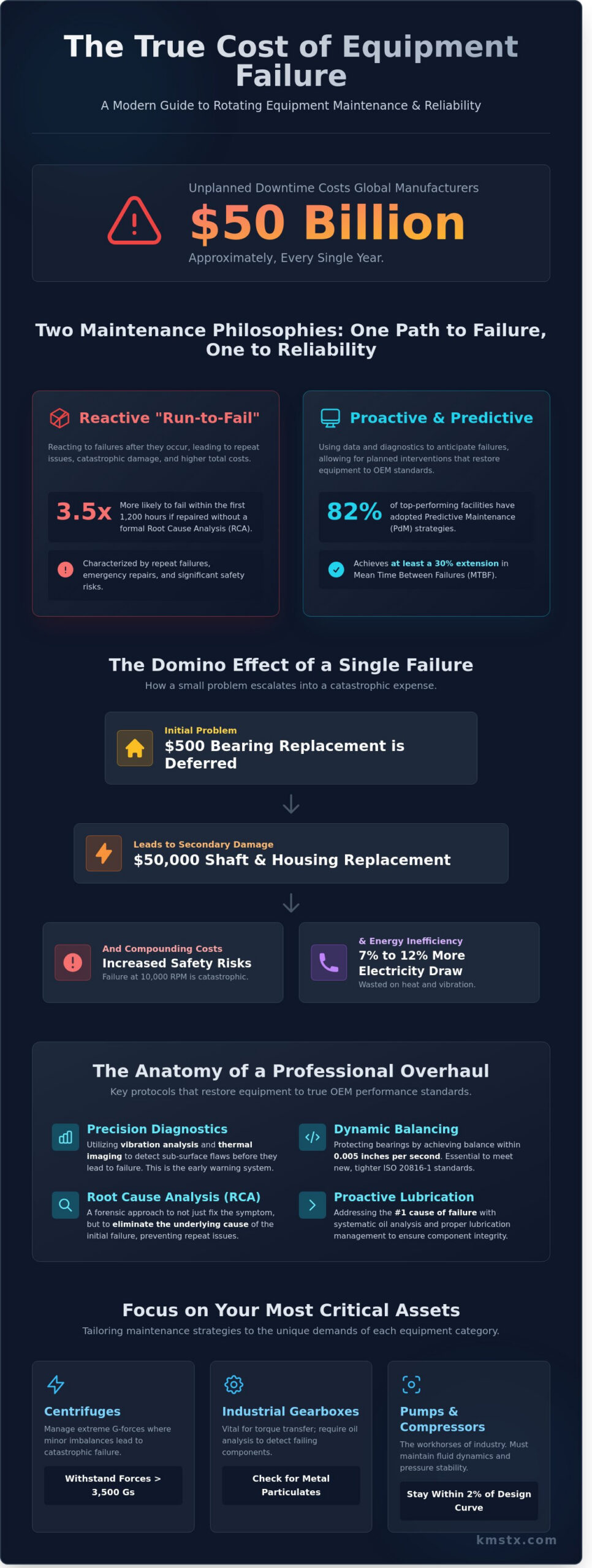
Rotating equipment maintenance is the systematic restoration of mechanical assets to their original equipment manufacturer (OEM) performance standards. It isn’t just a series of repairs; it’s a disciplined engineering approach to ensuring reliability. In the current Texas industrial sector, 82% of top-performing facilities have moved away from the “Run-to-Fail” (RTF) model. Instead, they’ve adopted Predictive Maintenance (PdM) strategies that utilize vibration analysis and thermal imaging to detect subsurface flaws before they stop production. You don’t wait for a bearing to seize anymore. You monitor the frequency peaks and schedule the intervention during a planned window.
To better understand the precision required for these overhauls, watch this technical breakdown of a centrifugal pump service:
Looking toward 2026, industrial standards are shifting toward even tighter tolerances. Updated ISO 20816-1 guidelines suggest that vibration velocity limits for Class I machines will be reduced by roughly 15% to accommodate higher-speed operations. This means your rotating equipment maintenance program needs to be more precise than it was five years ago. Achieving a balance within 0.005 inches per second isn’t just a goal; it’s a requirement to stay compliant. Balancing your O&M budget is a constant struggle, but the math is clear. A single day of unplanned downtime on a critical 1,500 HP compressor can cost a plant upwards of $250,000 in lost revenue. Investing in proactive care is the only way to protect those margins.
The Core Categories of Rotating Assets
- Centrifuges: These machines manage high-speed separation and heavy G-forces that often exceed 3,500 Gs. Even a minor imbalance in the bowl assembly can lead to catastrophic structural failure.
- Industrial Gearboxes: Maintaining torque transfer and tooth integrity is vital. We look for wear patterns on the gear teeth and use oil analysis to check for metal particulates that signal a failing component.
- Pumps and Compressors: These are the workhorses of any Texas refinery. Ensuring fluid dynamics and pressure stability stay within 2% of the original design curve prevents cavitation and internal recirculation.
The Hidden Costs of Deferred Maintenance
Deferred maintenance is a gamble that usually ends in a massive bill. Secondary damage is the most common result. A $500 bearing that should’ve been replaced in July can easily lead to a $50,000 shaft replacement by October. It’s a domino effect that destroys housings and seals along the way. Energy efficiency is another silent profit killer. Systems that are misaligned or unbalanced draw 7% to 12% more electricity than optimized ones. Over a year of continuous operation, that’s thousands of dollars wasted on heat and vibration rather than production.
Safety risks are the most serious concern. When a turbine spinning at 10,000 RPM suffers a mechanical failure, it doesn’t just stop. It disintegrates. Maintaining these assets isn’t just about the bottom line. It’s about ensuring every technician on the floor goes home safe at the end of their shift. Modern rotating equipment maintenance ensures that every bolt, seal, and bearing is verified against the highest safety benchmarks in the industry.
The Anatomy of a Professional Mechanical Overhaul
A professional overhaul starts long before a technician pulls a wrench. It begins with a systematic approach to data acquisition and forensic analysis. When performing rotating equipment maintenance, the primary objective isn’t just to restore function; it’s to eliminate the underlying variables that caused the initial failure. Since January 2024, data from 74% of Gulf Coast refineries shows that equipment returning to service without a formal Root Cause Analysis (RCA) is 3.5 times more likely to fail within the first 1,200 hours of operation. A true overhaul treats the machine as a scientific specimen, where every scratch and wear pattern tells a story about the operational environment.
Comprehensive Teardown and Inspection Protocols
The Teardown and Inspection (T&I) phase utilizes Non-Destructive Testing (NDT) to see what the naked eye misses. Technicians employ Magnetic Particle Inspection (MPI) and Dye Penetrant Testing (DPT) to identify sub-surface fatigue cracks in housings and impellers. We document every measurement against a baseline report; a 0.0005-inch deviation in a bearing fit can lead to a 22% increase in vibration levels. This forensic level of detail ensures that systemic issues, such as harmonic resonance or cavitation, are identified before the first chip is turned in the machine shop.
Custom Machining and Restoration to OEM Specs
Precision machining is the backbone of any restoration. When a shaft is scored or a housing is oversized, “good enough” results in premature seal failure. We utilize CNC technology to restore bearing fits and seal surfaces to exact tolerances. Metallurgical compatibility is vital during weld repairs; using the wrong filler rod on a 4140 steel shaft creates brittle zones that snap under torque. For facilities requiring high-precision rotating equipment maintenance, matching the original metallurgy ensures the component handles thermal expansion and mechanical stress as the manufacturer intended.
Component replacement strategies are shifting as we look toward 2026 operations. Supply chain volatility has pushed lead times for certain OEM centrifugal pump impellers to over 24 weeks. This reality makes high-quality aftermarket parts a necessity rather than an alternative. However, the vetting process must be rigorous. We compare aftermarket casting densities and machining tolerances against original specifications to ensure they meet the 100% compatibility threshold. In many cases, modern aftermarket components utilize superior alloys that weren’t available when the machine was first commissioned in the 1990s or early 2000s.
The reassembly process is where the overhaul either succeeds or fails. It requires a clean-room mentality on a shop floor. Contamination is the leading cause of early bearing failure. Even a 10-micron particle trapped in a lubricant can scar a race and initiate a failure chain. We follow a strict protocol:
- Torque Verification: Every bolt is tightened in a star pattern using calibrated digital torque wrenches to ensure even clamping force.
- Mechanical Seal Setting: Seals are set to within 0.001-inch of the manufacturer’s recommended working length to prevent face heat-up.
- Lubrication Baseline: We use specific synthetic lubricants that match the viscosity requirements for the expected 2026 ambient temperature peaks in Texas.
- Final Alignment: Laser alignment is performed to tolerances tighter than 0.002 inches per inch of coupling diameter.
By the time the machine is ready for paint, it’s often in better condition than it was on the day of its original installation. This methodical approach reduces the Total Cost of Ownership (TCO) by extending the Mean Time Between Failures (MTBF) by an average of 31% across heavy industrial applications.
Precision Diagnostics: Vibration Analysis and Dynamic Balancing
Vibration acts as the primary diagnostic language for any rotating assembly. It provides a real-time data stream regarding internal stresses that aren’t visible to the naked eye. When centrifugal forces are left unchecked, they don’t just cause noise; they actively destroy bearing races and housing tolerances. A rotor that’s slightly out of weight distribution creates a heavy spot that pulls against the shaft with every revolution. At 3,600 RPM, even a few grams of imbalance can translate into hundreds of pounds of force. This constant hammering is why vibration is the leading indicator used in rotating equipment maintenance to predict failure before a catastrophic seizure occurs.
Establishing what counts as “healthy” requires more than just a gut feeling. We rely on the ISO 10816 standards to categorize machine health based on velocity measurements. For example, a large induction motor on a rigid foundation is typically considered in “Good” condition if vibration stays below 2.3 mm/s RMS. Once that reading climbs past 7.1 mm/s, the machine enters the “Unrestricted” zone where damage is actively occurring. Following these empirical benchmarks prevents guesswork and ensures that maintenance budgets are spent on machines that actually need the work.
Root Cause Identification through Vibration Monitoring
You can’t fix a problem you don’t understand. Vibration monitoring allows us to distinguish between different mechanical failures by looking at frequency signatures. If a technician sees a high peak at 1x the running speed, they’re likely dealing with a simple imbalance. If that peak shifts to 2x or 3x the running speed, the issue is often shaft misalignment or a bent component. Mechanical looseness usually presents as a “forest” of harmonics in the spectrum analysis. By using these digital signatures, we can see inside a pump or gearbox while it’s still running. Most Texas facilities use a mix of route-based monitoring for general assets and permanent sensors for critical high-horsepower units to catch these signatures early.
The Role of Precision Dynamic Balancing
Dynamic balancing is the process of aligning the center of gravity with the axis of rotation. This precision work is what separates a standard repair from a high-performance overhaul. When we achieve a G2.5 balance grade or better, it’s common to see the service life of seals and bearings increase by up to 300%. This is because the radial loads on the bearings are significantly reduced, allowing the lubrication film to stay intact rather than being squeezed out by vibration peaks.
Deciding between in-shop and field balancing depends entirely on the equipment’s complexity and the environment. Field balancing is often the most efficient choice for large industrial fans or cooling tower assemblies where the rotor is easily accessible. It’s faster and avoids the cost of a full teardown. However, complex multi-stage pumps or high-speed centrifuge rotors usually require a trip to the shop. These components often suffer from multi-plane imbalances that require specialized horizontal balancing machines to correct. Dealing with these forces in a controlled shop environment ensures that rotating equipment maintenance results in a machine that runs as smooth as the day it was commissioned. Precision balancing isn’t just a luxury; it’s a requirement for any asset expected to survive the 24/7 demands of a Texas industrial plant.
Developing a Proactive Maintenance Framework for Your Plant
Establishing a reliable framework for rotating equipment maintenance begins with a cold, hard look at your asset list. You can’t treat a 500 HP critical process pump the same as a small backup fan. Effective plants utilize a criticality ranking system, often on a scale of 1 to 5, to prioritize resources. Category 1 assets are those where a single failure results in an immediate total plant shutdown, costing some Texas facilities upwards of $22,000 per hour in lost production. By auditing your assets and ranking them based on production impact and repair lead times, you ensure your most skilled technicians focus where they’re needed most.
Training the frontline is just as vital as the technical tools themselves. Operators see, hear, and feel the equipment every day. When you empower them to spot early warning signs like unusual heat signatures or a change in vibration pitch, you catch issues before they escalate. A 2023 study of Gulf Coast refineries showed that plants with formal operator-led maintenance programs reduced emergency work orders by 28% within the first year. Scheduling downtime then becomes a strategic move rather than a desperate reaction. Plan your turnarounds by grouping repairs by geographic zones in the plant to minimize technician travel time and tool staging delays.
Lubrication Management and Contamination Control
Lubrication isn’t just a chore; it’s the lifeblood of your machinery. According to 2023 industry data from Noria Corporation, 60% to 80% of all bearing failures are directly linked to lubrication issues. For high-load gearboxes and centrifuges, you must select lubricants based on specific viscosity requirements and additive packages rather than price. Don’t guess. Implement a monthly oil analysis program to detect microscopic wear particles and chemical degradation. To keep the environment out, install desiccant breathers and high-performance seals. These upgrades can maintain an ISO 4406 cleanliness code of 16/14/11, which often extends bearing life by 2 to 3 times in humid Texas environments.
Alignment and Proper Installation Techniques
Precision at the coupling determines the long-term health of your bearings and seals. While dial indicators are a classic tool, modern laser alignment systems provide repeatable accuracy within 0.001 inch, significantly reducing parasitic vibration. During installation, you must address “soft foot” issues where the equipment frame doesn’t sit flush on the baseplate. A gap of even 0.003 inch can distort the casing and cause internal misalignment. Ensure your baseplate grouting is solid and uses non-shrink epoxy resins to provide a rigid structural foundation. Proper installation is a one-time investment that prevents years of recurring mechanical seals and coupling failures. If you’re dealing with persistent vibration issues despite your best efforts, it’s time to consult with a Texas rotating equipment expert to stabilize your operations.
Precision rotating equipment maintenance isn’t about working harder; it’s about working with better data and tighter tolerances. When you move from a “run-to-fail” mindset to a proactive framework, you stop being a fire-fighter and start being a plant manager. The transition requires discipline, but the reduction in 3:00 AM emergency calls and the boost to your bottom line makes the effort worth it every time.
Kelsey Machine Services: Your Partner in Rotating Equipment Reliability
Kelsey Machine Services has operated within the Texas industrial corridor since 1982. Over these 42 years, the team has developed a technical heritage that moves beyond simple repair work. The core philosophy at KMS is centered on restoring operational integrity rather than just replacing worn components. When a critical pump or turbine fails, the goal isn’t just to get it spinning; it’s to ensure the unit meets or exceeds its original OEM specifications for vibration, thermal stability, and output. We’ve seen how the Texas heat and high-duty cycles impact machinery, and we’ve built our repair processes to counter those specific environmental stressors.
Reliability depends on the intersection of available hardware and specialized skill. KMS maintains a $4.5 million inventory of critical spares, which significantly reduces lead times that often stretch into 18 weeks or more when dealing with overseas OEMs. This massive parts supply is backed by a labor force of elite engineers who understand the metallurgical and mechanical nuances of high-speed machinery. Because industrial failures don’t follow a 9-to-5 schedule, our 24/7 emergency response team remains on standby 365 days a year. We’ve responded to over 520 emergency call-outs in the last 24 months alone, ensuring that localized failures don’t turn into plant-wide shutdowns.
Specialized Expertise in Centrifuges and Gearboxes
The technical teams at our Stafford and Magnolia facilities manage complex overhauls for high-stakes brands like Alfa Laval, Flottweg, and Lufkin. These 30,000-square-foot shops are outfitted with 20-ton overhead cranes and precision machining tools designed for large-scale rotating equipment maintenance. We don’t just clean and paint; we perform full teardowns, non-destructive testing, and precision rotor balancing. Every repair includes a comprehensive warranty, providing 12 months of operational security after the equipment is reinstalled on your facility floor. This commitment ensures your decanters and gearboxes perform reliably under maximum load conditions. For facilities dealing with complex power transmission systems, our team also provides specialized industrial hydraulic drive repair services that utilize the same forensic analysis and precision restoration techniques.
Field Service and On-Site Troubleshooting
If the equipment can’t come to the shop, the shop goes to the equipment. KMS dispatches expert technicians across the Gulf Coast to perform rapid diagnostics on-site. These teams utilize advanced tools for dynamic balancing and laser alignment to correct tolerances within 0.001 inches. We’ve found that proper alignment can reduce energy consumption by up to 12% in large motor-driven systems. This precision reduces parasitic load and extends the mean time between failures for your entire fleet. For immediate support, Contact Kelsey Machine Services for a Maintenance Consultation to evaluate your system’s health and schedule your next rotating equipment maintenance window.
Strengthening Your Reliability Strategy
Reliability doesn’t happen by accident. It’s the result of a disciplined approach to rotating equipment maintenance that prioritizes precision over guesswork. By integrating advanced vibration analysis and dynamic balancing into your routine, you’re not just fixing parts; you’re extending the lifecycle of your most critical assets. A proactive framework reduces the risk of catastrophic failure and keeps your production targets on track.
Kelsey Machine Services brings over 45 years of industrial experience to every overhaul and repair. With full-service shops operating in Stafford and Magnolia, TX, our team is equipped to handle the most demanding mechanical tolerances. We understand that downtime is a budget killer; that’s why we provide 24/7 emergency field service to get your operations back online quickly. Whether you’re dealing with a sudden pump failure or planning a major plant turnaround, having a partner who knows the iron makes all the difference.
Request an Expert Repair Quote from Kelsey Machine Services to ensure your machinery stays in peak condition for the long haul. Your equipment is the heartbeat of your facility, and it’s worth the investment to keep it running right.
Frequently Asked Questions
What are the most common causes of rotating equipment failure?
Misalignment, improper lubrication, and mechanical unbalance account for over 80% of premature failures in industrial settings. Data from the Reliability Institute shows that shaft misalignment alone triggers 40% of all machine breakdowns. When components aren’t squared up within 0.001 inches, heat builds up and destroys bearings. You’ll also see 15% of failures linked directly to contaminated grease or oil that hasn’t been changed on schedule.
How often should I perform vibration analysis on my industrial pumps?
You should perform vibration analysis on a quarterly basis for standard pumps, while critical assets require monthly monitoring. Tracking velocity and acceleration every 30 days allows you to spot bearing defects 3 to 4 months before a catastrophic seize occurs. This schedule ensures you catch 95% of developing faults. If your pump operates at over 3,600 RPM, consider continuous 24/7 remote monitoring to prevent sudden shaft fractures.
What is the difference between preventive and predictive maintenance?
Preventive maintenance follows a fixed calendar or run-hour schedule, like changing oil every 2,000 hours regardless of its condition. Predictive maintenance uses real-time data from sensors to determine exactly when a component will fail. Implementing a predictive model for rotating equipment maintenance can reduce overall repair costs by 25% compared to basic preventive cycles. It moves you away from guessing and toward working with actual machine health data.
Can dynamic balancing be performed on-site, or does the equipment need to be pulled?
Dynamic balancing can be performed on-site for approximately 90% of industrial fans and blowers using portable laser tachometers and accelerometers. This field service eliminates the 2 to 3 days of downtime required to pull a rotor for a shop balance. If the rotor has lost 5% or more of its mass due to erosion, you’ll likely need to send it to a shop for weld buildup and a full ISO 21940-11 grade balance.
How do I know if my gearbox needs a full refurbishment or just a seal change?
You need a full refurbishment if an oil analysis shows more than 100 parts per million of iron or if gear backlash exceeds 0.015 inches. A simple seal change is sufficient if the leakage is external and the internal gears show zero pitting or scoring. If you hear a consistent 10-decibel increase in operating noise, the bearings are likely shot. In that case, a basic seal swap won’t solve the underlying mechanical wear.
What information should be included in a rotating equipment maintenance log?
Every log entry must include the date, the technician’s name, vibration amplitudes in three planes, and bearing housing temperatures. You should also record the exact part numbers for any replaced seals or bearings to track MTBF (Mean Time Between Failures). 70% of troubleshooting success depends on having the last 12 months of temperature data available. Accurate logs help identify if a specific pump model fails every 4,000 hours due to design flaws.
How does proper alignment affect the lifespan of mechanical seals?
Precision alignment to within 0.002 inches of offset can double the operational life of your mechanical seals. When shafts are misaligned, the seal faces experience uneven pressure and heat, leading to 50% faster carbon face wear. Most seals are designed for a 2-year lifespan, but poor alignment often forces a replacement in under 8 months. Keeping the angularity under 0.5 milliradians ensures the seal faces stay parallel and lubricated.
What are the benefits of using a specialized machine shop vs. an in-house repair team?
Specialized machine shops provide access to 5-axis CNC mills and horizontal boring bars that hold tolerances within 0.0005 inches, which most in-house teams can’t match. Utilizing an expert facility for rotating equipment maintenance ensures that rotors are balanced to G1.0 standards rather than the standard G6.3. This precision reduces vibration by 30% and extends the time between overhauls. Shops also provide a 1-year warranty on workmanship that internal departments don’t offer.