
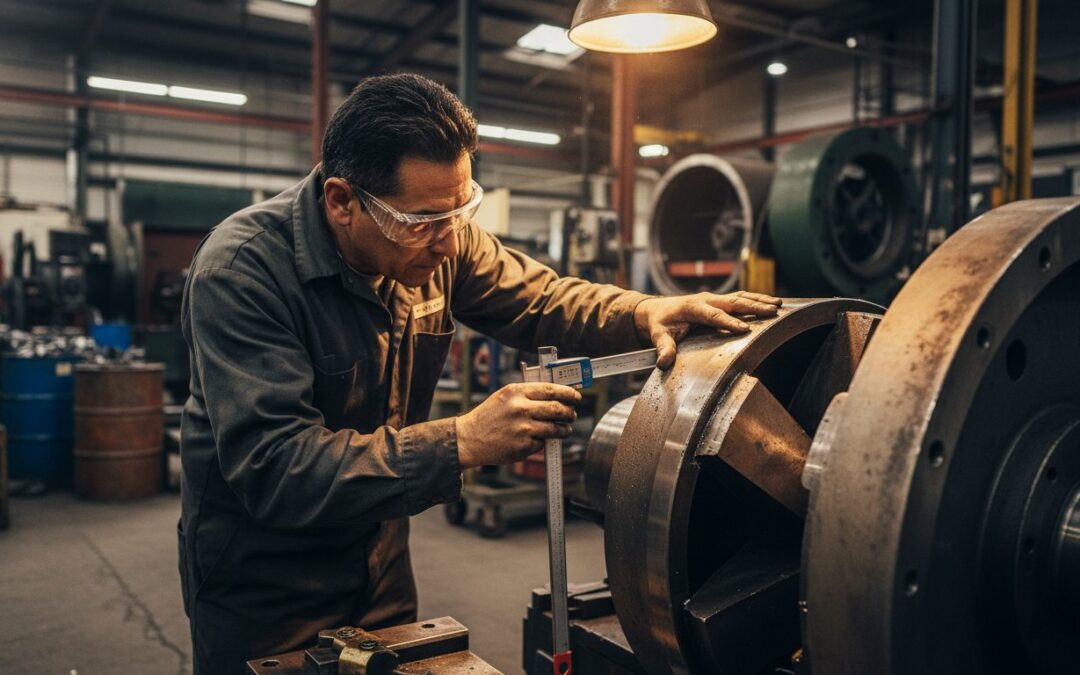
Most maintenance managers believe a blower repair is successful if the unit spins back up on the test stand, but that metric ignores the fact that 40% of rotating equipment failures occur within the first 90 days of redeployment. You know that a patch job isn’t a solution when a single hour of unplanned downtime in a pneumatic conveying system can cost upwards of $12,500 in lost throughput. Selecting the right industrial blower repair company requires looking past the paint job to evaluate the technical rigors of their shop floor. It’s frustrating to pull the same unit twice in six months because the tolerances weren’t met or obsolete parts were swapped for near-fits that didn’t hold up under load.
This guide provides a technical framework to evaluate repair services through a precision lens so you can restore OEM-level performance and extend service life. You’ll learn how to audit a shop’s balancing standards, verify their material sourcing for discontinued units, and demand the transparent reporting necessary for long-term reliability. We’ll break down the specific inspection protocols and clearance checks that separate a standard overhaul from a true restoration.
Key Takeaways
- Understand why superficial “quick fixes” often trigger catastrophic bearing failures and how a professional overhaul protects your long-term operational uptime.
- Learn the technical requirements of a high-standard teardown, including the precision measurement of critical tolerances against original OEM specifications.
- Apply the “50% rule” to evaluate the economics of restoration versus replacement while accounting for the impact of equipment lead times on your bottom line.
- Identify essential criteria for selecting an industrial blower repair company, focusing on in-house machining capabilities and the availability of 24/7 emergency field support.
- Discover how multi-brand expertise across major names like Roots and Gardner Denver ensures your equipment is restored to its original performance standards.
The Critical Role of a Professional Industrial Blower Repair Company
When a PD blower or centrifugal unit goes down in a wastewater facility or a pneumatic conveying line, the clock starts ticking at a rate of roughly $1,200 per hour in lost productivity. It’s not just about the air; it’s about the entire process flow. Many facilities try to save a few bucks with a local general machine shop, but an industrial blower repair company understands that these machines aren’t just fans. They’re precision-engineered assets where a deviation of 0.002 inches in rotor timing can mean the difference between a five-year run life and a catastrophic seizure within 48 hours.
To better understand the precision required in these technical overhauls, watch this brief overview of the restoration process:
Refurbishment isn’t just a fancy word for a cleanup. It involves a deep dive into rotating equipment dynamics. While basic maintenance covers oil changes and belt tensioning, a technical overhaul addresses the root causes of failure. If you’re dealing with Centrifugal Fan Design and Operation, you know that even minor blade erosion can throw the entire assembly out of balance. This leads to bearing housing cracks and seal failures that often cost upwards of $15,000 to replace if ignored. Quick fixes usually mask these underlying issues rather than solving them.
Understanding Blower Degradation and Performance Loss
Early warning signs like a 15% increase in vibration, unusual acoustics, or discharge temperatures exceeding 210 degrees Fahrenheit are often ignored until it’s too late. Internal clearances are the heart of volumetric efficiency. When housing wear increases those gaps by just 0.005 inches, your blower spins faster to maintain pressure, consuming 12% more energy. In grit-heavy environments, rotor lobes can lose their profile in under 18 months, rendering the machine inefficient.
Risk Mitigation Through Expert Diagnostics
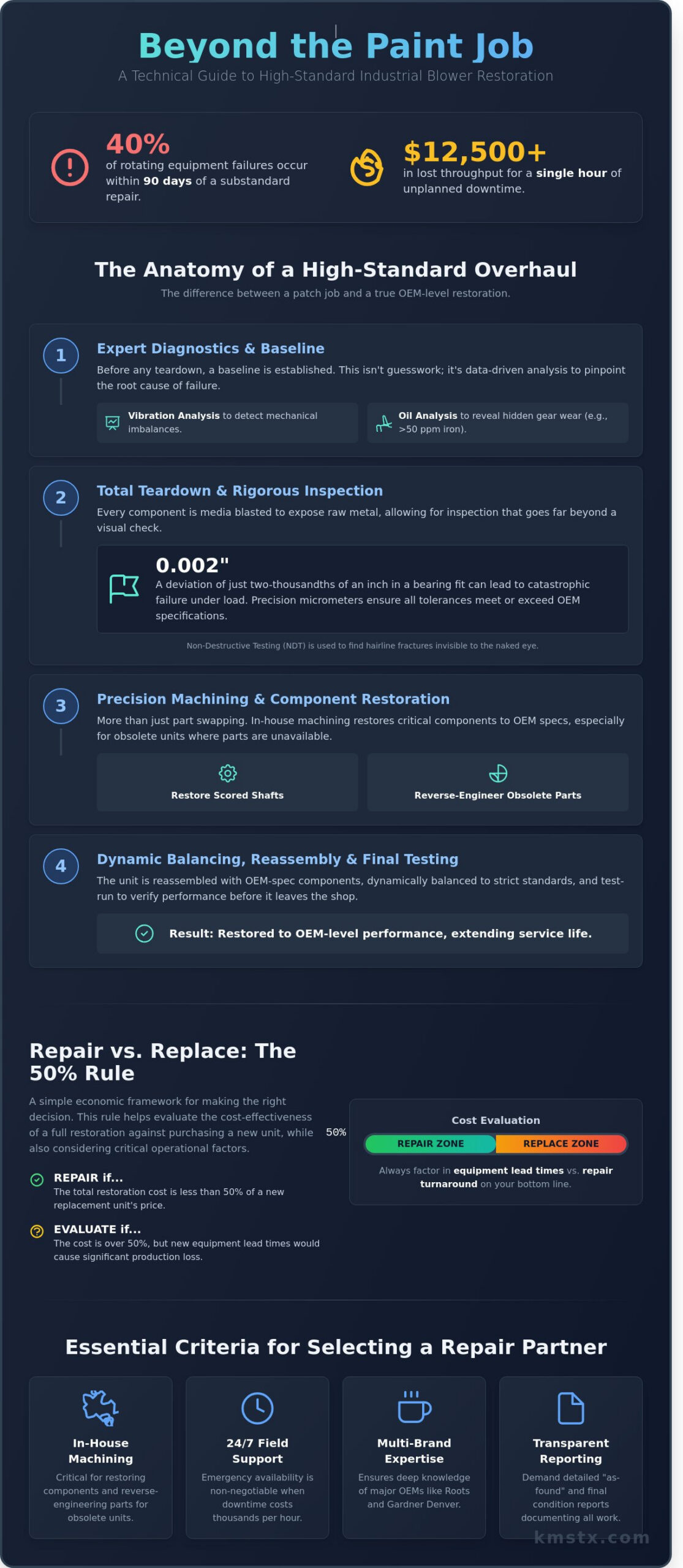
A top-tier industrial blower repair company won’t start turning wrenches without a baseline. They use vibration analysis to catch mechanical imbalances before the first bolt is pulled. Oil analysis is equally critical; finding 50 parts per million of iron suggests gear wear that visual checks miss. Every repair begins with an as-found condition report documenting metrics against 1998 OEM specifications to ensure the unit returns to peak performance.
The Anatomy of a High-Standard Industrial Blower Overhaul
A thorough restoration begins long before a single part is replaced. When an industrial blower repair company receives a unit, the process starts with a total teardown where every component is chemically cleaned or media blasted to remove carbon buildup and process residues. This step isn’t just for aesthetics; it’s required to expose raw metal surfaces for rigorous inspection. Technicians then utilize precision micrometers to measure critical tolerances against original OEM specifications. Even a deviation of 0.002 inches in a bearing fit can lead to catastrophic failure under load. Non-destructive testing (NDT), such as dye penetrant or magnetic particle inspection, is applied to rotors and housings to detect hairline fractures that the naked eye would miss during a standard visual check.
Precision Machining and Component Restoration
Restoration often requires more than just swapping parts. If a shaft journal is scored or a housing bore is oversized, custom machining becomes the only viable path to recovery. This is common in systems that must adhere to strict OSHA ventilation standards for abrasive blasting or dust collection. For obsolete models where parts haven’t been manufactured since 2005, shops must reverse-engineer components to restore proper impeller clearances. This level of detail ensures the blower maintains its designed CFM and pressure ratings without internal contact or parasitic loss.
The Role of Dynamic Balancing in Longevity
Vibration is the primary driver of premature bearing fatigue in rotating equipment. An imbalance as small as 7 grams on a large rotor can increase bearing loads by 30% at speeds of 3,600 RPM. A professional industrial blower repair company performs dynamic balancing to ISO 1940/1 Grade G2.5 or better to eliminate harmonic frequencies. Every balance run is documented in a final service report, providing a baseline for future vibration analysis. If your facility is experiencing recurring mechanical issues, it’s often helpful to analyze your system’s operational data with an expert. Final assembly concludes the overhaul with premium C3 or C4 clearance bearings and specialized synthetic lubricants, ensuring the unit survives the 24/7 demands of a modern industrial plant floor.
Repair vs. Replace: Evaluating the Economics of Blower Restoration
The decision to overhaul a machine or buy new usually starts with the 50% rule. If a quote from an industrial blower repair company exceeds half the cost of a replacement unit, procurement teams often lean toward a new purchase. However, this metric is often too simple for complex systems. You’ve got to look at the total cost of ownership. Lead times for new, custom-engineered blowers in 2024 frequently stretch to 26 weeks or more. A precision refurbishment usually gets the machine back on the line in under 6 weeks. If your plant loses $15,000 in daily production during an outage, those 20 extra weeks of waiting represent a $2.1 million loss that a new unit’s warranty can’t cover.
When Refurbishment is the Superior Option
Restoration is often the smarter move for older, heavy-duty cast-iron units. Modern “value-engineered” models often use thinner gauges that don’t dampen vibration as well as the 1990s-era castings. By choosing a specialized industrial blower repair company, you preserve the existing footprint. This avoids several “hidden” expenses that arise when installing new technology:
- Re-pouring concrete foundations to match different bolt patterns.
- Modifying Schedule 40 inlet and discharge piping to accommodate new flange locations.
- Upgrading electrical starters or VFDs to match different motor frame sizes.
Beyond the logistics, restoring a 5,000-pound housing keeps significant amounts of scrap out of the waste stream; this supports corporate sustainability targets without sacrificing 24/7 reliability. A well-executed rebuild can return a machine to its original tolerances, often with better-than-factory bearings or seals.
Signs that Replacement is Unavoidable
Sometimes the metal tells you it’s finished. Severe housing “washout” or internal erosion that exceeds 25% of the original wall thickness often makes machining impossible. If a catastrophic failure has caused major fractures in the main casting, the structural integrity is compromised beyond what thermal spray or welding can safely fix. You should also consider replacement when the efficiency gap is too wide. Modern designs often adhere to higher industrial fan performance standards, specifically regarding the Fan Energy Index (FEI). If a new unit offers a 15% to 20% reduction in brake horsepower (BHP) for the same CFM, the energy savings might pay for the new equipment within 18 months of operation.
Key Criteria for Evaluating Blower Repair Services and Field Support
Selecting an industrial blower repair company requires more than just checking a vendor list. It’s about verifying their internal infrastructure and technical depth. If a shop lacks in-house machining, your equipment sits on a pallet waiting for a third-party contractor. This logistical gap often adds 7 to 14 days to a standard turnaround. High-tier facilities maintain their own horizontal boring mills and lathes to ensure interference fits and clearance profiles stay within 0.002 inches of OEM specifications. This control over the machining process is what separates a patch job from a true restoration.
Inventory depth is another deal-breaker for critical operations. A reliable industrial blower repair company keeps a $500,000+ stock of specialized bearings, seals, and gaskets for major brands like Roots, Howden, and Aerzen. Since January 2024, supply chain delays for custom viton seals have stretched to 16 weeks in some regions. A shop that stocks these parts can bypass those delays entirely. You should also demand quality assurance protocols that meet ISO 9001:2015 standards and a 12-month warranty on both parts and labor to protect your capital investment.
Field Service vs. Shop Repair: Which Do You Need?
Field service technicians typically handle the 65% of issues that don’t require a total teardown. This includes precision laser alignment, oil analysis, and vibration monitoring to detect early bearing fatigue. However, if your unit has experienced a catastrophic “crash” or housing contact, it needs a shop repair. Heavy-duty rigging teams are necessary for units exceeding 5,000 pounds, ensuring the blower is extracted without damaging adjacent piping or structural steel. Shop repairs allow for dynamic balancing and submerged pressure testing that isn’t possible in a field environment.
The Importance of Technical Documentation
Technical documentation isn’t just paperwork; it’s a diagnostic roadmap for your facility. An “As-Built” report should be a standard deliverable, not an optional extra. This report provides the empirical data needed to justify the repair costs and plan for future cycles. A comprehensive report includes:
- As-found clearances: Documenting the exact measurements of the impellers and headplates before any work begins.
- Dynamic balance data: Proof that the rotating assembly meets a G2.5 balance grade or better to minimize harmonic vibration.
- Failure analysis: A scientific breakdown of why the unit failed, such as particulate ingestion or lubrication breakdown, which helps 85% of plants avoid repeat failures.
This data allows your team to adjust preventive maintenance intervals based on actual wear patterns rather than generic manufacturer charts. If a unit failed due to heat, the report should state that clearly so you can inspect your cooling systems. Transparency in these findings builds the trust necessary for a long-term technical partnership.
Technical Excellence in Industrial Fan and Blower Repair
Our Approach to Heavy Industrial Rotating Equipment
Ready to Restore Your Equipment?
- Technical consultations are usually available within 24 hours.
- Field service crews are equipped for immediate deployment to your site.
- Full performance testing is conducted on every repaired unit before it returns to service.
Securing Operational Uptime Through Technical Expertise
Choosing the right industrial blower repair company is the most critical factor in determining whether your equipment operates for another 10 years or fails before the next quarter ends. We’ve examined how a high-standard overhaul, utilizing precision dynamic balancing and meticulous in-house machining, consistently restores units to original OEM specifications. It’s a proven strategy that avoids the heavy capital expenditure of new purchases while ensuring your rotating assets remain efficient and reliable. KMS Technologies brings over 40 years of specialized expertise to every project, ensuring that technical precision isn’t just a goal but a standard shop requirement. We understand that mechanical failures don’t wait for business hours, so we provide 24/7 emergency field service to address critical issues the moment they arise. This combination of deep shop experience and rapid field response keeps your facility running at peak capacity. Don’t leave your production schedule to chance when you can rely on four decades of engineered results. Request a Technical Repair Quote to start your restoration project today. You’ll see that having the right technical partner makes the difference in your plant’s long-term performance.
Frequently Asked Questions
How long does a typical industrial blower repair take?
Standard repairs generally require 5 to 10 business days depending on the extent of the internal damage. If your facility faces a critical outage, emergency services can often reduce this lead time to 48 hours. The total duration depends on the availability of specialized components like custom seals or proprietary bearings that might need to be sourced or machined.
Can you repair blowers from manufacturers that are no longer in business?
Yes, we specialize in reverse-engineering components for legacy brands that have been defunct for decades. Roughly 15% of the machinery we service involves obsolete models from the 1980s or 1990s. As a specialized industrial blower repair company, we use CMM scanning to recreate shafts, gears, and impellers that meet or exceed the original factory specifications.
What is the difference between a positive displacement blower and a centrifugal fan repair?
Positive displacement repairs focus on maintaining extremely tight internal clearances, while centrifugal repairs prioritize rotor balance and aerodynamic integrity. PD units often require tolerances as narrow as 0.003 inches between the lobes and the casing. Centrifugal fans require precision balancing to G2.5 standards to prevent vibration from causing structural fatigue over time.
Do you offer on-site vibration analysis for blowers?
We provide comprehensive on-site vibration analysis using 4-channel data collectors to identify faults without requiring a full teardown. This diagnostic approach successfully identifies 92% of common mechanical issues like misalignment, looseness, or resonance. Our technicians analyze velocity and acceleration spectra to establish a reliable baseline for your ongoing preventive maintenance program.
Is it possible to upgrade a blower’s performance during the repair process?
Performance can often be improved by 10% to 15% through the application of specialized coatings or material upgrades. We frequently apply ceramic-reinforced polymers to impellers to reduce surface friction and improve efficiency. Partnering with an experienced industrial blower repair company allows you to integrate these technical enhancements, which can extend your MTBF by 24 months.
What kind of warranty is provided on industrial blower refurbishment?
Our refurbishment projects carry a 12-month warranty that covers both parts and labor. This protection period matches the standard OEM warranty offered on brand-new equipment. If a unit fails within the first 365 days due to a workmanship error, we cover the costs of transportation and rectification to ensure your operation stays on track.
How do I know if my blower’s bearings are failing before it seizes?
A temperature increase of 15 degrees Fahrenheit above your established baseline is a reliable indicator of impending bearing failure. You should also listen for high-pitched whining or grinding sounds during operation. Utilizing an ultrasonic probe can often detect these subsurface anomalies 3 to 4 weeks before a catastrophic seizure occurs, saving you from expensive housing damage.
What information do I need to provide for an accurate repair quote?
You should provide the nameplate data, the current operating RPM, and a summary of the failure symptoms. Including 3 to 5 clear photos of the drive end and seals helps our team assess the external condition. If the unit handled corrosive gases, let us know so we can accurately quote 316 stainless steel components or specialized protective coatings.