
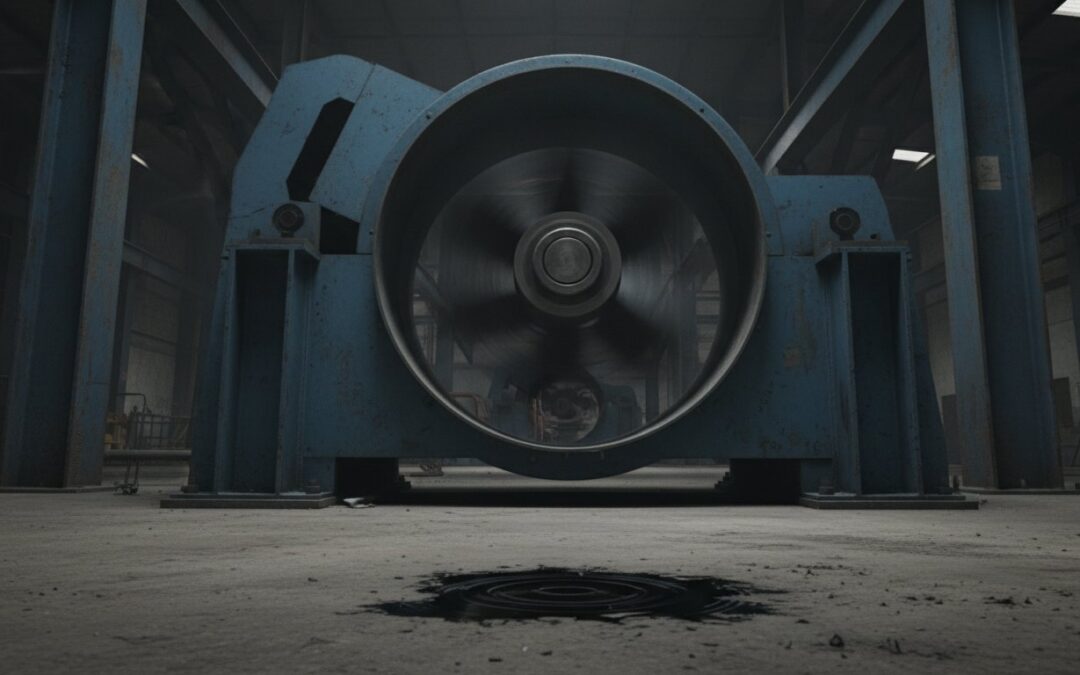
When 98% of industrial organizations report that a single hour of downtime costs over $100,000, ignoring a slight vibration in your blower or centrifuge isn’t just a maintenance oversight; it’s a gamble with your facility’s structural integrity. You’ve likely walked the shop floor and felt that specific, bone-deep hum coming from a pump or compressor. It’s easy to assume it’ll hold until the next scheduled turnaround, but the dangers of unbalanced industrial machinery are cumulative and often violent.
We understand that you can’t afford to pull critical assets for no reason. This article explains the mechanical and safety risks posed by rotational unbalance and how precision balancing prevents the kind of catastrophic failure that keeps plant managers up at night. We’ll look at the physics of centrifugal force, the requirements of the ISO 21940-11 standard, and how dynamic balancing justifies its cost by extending the life of your bearings and seals.
Key Takeaways
- Learn how centrifugal force acts as an exponential force multiplier, creating the primary dangers of unbalanced industrial machinery that lead to structural degradation.
- Understand why vibration loads aren’t just annoying; they directly compromise the lubrication film and drastically shorten your bearings’ L10 life cycle.
- Discover how machine unbalance can excite nearby structures through resonance, causing secondary damage to piping and foundations far beyond the rotating asset itself.
- Identify the hidden costs of running vibrating equipment, where downtime can exceed $100,000 per hour, and the genuine risk of high-speed rotor ejection.
- Learn how to use vibration analysis to isolate unbalance from misalignment and determine when your equipment requires a shop balance to meet ISO 21940-11 standards.
The Physics of Rotational Unbalance: Why Mass Distribution Matters
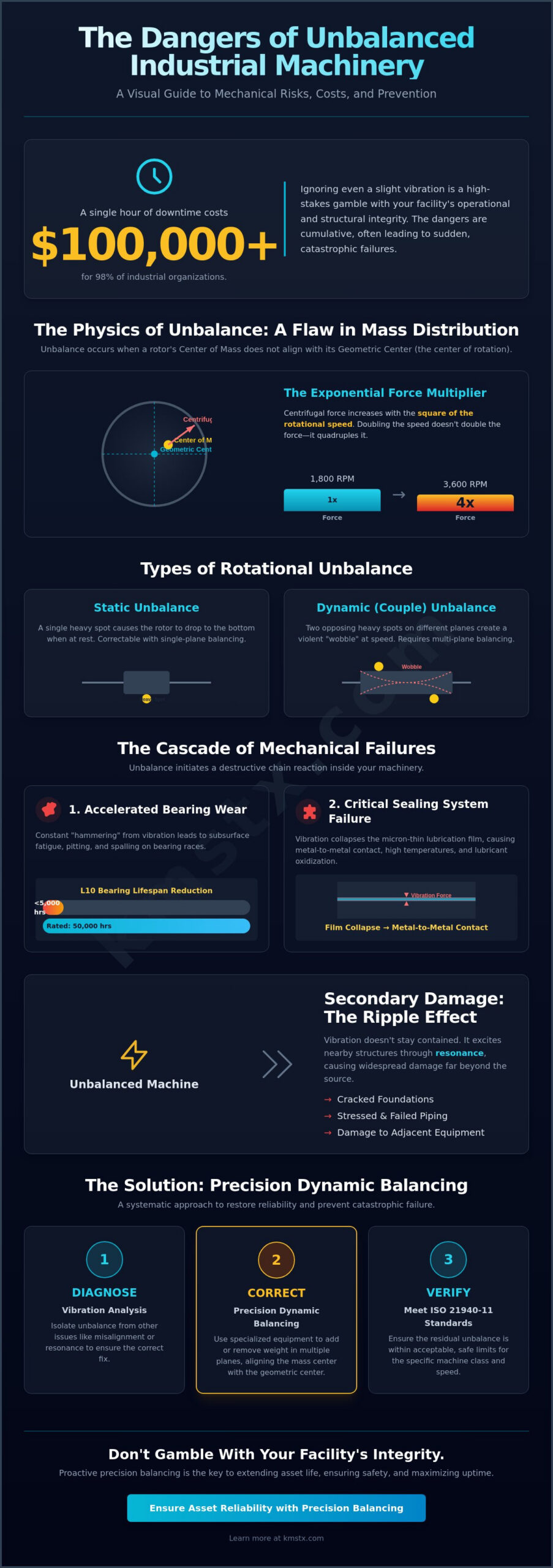
At its core, rotational unbalance is a simple case of mass distribution gone wrong. It happens when the geometric center of a part, the physical center of the shaft, doesn’t align with the mass center, also known as the center of gravity. When you spin that part, the offset mass wants to fly outward. To grasp The Physics of Rotational Unbalance, you have to look at how centrifugal force reacts to speed. It isn’t a linear relationship. One of the primary dangers of unbalanced industrial machinery is that the force generated by an offset mass increases with the square of the rotational speed.
To better understand the risks associated with rotating equipment, watch this helpful video:
Static vs. Dynamic Imbalance
You might have a rotor that seems perfectly fine on a set of knife edges, which is a state called static balance. However, once that same rotor hits operational speeds, it can vibrate so hard it threatens to walk the machine off its base. This happens because static balancing only addresses a single plane. In longer components like decanter centrifuges or large blowers, you’re often dealing with couple unbalance. This occurs when two heavy spots exist on opposite ends and opposite sides of the rotor. While they might cancel each other out while sitting still, they create a violent wobble once the machine is at speed. Dynamic imbalance is a condition where the principal inertia axis is not coincident with the shaft axis. This misalignment requires multi-plane balancing to correct, ensuring the machine runs smooth throughout its entire speed range.
The Exponential Force Multiplier
The real threat lies in the math of centrifugal force. Because force is proportional to the square of the speed, doubling your RPM doesn’t just double the stress on your bearings; it quadruples it. If you have a blower running at 1,800 RPM and you ramp it up to 3,600 RPM, any existing unbalance becomes four times more destructive. In high-speed turbines, even a heavy spot weighing only a few grams can translate into hundreds of pounds of centrifugal force. This force hammers the bearing housing 60 times a second at 3,600 RPM. By the time you notice the vibration, the dangers of unbalanced industrial machinery have likely already started fatiguing the metal and degrading the internal clearances of your seals. Precision balancing to ISO 21940-11 standards is the only way to keep these forces under control before they lead to a total asset loss.
Immediate Mechanical Dangers: From Bearing Fatigue to Seal Failure
When a rotor is out of balance, the resulting vibration doesn’t just shake the machine; it physically disrupts the thin layer of oil or grease meant to protect your moving parts. This lubrication film is often only a few microns thick. Under the constant, rhythmic pounding of an unbalanced load, that film can collapse. Metal-to-metal contact follows, leading to rapid wear and high temperatures that oxidize the lubricant. Understanding the dangers of unbalanced industrial machinery starts with recognizing that these vibrations are actually high-frequency impacts that destroy the internal chemistry of your lubrication system.
Accelerated Bearing Wear and Fatigue
The L10 life of a bearing is a calculated statistical measure of how long a group of identical bearings will last under a specific load. One of the most direct dangers of unbalanced industrial machinery is how it slashes this lifespan. Because the centrifugal force is a rotating load, it “hammers” the bearing race at the same spot during every revolution. This localized stress leads to subsurface fatigue. You’ll first see this as microscopic pitting, which eventually turns into spalling, where chunks of the metal race flake away. If your vibration levels are double what they should be, you aren’t just losing half your bearing life; the reduction is often logarithmic. A bearing rated for 50,000 hours might fail in less than 5,000 when subjected to severe, uncorrected unbalance.
Failure of Critical Sealing Systems
Mechanical seals are precision components that rely on incredibly tight tolerances to keep fluids contained. When unbalance causes shaft deflection, the shaft essentially “whips,” forcing the seal faces to open and close with every turn. This allows process fluid to enter the seal chamber or, worse, causes the seal to run dry and overheat. In pumps and centrifuges, this often leads to hazardous leaks or contamination of the bearing housing. Consistent rotating equipment maintenance is the only way to catch these issues before they result in a total seal blowout. Beyond the repair costs, the Economic and Safety Risks of Unplanned Downtime are massive, especially if a seal failure results in an environmental release or a fire hazard.
Friction isn’t the only source of heat in these scenarios. The internal molecular stress on the metal shaft and housings during high-vibration events generates significant thermal energy. This heat can cause thermal expansion, which further tightens clearances and accelerates the cycle of destruction. If you’re noticing localized hot spots on your bearing housings, it’s time to look into precision repair services to stabilize the asset before the internal components reach their breaking point.
Secondary Damage: How Unbalance Destroys Foundations and Piping
Vibration is energy that has to go somewhere. When your equipment is out of balance, that energy transfers from the shaft to the bearings, then to the housing, and finally through the machine feet into the foundation. This is where the dangers of unbalanced industrial machinery extend beyond the asset itself and begin to compromise your entire facility’s infrastructure. If the vibration frequency hits the natural resonance of the floor or supporting steel, the amplitude can double or triple. This creates a destructive feedback loop that affects everything in the immediate vicinity.
Anchor bolts and hold-down hardware bear the brunt of this energy. Constant cyclic loading leads to bolt fatigue, where the metal eventually stretches or snaps. Once a machine loses its rigid connection to the foundation, the vibration levels skyrocket. This often leads to the type of catastrophic failure that requires Precision Dynamic Balancing to rectify. Keeping the machine tied down is only half the battle; you have to stop the shake at the source.
Foundation Degradation and Concrete Cracking
Grout and concrete are designed for compression, not the rhythmic “pumping” action of a vibrating machine. Over time, these forces create micro-cracks in the grout bed. These cracks act as a straw, pulling in oil, water, and chemicals from the shop floor. This ingress causes the concrete to soften and lose its bond with the baseplate. You’ll know you’re in trouble when you see oil seeping from under a sole plate or notice that your anchor bolts won’t stay tight no matter how much torque you apply. Re-pouring a foundation in 2026 can cost ten times more than a simple balancing job.
Piping Fatigue and Ancillary Failures
Attached piping is rarely as flexible as it needs to be. When a pump or compressor vibrates due to unbalance, it forces the suction and discharge piping to move with it. This creates immense stress at the weld points and flange connections. We often see fatigue cracking in these areas, which leads to sudden leaks and environmental hazards. This isn’t limited to the vibrating machine; “sympathetic vibration” can cause a perfectly balanced motor ten feet away to start shaking because it’s sitting on the same structural steel. When these structural failures occur, having a plan for emergency machine repair Gulf Coast is essential to prevent a total facility shutdown.
The dangers of unbalanced industrial machinery also extend to your electrical systems. Rigid conduits can shake loose, and internal wiring can rub against sharp edges until it shorts out. It’s a chain reaction of failures that starts with a few grams of mass in the wrong place. Addressing unbalance early protects not just the rotor, but every pipe, bolt, and wire connected to it.
The Economic and Safety Risks of Unplanned Downtime
The financial reality of modern production is unforgiving. According to reports from early 2026, 98% of organizations now state that a single hour of unplanned downtime can cost more than $100,000. When you’re running at those stakes, the dangers of unbalanced industrial machinery represent a massive economic liability. It’s not just the cost of the repair; it’s the lost throughput, the wasted labor, and the potential for late-delivery penalties that eat your margins. Vibration is essentially energy you’ve paid for that isn’t doing any work. It’s expensive electrical energy being converted into useless heat and structural noise.
Catastrophic Failure and Personnel Safety
Every rotating asset has a “critical speed” where the natural frequency of the system matches the rotational speed. If unbalance is high enough, passing through these speeds can cause the rotor to deflect so far it strikes the internal housing. This is where maintenance issues turn into life-safety events. In high-speed centrifuges or compressors, a rotor burst can release shrapnel at ballistic velocities, effectively turning the machine into a fragmentation grenade. Operating equipment outside of the current ISO 21940-11 balance standards (which replaced the older ISO 1940-1) is a significant legal risk. OSHA has increased its focus on targeted inspections in 2026, with major hazard communication deadlines hitting on May 19 and November 20. They don’t take a light view of documented vibration issues that were ignored until they caused a workplace injury.
Energy Consumption and Operational Efficiency
Beyond the risk of a blowout, unbalance kills your operational efficiency. For machines like decanter centrifuges, stability is the key to separation. If the bowl is shaking, your G-force isn’t being applied consistently to the process fluid. This leads to poor product quality and higher energy bills as the motor fights the internal friction caused by vibration. When the damage eventually forces a shutdown, you’re faced with a tough choice: repair or replace. The cost of industrial gearbox repair Houston is often a fraction of the cost of a total replacement, especially with the long lead times currently seen in the 2026 supply chain. While having a reliable source for industrial machine spare parts Texas is a necessary fallback, simply throwing new parts at a machine won’t fix the underlying physics of an unbalanced rotor.
Don’t wait for a vibration alarm to turn into a catastrophic failure. If your equipment is showing signs of instability, it’s time to bring in the experts. Contact KMS Technologies today to schedule a precision dynamic balance and protect your facility from the high cost of unplanned downtime.
Precision Dynamic Balancing: The Solution for Industrial Reliability
Fixing a vibration issue requires more than just a gut feeling or a handheld sensor. While basic tools can tell you that a machine is shaking, they often fail to distinguish between a bent shaft, mechanical looseness, or true mass unbalance. To mitigate the dangers of unbalanced industrial machinery, we use high-resolution vibration analysis to isolate the specific frequency of the unbalance. This diagnostic phase is critical because attempting to balance a machine that actually has a misalignment problem will only result in wasted time and continued asset degradation.
One of the biggest decisions you’ll face is whether to perform field balancing or pull the rotor for a shop balance. Field balancing is often effective for large fans or simple assemblies where access is easy. However, for complex assets like decanter centrifuges, multi-stage pumps, or high-speed blowers, field corrections are often just a temporary fix. These machines frequently require multi-plane balancing that can only be achieved in a dedicated balancing cradle. Kelsey Machine Services utilizes precision dynamic balancing services in Houston to restore these assets to their original specifications, often correcting “built-in” manufacturing errors through custom machining that handheld field tools simply can’t address.
The Professional Balancing Process
Our process starts with mounting the rotor or assembly into a dynamic balancing machine equipped with high-resolution piezoelectric sensors. We identify the “heavy spot” by measuring the phase angle of the vibration relative to a fixed point on the shaft. Using the trial weight method, we add a known mass and measure the resulting change in vibration. This data allows us to perform precise vector calculations to determine exactly where to add or remove weight. It’s not enough to just balance the rotor alone; we prioritize balancing the entire rotating assembly, including couplings and impellers, to ensure the system remains stable once it’s reinstalled in your facility.
Restoring OEM Specifications
In heavy industry, “good enough” is a recipe for a 2:00 AM emergency call. High-speed equipment requires adherence to strict G-grades under the ISO 21940-11 standard. For most industrial pumps and blowers, a G6.3 grade is the baseline, but high-precision assets often require G2.5 or better to ensure a long service life. With the 2026 supply chain still presenting long lead times for new equipment, professional restoration is the most cost-effective way to extend your asset’s life by decades. A properly balanced machine runs cooler, quieter, and draws less amperage, directly impacting your bottom line. If you’re fighting persistent vibration, don’t let it turn into a catastrophic failure. Contact Kelsey Machine Services for a technical consultation on your rotating assets and let’s get your equipment back to peak reliability.
Securing Your Facility Against Rotational Failure
Ignoring a vibrating rotor is a gamble that eventually leads to the structural and economic losses described in this guide. From the exponential growth of centrifugal force to the logarithmic reduction in bearing life, the physics show that unbalance is a primary driver of unplanned downtime. We’ve explored how these forces destroy more than just the rotor; they compromise foundations, piping, and personnel safety across your entire facility.
Mitigating the dangers of unbalanced industrial machinery requires a partner who understands the day-to-day realities of the shop floor. Kelsey Machine Services brings over 40 years of industrial mechanical expertise to every project. Whether you need a shop balance to current ISO standards or a 24/7 emergency response for a critical failure, we utilize proprietary dynamic balancing and custom machining to restore your assets to peak performance. Don’t wait for a catastrophic failure to take your plant offline. You can protect your investment and your team by being proactive about asset health.
Request a Technical Evaluation for Your Rotating Equipment and ensure your machines run smooth for years to come.
Frequently Asked Questions
What are the first signs of an unbalanced industrial machine?
The first signs are usually a steady increase in vibration that matches the shaft’s rotational speed, often referred to as 1x RPM. You’ll likely notice that mounting bolts or housing covers start to loosen despite being properly torqued. If you’re seeing premature oil leaks from seals that were recently replaced, it’s a strong indicator that the vibration is already forcing the seal faces apart and compromising the internal clearances.
Can I run a vibrating machine until the next scheduled maintenance shutdown?
Running a machine with known unbalance until a scheduled shutdown is a high-stakes gamble that rarely pays off. Since centrifugal force increases with the square of the speed, the damage to your bearings and seals isn’t linear; it’s exponential. You risk a catastrophic failure that could cost over $100,000 per hour in lost production, making a short, planned outage for balancing much more cost-effective than waiting for a total seize.
How does rotational unbalance differ from shaft misalignment?
Unbalance is a mass distribution problem where the center of gravity doesn’t align with the center of rotation, whereas misalignment happens when the centerlines of two coupled shafts aren’t correctly positioned. In the field, we distinguish them using vibration frequency. Unbalance typically peaks at 1x the rotational speed on a spectrum, while misalignment often shows up at 2x or 3x RPM, signaling that the shafts are fighting each other at the coupling.
What is the difference between static and dynamic balancing?
Static balancing is a single-plane correction that can be performed while the rotor is at rest, often using knife edges to find the heavy spot. Dynamic balancing is a multi-plane correction that must be done while the rotor is spinning. You need dynamic balancing for long rotors, such as those in blowers or centrifuges, because a rotor can be statically balanced but still vibrate violently due to weight offsets at opposite ends.
How much vibration is considered dangerous for heavy machinery?
Danger levels depend on the specific machine class, but the ISO 10816 standard provides a reliable baseline for most facilities. For general industrial equipment, vibration levels exceeding 0.28 inches per second are considered unsatisfactory and require monitoring. Once levels hit 0.45 inches per second, you’re in the danger zone. The primary dangers of unbalanced industrial machinery at these levels include rapid bearing fatigue and potential structural cracking in the foundation.
What industries are most at risk from unbalanced rotating equipment?
Industries that rely on high-speed, continuous-duty assets like oil and gas, wastewater treatment, and power generation are the most vulnerable. These sectors use large-scale pumps, compressors, and blowers that run 24/7. In these environments, an unbalance issue doesn’t just stop one machine; it can halt an entire production line. This leads to the massive financial liabilities and safety risks that characterize the dangers of unbalanced industrial machinery in high-output facilities.
Can unbalance be caused by thermal expansion or material buildup?
Thermal expansion and material buildup are common but often overlooked causes of unbalance. If an impeller or fan blade accumulates just a few grams of process material unevenly, it creates a heavy spot that hammers the bearings. Similarly, if a rotor isn’t allowed to reach a uniform temperature, it can develop a “thermal bow.” This slight bend shifts the mass center, creating a destructive unbalance that may only appear at operational temperatures.
What is the ISO 1940-1 standard for machine balance?
ISO 1940-1 was the long-standing industry standard for balance quality, though it has been officially updated and replaced by ISO 21940-11 as of early 2026. The standard uses “G” grades to define acceptable residual unbalance based on the machine’s service. For instance, G6.3 is the standard for most pumps and fans, while high-speed turbines often require a stricter G2.5 grade. Adhering to these specifications ensures your equipment stays within safe operating limits.