
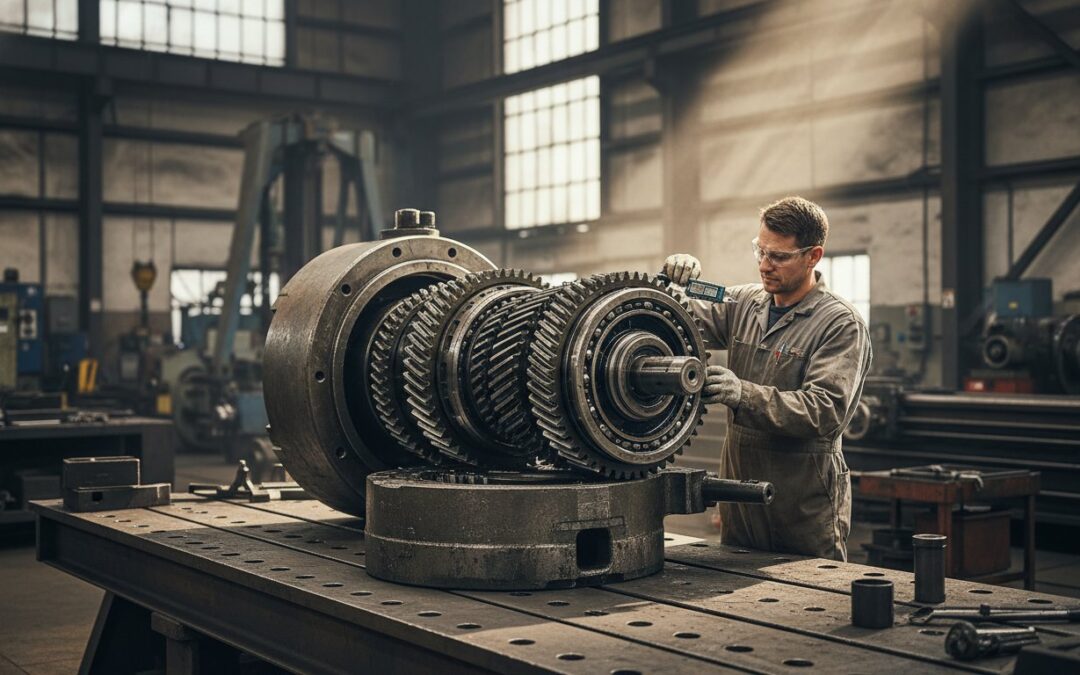
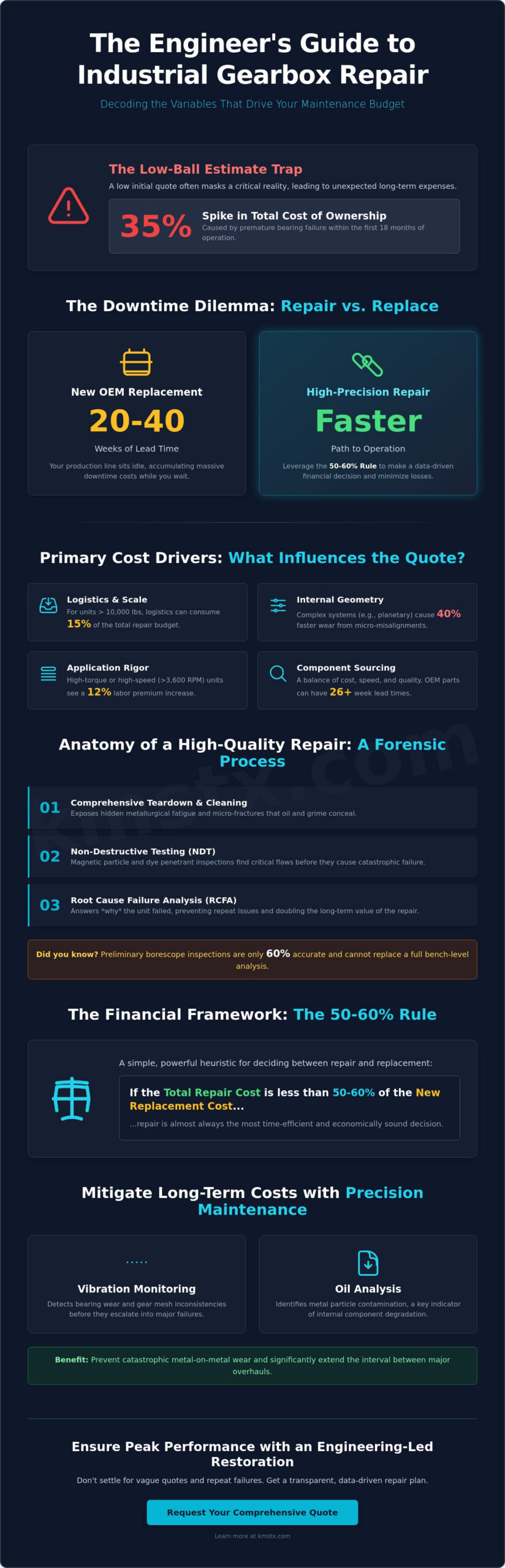
A low-ball estimate on a planetary drive rebuild typically masks a 35% spike in total cost of ownership due to premature bearing failure within the first 18 months of operation. It’s a hard reality that most maintenance managers face when trying to justify the cost of industrial gearbox repair against a tightening CAPEX budget. You’ve likely felt the frustration of a 22-week lead time for a new OEM unit while your primary production line sits idle. We understand that vague quotes and shifting timelines make it nearly impossible to forecast your annual maintenance spend accurately.
This guide provides a technical framework to evaluate repair variables by analyzing labor hours, specialized machining requirements, and component sourcing in the 2026 market. You’ll gain the data necessary to decide between a shop overhaul and a full replacement to minimize your plant’s operational downtime. We’ll examine the specific breakdown of technical labor costs and the warranty standards you should demand from any high-precision repair facility to ensure your equipment returns to the floor in peak condition.
Key Takeaways
- Identify how physical scale and complex internal geometries—such as helical or planetary gearing—dictate your baseline logistical and machining expenses.
- Learn why a comprehensive teardown and Non-Destructive Testing (NDT) are critical for uncovering hidden metallurgical defects that standard visual inspections miss.
- Master the “50-60% Rule” to accurately weigh the cost of industrial gearbox repair against the 20–40 week lead times associated with new OEM replacements.
- Discover how precision maintenance strategies, including vibration monitoring and oil analysis, can prevent metal-on-metal wear and extend the interval between major overhauls.
Primary Variables Influencing Industrial Gearbox Repair Costs
Estimating the cost of industrial gearbox repair requires a detailed assessment of the mechanical state of the unit. Logistics alone often consume 15% of the total budget for units exceeding 10,000 pounds, as specialized rigging and heavy-duty crane services are mandatory for safe transport. The physical scale of the equipment doesn’t just impact shipping prices; it also dictates the shop floor footprint and the size of the specialized disassembly tools required for the job.
To better understand the precision required during the inspection phase, watch this video demonstrating a critical diagnostic step:
Internal geometry is another major cost driver. While a standard single-stage helical unit is relatively straightforward, complex planetary systems or multi-stage worm gears require significantly more labor hours for precise alignment and shimming. A solid understanding of fundamental gear mechanics explains why microscopic misalignments in high-speed applications lead to 40% faster wear rates. If the damage has progressed from a simple seal leak to a catastrophic gear tooth failure, the repair strategy shifts from basic maintenance to a full-scale rebuild, which can double the initial estimate.
Gearbox Type and Application Rigor
High-torque environments like mining or marine operations demand more than just a standard fix. These gearboxes often operate in abrasive or corrosive conditions, which requires specialized housings like 316 stainless steel or explosion-proof enclosures. In 2026, labor premiums for these specialized units have risen by roughly 12% due to increased safety protocols and precision requirements. High-speed industrial applications, particularly those exceeding 3,600 RPM, leave zero margin for error in bearing tolerances and balance. The cost of industrial gearbox repair in these sectors is naturally higher because the stakes of a secondary failure are so extreme.
Component Sourcing and Lead Times
Sourcing parts is often the biggest bottleneck in the repair process. While OEM parts ensure a perfect fit, lead times for specialized components can stretch to 26 weeks or more in the current supply chain environment. High-quality aftermarket alternatives can save up to 30% in costs, but custom machining often becomes the preferred route when downtime costs exceed $5,000 per hour. A lead-time surcharge is a premium fee paid to bypass the standard production queue or to expedite the manufacturing of a one-off component to get the line moving again. When calculating the total cost of industrial gearbox repair, you’ve got to weigh these surcharges against the daily losses of an idle facility.
The Technical Breakdown: What Your Repair Quote Actually Covers
When you review a quote for the cost of industrial gearbox repair, you aren’t just paying for a list of replacement bearings and seals. You’re paying for a forensic engineering process. A high-quality repair begins with a comprehensive teardown and chemical cleaning. This isn’t for aesthetics; it’s the only reliable method to expose micro-fractures and metallurgical fatigue that oil and grime hide. We utilize Non-Destructive Testing (NDT) protocols, including magnetic particle and dye penetrant inspections, to identify cracks before they lead to catastrophic housing failures during operation.
Inspection and Diagnostic Engineering
A reputable shop won’t just tell you a unit is broken; they’ll explain why it failed. Precise measurements of axial play and backlash are the baseline for determining the current state of wear. While borescope inspections offer a 60% accurate preliminary estimate without a full teardown, they can’t replace a bench-level analysis. Cheap quotes often skip the Root Cause Failure Analysis (RCFA) phase. If the shop doesn’t identify why the gear teeth pitted or the bearing spun, you’re just setting a timer for the next failure, which ultimately doubles the long-term cost of industrial gearbox repair. Adhering to industry repair standards ensures that every diagnostic measurement is recorded and compared against original design intent.
Machining and Restoration to OEM Specs
Restoration frequently involves more than just swapping off-the-shelf components. We often see shaft journals and housing bores that have been “egged out” or worn beyond acceptable limits. These require specialized welding and precision machining to return them to original equipment manufacturer (OEM) specifications. For any high-speed assets operating above 1,800 RPM, precision dynamic balancing is a technical necessity. This process eliminates the parasitic vibration that destroys seals and bearings prematurely. Every tolerance must meet or exceed the original 0.001-inch specifications to ensure the unit survives its next multi-year run.
The final stage involves a rigorous spin test to verify operational integrity. We run the unit at full operational speed while monitoring temperature spikes and vibration signatures. This verification proves the gearbox is ready for the field before it leaves the shop floor. If your facility is dealing with a recurring vibration issue on a critical drive, you might want to consult with a diagnostic specialist to evaluate the entire drivetrain system.
Financial Decision Framework: Repair, Refurbish, or Replace?
Maintenance managers often use the 50-60% rule as a baseline for decision-making. When the estimated cost of industrial gearbox repair exceeds 60% of the price of a new unit, the scale usually tips toward replacement. However, that calculation ignores the current reality of global supply chains. In recent years, OEM lead times for new heavy-duty gearboxes have frequently stretched between 20 and 40 weeks. Waiting nine months for a replacement is rarely feasible for a critical asset. A comprehensive repair often carries a 12 to 36 month warranty. This often matches or exceeds the 12-month standard warranty provided by original manufacturers for new equipment. Over a 5-year operational horizon, the Total Cost of Ownership (TCO) favors high-quality restoration because it eliminates the capital expenditure of structural modifications required for modern replacements.
Assessing Equipment Lifecycle and Obsolescence
Legacy gearboxes pose a unique challenge when the OEM no longer supports the model or has exited the market. In these cases, industrial gearbox repair is the only path forward to maintain operations. Repairing these units allows for the retention of custom footprints, which avoids the massive costs of rerouting piping or modifying concrete foundations. Skilled technicians can also upgrade internal components, such as utilizing modern bearing alloys or optimized gear tooth profiles. These engineering changes can increase mechanical efficiency by 3% to 7% over the original design specifications, effectively modernizing the asset without replacing the housing.
Calculating the Cost of Downtime
The true expense of a failure isn’t the shop invoice; it’s the lost revenue. You can calculate this using a basic formula: (Total Units Produced per Hour x Net Profit per Unit) x Hours of Downtime. If a line generates $5,000 in hourly profit, a 40-week wait for a new gearbox results in millions in lost opportunity. This is why 24/7 emergency support is a critical factor in the total cost of industrial gearbox repair. A rapid turnaround time effectively offsets a higher technical labor rate by returning the asset to service weeks or months ahead of a new delivery. Speed is the most valuable currency in high-stakes manufacturing environments where every hour of idleness compounds financial loss.
Mitigating Long-Term Costs Through Precision Maintenance
Precision maintenance isn’t a luxury; it’s a financial safeguard against the escalating cost of industrial gearbox repair. A rigorous lubrication analysis program serves as the first line of defense. By measuring metallic particulates in parts per million (ppm) and monitoring viscosity shifts, technicians can identify gear scuffing before the teeth lose their profile. This early detection prevents a total rebuild. Similarly, vibration monitoring allows maintenance teams to isolate specific bearing frequencies. Catching a failing roller bearing early prevents it from seizing and spinning in the housing, which usually turns a simple bearing swap into a costly machining project.
Integrating consistent rotating equipment maintenance into your schedule significantly extends the mean time between failures (MTBF). We’ve seen facilities increase MTBF by 40% simply by training floor staff to recognize early warning signs. If a gearbox shows heat discoloration or emits a high-pitched whine, the internal damage is already progressing. Equipping operators with basic infrared thermometers and acoustic sensors allows for intervention before a catastrophic event occurs.
Predictive vs. Reactive Maintenance Costs
The math is straightforward. A $5,000 preventative service that includes oil filtration, seal replacement, and alignment often prevents a $50,000 catastrophic failure. Identifying the “point of no return” is critical; once gear teeth show significant pitting or spalling, the cost of industrial gearbox repair climbs as custom gear cutting becomes necessary. Managing a strategic industrial machine spare parts inventory ensures that these smaller, predictive repairs don’t result in weeks of downtime.
The Impact of Dynamic Balancing on Gear Life
Mechanical imbalance is a silent killer of gearboxes. It accelerates bearing wear and causes seal lips to deflect, leading to oil leaks and contamination. Every major overhaul must include a dynamic balance report to ensure the rotating assembly meets ISO 21940-11 standards. Precision balancing and alignment reduce parasitic power loss by up to 3%, which translates to thousands of dollars in energy savings over the life of a high-horsepower drive. These technical adjustments ensure the unit operates within its designed thermal and mechanical limits.
Engineering-Led Restoration: The Kelsey Machine Services Advantage
Since 1980, Kelsey Machine Services has focused on the complex restoration of high-torque, heavy-duty rotating assets. We’ve spent over four decades analyzing the internal geometries and failure modes of major industrial brands like Falk, Lufkin, and Philadelphia Gear. When plant managers evaluate the total cost of industrial gearbox repair, the most significant variable is rarely the shop labor itself. Instead, the true expense stems from the weeks of lost production while waiting on OEM parts. We built our proprietary 24/7 emergency response model specifically to mitigate these operational bottlenecks for critical infrastructure providers.
Our facility operates on the principle that precision machining shouldn’t be outsourced. We maintain a full suite of in-house capabilities that allow us to manufacture shafts, housings, and specialized components that bypass the current 26 to 52 week lead times common in OEM supply chains. This vertical integration ensures that every step of the restoration meets our rigorous internal standards. We back this technical precision with comprehensive warranties that provide long-term peace of mind for your most vital assets.
Our Full-Service Technical Facility
We manage the entire lifecycle of a repair under one roof, from the initial forensic teardown to final dynamic balancing. Our emergency machine repair teams provide on-site troubleshooting to identify root causes before the unit even reaches our floor. By integrating industrial centrifuge repair expertise into our gearbox overhauls, we apply advanced vibration analysis and high-speed balancing techniques that many standard shops simply can’t match. This cross-disciplinary approach results in a cost of industrial gearbox repair that reflects a permanent fix rather than a temporary patch.
Requesting a Precision Repair Quote
Accuracy in a preliminary estimate is vital for your maintenance budget. To provide a detailed technical quote, our engineers typically require the nameplate data, a brief history of the unit’s performance, and any recent oil analysis reports. We utilize a transparent, line-itemized billing process so your team knows exactly where every dollar is allocated. There are no hidden surcharges or vague “miscellaneous” fees in our proposals. We treat every repair as an engineering project, not just a service ticket. If your facility is facing a critical failure or planning a scheduled overhaul, contact Kelsey Machine Services for a technical consultation on your gearbox repair today.
Securing Your Rotating Assets for the Long Haul
Navigating the total cost of industrial gearbox repair requires looking past the initial estimate and focusing on how the unit will perform once it’s back in the dirt. You’ve seen how technical variables like gear geometry and metallurgical integrity dictate the final bill. Balancing these expenses against the 2026 lead times for new replacements often makes high-end refurbishment the smartest financial move for critical path equipment. It’s about minimizing the total cost of ownership, not just the immediate repair invoice.
When a gearbox fails at 2:00 AM, you don’t need a sales pitch; you need a team that’s been solving these problems for over 40 years. Our facility provides 24/7 emergency field service and shop support with full in-house machining and dynamic balancing capabilities. This integrated approach eliminates the delays caused by third-party vendors and ensures every component meets precise engineering standards. Precision maintenance is the only way to avoid the cycle of repetitive failures and unplanned downtime.
If you’re ready to get your equipment back to peak operational status, Request a Technical Repair Quote from Kelsey Machine Services today. Let’s make sure your hardware is ready for the next decade of service.
Frequently Asked Questions
How much does a typical industrial gearbox repair cost?
The cost of industrial gearbox repair generally falls between 40% and 60% of the replacement value for a new unit. This figure fluctuates based on the extent of the internal damage and the current market price for high-grade alloys. For units where the housing is salvaged, the savings are substantial compared to buying a completely new assembly with a long factory lead time.
What is the standard turnaround time for a gearbox overhaul?
Standard turnaround times for a comprehensive overhaul range from 10 to 20 business days once the unit is on the bench. If your gearbox requires custom-cut gears or specialized shaft grinding, the process can take longer. We provide a detailed project timeline after the initial teardown because we know that every day of lost production impacts your bottom line.
Is it better to repair an old gearbox or buy a new one?
Repairing an existing unit is often the superior choice when the lead time for a new gearbox exceeds 24 weeks. Many older units are built with heavier castings that handle vibration better than modern, thinner-walled designs. If the repair quote stays under 55% of the new unit price, rebuilding the internals is usually the most cost-effective path for long-term reliability.
What are the most common causes of industrial gearbox failure?
Lubrication failure is responsible for roughly 60% of the industrial gearbox issues we diagnose in the field. This usually stems from particulate contamination or the breakdown of thermal properties in the oil. Mechanical misalignment and bearing fatigue account for another 30% of failures. Monitoring these factors through regular oil analysis can prevent the need for a total system overhaul.
Do you provide a warranty on industrial gearbox repairs?
We provide a standard 12 month warranty on all major gearbox repairs, which covers both our craftsmanship and the replacement parts. This guarantee matches the industry standard for new equipment and ensures the unit operates within OEM tolerances. We stand behind our work because we use precision measurement tools to verify every clearance before the unit leaves the shop.
Can you repair gearboxes from any manufacturer?
We service gearboxes from every major manufacturer, including brands like Falk, Lufkin, and Philadelphia Gear. Our shop isn’t limited by brand name because we use advanced coordinate measuring machines to reverse engineer components that are no longer in production. This allows us to support legacy equipment that the original manufacturer may have discontinued years ago.
What is the difference between a gearbox rebuild and a gearbox refurbishment?
A refurbishment involves replacing seals and bearings to keep a healthy unit running, while a rebuild returns the entire gearbox to like-new condition. During a rebuild, we replace all rotating elements and machine the housing bores if they’re out of spec. While the cost of industrial gearbox repair is higher for a rebuild, it effectively resets the clock on the equipment’s service life.
How can I reduce the cost of my next gearbox repair?
You can lower your long-term expenses by 25% if you catch bearing wear before it causes gear tooth pitting. Once metal chips start moving through the oil, they destroy every precision surface in the box, which triples the parts list. Setting up a consistent vibration monitoring program is the best way to avoid these expensive, unplanned catastrophic failures.