
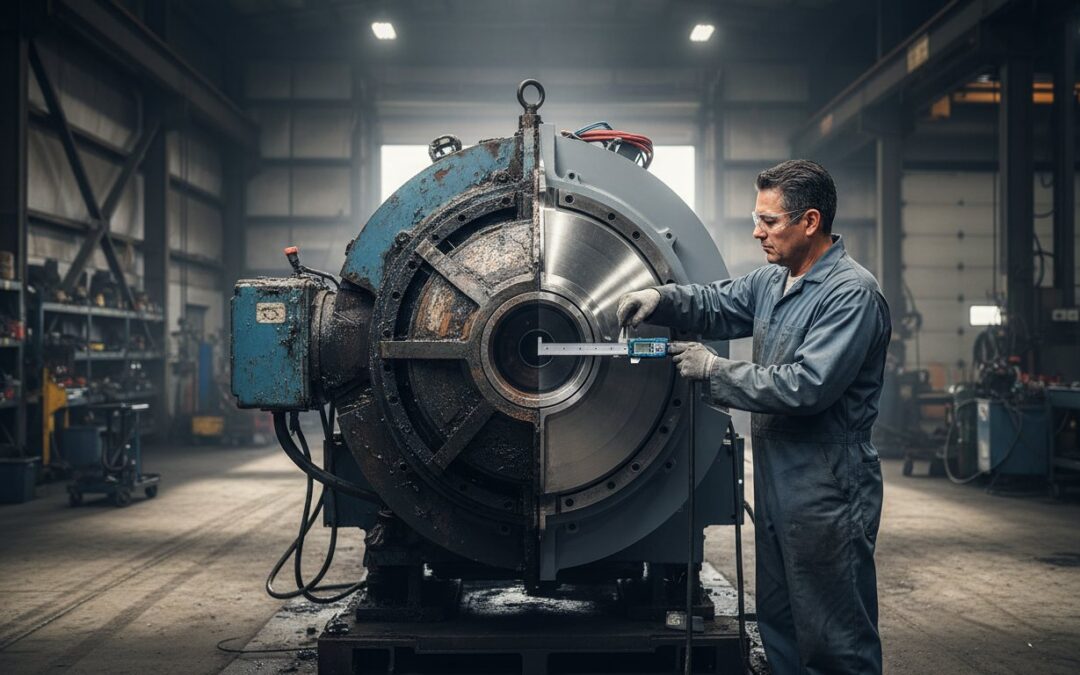
The fastest way to secure a high-performance 5,000 HP motor for your facility isn’t placing a factory order; it’s stripping your existing unit down to the bare metal. When you’re staring at a 40-week lead time for new OEM replacements, waiting isn’t just an inconvenience, it’s a direct hit to your quarterly production targets. You already know that your veteran crew understands the quirks of your current machinery better than any new interface. The primary benefits of equipment refurbishment allow you to capitalize on that existing knowledge while bypassing the massive CAPEX burden of a total system overhaul.
In this guide, we’ll show you how a structured industrial refurbishment program restores OEM-level precision and adds another 15 years of reliable service to your heavy rotating assets. You’ll discover how specialized machining and advanced component balancing return your equipment to “like-new” performance levels. We will examine the specific technical workflows that slash lead times and maximize the ROI of your existing capital investments by utilizing the latest in vibration analysis and precision engineering.
Key Takeaways
- Learn the critical differences between routine repairs and full-scale refurbishment to ensure your rotating assets are restored to true OEM standards.
- Discover how to bypass the 6-12 month lead times of new machinery by leveraging the benefits of equipment refurbishment to get your production back online faster.
- Master the “50% Rule” and the decision matrix to accurately determine if an aging asset is a prime candidate for restoration or a total loss.
- Explore how precision engineering and dynamic balancing restore mechanical integrity, eliminating the vibration issues that plague high-speed gearboxes and centrifuges.
- Identify the technical benchmarks for choosing a refurbishment partner who can provide the documented inspection reports needed for long-term reliability.
Defining Industrial Refurbishment: Why It Is Smarter Than Replacement
Industrial refurbishment is a comprehensive restoration of an asset to its original performance specifications through engineering intervention. For maintenance teams managing heavy rotating equipment, this process represents a strategic pivot away from the “disposable” mindset common in modern procurement. One of the primary benefits of equipment refurbishment is the ability to retain high-quality, heavy-duty castings. Many assets manufactured 30 years ago feature wall thicknesses and material grades that far exceed the specifications of today’s lightweight replacements. These older units provide superior vibration dampening and thermal stability, qualities that are often sacrificed in modern designs to reduce shipping weights and material costs.
To better understand how specialized restoration impacts operational revenue, watch this helpful video:
The Refurbishment vs. Repair Distinction
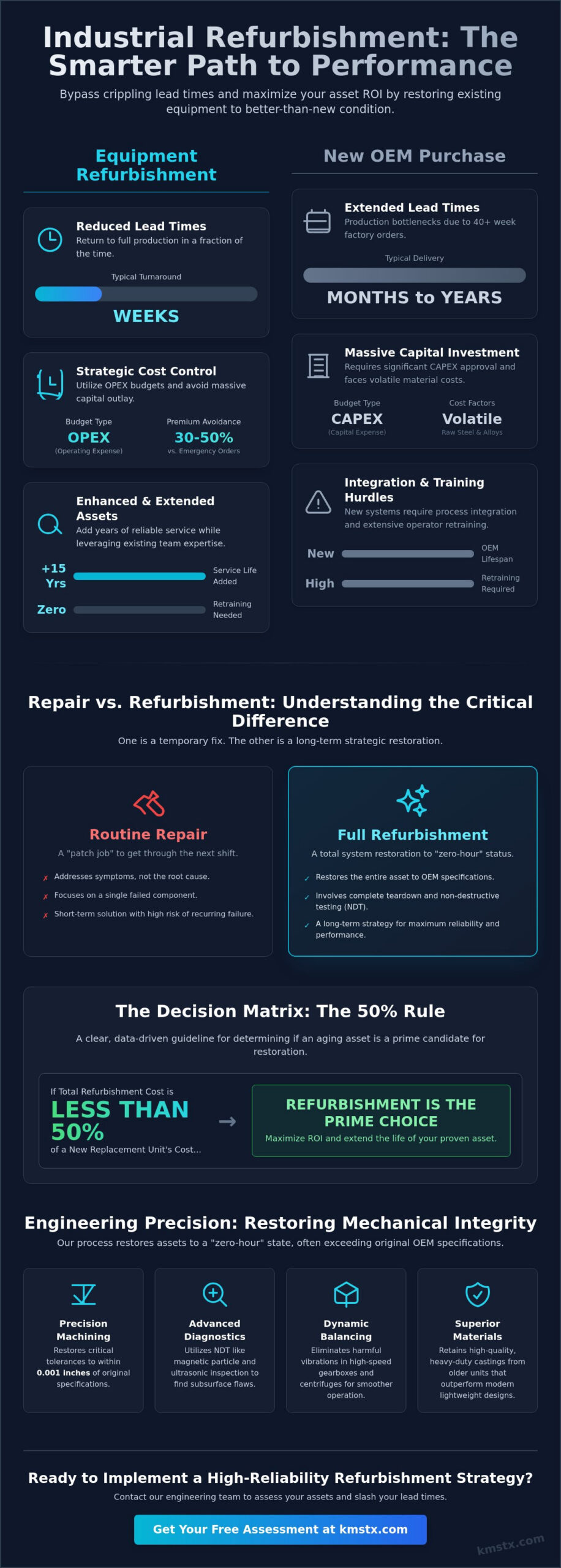
A routine repair is often just a “patch job” meant to stop a leak or replace a bearing to get through the current shift. Refurbishment is a different animal entirely. It requires a complete teardown where every component is measured against OEM tolerances. We use non-destructive testing (NDT), such as magnetic particle or ultrasonic inspection, to identify subsurface cracks that a visual check would miss. This level of rigor aligns with the principles of Remanufacturing, aiming to restore the machine to a “zero-hour” status. It’s about addressing the systemic health of the asset rather than just fixing a symptom. By the time the unit is reassembled, it doesn’t just work; it performs as if it just rolled off the original assembly line.
Economic Realities of 2026
Current market data shows that lead times for new large-scale rotating assets have stretched to 18 or 24 months in some specialized sectors. This delay makes refurbishment a necessity for maintaining operational uptime. From a budget perspective, refurbishment typically falls under Operating Expenditure (OPEX). This is often easier for maintenance managers to clear than a massive Capital Expenditure (CAPEX) request for a new unit. While the Bureau of Labor Statistics noted steady increases in technical labor costs through 2025, the price of raw steel and specialized alloys for new equipment has remained volatile. Refurbishment provides a more predictable cost structure by focusing on precision machining and engineering skill. This approach captures the long-term benefits of equipment refurbishment by extending the life of proven assets without the risk of integrating unproven new technology into an existing process flow.
- Asset Longevity: Extends service life by 10 to 15 years on average.
- Precision: Restores critical tolerances to within 0.001 inches of original specs.
- Budget Control: Avoids the 30% to 50% price premiums often seen on emergency new equipment orders.
Engineering Precision: How Refurbishment Restores Mechanical Integrity
Heavy rotating assets don’t just wear out; they drift. Over 15 or 20 years of continuous operation, thermal cycling and mechanical stress cause tolerances to shift away from their design intent. One of the primary benefits of equipment refurbishment is the technical opportunity to reset these tolerances to a zero-hour state, or often, to a standard that exceeds the original manufacturer’s specifications. This process fits perfectly within the circular economy, as it prioritizes the restoration of high-value metallurgical cores rather than the wasteful cycle of total replacement.
Restoring mechanical integrity requires a deep dive into the asset’s geometry. Engineers must correct shaft runout and housing misalignments that developed due to years of torque-induced twisting. By utilizing precision machining, shops can restore bearing fits and seal surfaces to within 0.0005 inches. This level of accuracy ensures that the internal clearances are tight enough to maintain hydraulic or mechanical efficiency but loose enough to allow for proper lubrication and thermal expansion. It’s a delicate balance that requires both heavy-duty equipment and a high degree of technical expertise.
Dynamic Balancing and Vibration Analysis
In high-speed centrifuges and gearboxes, mass asymmetry is a silent killer. The physics are simple: centrifugal force increases with the square of the rotational speed. A few grams of imbalance at 3,600 RPM can generate hundreds of pounds of force that hammer away at bearings and seals. Utilizing precision dynamic balancing services is non-negotiable for protecting these assets. By eliminating parasitic loads, we can extend the mean time between failures by 40% or more. Engineers use vibration signatures to verify the project’s success; if the peak velocity stays under 0.1 inches per second during testing, the asset is ready for another decade of service.
Advanced Machining and Component Restoration
Custom machining is often the only solution for assets where the OEM no longer provides support. When a part becomes obsolete, refurbishment shops can reverse-engineer and manufacture components that actually improve on the original 1970s or 1980s designs. Integrating modern coatings, such as tungsten carbide or specialized ceramics, can improve wear resistance in pumps and blowers by as much as 300%. These upgrades reduce the friction that leads to heat buildup and energy loss. If you’re dealing with recurring failure patterns, you can discuss a technical assessment with our team to identify which modern materials can solve your specific wear issues. This approach turns a standard repair into a strategic performance upgrade.
Operational Advantages: Lead Times, Training, and Process Continuity
Procurement for high-spec rotating assets is currently a significant bottleneck in heavy industry. When a critical pump, motor, or turbine fails, waiting 26 to 52 weeks for a replacement isn’t just an inconvenience; it’s a direct threat to operational viability. Refurbishment bypasses this delay, providing a faster path to production by utilizing the existing core and structural components. One of the primary benefits of equipment refurbishment is the ability to restore an asset to peak condition in a fraction of the time required to source a new unit.
Supply Chain Resilience and Rapid Turnaround
New equipment orders frequently face 40+ week lead times due to global supply chain volatility and manufacturing backlogs. In contrast, a focused refurbishment project typically concludes within a 4 to 8 week window. This speed is facilitated by maintaining a robust industrial machine spare parts inventory, which allows for immediate component replacement rather than waiting on international shipping cycles.
Relying on a domestic refurbishment partner mitigates the risks associated with global logistics. These partners often adhere to rigorous quality standards, such as the API Repair and Remanufacture Program, ensuring that the restored asset meets or exceeds its original performance specifications. This approach provides a predictable timeline that new procurement simply cannot match in the current economic climate.
Preserving Institutional Knowledge
The “hidden cost of new” often manifests in the weeks following the commissioning of a replacement asset. New machinery frequently introduces different control logic, digital interfaces, or proprietary software that requires extensive operator retraining. This transition period is a common source of “learning curve” errors that can cause more significant downtime than the mechanical repair itself. Operators already trust the existing machinery; they understand its specific vibration signatures and thermal profiles.
By choosing restoration, facilities also maintain footprint compatibility. New equipment designs rarely align perfectly with existing foundations, piping, or electrical hookups. Avoiding the expensive civil and structural modifications required for a new installation is one of the key benefits of equipment refurbishment. It allows for a seamless “plug-and-play” return to service. Maintaining the same asset also ensures consistency in lubrication programs and maintenance schedules, which prevents the confusion that often occurs when managing a fleet of mixed-generation equipment. This continuity keeps the focus on production rather than troubleshooting new system quirks.
The Refurbishment Decision Matrix: Assessing Your Asset’s Future
Deciding whether to scrap or save a heavy asset isn’t a gut feeling; it’s a calculated move based on the 50% rule. If the cost to restore a machine exceeds 50% of the price of a new unit, the financial scale usually tips toward replacement. However, you can’t ignore lead times. In the current industrial climate, a new compressor or turbine might take 12 to 18 months to arrive. In those cases, the benefits of equipment refurbishment become clear because a rebuild can often be completed in a fraction of that time, keeping your production lines moving.
We look at the main casting or frame first. If the “bones” of the machine are sound, almost everything else can be replaced or upgraded. If the OEM no longer supports the model, we don’t view that as a total loss. Modern CNC machining and reverse engineering allow shops to manufacture critical internal components that meet or exceed original tolerances. The primary benefits of equipment refurbishment involve this ability to keep a proven, heavy-duty frame while integrating modern precision internals.
Key Indicators for Successful Refurbishment
Base metal integrity is your most important metric. If ultrasonic testing confirms the non-wearing structural components are within 95% of their original thickness, you’ve got a prime candidate for a rebuild. You also need to look closely at the rotating equipment maintenance history. A machine with 15 years of documented oil analysis and vibration data is a known quantity. It’s much easier to predict the success of a rebuild when you have a clear picture of the asset’s operational stress levels over time.
When Replacement is the Only Option
You can’t fix everything. If NDT testing reveals “spiderweb” cracking or deep-seated structural fatigue in the main frame, the asset is a liability. It’s also time to move on if your process requirements have shifted by more than 20% in volume or pressure, as pushing an old unit beyond its design envelope is a recipe for catastrophic failure. Finally, consider the energy gap. If a modern, high-efficiency motor offers 32% power savings over your current 1990s-era setup, the long-term ROI of refurbishment won’t ever catch up to the efficiency of new technology.
Implementing a High-Reliability Refurbishment Strategy
Executing a successful overhaul requires more than just replacing worn components. It’s a technical process that demands a structured approach to ensure the asset returns to the floor in better-than-OEM condition. One of the primary benefits of equipment refurbishment is the ability to integrate modern engineering upgrades into older frames, but this only happens when the strategy is built on empirical data and precision standards. You need a documented inspection report that captures every critical clearance and runout before any metal is cut. This report serves as your baseline, allowing for a clear scope of work that eliminates “scope creep” while ensuring no hidden fatigue cracks or bearing housing issues are overlooked.
What to Look for in a Service Provider
Selecting a partner with the right technical pedigree is the difference between a five-year run and a catastrophic failure three months post-startup. You should prioritize shops that maintain full control over the process through in-house machining and dynamic balancing. If a provider has to outsource the boring of a gearbox housing or the balancing of a high-speed centrifuge bowl, you lose the chain of custody on quality. Specialized experience in complex rotating assemblies like multi-stage gearboxes beats a generalist machine shop every time because they understand the specific thermal expansion rates and load profiles of your industry. Reliability doesn’t punch a time clock, so ensure your partner offers 24/7 emergency machine repair to support your refurbished assets during unplanned outages.
- Technical Verification: Demand ISO 1940/1 G2.5 balancing certificates for all rotating elements.
- Precision Tooling: Confirm the use of calibrated micrometers and laser trackers for housing alignments.
- Metallurgical Integrity: Ask for NDT (Non-Destructive Testing) results, such as dye penetrant or magnetic particle inspections, on high-stress areas.
Closing the Loop: Post-Refurbishment Care
The work doesn’t end when the truck leaves the shop. To capture the full benefits of equipment refurbishment, you must establish a “New Baseline” immediately upon re-installation. This involves recording initial vibration signatures and thermal profiles while the machine is under 100% load. Precision alignment is mandatory; using old-school straightedges or rim-and-face methods often leaves 0.005 to 0.010 inches of misalignment that will eat bearings for breakfast. Laser alignment should target tolerances within 0.001 inches to minimize parasitic loads. Integrating these refurbished assets into a proactive maintenance program, supported by a solid warranty and post-service technical support, ensures the investment pays off. Refurbishment isn’t just a way to save 40% compared to new capital expenditure; it’s a strategic investment in long-term plant reliability that stabilizes your O&M budget for years to come.
Securing Long-Term Reliability for Your Rotating Fleet
Deciding between a total replacement and a strategic overhaul comes down to protecting your plant’s uptime. When you choose to restore an asset, you’re leveraging the benefits of equipment refurbishment to bypass the 12 to 18 month lead times often found with new OEM orders. This approach maintains your existing mechanical footprint, so your team doesn’t have to relearn a system or modify legacy piping. It’s a practical way to keep operations steady without the headache of a full-scale redesign.
KMS brings over 40 years of technical restoration expertise to every project. Our facility utilizes comprehensive in-house precision machining and dynamic balancing to ensure every component meets tight tolerances. We also maintain an extensive inventory of hard-to-find OEM and aftermarket spare parts to prevent delays during the rebuild. Restoring your heavy assets isn’t just about fixing what’s broken; it’s about returning a machine to service that performs with the same integrity as a new unit.
Ready to restore your critical assets? Consult with our senior engineers on your next refurbishment project. We look forward to helping you extend the life of your most important hardware.
Frequently Asked Questions
What is the main difference between equipment refurbishment and reconditioning?
Refurbishment is a total disassembly and restoration to original specifications, whereas reconditioning focuses on cleaning and repairing specific components. During refurbishment, every tolerance is checked against the original blueprints. Reconditioning usually addresses only 40 percent of the wear surfaces. This process ensures the machine meets modern performance standards while replacing every internal wear part rather than just the failed ones.
How much can I expect to save by refurbishing instead of buying new industrial machinery?
You’ll typically realize the benefits of equipment refurbishment by spending 40 percent to 60 percent of the cost of a new replacement. These savings are documented in 2023 industry reports for heavy rotating assets. By reusing the heavy cast iron or steel housings, you avoid the high material costs of new procurement. This approach also eliminates the 12 to 18 month lead times often seen with new OEM orders.
Will a refurbished centrifuge or gearbox have the same lifespan as a new one?
A refurbished centrifuge or gearbox often achieves 95 percent to 100 percent of the lifespan of a new unit. We see this because modern materials and better machining techniques are used during the rebuild. If you upgrade the bearings to modern ceramic or high-performance alloys, the refurbished unit might even outlast the original design. It’s a matter of technical precision during the final assembly phase.
How long does the typical refurbishment process take for rotating equipment?
The typical refurbishment process for heavy rotating equipment takes between 8 and 16 weeks. This timeline covers the initial teardown, non-destructive testing, machining, and final balancing. While a new unit might take 52 weeks to arrive from an overseas factory, a local rebuild gets the asset back into production much faster. We track every stage of the schedule to ensure the 16 week window is met.
Can older equipment be refurbished if the original manufacturer (OEM) no longer exists?
Older equipment can be refurbished even if the OEM is defunct because we use 3D scanning and reverse engineering to recreate parts. We’ve successfully restored assets manufactured in the 1970s by fabricating custom components that meet or exceed the original metallurgical specs. This capability prevents the forced retirement of a perfectly good machine frame just because a spare part isn’t in a catalog.
Is there a warranty provided for refurbished industrial equipment?
Most reputable shops provide a 12 month warranty on the entire refurbished assembly, mirroring the standard coverage of a new machine. This guarantee covers both workmanship and the new components installed during the process. It’s a standard practice that builds confidence in the benefits of equipment refurbishment. You’ll receive a full documentation package including balance reports and material certifications to back this up.
Does refurbishment include upgrades to modern safety and control standards?
Refurbishment includes integrating modern vibration sensors and upgraded safety interlocks to meet current OSHA standards. We don’t just fix what’s broken; we install PLC-based control systems that didn’t exist when the asset was first built. By adding these digital monitoring tools, you get a machine that’s safer and easier to manage than it was 20 years ago.
What types of rotating equipment are best suited for the refurbishment process?
High-value assets with heavy structural frames, like decanter centrifuges, multi-stage pumps, and industrial gearboxes, are the best candidates for this process. These machines represent a massive capital investment where the housing remains structurally sound for 40 years. It makes sense to replace the rotating internals and bearings rather than scrapping the entire 10 ton assembly for a newer model.