
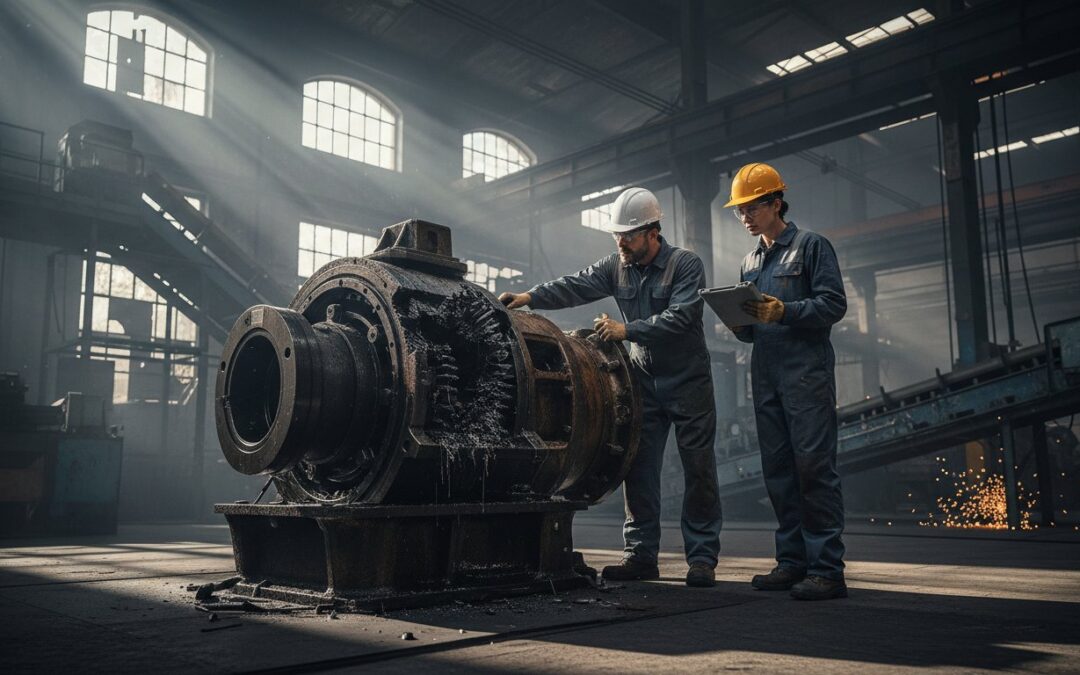
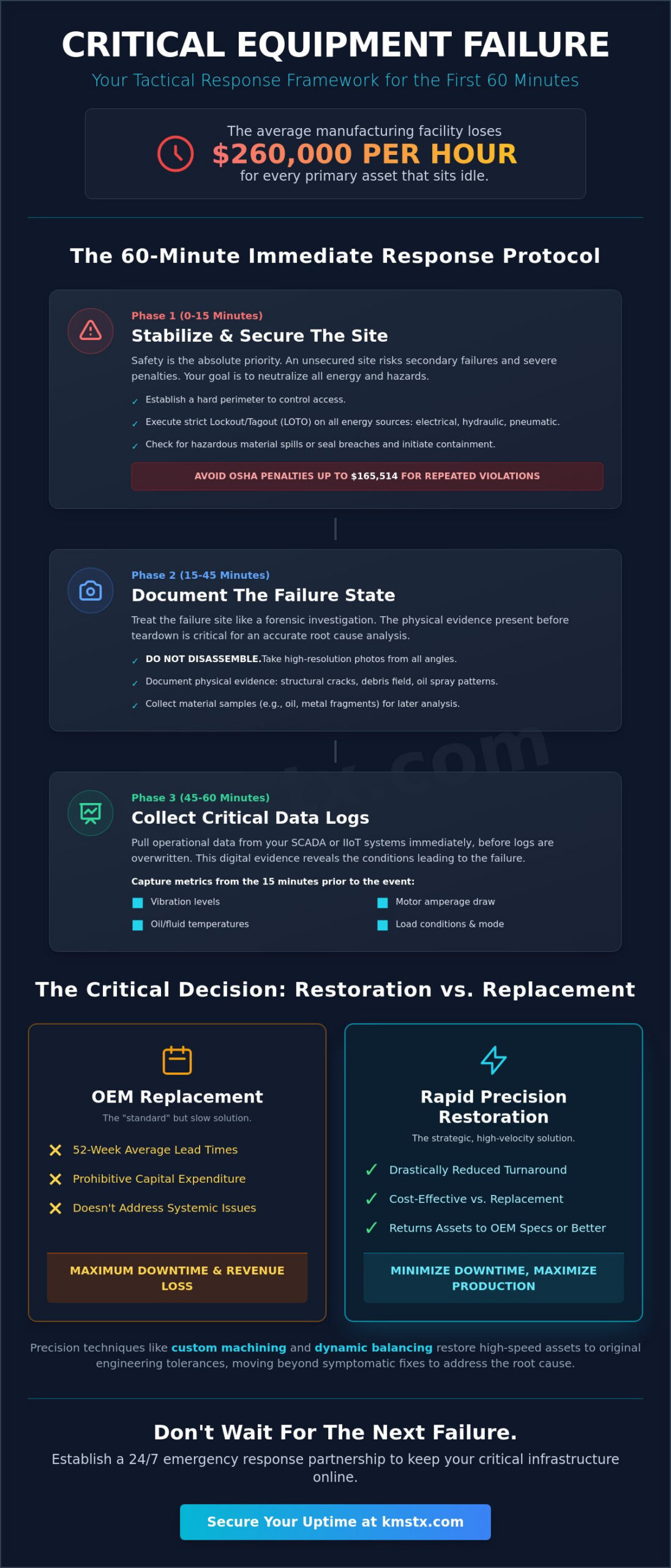
Did you know that the average manufacturing facility loses $260,000 every single hour a primary asset sits idle? When a critical gearbox or centrifuge seizes, the clock doesn’t just tick; it burns through your annual budget. Most operators know the stress of a sudden silence on the floor, but few have a documented protocol for what to do when critical equipment fails. It’s a high-stakes moment where a rushed decision can lead to safety risks or OSHA penalties that now reach up to $165,514 for repeated violations.
We understand that waiting months for an OEM replacement isn’t an option when production targets are on the line. This guide provides a tactical response framework to help you stabilize your site immediately and move toward a precision restoration. You’ll learn how to execute an accurate root cause diagnosis and utilize custom machining or dynamic balancing to bring your pumps, compressors, or blowers back to original specifications without the prohibitive lead times. We’re moving past the “quick fix” mentality to ensure your equipment runs better than it did before the breakdown.
Key Takeaways
- Master the 60-minute protocol to stabilize your facility and preserve critical evidence for root cause analysis immediately after a breakdown.
- Learn to identify the fundamental physics behind mechanical failures in gearboxes and compressors rather than just treating the visible symptoms.
- Get a clear framework for what to do when critical equipment fails by comparing the total cost of ownership between 52-week OEM lead times and rapid shop restorations.
- Understand how precision techniques like dynamic balancing and custom machining bring high-speed rotating assets back to original engineering tolerances.
- Discover the value of a 24/7 emergency response partnership to ensure your critical infrastructure stays online and your spare parts inventory is ready.
The 60-Minute Protocol: Immediate Steps After a Critical Failure
The silence following a catastrophic mechanical failure is often the most expensive sound a plant manager hears. When you’re deciding what to do when critical equipment fails, your response in the first 60 minutes dictates whether you face a standard repair or a multi-million dollar liability. This window is your only chance to stabilize the site and preserve the data needed for a successful restoration. You’ve got to move fast to keep people safe and keep the evidence of the failure intact.
To better understand the investigation process following a breakdown, watch this helpful video:
Safety stabilization is the absolute priority. You aren’t just looking at a broken machine; you’re looking at stored kinetic, thermal, and potential energy. OSHA serious violation penalties recently increased to $16,550, but the human cost of a secondary failure during inspection is far higher. Every technician on the floor must understand that the failure site stays untouched until it’s verified safe and all energy sources are locked out.
Safety Stabilization and Site Control
Start by establishing a hard perimeter. If a high-speed blower or centrifuge has suffered a rotor failure, the risk of housing penetration or thrown debris is real. You’ve got to verify that all energy sources are neutralized through strict Lockout/Tagout (LOTO) procedures. This includes electrical feeds, hydraulic pressure, and pneumatic lines. If you’re dealing with a pump or compressor handling hazardous materials, check for seal breaches immediately. Spills must be contained before they hit floor drains to avoid environmental compliance issues under ISO 14001:2026 standards.
Documenting the Failure State
Once the area is secured, understanding what to do when critical equipment fails means treating the site like a forensic investigation. Don’t let the maintenance crew start the teardown until you have high-resolution photos of the equipment from every angle. Start your failure analysis process by pulling the data logs from your SCADA or IIoT system right away. You need to capture specific metrics before they’re overwritten:
- Vibration levels across all bearing housings in the 15 minutes before the trip.
- Inlet and outlet temperatures for oil or process fluids.
- Motor amperage draw to check for sudden torque spikes.
- The exact load conditions and operational mode at the moment of the event.
Note any structural cracks or oil spray patterns on the floor. These details are the difference between a guess and an accurate diagnosis during the restoration phase. Capturing the state of the machine before disassembly ensures that the root cause isn’t lost in the rush to get back online.
Diagnostic Triage: Distinguishing Between Symptomatic and Root Failures
Once the site is stabilized, the real work begins. You can’t just look at a seized pump and call it “broken.” Knowing what to do when critical equipment fails requires a shift from basic maintenance to technical forensics. If you just swap out a bearing without asking why it failed, you’re simply scheduling your next outage. Research indicates a direct correlation between mechanical failures and industrial incidents and accidents; getting the diagnosis right isn’t just about production, it’s about ensuring the safety of every person on your floor.
Most failures represent the end of a long chain of physical stressors. While some might tell you it’s always a lubrication issue, we know that mechanical imbalances and metallurgical fatigue are the real drivers in heavy rotating gear. With the average facility experiencing 25 unplanned downtime incidents per month, moving beyond symptomatic fixes is a financial necessity. Vibration analysis often reveals the truth. A high-frequency peak might point to a bearing race defect, while a 1x RPM spike usually signals a fundamental balance problem. If you ignore these signals, even a brand-new part will fail prematurely under the same stress.
Common Failure Modes in Rotating Assets
In gearboxes, we often see a struggle between bearing seizure and gear tooth fatigue. If a bearing goes first, the resulting shaft misalignment can shred a gear set in minutes. In centrifugal systems and pumps, dynamic imbalance is the silent killer. It puts a cyclic load on seals and bearings that they weren’t designed to handle, leading to rapid degradation. We also look closely at contamination ingress. Even a few microns of grit in a hydraulic drive can act like liquid sandpaper, destroying precision-machined surfaces and causing internal pressure drops that baffle standard troubleshooting teams.
The Importance of Forensic Disassembly
You don’t find the root cause by looking at the outside of the housing. A controlled teardown is essential to inspect internal wear patterns and see if the load was distributed correctly. We utilize Non-Destructive Testing (NDT), such as dye penetrant or magnetic particle inspection, to find invisible cracks in shafts before they lead to a catastrophic snap. This level of detail is the core of effective rotating equipment maintenance. Adopting this forensic approach is part of a strategy that can yield a 10x return on investment compared to reactive models. If you’re currently facing an asset breakdown, our team can provide a detailed gearbox repair assessment to ensure your restoration is built on solid data, not guesswork.
Repair vs. Replace: Evaluating the Restoration Framework
When you’re staring at a seized asset, the immediate instinct is often to call the OEM for a replacement quote. However, the decision of what to do when critical equipment fails has changed significantly since the supply chain shifts of 2020. In the current market, age is rarely the deciding factor; availability is. You have to weigh the total cost of ownership (TCO) against the reality of your production schedule. A new unit might look good on paper, but if it doesn’t arrive for a year, the “newness” doesn’t help your bottom line today.
Refurbishment offers a strategic path that procurement often overlooks. Beyond just fixing what’s broken, a teardown allows us to assess the “upgradability” of the machine. We can often integrate modern seal designs or superior bearing materials that weren’t available when the equipment was first commissioned. Plus, a reputable shop restoration comes with warranty coverage that rivals a factory unit, giving you the same peace of mind without the 12-month wait.
The Lead Time Crisis in Modern Industry
The gap between ordering a new industrial centrifuge or gearbox and having it on your pad is widening. Current OEM lead times frequently stretch between 24 and 52 weeks. For a facility losing $260,000 per hour of downtime, that wait is a death sentence for annual production targets. This is where strategic industrial machine spare parts procurement becomes your bridge. If a component is obsolete, custom machining can recreate it to original tolerances in a matter of days. We’ve seen shop restorations completed in 2 to 4 weeks, getting a plant back to full capacity while the competition is still waiting for a shipping notification.
Performance Restoration Standards
Restoring an asset to OEM specifications isn’t just a marketing phrase; it’s a rigorous engineering standard. It means every tolerance is checked against the original blueprints and every rotating component undergoes dynamic balancing to eliminate the parasitic vibrations that caused the failure in the first place. Integrating a high-quality industrial gearbox repair into your capital expenditure plan allows you to extend the life of your infrastructure by another 10 to 15 years. You aren’t just patching a hole; you’re executing a precision overhaul that often results in a machine that runs smoother than the day it was first installed. When you’re figuring out what to do when critical equipment fails, remember that a precision-restored asset is often a more reliable bet than a generic replacement with a long lead time.
The Precision Restoration Process: From Teardown to Re-Commissioning
Once the decision is made to refurbish an asset, the process moves from the field into a controlled shop environment. This isn’t a simple “identify and replace” job. Knowing what to do when critical equipment fails at this stage requires a methodical teardown where every component is stripped, chemically cleaned, and inspected. You can’t see a hairline fracture on a gear tooth or a microscopic groove on a shaft journal if it’s covered in decades of baked-on lubricant and process debris. We take the machine down to the bare metal to ensure the foundation of the repair is sound.
Precision measurement is the backbone of this phase. We compare every critical dimension against the original engineering drawings or established industry standards. If a bearing housing has “egged” out by even a few thousandths of an inch, the new bearing won’t sit right, leading to a repeat failure within months. This level of scrutiny ensures that the restoration isn’t just a patch job but a return to a known, reliable state. If you are ready to move from a breakdown to a solution, you can request a precision restoration quote to get your project on the schedule.
Precision Machining and Component Restoration
When parts are out of tolerance, we don’t always need to wait for a factory replacement. We use CNC machining to fabricate high-tolerance parts that might be obsolete or have 52-week lead times. This includes re-sleeving bearing housings and restoring shaft journals to their proper interference fits. A major part of this process is precision dynamic balancing for all rotating elements. Dynamic balancing is the correction of mass distribution to eliminate centrifugal force issues. Without this step, high-speed gearboxes and centrifuges will vibrate themselves to pieces, regardless of how new the bearings are.
Testing and Quality Assurance
The job isn’t finished when the last bolt is torqued. Re-commissioning requires rigorous testing to prove the asset can handle its operational load. We perform spin tests to monitor thermal stability and ensure vibration levels stay within acceptable limits. Final seal pressure testing is also mandatory to prevent environmental leaks and stay compliant with current EPA regulations. By the time the asset leaves the shop, you have a documented record of its performance. This data-driven approach is exactly what to do when critical equipment fails if you want to avoid the cycle of “fix and fail” that plagues so many industrial operations.
- Full mechanical teardown to expose hidden metallurgical defects.
- Restoration of shaft journals to original interference fit specifications.
- Dynamic balancing of all rotating assemblies to G-level standards.
- Final load-testing to verify seal integrity and thermal stability.
Minimizing Future Downtime with Rapid Response Partners
The final step in any tactical response isn’t just getting the machine back on its pad; it’s ensuring you’re never caught off guard again. If you’re only thinking about what to do when critical equipment fails after the vibration sensors trip, you’re already behind the curve. High-stakes industrial operations require a pre-vetted network of experts who can move as fast as your production schedule demands. A proactive partnership transforms a catastrophic failure into a managed event, reducing the chaos and financial bleeding that usually follows a major asset seizure.
Reliability isn’t a static state. It’s the result of having a partner who understands the specific physics of your rotating gear and maintains the infrastructure to support it. With 25% of the manufacturing workforce now aged 55 or older, the internal knowledge gap is widening. This makes external technical expertise more valuable than ever. You need a team that doesn’t just read a manual but has the hands-on experience to identify a failing bearing or a misaligned shaft before it triggers a total plant shutdown.
Developing an Emergency Response Plan
Your emergency plan should be documented and ready for immediate execution. This starts with pre-vetting partners for emergency machine repair before the crisis hits. You’ve got to verify that your service provider has the actual crane capacity and shop floor square footage to handle your largest gearboxes or blowers. On-site field services are also a major factor. Having a team that can perform initial troubleshooting and extraction right at your facility saves hours of logistical headaches and gets the restoration process started in half the time.
The Kelsey Advantage: 40 Years of Industrial Expertise
Kelsey Machine Services has spent the last 40 years refining the art of industrial restoration. We’ve built our reputation on the technical overhaul of centrifuges, gearboxes, and high-speed compressors. We don’t just “fix” machines; we re-engineer them for longevity. Our shop is equipped for the precision work we’ve discussed, from custom machining obsolete components to high-level dynamic balancing. We maintain a deep spare parts inventory specifically to bypass the 52-week lead times that currently plague the OEM market.
- 24/7 emergency support to minimize the $260,000 per hour cost of unplanned downtime.
- Full-service repair for pumps, blowers, and hydraulic drives under one roof.
- Warranted restoration solutions that meet or exceed original factory specifications.
- Direct access to senior engineering staff for rapid root cause diagnosis.
If you’re currently managing a breakdown or looking to shore up your reliability strategy, don’t wait for the next alarm. You can contact our engineering team directly to discuss your specific equipment needs and establish a rapid response protocol that protects your bottom line.
Restoring Reliability Beyond the Breakdown
A catastrophic failure doesn’t have to be the end of an asset’s service life. By following a structured 60-minute protocol and prioritizing forensic diagnosis over quick fixes, you protect both your personnel and your production targets. You’ve seen that the choice of what to do when critical equipment fails often comes down to a balance between year-long OEM lead times and the precision of a professional shop restoration. Precision dynamic balancing and custom machining aren’t just luxuries; they’re the technical requirements for making an old machine perform to modern standards.
Kelsey Machine Services brings over 40 years of heavy industrial experience to every project. We specialize in the rapid turnaround of centrifuges, gearboxes, and pumps, utilizing proprietary dynamic balancing and precision machining to ensure every restoration meets the most demanding specifications. It’s our mission to get your floor back to peak capacity without the wait. Facing a critical failure? Contact Kelsey Machine Services for 24/7 Emergency Support. We’re ready to help you turn a mechanical crisis into a reliable, long-term solution.
Frequently Asked Questions
What are the most common causes of industrial equipment failure?
Mechanical fatigue and dynamic imbalance cause more catastrophic failures in heavy rotating gear than simple lubrication issues. While 50% of organizations still rely on manual maintenance tracking, the real killers are unseen vibrations and metallurgical stress. Identifying these root causes during a forensic teardown is the only way to stop a repeat failure from occurring within months of a restart.
Is it better to repair or replace a failed industrial gearbox?
Repair is often the superior choice because current OEM lead times for new gearboxes stretch between 24 and 52 weeks. If your facility is losing $260,000 per hour, you can’t afford to wait a year for a replacement. A precision restoration brings the asset back to original specs in 2 to 4 weeks while allowing for component upgrades that improve on the original design.
How long does a typical industrial centrifuge repair take?
A comprehensive industrial centrifuge repair typically takes 2 to 4 weeks depending on the extent of internal damage. This timeline includes the full mechanical teardown, chemical cleaning, precision machining of shaft journals, and dynamic balancing. Compared to the massive lead times for new units in 2026, this shop restoration is the most effective way to manage what to do when critical equipment fails.
Can critical rotating equipment be repaired on-site?
Initial troubleshooting and extraction often happen on-site, but the precision restoration of high-speed assets requires a controlled shop environment. You can’t perform dynamic balancing or CNC machining on a factory floor. We use on-site field services to stabilize the situation and extract the gear, then move it to our facility to ensure all tolerances meet original engineering drawings.
What is dynamic balancing and why is it necessary after a repair?
Dynamic balancing is the process of correcting mass distribution in a rotating assembly to eliminate centrifugal force issues. It’s mandatory after any repair because even a few grams of imbalance at high RPMs will destroy new bearings and seals. Without this step, your high-speed pumps or blowers will experience parasitic vibrations that lead directly to another catastrophic failure.
What should I do if my equipment fails and I don’t have spare parts?
If you lack spares, we use custom machining and CNC fabrication to recreate obsolete or out-of-stock components in-house. You don’t have to wait for a manufacturer to ship a part that might be backordered for months. Knowing what to do when critical equipment fails involves finding a repair partner who can manufacture precision parts to bridge gaps in your inventory.
How do I prevent catastrophic failure in high-speed rotating assets?
Adopting AI-driven predictive maintenance and regular vibration analysis can reduce unplanned downtime by 85%. By monitoring for small deviations in temperature or frequency, you can catch a failing bearing weeks before it seizes. Since 25% of the factory workforce is now over age 55, leveraging these automated sensors helps bridge the skills gap and prevents major structural damage.
What information does a repair shop need during an emergency call?
We need the equipment make and model, the exact time of the trip, and any recent SCADA data logs. Be prepared to describe the load conditions at the moment of failure and any visible signs of damage like oil spray or structural cracks. Having this data ready helps our engineering team perform a faster diagnostic triage and prepare the shop for your restoration.