
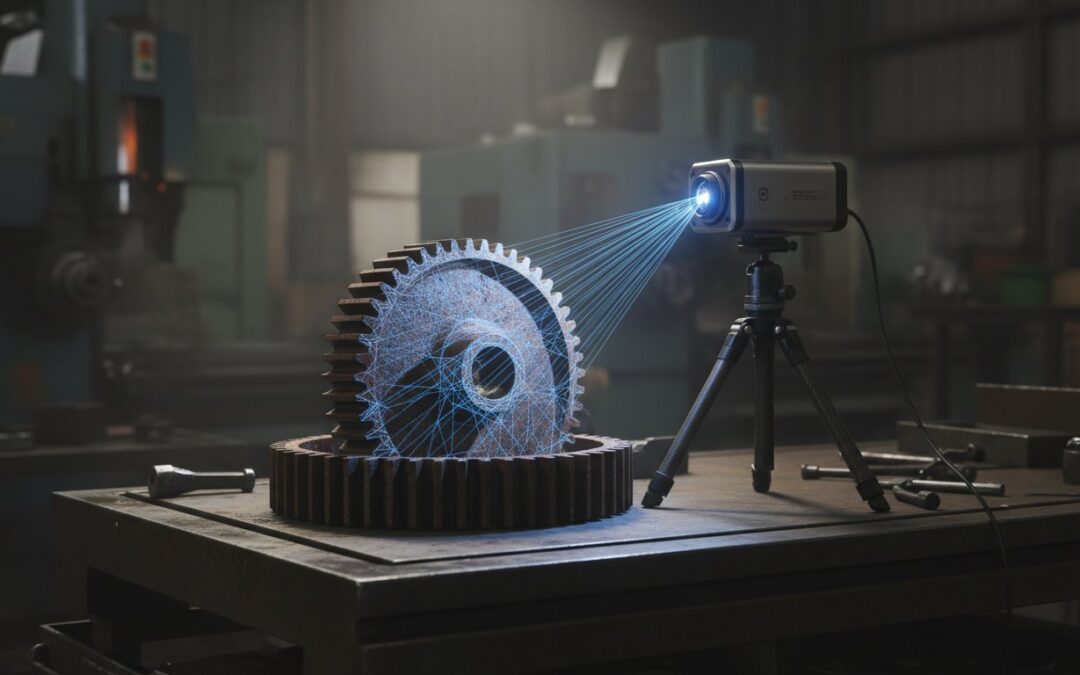
Last Tuesday, a facility manager in Houston watched a $45,000-per-hour production line grind to a halt because of a single sheared pinion gear. When the OEM quoted a 26-week lead time for a replacement, that downtime cost threatened to exceed $7.5 million before the part even arrived. You know as well as I do that waiting six months for a component isn’t just an inconvenience; it’s a structural failure in the supply chain. Utilizing reverse engineering machine parts is often the only way to bypass these bottlenecks when original technical drawings no longer exist.
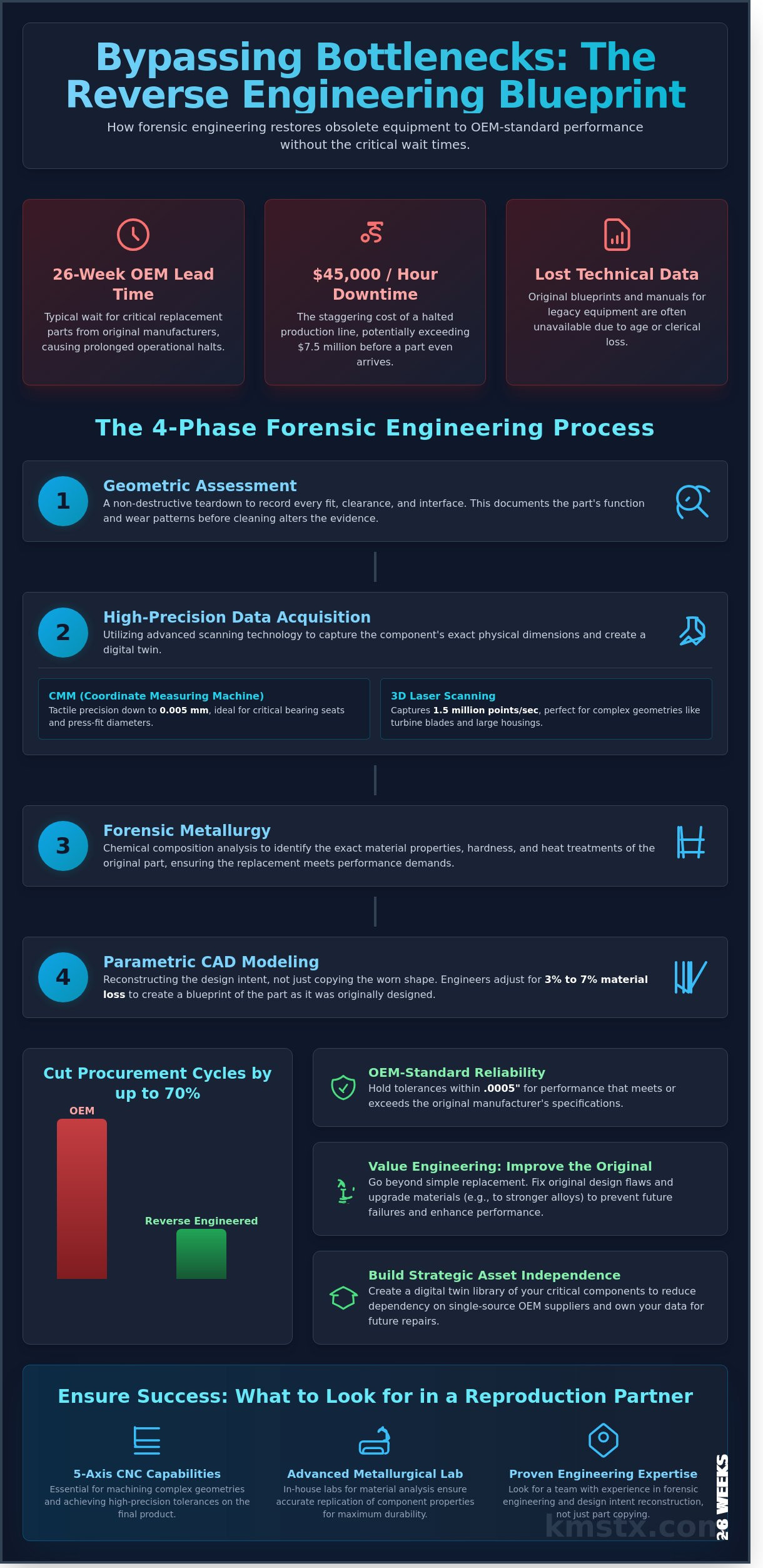
This guide will show you exactly how this precision restoration process restores your obsolete equipment to OEM-standard performance without the wait. We’ll break down the precision scanning process, material analysis, and the quality benchmarks required to ensure your new components meet or exceed the original specifications. You’ll see how to cut procurement cycles by 70% and secure a reliable source for high-precision replacements that keep your 24/7 operations running.
Key Takeaways
- Stop waiting months for OEM replacements by learning how forensic engineering bypasses supply chain bottlenecks to keep your critical machinery running.
- See how technicians use CMM and laser scanning to turn a worn physical part into a high-precision digital blueprint without damaging the original component.
- Get the facts on reliability and learn how reverse engineering machine parts can hold tolerances within .0005 for performance that rivals the original manufacturer.
- Look beyond simple replacement to “value engineering,” where you can fix original design flaws and upgrade materials to prevent future failures.
- Know what to look for in a reproduction partner, from 5-axis CNC capabilities to advanced metallurgical labs, to ensure your shop gets OEM-standard results.
The Industrial Obsolescence Crisis: Why Reverse Engineering is Essential
Maintaining heavy rotating machinery requires more than just a standard maintenance schedule; it requires a strategy for when the supply chain fails. In the context of industrial overhauls, reverse engineering machine parts is the process of deconstructing a physical component to document its design, material composition, and tolerances. This technical deep dive allows for the recreation of parts that are no longer available from the Original Equipment Manufacturer (OEM). It’s a reconstructive engineering approach that focuses on restoring functionality to assets that would otherwise be decommissioned.
The reality of the modern supply chain is grim for plant managers. Since 2021, lead times for specialized components like high-pressure seals or custom gear sets have ballooned to 30 weeks or more. This breakdown forces a difficult economic calculation. If a critical turbine or pump goes offline, the cost of downtime often hits $22,000 per hour for mid-sized processing facilities. When compared to the cost of custom fabrication, the investment in reverse engineering pays for itself in a matter of days. You’re looking for “Critical Path” components. These are the single points of failure that, if broken, stop the entire production line. When these parts aren’t on a shelf, reverse engineering becomes the only path forward.
The Problem with Legacy Equipment
Manufacturers frequently stop supporting hardware after a 15 year service life to encourage the purchase of newer models. This planned obsolescence leaves operators with 20 year old assets that are mechanically sound but functionally dead due to a single discontinued bracket or bearing housing. Technical manuals and original blueprints often disappear during corporate acquisitions or simple clerical errors over decades. Reverse engineering machine parts bridges this gap by using 3D laser scanning and material analysis to recreate the missing documentation, ensuring your legacy fleet stays operational without a total capital equipment replacement.
Beyond the Spare Part: Strategic Asset Management
Smart operations don’t wait for a catastrophic failure to act. They use reverse engineering to reduce their dependency on single-source OEM suppliers who dictate pricing and delivery schedules. By developing a digital twin library of your most vulnerable components, you’re building a rapid response kit for future repairs. This proactive approach integrates seamlessly with broader procurement strategies, such as those detailed in this industrial machine spare parts Texas guide. Creating a proprietary database of your machine specs means you own the data, giving you the power to choose local fabrication shops over international shipping delays.
The Forensic Engineering Process: From Physical Part to Digital Blueprint
The process of reverse engineering machine parts starts with a methodical, non-destructive teardown. Phase 1 involves a detailed geometric assessment where we record every fit, clearance, and interface in its current state. This stage is critical because it identifies how the part functioned within the assembly before 10,000 hours of operation or a catastrophic failure occurred. We document the baseline before any cleaning or disassembly alters the evidence of wear.
Phase 2 moves into high-precision data acquisition. We utilize 3D scanners and Coordinate Measuring Machines to capture the physical dimensions of the component. Phase 3 focuses on the “secret sauce” through forensic metallurgy and chemical composition analysis. Finally, Phase 4 involves parametric modeling. We don’t just create a static 3D mesh; we reconstruct the design intent by adjusting for the 3% to 7% material loss typically found on worn contact surfaces. This ensures the digital blueprint represents the part as it was originally engineered, not just as it looks today.
Precision Data Acquisition Techniques
Choosing between a CMM and a handheld laser scanner depends on the required tolerance for the specific application. A CMM provides tactile precision down to 0.005 mm, which is necessary for critical bearing seats and press-fit diameters. Handheld scanners capture 1.5 million points per second, making them better for complex turbine blade geometries or large pump housings. When we’re reverse engineering machine parts, capturing internal bores requires more than just a surface scan. We often use custom machining setups to hold parts in specific orientations, allowing us to map internal geometries with ultrasonic thickness gauges or borescope inspections.
Forensic Metallurgy: Identifying the Secret Sauce
A part’s shape is only half the battle. To ensure the restoration lasts, we use Optical Emission Spectroscopy (OES) to identify the exact alloy composition. Whether it’s a standard AISI 4140 steel or a 300-series stainless, knowing the chemistry is vital for weldability and corrosion resistance. Our process includes:
- Hardness testing: We use Rockwell C or Brinell scales to determine the depth of specific heat-treatment processes.
- Microstructure analysis: Identifying grain structures helps us replicate the original manufacturing method, such as forging versus casting.
- Thermal matching: We ensure the new material matches the thermal expansion and wear characteristics of the original to prevent seizing at 500-degree operating temperatures.
Matching these metallurgical properties prevents premature failure in high-stress environments. If you’re dealing with recurring component failures, our precision engineering services can help you identify why the original part failed and how to improve the replacement design.
OEM vs. Reverse Engineered: The Reliability and Tolerance Debate
The biggest concern plant managers have about reverse engineering machine parts is safety. They worry a non-OEM component might fail under load or cause premature wear. In reality, modern scanning and CNC machining often exceed the original manufacturing standards from 20 years ago. We aren’t just copying a shape; we’re hitting tolerances of +/- .0005 inches. This precision is vital for high-speed applications where even a hair’s breadth of deviation leads to excessive vibration and heat.
Understanding the “design intent” is just as important as the geometry. If a shaft has a specific fillet radius, it’s usually there to mitigate stress concentrations that lead to fatigue cracking. A quality shop looks at the wear patterns on the old part to determine if the original design was actually the weak point. We’ve seen cases where the reverse-engineered part performs better because we’ve corrected a design flaw the OEM ignored for decades.
The Tolerance Stack-Up Challenge
Precision doesn’t happen in a vacuum. When you’re dealing with an assembly, a .001 inch error on three different parts adds up to a .003 inch gap. That’s enough to ruin the fit of industrial bearings and seals, leading to oil leaks or bearing seizure. For rotating equipment, we use dynamic balancing to ISO 1940/1 standards. This ensures the final product won’t vibrate itself to pieces at 3,600 RPM. We don’t just measure the part; we measure how it interacts with the entire system.
Quality Assurance and Validation Protocols
Safety isn’t a guess; it’s a measurable protocol. Every part undergoes a rigorous first-article inspection to verify dimensions against the digital twin. We use Finite Element Analysis (FEA) to simulate 150% of the operational stress before the first chip is even cut. This data-driven approach proves the part can handle the load.
Choosing to invest in reverse engineering machine parts through a validated process gives you a documented trail of material certs and precision measurements. A warrantied repair from a reputable domestic shop is often more reliable than a “grey market” OEM part. These items frequently sit in humid warehouses for 10 years without quality documentation. By controling the manufacturing process, you ensure the metallurgy and dimensions meet the specific needs of your current operation.
Value Engineering: Improving Upon the Original Design
Reverse engineering machine parts provides a unique opportunity to address the inherent weaknesses found in original equipment manufacturer (OEM) components. Often, an OEM part is designed for a broad range of general applications rather than the specific, harsh conditions of your facility. By the time a part lands on a technician’s bench for inspection, the wear patterns usually tell a clear story. We frequently see recurring stress fractures in cast iron housings that weren’t built for the 20% increase in vibration seen in aging systems. Swapping these for 316L stainless steel or specialized 4340 chromoly alloys often extends the mean time between failures (MTBF) by 40% or more.
Durability often comes down to the details of geometric optimization. Adding a 3mm fillet to a sharp internal corner can reduce localized stress by nearly 50%. During a recent centrifuge repair project, we identified that the discharge ports were eroding prematurely due to high-velocity slurry. By thickening the wall section by 4mm and adjusting the exit angle, the replacement parts outlasted the originals by two full maintenance cycles. This process turns a simple replacement into a long-term reliability gain.
Correcting Original Equipment Flaws
Identifying the root cause is the first step in any successful rebuild. It’s not enough to just measure the broken pieces; you’ve got to understand why the metal gave up. This incremental design approach was central to a compressor refurbishment case study where we analyzed a failed crankshaft. By identifying a lubrication path bottleneck, the team didn’t just fix the break; they ensured the machine operated at 15% lower temperatures during peak loads. We use these data points to refine the geometry until the part is better than the day it left the factory.
Legal and Ethical Considerations
Legal boundaries regarding the “Right to Repair” are manageable if you focus on functional reproduction. While proprietary software or patented aesthetic designs are off-limits, creating a functional replacement for a mechanical part is a standard industry practice. Every component we produce must meet or exceed API 610 or ASME Section VIII standards to ensure safety. This isn’t about counterfeiting; it’s about keeping critical infrastructure running when the original supplier can’t or won’t provide support. We prioritize transparency and compliance to protect both the operator and the integrity of the machine.
If you’re dealing with recurring component failures, consult with our engineering team to discuss how material upgrades and design optimizations can stabilize your operations.
Selecting a Partner for Precision Part Reproduction
Choosing the right facility for reverse engineering machine parts determines whether a component lasts ten years or ten days. A standard machine shop often lacks the specialized instrumentation required for high-stress industrial applications. While a local job shop might replicate a simple bracket, they rarely possess the 5-axis CNC capabilities or the Coordinate Measuring Machine (CMM) technology needed for complex geometries. Precision requires more than a visual match; it demands a facility equipped with an advanced metallurgical lab to identify specific alloy compositions and heat treatment profiles that aren’t visible to the naked eye.
Reliability is measured by the ability to handle critical failures. In the energy and manufacturing sectors, downtime costs can exceed $50,000 per hour. Emergency response isn’t a luxury, it’s a requirement. You need a partner that offers 24/7 support and understands the urgency of a “machine down” situation. This includes having a robust supply chain for raw materials so that production can begin the moment the digital model is finalized.
High-speed rotating equipment requires a specific level of expertise that generalists don’t have. When a shaft or impeller rotates at 3,600 RPM or higher, even a microscopic imbalance leads to catastrophic vibration. Evaluate your partner’s history with dynamic balancing and their ability to hold tolerances within microns. If they can’t provide a detailed report on the component’s center of gravity and rotational stability, they aren’t equipped for the job.
Questions to Ask Your Engineering Partner
Before signing a contract, vet the provider’s technical depth. Do you have in-house metallurgical testing capabilities? Relying on third-party labs often adds 48 to 72 hours to a project. What is your process for verifying design intent versus just “copying the wear” on a damaged part? You don’t want a replica of a failed component; you want a part that functions as originally intended. Finally, confirm if they can provide oem specification repair documentation to maintain your site’s safety and insurance compliance.
The KMS Advantage in Precision Machining
KMS leverages 40 plus years of technical heritage in rotating equipment and geoscientific instrumentation to lead the industry in reverse engineering machine parts for high-stakes environments. Our proprietary approach to rapid part fabrication integrates high-precision balancing that meets ISO 1940-1 standards. We don’t just replicate geometry; we optimize the component’s metallurgical properties for its specific operating environment to extend its service life. Contact our engineering team for a technical consultation on your obsolete components to secure your operational uptime.
Modernizing Your Legacy Infrastructure Through Precision Reproduction
Industrial equipment doesn’t care about supply chain delays or discontinued OEM support. When a critical component fails, the technical process of reverse engineering machine parts becomes the most viable path to maintaining your facility’s uptime. It’s not just about copying a physical geometry; it’s about utilizing 2024-standard metallurgy and tighter tolerances to correct original design weaknesses. This value engineering approach ensures that the replacement part often outlasts the component it replaced.
Success in restoration depends on documented precision and field-tested expertise. At KMS, we’ve built 40+ years of industrial repair experience into every project we touch. We utilize in-house precision balancing and CNC machining to eliminate the variables that lead to premature wear. We know that a 3:00 AM equipment failure can cost an operation upwards of $10,000 per hour in lost production. That’s why we maintain a 24/7 emergency response protocol for critical infrastructure challenges. Don’t let an obsolete catalog number dictate your operational availability. Consult with our engineering team on your obsolete part challenges and keep your machines running at peak performance.
Frequently Asked Questions
Is reverse engineering legal for patented machine parts?
Reverse engineering machine parts for the purpose of internal repair and maintenance is generally legal under the “Right to Repair” doctrine. You aren’t violating 35 U.S.C. § 154 as long as you’re restoring a single unit for continued operation rather than manufacturing a patented design for commercial resale. Most industrial facilities use this method to keep legacy equipment running when OEMs no longer provide support for older models.
How long does the reverse engineering process typically take?
The process typically spans 5 to 14 business days depending on the component’s complexity. A standard shaft or gear might take 48 hours for initial 3D scanning and another 72 hours for CAD refinement. If the part requires metallurgical testing or stress analysis, expect the timeline to extend by an additional 120 hours to ensure technical accuracy.
Can you reverse engineer a part that is completely shattered or missing pieces?
You can absolutely reverse engineer a part even if 40% of the material is missing or shattered. Engineers use the mating components, such as the housing or the shaft the part sits on, to extrapolate the original dimensions. By utilizing 3D coordinate measuring machines, we can reconstruct the geometry based on the remaining 60% of the physical evidence and the known clearances of the machine.
Does reverse engineering a part void my original equipment warranty?
Installing a reverse-engineered part will likely void the OEM warranty on that specific assembly. However, since 85% of reverse engineering projects involve machines that are at least 15 years old, most of these units are already well past their original 12-month or 24-month coverage periods. It’s a calculated risk that’s often necessary when the manufacturer’s lead time for a replacement exceeds 20 weeks.
What is the cost difference between reverse engineering and buying from an OEM?
You’ll typically see a 35% to 50% cost reduction when reverse engineering machine parts compared to purchasing directly from an OEM. For a specialized turbine blade, an OEM might charge $12,000 with a 6-month wait, while a local restoration might cost $7,500. These savings are even more pronounced when you factor in the $5,000 per hour cost of unplanned downtime during a production halt.
How do you ensure the material properties match the original part?
Engineers use Optical Emission Spectroscopy to identify the exact chemical composition of the alloy. We follow ASTM E1476 protocols to ensure the new part matches or exceeds the original 4140 or 4340 steel specifications. Hardness testing via the Rockwell C scale ensures the heat treatment matches the 58-62 HRC requirements of the original design, preventing premature wear in high-friction environments.
What types of machine parts are best suited for reverse engineering?
High-wear components like centrifugal pump impellers, helical gears, and stepped shafts are the best candidates for this process. Parts that have a lead time of more than 16 weeks from the factory are prime targets for restoration. We often focus on components where the original manufacturer has gone out of business or no longer stocks spares for models built before 2005.
Can reverse engineering improve the lifespan of my equipment?
It’s common to see a 20% to 30% increase in component lifespan after a successful reverse engineering project. Because we can specify modern coatings like Tungsten Carbide or use higher-grade stainless steels that weren’t available when the machine was built in 1992, the part often outperforms the original. This technical upgrade directly improves the Mean Time Between Failures for the entire system.