Buying a brand new OEM unit in 2026 might actually be the riskiest financial move your facility makes this year. You’ve likely seen the quotes for new gearboxes and pumps lately; they’re enough to make any maintenance manager wince. With interest rates for equipment financing currently sitting between 7% and 14% for even the strongest borrowers, the process of calculating ROI on equipment refurbishment has become a critical survival skill for the modern plant floor. You’re facing unpredictable downtime and rising costs that eat into your margins every single quarter.
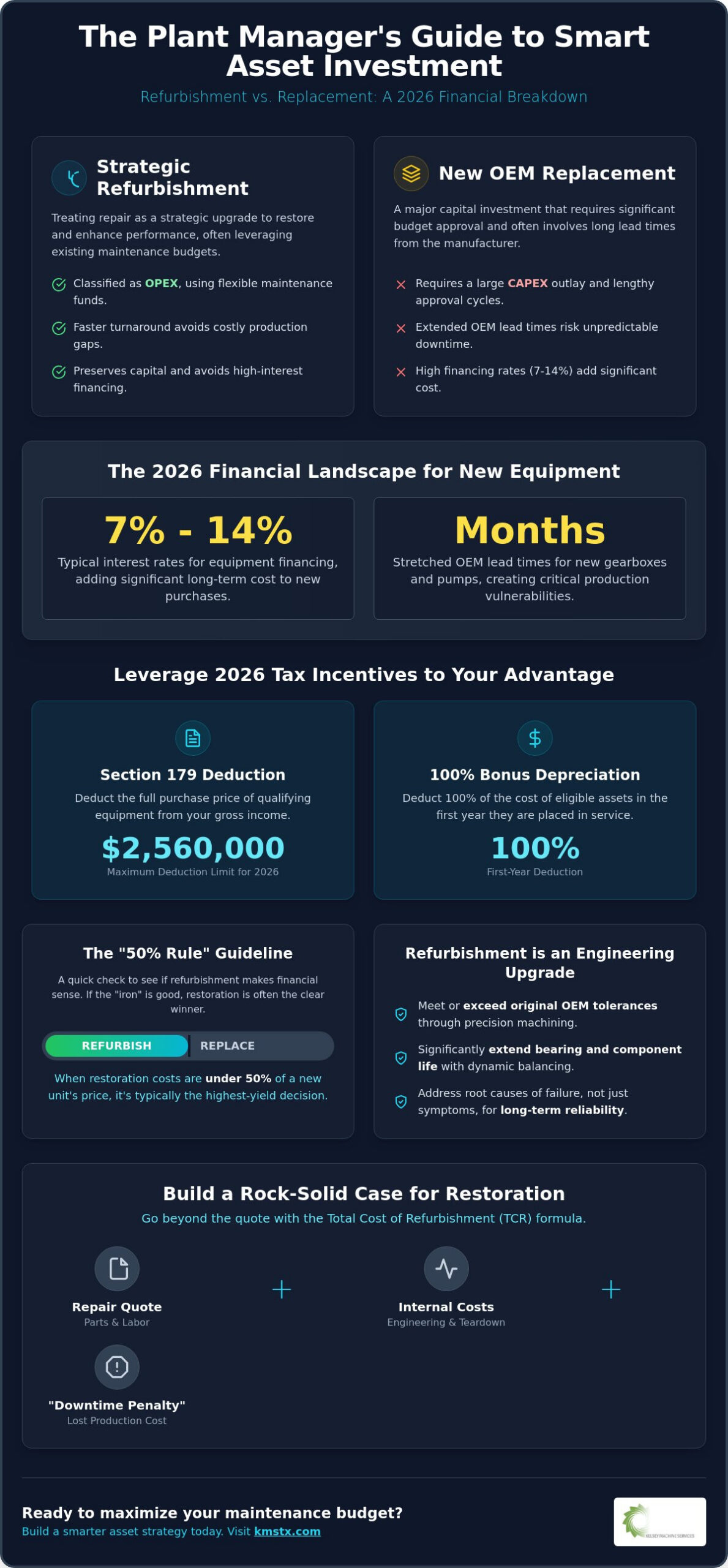
We understand that you need more than just a repair quote to win a budget battle. This technical guide focuses on treating the refurbishment process as a strategic engineering upgrade rather than a simple fix. We’ll show you how to quantify life-extension benefits and navigate the 2026 tax landscape, including the $2,560,000 Section 179 deduction limit and the current 100% bonus depreciation rules. You will learn how to build a rock-solid case for restoration that balances immediate cash flow with long-term mechanical reliability.
Key Takeaways
- Learn how to distinguish between CAPEX for new machinery and OPEX for restoration, providing a clear framework for calculating ROI on equipment refurbishment that satisfies upper management requirements.
- Master the Total Cost of Refurbishment (TCR) formula to account for engineering labor and teardown costs while factoring in the “downtime penalty” of non-operational assets.
- Understand the “50% Rule” to determine when the structural integrity of your equipment’s “iron” justifies restoration even when costs approach half the price of a new unit.
- Discover how precision services like dynamic balancing and custom machining can extend bearing life and ensure refurbished units meet or exceed original OEM tolerances.
- Leverage 2026 tax incentives, such as Section 179 and 100% bonus depreciation, to maximize the financial yield and cash flow of your maintenance budget.
The Economic Case for Industrial Equipment Refurbishment vs. Replacement
In the current industrial environment, deciding whether to scrap a worn gearbox or send it out for a full overhaul isn’t just about the repair bill. It’s a strategic calculation. When you are calculating ROI on equipment refurbishment, you’re measuring the ratio of net gain from life extension against the total cost of technical restoration. For most plant managers in 2026, the decision hinges on how quickly they can get an asset back into production without overextending their capital budget.
The financial distinction between Capital Expenditure (CAPEX) and Operational Expenditure (OPEX) is the primary driver here. Purchasing a new compressor or blower requires a heavy CAPEX outlay that often needs multiple layers of corporate approval. Refurbishment usually falls under OPEX, allowing you to use existing maintenance budgets to restore a machine to its original performance levels. This shift in spending category often makes the difference between a project that gets green-lit today and one that sits in a queue for six months.
To better understand the fundamentals of these financial calculations, watch this helpful video:
You also have to consider the Law of Diminishing Returns. There’s a sweet spot for restoration where the “iron,” meaning the heavy frames and housings, is still structurally sound even if the internal components are shot. If you wait too long and the main housing fails, the ROI drops significantly. However, with 2026 lead times for new OEM equipment still stretching out several months, refurbishing your current fleet is often the only way to avoid catastrophic production gaps. This process, often referred to as Remanufacturing, aims to bring the asset back to original or better specifications much faster than a new unit can be delivered.
Refurbishment as a Capital Preservation Strategy
Refurbishing protects your liquidity, which is vital when interest rates for equipment financing are hovering between 7% and 14% for most borrowers. By opting for a repair, you avoid high-interest debt while still gaining a reliable asset. From a tax perspective, the 2026 Section 179 deduction allows businesses to deduct up to $2,560,000 for eligible equipment; combining this with 100% bonus depreciation makes the math even more attractive. In the context of asset life-cycle management, refurbishment ROI is the net financial benefit derived from extending an asset’s service life divided by the total expenditure required for its technical restoration.
The Performance Gap: Refurbished vs. New
It’s a common misconception that a 10-year-old centrifuge can’t keep up with a brand new model. If the mechanical integrity of the frame is solid, precision machining can often bring old units back to modern tolerances. Ongoing rotating equipment maintenance plays a huge role in keeping that gap closed. Unless the new model offers a revolutionary technological leap that drastically cuts energy or chemical use, the mechanical restoration of your existing equipment usually provides a higher yield on your investment.
The Refurbishment ROI Formula: Quantifying Technical Restoration Value
Calculating ROI on equipment refurbishment requires looking far beyond the initial repair quote. To build a case that stands up to scrutiny from the front office, you need a formula that accounts for the technical reality of the shop floor. Most people make the mistake of only looking at the repair bill versus the purchase price, but that misses half the story. A true ROI calculation involves four distinct steps to capture the full financial impact of your decision.
To get an accurate number, follow this four-step process:
- Step 1: Identify the Total Cost of Refurbishment (TCR). This includes the obvious parts and labor, but don’t forget the engineering hours for teardown, inspection, and the logistical costs of transport.
- Step 2: Calculate Avoided Cost (AC). This is the total sum you would spend on a new unit, including the purchase price, the cost of professional installation, and the disposal fees for the old machine.
- Step 3: Estimate Life Extension (LE). Determine how many additional years of service the restoration provides and estimate the revenue the machine will generate during that specific window.
- Step 4: Apply the ROI Formula. Use this calculation: [(Avoided Cost + Revenue from LE) – TCR] / TCR.
This formula gives you a percentage that represents the technical restoration value. If your result is 150%, it means every dollar spent on refurbishment is returning that dollar plus another fifty cents in avoided costs and extended production revenue. It’s a much more robust way of looking at your maintenance budget than a simple cost comparison.
Calculating Avoided Capital Expenditure
The sticker price of new equipment is often just a distraction. In heavy industry, that price usually only represents about 60% of the true replacement cost. When you bring in a new model, you’re frequently forced to modify concrete foundations, reroute piping, or update electrical panels to match the new footprint. By choosing refurbishment, you’re preserving the value of your existing infrastructure. This is a major factor in the repair or replace equipment decision; if the “iron” is good, moving the bolts in the concrete is just wasted money.
Estimating Increased Productivity Gains
Productivity isn’t just for new machines. When you invest in restoring industrial gearboxes or pumps, you’re often improving torque efficiency and dropping energy consumption back to original specs. A worn unit might be slipping or vibrating, which creates heat and wastes power. Beyond the energy savings, a precision-refurbished unit often sees a significant delta in throughput and a reduction in product rejects. If you’re ready to see how these numbers look for your specific fleet, a detailed technical assessment can help pinpoint exactly where your current units are losing efficiency.
Factoring in Total Cost of Ownership (TCO) and Operational Downtime
When you’re deep into calculating ROI on equipment refurbishment, focusing only on the repair bill is a trap. You have to look at the Total Cost of Ownership (TCO). This metric includes every dollar you’ll spend on maintenance, energy consumption, and reliability over the next five to ten years. A refurbished asset often carries a lower TCO because your team already knows the machine’s quirks and maintenance schedule. You aren’t starting from scratch with a new, unproven system that might require a completely different set of specialized tools or lubricants.
The “Downtime Penalty” is the most aggressive variable in your ROI equation. To find your cost per hour, you need to calculate the total lost revenue during a stoppage and add it to your fixed overhead costs that continue to run. If a critical centrifuge or blower stops, the bill isn’t just the repair; it’s the idle labor and missed shipment deadlines. In 2026, the gap between refurbishment and replacement has widened due to supply chain realities. While a comprehensive refurbishment might take four weeks, lead times for new OEM equipment are frequently stretching to 26 weeks or more. That 22-week difference represents pure production time that a new unit simply can’t recover.
Consider these hidden TCO variables that often get overlooked in initial budget meetings:
- Spare Parts Inventory: The cost of stocking entirely new components for a different model.
- Training Requirements: Time spent getting operators and mechanics up to speed on new interfaces.
- Integration Labor: The man-hours required to tie a new machine into your existing SCADA or ERP systems.
- Legacy Disposal: The logistical and environmental fees associated with decommissioning old “iron.”
The Hidden Costs of New Equipment Integration
Buying new often introduces software compatibility headaches. Many 2026 OEM models feature proprietary control systems that don’t always play nice with legacy plant infrastructure. You also have to factor in the “learning curve” cost; even the best operators make more errors during the first month with a new machine. This is where having a reliable source for industrial machine spare parts for your current fleet becomes a massive TCO advantage. You’re leveraging parts you already understand and stock.
Mitigating Downtime through Rapid Field Service
The speed of your service partner directly dictates the “D” in your ROI calculation. If a restoration takes too long, the avoided cost of a new unit is quickly eaten up by lost production. Utilizing emergency machine repair services can dramatically shorten the refurbishment cycle. Rapid turnaround times directly increase your ROI percentage by putting the asset back into the revenue-generating column weeks or months ahead of a new replacement. It’s about getting the machine back on its foundation and running at full capacity as quickly as possible.
Strategic Decision-Making: When Refurbishment Offers the Highest Yield
Shop veterans usually rely on the “50% Rule” as a standard benchmark. The logic is simple. If the cost of restoring a machine exceeds half the price of a new unit, you start looking at the scrap yard. But calculating ROI on equipment refurbishment in 2026 requires a more flexible threshold. With current financing rates and those long OEM lead times we discussed earlier, it often makes financial sense to push that limit to 60% or even 70% if the core “iron” is solid. The real value is often locked in the housings and frames. If these heavy components are structurally sound, you’re essentially getting a new machine in an old skin for much less money.
This strategic logic is especially relevant for high-value rotating assets. Investing in industrial centrifuge repair for specialized decanter or disc stack models usually yields a higher return than a full replacement. These units are engineered to serve for decades. As long as the rotating assembly hasn’t suffered catastrophic fatigue, a precision overhaul returns them to like-new performance levels. However, you have to know when to call it. If an audit reveals stress cracks in the main casting or severe erosion that compromises the vessel’s pressure rating, the ROI disappears. In those cases, the risk of a catastrophic failure outweighs the savings.
The Technical Audit: Inspection-Based ROI
Guesswork has no place in your maintenance budget. A reliable ROI calculation starts with a full teardown and a detailed inspection report. Utilizing Non-Destructive Testing (NDT), such as ultrasonic thickness gauging and dye penetrant inspection, allows you to validate the structural integrity of the machine before any metal is cut. This data-driven approach ensures you aren’t throwing good money after bad. Interestingly, a teardown often reveals that precision machining can actually improve on the original OEM design. It allows for the correction of historical flaws, such as undersized bearing seats or poor seal fits, that might have caused the unit to fail prematurely.
Environmental and Sustainability ROI
Sustainability is no longer just a corporate buzzword. Keeping tons of high-grade steel out of a landfill provides a measurable “Green ROI” that helps meet carbon footprint reduction targets. Beyond the environmental impact, refurbishment offers a chance to integrate energy-efficient upgrades. Installing high-efficiency seals or optimized internal components during the restoration process often allows the machine to pay for its own repair through lower utility bills and reduced chemical consumption over the next few years.
If you’re looking at a piece of equipment and aren’t sure if it’s past its prime, request a technical teardown and inspection to get the hard data you need to make a confident decision.
Maximizing Asset Lifespan through Precision Machining and Engineering
The technical execution of the repair is where your paper ROI becomes a reality on the plant floor. You can’t just slap in new bearings and call it a day. To truly maximize the lifespan of a rotating asset, you need to address the root causes of wear that the original manufacturer might have overlooked. When you’re calculating ROI on equipment refurbishment, the quality of the machining and the precision of the final assembly are the variables that determine if a machine lasts five years or fifteen.
At Kelsey Machine Services, we’ve spent over 40 years collecting technical data on how different machines fail in the field. We use this historical database to optimize every refurbishment. It’s not just about getting a pump or compressor back to “running condition”; it’s about utilizing custom machining to fabricate parts that actually exceed original OEM tolerances. By tightening these fits and using superior modern alloys, we often produce a unit that is more reliable than it was the day it left the factory.
The Role of Precision Dynamic Balancing
A balanced rotor is the single most important factor in long-term ROI. Even a tiny amount of unbalance at high RPM creates massive centrifugal forces that beat up your bearings and seals. By utilizing dynamic balancing, we eliminate the vibration that leads to premature fatigue. This process also reduces parasitic energy loss; a smooth-running machine simply draws less power. As vibration levels decrease through precision balancing, the Mean Time Between Failures (MTBF) increases exponentially, directly protecting the capital you’ve invested in the restoration.
Engineering Beyond OEM Specifications
Operationalizing Your Restoration Strategy
Refurbishing your critical rotating assets is about more than just dodging a high equipment financing rate. It’s a calculated move to reclaim production time and optimize your existing infrastructure. By shifting from a simple repair mindset to a strategy of engineering upgrades, you can often produce a machine that runs smoother and longer than its original OEM version. We’ve covered the technical variables of calculating ROI on equipment refurbishment, from the 26-week lead time gap to the long-term benefits of precision dynamic balancing.
With over 40 years of heavy industrial repair expertise and a full-service machine shop, we understand exactly what’s at stake when a centrifuge or gearbox goes down. Whether you need 24/7 emergency field service or a deep-dive technical audit to justify your maintenance spend, we have the data and the tools to support your decision. Don’t leave your 2026 budget to guesswork. Request a technical evaluation and ROI analysis for your rotating equipment today to see the hard numbers for yourself. Your fleet has more life in it than you think.
Industrial Refurbishment: Frequently Asked Questions
How do I calculate the payback period for an equipment refurbishment project?
You calculate the payback period by dividing the total cost of the technical restoration by the projected monthly revenue or cost savings the machine generates. For example, if a restored pump saves a facility a specific amount in monthly energy and maintenance while the repair cost a certain total, the months required to break even is your payback. This metric helps you understand how quickly the asset returns to a profitable state.
What is the typical ROI percentage for refurbishing a decanter centrifuge?
While specific outcomes depend on the machine’s condition, many industrial operators see a yield exceeding 150% when calculating ROI on equipment refurbishment for decanter centrifuges. This high percentage stems from the massive delta between a technical overhaul and the high purchase price of a new unit. When you factor in the avoided 2026 lead times for new machinery, the financial case becomes even more compelling.
Is it better to use OEM or aftermarket parts to maximize refurbishment ROI?
Maximizing ROI isn’t always about the brand on the box; it’s about the precision of the fit. Custom machining often allows for the fabrication of parts that meet or exceed original tolerances. Utilizing high-quality aftermarket components can significantly lower your total cost of refurbishment without compromising the machine’s mechanical integrity or its projected service life. It’s about finding the best technical solution for the specific application.
How does equipment downtime affect the total ROI calculation?
Downtime acts as a major multiplier in your ROI equation. If a new machine has a 26-week lead time and a refurbishment only takes four weeks, those 22 weeks of extra production are counted as avoided costs. You have to factor in the revenue lost every hour the machine sits idle to get a true picture of the restoration’s value. Speed to production is often the most valuable part of the deal.
Can refurbishing older machinery help meet 2026 sustainability goals?
Restoration is a core practice of the circular economy and directly supports 2026 ESG targets. By keeping heavy steel frames out of landfills, you’re significantly reducing your facility’s carbon footprint. Additionally, integrating energy-efficient upgrades like modern high-efficiency seals during the process helps meet stricter environmental regulations while lowering your long-term total cost of ownership. It’s a win for both the planet and the budget.
What technical signs indicate that refurbishment will no longer provide a positive ROI?
Terminal signs include stress cracks in the main casting, severe erosion that compromises pressure ratings, or structural fatigue in the “iron” that precision machining can’t fix. If the core housing is compromised, the cost of restoration often approaches the price of a new unit. At that point, the mechanical risk usually outweighs the financial savings, making replacement the more logical path forward for long-term reliability.
How does dynamic balancing impact the long-term ROI of rotating equipment?
Dynamic balancing is the single best way to protect your repair investment over the long haul. By eliminating vibration, you’re directly extending the life of your bearings and seals. This process ensures the machine hits its projected mean time between failures (MTBF), preventing premature breakdowns that would otherwise tank your ROI. A smooth-running machine also draws less power, adding energy savings to the equation.
Should I factor in operator training when calculating the ROI of a new vs. refurbished unit?
You absolutely should include training costs when calculating ROI on equipment refurbishment compared to a new purchase. New units often come with proprietary software or complex interfaces that require expensive staff training and cause initial production errors. Refurbished equipment leverages your team’s existing expertise, which eliminates the learning curve and keeps your operational costs predictable from the moment the machine is reinstalled.