A single vibrating gearbox or a compromised centrifuge seal isn’t just a line item on a maintenance report. It’s a high-stakes risk to your facility’s safety and bottom line. When you’re managing aggressive chemicals and tight production schedules, you’ve likely seen how quickly unplanned downtime can spiral into a massive financial headache. Finding a partner who understands the specific tolerances required for equipment repair for chemical processing industry assets is often the difference between a long-term fix and a catastrophic failure just weeks after a restart.
We agree that your rotating machinery deserves more than a “patch and pray” approach. This technical guide breaks down the expert-level restoration processes needed to ensure your pumps, blowers, and gearboxes achieve zero-leakage reliability. You’ll learn how precision machining and dynamic balancing can push your asset lifecycle further than ever before. We are diving deep into the documented standards and shop-floor realities that keep chemical plants running safely in 2026.
Key Takeaways
- Understand why standard maintenance isn’t enough for chemical plants and how to combat chemical-induced corrosion and thermal stress.
- Learn the technical requirements for restoring critical rotating assets like centrifuges and gearboxes to OEM-grade tolerances.
- Discover how precision machining and dynamic balancing eliminate vibration and ensure zero-leakage reliability in high-pressure environments.
- See why equipment repair for chemical processing industry requires a 24/7 emergency response and a robust spare parts strategy to protect your bottom line.
- Gain insights into the teardown and NDT procedures that document asset health and extend the operational lifecycle of your most expensive machinery.
The Critical Role of Equipment Repair for Chemical Processing Industry
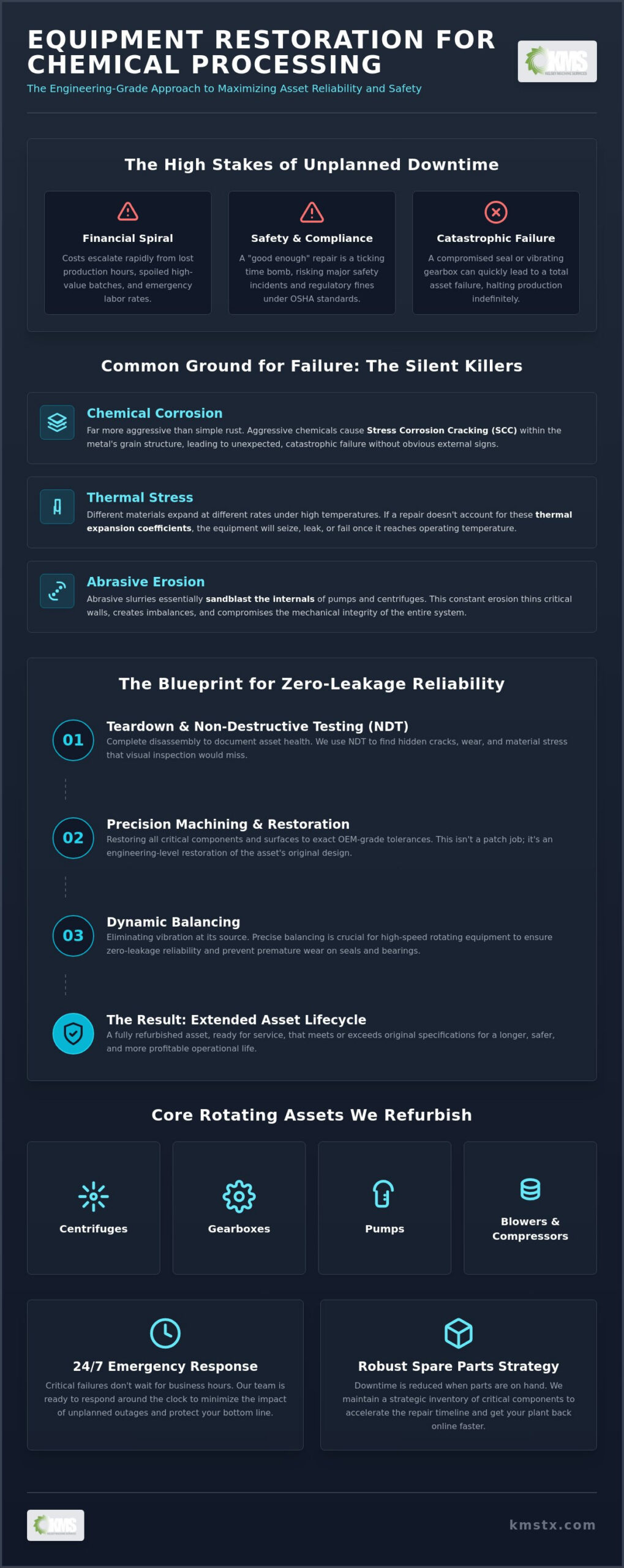
Chemical processing plants operate in an environment where margins for error simply don’t exist. Whether you’re dealing with volatile hydrocarbons or highly corrosive acids, the mechanical integrity of your facility is the only thing standing between a productive shift and a major safety incident. In this high-stakes setting, equipment repair for chemical processing industry assets isn’t just about turning a wrench; it’s a technical discipline. Rotating equipment like centrifuges, gearboxes, and pumps serve as the heartbeat of these operations. When that heartbeat stutters, the financial consequences are immediate and often staggering.
The cost of unplanned downtime goes far beyond lost production hours. You have to account for spoiled batches, emergency labor rates, and the potential for regulatory fines. With the U.S. maintenance, repair, and operations (MRO) market projected to grow to $4.45 billion by 2034, it’s clear that facilities are moving away from the “run to failure” mentality. Modern plants are adopting rigorous industrial equipment maintenance programs that focus on complete mechanical refurbishment. This shift from reactive fixes to engineering-grade restoration is what keeps a plant profitable over decades.
To better understand the nuances of technical service in this field, watch this helpful video:
Basic vs. Specialized Chemical Processing
Basic chemical production, like petrochemical refining, involves massive volumes and continuous flow that put immense stress on large gearboxes and high-volume pumps. Specialized chemical processing, such as fine chemical blending or pharmaceutical refining, demands even tighter precision. In these specialized environments, even a minor deviation in a centrifuge’s balance or a pump’s seal can contaminate an entire batch of high-value product. Common assets found in both sectors include blowers, compressors, and hydraulic drives. Each of these requires specialized equipment repair for chemical processing industry standards to ensure they don’t fail under the pressure of 24/7 operations.
Why OEM Standards Matter in Chemical Environments
In a corrosive or high-pressure chemical setting, a “good enough” repair is essentially a ticking time bomb. Cutting corners on tolerances or using sub-par replacement parts often leads to premature failure and environmental hazards. Adhering to OEM standards is vital for meeting OSHA 29 CFR 1910 safety regulations and maintaining your facility’s permit to operate. Professional refurbishment restores the asset’s original design intent, which is the only way to guarantee mechanical integrity. This level of precision doesn’t just prevent leaks; it significantly extends the lifecycle of multi-million dollar assets, protecting your long-term capital investment.
Technical Challenges in Chemical Equipment Restoration
Corrosion in a chemical environment is far more aggressive than simple atmospheric oxidation. It acts as a silent killer for rotating machinery, often manifesting as stress corrosion cracking (SCC) within the grain structure of high-speed shafts or centrifuge bowls. When performing equipment repair for chemical processing industry clients, we frequently find that standard 316 stainless steel isn’t enough to withstand the environment. Managing these technical hurdles requires a deep understanding of material science and how specific chemicals interact with alloys at varying temperatures and pressures.
Thermal stress is another major factor that many general repair shops overlook. In high-temperature chemical reactions, different components expand at different rates. If a technician doesn’t account for these thermal expansion coefficients during precision machining, the equipment will likely seize or leak once it reaches operating temperature. Abrasive slurries add another layer of complexity, essentially sandblasting the internals of pumps and centrifuges. This erosion thins out critical walls and compromises the mechanical integrity of the entire system.
Corrosion and Erosion Management
Identifying SCC early is critical because it leads to catastrophic mechanical failure without any visible warning. We utilize non-destructive testing (NDT) to find these microscopic cracks before they propagate through a rotor or impeller. Restoring surfaces damaged by aggressive agents often involves specialized cladding or the application of protective coatings designed to resist specific pH levels. Selecting the right alloys, such as Duplex stainless steel or nickel-based superalloys, is a standard part of any high-level chemical equipment refurbishment.
Seal and Bearing Integrity
Mechanical seal failure remains the leading cause of unplanned downtime in chemical facilities. Because these seals are the primary barrier between hazardous chemicals and the environment, their integrity is non-negotiable. Pump reliability depends heavily on the precision fitment of these seals and the selection of bearings that can handle chemical-specific load profiles.
Bearings in these environments often face “washout” from chemical ingress or premature fatigue from vibration caused by imbalanced rotors. Ensuring a precision fit during the reassembly phase is the only way to prevent hazardous leaks. If you are dealing with recurring seal failures, it might be time to look at custom machining solutions that address the root cause of the wear rather than just replacing the damaged parts. This proactive approach turns a simple repair into a long-term reliability upgrade.
Core Asset Refurbishment: Centrifuges, Gearboxes, and Pumps
The “big three” of chemical processing—centrifuges, gearboxes, and pumps—are the components most likely to suffer from the corrosive and thermal stressors we’ve already discussed. While general machine shops might offer basic service, equipment repair for chemical processing industry assets requires a much higher level of engineering precision. If a decanter centrifuge isn’t balanced perfectly, the massive G-forces involved can cause catastrophic failure at high speeds. Similarly, a gearbox with a poor gear tooth contact pattern will overheat and fail under the heavy torque loads required for continuous chemical mixing.
High-volume pumps are the workhorses of corrosive fluid transfer. Maintenance here isn’t just about the mechanical seal; it’s about the hydraulic performance of the impeller and the internal clearances within the volute. Even a small increase in clearance due to erosion can lead to a massive drop in efficiency and significantly higher energy costs. Because these assets are so critical, the decision to repair or replace must be based on a rigorous technical assessment of the machine’s core integrity.
Industrial Centrifuge Repair and Maintenance
Refurbishing decanter and disc stack centrifuges is a highly specialized task. It involves far more than just swapping out bearings and seals. We perform a complete evaluation of the scroll, the integrity of the bowl, and the precision of the planetary gear units. Every micron counts when your equipment is spinning at thousands of RPMs. Restoring these parts to OEM specifications is the only way to ensure safe operation in a chemical environment. If you’re looking for more detail on the specifics of this process, check out our guide on industrial centrifuge repair Texas.
Gearbox Refurbishment for Heavy Chemical Drives
For heavy chemical drives, the gearbox is the literal muscle of the operation. Whether you’re running a planetary or helical design, we perform a full teardown to inspect for pitting, fatigue, or gear tooth wear. The gear tooth contact pattern is the most critical check in the shop; it tells us exactly how the load is distributed across the teeth during operation. Misalignment here leads to rapid wear and eventual failure. You can find a deeper dive into these engineering standards in our article on industrial gearbox repair Houston.
The Repair vs. Replace Framework
Chemical plant decision-makers often struggle with the “Repair vs. Replace” dilemma. We generally recommend looking at the 50% rule: if the refurbishment cost exceeds half the price of a new unit, replacement might be considered. However, you also have to factor in the lead time. A new OEM unit can take months to arrive, whereas expert equipment repair for chemical processing industry assets can often be completed in a fraction of that time. If the core casting is sound and the tolerances can be restored through custom machining, refurbishment is almost always the faster and more cost-effective choice to maintain your plant’s reliability.
The Precision Restoration Process: From Teardown to Balancing
The restoration of high-speed rotating equipment begins with a meticulous teardown that leaves no bolt unturned. We don’t just look for obvious breakage; we use non-destructive testing (NDT) to find the damage the naked eye misses. Methods like dye penetrant, ultrasonic testing, and magnetic particle inspection allow us to see through the surface of the metal. In the context of equipment repair for chemical processing industry assets, these early steps are where we identify the microscopic stress corrosion cracking or intergranular corrosion that often leads to catastrophic failure. Once we have diagnosed the root cause of the wear, we move into the heavy lifting of mechanical restoration.
Every step of this process is documented to provide a clear audit trail of the work performed. This data is vital for your facility’s reliability-centered maintenance (RCM) records. We focus on restoring the mechanical integrity of the asset by addressing the specific stressors it faces in your plant’s unique chemical environment. This isn’t a “one size fits all” repair; it is an engineering-grade refurbishment designed to meet or exceed the original design intent of the machine.
Precision Machining and Custom Fabrication
Precision machining is the phase where we bring the equipment back to life. Often, a corrosive chemical environment has eaten away at critical dimensions, meaning standard replacement parts simply won’t fit correctly. We utilize CNC technology for custom component fabrication, allowing us to restore shaft fits and bearing housings to exacting standards. This custom approach is necessary because ‘off-the-shelf’ components frequently lack the specific material grade or precise tolerances required for high-pressure chemical service. By machining parts in-house, we ensure perfect concentricity and interference fits that prevent the micro-vibrations that kill bearings.
Dynamic Balancing: The Key to Equipment Longevity
Dynamic balancing is the final, non-negotiable step before reassembly. Even a perfectly machined rotor will vibrate itself to pieces if the weight distribution is off by just a few grams. Mechanical imbalance is the leading cause of premature bearing and seal failure in centrifuges and pumps. For heavy rotors, we perform multi-plane dynamic balancing to ensure the machine runs smooth across its entire operating range, from startup to full production speed. This step is what protects your most expensive components from fatigue. If you need to stabilize your machinery, our precision dynamic balancing services Houston are designed to meet the strictest industrial standards for 2026.
Final assembly and testing are where the entire process is validated. We don’t just put the machine back together and ship it; we run the equipment under load to check for heat signatures, vibration levels, and seal integrity. This rigorous testing protocol ensures the asset is ready for the aggressive realities of chemical service. If your facility is currently struggling with repeat failures or excessive vibration, you should contact our technical team today to discuss a precision restoration plan for your rotating assets.
Maximizing Reliability with Emergency Support and Spare Parts
When a critical pump or centrifuge goes down at 2 AM on a Tuesday, your facility’s reliability plan is put to the ultimate test. In the chemical industry, continuous processes don’t have “off hours,” which means your service provider shouldn’t either. Effective equipment repair for chemical processing industry assets relies heavily on a rapid-response infrastructure that can handle everything from on-site troubleshooting to full-scale shop overhauls under tight deadlines. You need a partner who understands that every hour of lost production is a direct hit to the bottom line.
Choosing between field service and a full shop repair often comes down to the depth of the mechanical failure. Minor seal leaks or bearing adjustments might be handled on-site to get you back online quickly. However, when the issue involves internal gear damage or rotor imbalance, pulling the unit for a controlled shop environment is the only way to ensure the precision restoration we’ve discussed in previous sections. For facilities operating in high-pressure corridors, having access to emergency machine repair Gulf Coast teams can be the difference between a 24-hour turnaround and a week of lost production.
24/7 Emergency Response for Chemical Plants
Rapid response is more than just answering the phone; it’s about having the logistics in place to extract heavy machinery and begin the teardown process immediately. We’ve seen cases where a critical centrifuge failure threatened a total plant shutdown during a turnaround. In those scenarios, every hour saved in transport and diagnostic testing is worth thousands in recovered revenue. Our teams are trained to stabilize the situation on-site before facilitating a rapid move to the shop for the precision work that field tools simply can’t match. This 24/7 capability ensures that equipment repair for chemical processing industry clients is always a priority, not a scheduled convenience.
Strategic Parts Procurement and Inventory
The biggest bottleneck in any industrial repair isn’t usually the labor, it’s the lead time on specialized components. A robust industrial machine spare parts Texas inventory is essential for minimizing these delays. We maintain a deep stock of high-wear items to keep your project moving, including:
- Precision-grade bearings and chemical-resistant mechanical seals
- High-torque gears for planetary and helical drives
- Custom-machined shafts and sleeves for common pump and blower models
By sourcing both OEM and high-quality aftermarket components, we can often bypass the months-long wait times seen in the global supply chain. This strategic approach to inventory ensures that once your equipment is on our floor, the repair process doesn’t stall waiting for a single seal or bearing. It’s about having the right parts and the right expertise ready the moment the emergency call comes in.
Securing Your Plant’s Mechanical Integrity
Reliability in a high-pressure environment isn’t a result of luck. It’s the outcome of rigorous engineering and precision maintenance. We have explored how combating chemical-induced corrosion and maintaining strict tolerances through dynamic balancing can significantly extend the lifecycle of your rotating assets. By prioritizing engineering-grade equipment repair for chemical processing industry machinery, you move from reactive troubleshooting to a proactive strategy that ensures zero-downtime performance.
Kelsey Machine Services brings over 40 years of technical expertise to every project. Whether you’re dealing with a compromised centrifuge or a failing gearbox, our 24/7 nationwide emergency support and full-service precision machining are ready to restore your equipment to OEM standards. Don’t let unplanned downtime dictate your production schedule. When your critical assets need expert attention, our team has the shop capabilities and field experience to get the job done right the first time.
Request a Technical Consultation for Your Chemical Processing Equipment and take the first step toward documented asset reliability. We look forward to helping you maintain a safer and more efficient facility.
Frequently Asked Questions
What are the most common causes of equipment failure in the chemical industry?
Chemical-induced corrosion and thermal stress are the primary drivers of mechanical failure in this sector. Aggressive reagents cause stress corrosion cracking in high-speed shafts, while extreme temperature fluctuations lead to uneven thermal expansion and component seizure. These factors, combined with imbalanced rotors, often result in premature seal and bearing failure. Addressing these root causes requires specialized equipment repair for chemical processing industry standards to ensure long-term mechanical integrity.
How often should industrial centrifuges undergo full mechanical refurbishment?
Industrial centrifuges typically require a full mechanical refurbishment every 12 to 24 months to maintain operational safety. If you’re processing highly abrasive slurries or corrosive acids, this interval may be shorter to prevent catastrophic bowl or scroll failure. Regular inspections help identify when tolerances have shifted beyond OEM specifications. This allows you to schedule maintenance during a planned turnaround before an unplanned shutdown occurs.
Can high-speed rotating equipment be repaired on-site, or must it go to a shop?
Minor repairs like seal replacements or basic troubleshooting can often be performed on-site, but high-speed rotating equipment usually requires a shop environment for major restoration. Precision machining and multi-plane dynamic balancing need a controlled setting and heavy-duty equipment that isn’t portable. Sending the asset to a shop ensures it meets the exact tolerances required for safe, high-speed operation in a chemical plant.
What is the difference between dynamic balancing and static balancing for chemical assets?
Static balancing only corrects the center of gravity while the part is stationary, whereas dynamic balancing addresses weight distribution across multiple planes while the asset is rotating. For high-speed chemical assets like centrifuge bowls or pump impellers, dynamic balancing is non-negotiable. It eliminates the centrifugal forces that cause vibration. This process protects your seals and bearings from premature fatigue during continuous production cycles.
How does precision machining help in extending the life of chemical pumps?
Precision machining restores the critical internal clearances between the impeller and volute that are often lost to erosion. By machining custom sleeves or resizing bearing housings, technicians ensure perfect shaft concentricity. This eliminates the micro-vibrations that cause seal failure. This engineering-grade equipment repair for chemical processing industry pumps often results in a machine that runs more efficiently and lasts longer than a standard off-the-shelf replacement.
What safety certifications should I look for in an industrial repair partner?
You should prioritize partners who demonstrate strict adherence to OSHA 29 CFR 1910 general industry standards and relevant API specifications. For example, API 610 is the benchmark for centrifugal pumps in petrochemical and gas industries. A qualified partner will also have documented quality control processes and NDT certifications. These ensure every repair meets the mechanical integrity requirements of the EPA and other regulatory bodies.
How can 24/7 emergency repair services reduce the cost of unplanned downtime?
Emergency repair services reduce downtime costs by eliminating the wait time for standard business hours to begin diagnostics. Because chemical processes are often continuous, a single day of lost production can cost thousands of dollars. Having a team ready to extract, transport, and begin shop repairs immediately ensures that your facility returns to full capacity in the shortest possible timeframe, protecting your bottom line.
Why is material selection critical when repairing equipment for corrosive chemical environments?
Selecting the correct material is vital because standard stainless steels often can’t withstand the specific pH levels or reagents found in chemical processing. Using specialized alloys like Duplex or nickel-based superalloys ensures the repaired component resists stress corrosion cracking and erosion. If the material isn’t matched to the chemical environment, the asset will likely fail prematurely. This leads to hazardous leaks and additional repair costs.