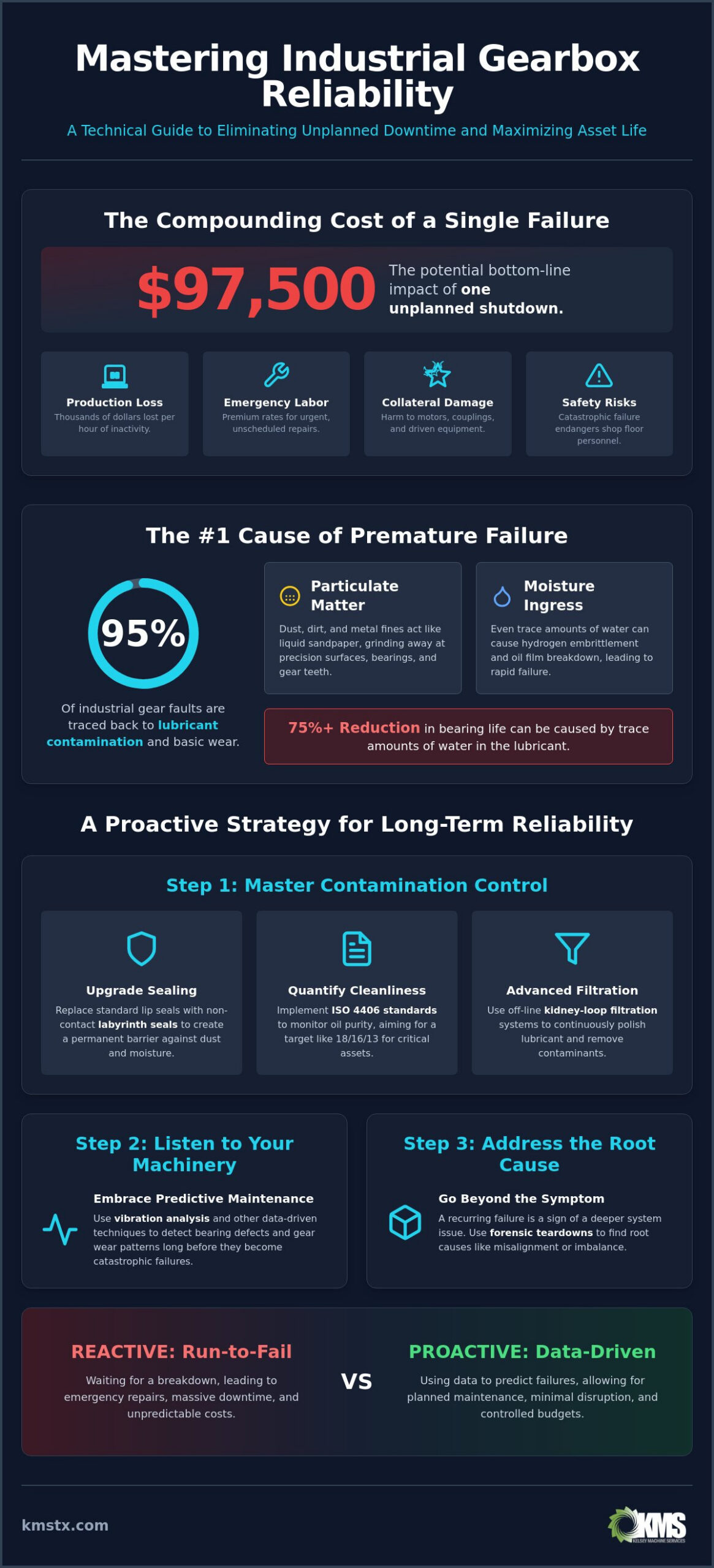
Did you know that an estimated 95% of industrial gear faults are traced back to simple wear, fatigue, or basic oil contamination? For a heavy-duty operation, a single failure isn’t just a repair bill. It’s a potential $97,500 hit to your bottom line in unplanned downtime alone. Understanding how to improve gearbox reliability isn’t about finding a magic fix. It’s about mastering the precision engineering and shop-floor discipline required to keep those gears turning.
You’ve likely dealt with the headache of premature bearing failure or the struggle of finding a technician who actually knows their way around a heavy overhaul. It’s a frustrating, expensive cycle that feels impossible to break when you’re constantly putting out fires. This guide changes that by providing the technical strategies and practical practices you need to eliminate those surprise shutdowns and significantly extend your equipment’s service life. We will walk through a clear roadmap for predictive maintenance, focusing on vibration management and strict contamination control to ensure your gearboxes reach their full design potential.
Key Takeaways
- Understand why reliability is more than just uptime and how unplanned downtime creates compounding costs across your shop floor.
- Learn how to improve gearbox reliability by implementing contamination control measures that stop the #1 cause of premature failure: particulate and moisture.
- Transition from a run-to-fail mindset to a data-driven strategy. Use vibration analysis to catch bearing defects before they shut down your line.
- Discover why forensic teardowns and root-cause inspections are necessary to ensure a repair isn’t just a temporary patch on a deeper mechanical issue.
- Identify the benefits of partnering with a specialized machine shop to manage the full reliability lifecycle of your heavy industrial assets.
The Real Cost of Industrial Gearbox Failure
In heavy industry, reliability isn’t just about whether a machine is spinning today. It’s a calculated probability that your equipment will perform its function without failure under specific operating conditions for a defined period. When we look at how to improve gearbox reliability, we’re looking at assets like Falk or Lufkin units that are expected to run for decades, not just a few thousand miles. Unlike a standard automotive mechanical transmission, industrial gearboxes face constant high-torque loads and harsh environments that make standard “uptime” a poor metric for success.
To see how technical upgrades and precision can increase the longevity of a gearbox system, watch this helpful video:
Most industrial failures follow the “Bathtub Curve” model. This shows high failure rates during the initial break-in period (infant mortality), a steady state of random failures during useful life, and a sharp increase during the wear-out phase. Identifying where your asset sits on this curve is the first step in moving from reactive repairs to a proactive strategy. If you’re seeing failures shortly after a rebuild, you’re likely dealing with infant mortality caused by poor installation or substandard parts. This holistic view is essential for anyone wondering how to improve gearbox reliability over the long haul.
The Economic Impact of Unreliability
Unplanned downtime is a compounding expense. Beyond the immediate loss of production, which can cost thousands of dollars per hour, you have to account for emergency labor rates and the potential for collateral damage to the motor or driven equipment. In some sectors, a single catastrophic failure has been documented to cost $97,500 when all factors are tallied. There’s also the safety aspect. A gearbox that seizes at high speed or suffers a housing breach creates a massive risk for personnel on the shop floor. Investing in reliability isn’t just a maintenance cost; it’s a way to protect your long-term asset value and keep your team safe.
Beyond the Gears: Systemic Reliability
A gearbox is only as reliable as the system it’s part of. It interacts constantly with motors, couplings, and the driven load. If you have a misalignment in your couplings or a motor that’s vibrating out of spec, the gearbox will take the brunt of that force. This is why “fixing the symptom” by just swapping out a bearing often leads to another failure within 6 to 12 months. True longevity requires a focus on rotating equipment maintenance as a whole. By looking at the entire drivetrain, you can identify the root causes that are actually killing your gears before they cause a total system shutdown.
Precision Lubrication and Contamination Control
Contamination is the primary cause of failure in approximately 95% of industrial gearboxes. While many operators focus on the visible wear of gear teeth, the root cause is almost always what’s floating in the oil. Particulate matter and moisture ingress act like liquid sandpaper, grinding down precision-machined surfaces until the unit seizes or loses its tolerance. If you’re looking for practical ways on how to improve gearbox reliability, you have to treat your lubricant as a critical mechanical component rather than just a consumable fluid.
The Gearbox Reliability Collaborative has documented how even trace amounts of water can reduce bearing life by over 75% due to hydrogen embrittlement and oil film breakdown. Upgrading from standard lip seals to modern non-contact labyrinth seals is one of the most effective ways to keep these contaminants out. Unlike traditional seals, labyrinth designs don’t wear out over time; they provide a permanent barrier against the dust and moisture common in heavy industrial environments.
Establishing Oil Cleanliness Standards
Using the ISO 4406 standard allows you to quantify exactly how clean your oil is. For high-speed gears, you’re usually aiming for a target like 18/16/13. Achieving this often requires more than just a standard filter change. Off-line kidney-loop filtration systems are a game changer for critical assets because they allow you to polish the oil while the machine is running. This process removes sub-micron particles that standard full-flow filters simply miss. When you’re performing a scheduled gearbox repair, setting these cleanliness benchmarks ensures the unit doesn’t fail immediately after being put back into service.
Lubricant Selection for Heavy Loads
Viscosity is the most important physical property of any lubricant. If the oil is too thin under heavy load, you’ll experience metal-to-metal contact and micropitting. If it’s too thick, you’ll see excessive heat generation and energy loss. Synthetic oils often justify their higher price tag in extreme temperatures because they maintain a more stable film thickness than mineral-based alternatives. Always look for Extreme Pressure (EP) additives that chemically bond to the gear surfaces. These provide a secondary layer of protection when shock loads occur, preventing the catastrophic scuffing that leads to premature gear failure.
Predictive Maintenance: Listening to the Machinery
Waiting for a gearbox to make an audible grinding sound before taking action is a recipe for disaster. By the time you can hear a failure from the shop floor, the internal damage is usually catastrophic and expensive to repair. Shifting to a data-driven predictive maintenance (PdM) strategy is a fundamental step in how to improve gearbox reliability. This approach relies on empirical data rather than “gut feelings” to determine exactly when a component needs attention.
One of the most effective tools in this arsenal is vibration analysis. Every gear set has a unique vibration signature based on its rotational speed and number of teeth. According to the GRC Project Report: Findings from Phase 1 and Phase 2 Testing, identifying these specific frequencies allows engineers to pinpoint defects like tooth cracking or bearing spalling months before a total breakdown occurs.
Vibration Monitoring Fundamentals
To monitor effectively, you’ve got to track the Gear Mesh Frequency (GMF) and its associated sidebands. If you see the amplitude of these sidebands increasing, it’s a clear indicator of wear or misalignment. It’s also vital to look at the driven load. Even a perfectly rebuilt gearbox will fail prematurely if the connected equipment is vibrating excessively. This is where dynamic balancing services become critical. By ensuring that all rotating components are balanced to precision tolerances, you remove the parasitic loads that chew through bearings and seals.
Non-Invasive Diagnostic Tools
Beyond vibration, several other non-destructive testing (NDT) methods provide a window into the health of your machinery. Thermal imaging is excellent for identifying localized hot spots that signal lubrication starvation or misaligned couplings generating friction. Ultrasonic testing catches high-frequency turbulence caused by early-stage bearing defects that standard vibration sensors might miss. Finally, regular magnetic plug inspections give you a tangible look at internal wear rates. Establishing a baseline when a unit is new or freshly refurbished is the only way to track these changes accurately. Without a known “good” state to compare against, your data is just noise. Consistently monitoring these metrics is how you move from reactive fire-fighting to a controlled, reliable operation.
Addressing the Root Cause During Refurbishment
When a gearbox finally lands on the shop floor, the temptation for many shops is to simply swap the broken parts and ship it back. That’s a short-sighted approach. If a unit failed before its expected service life, a standard repair is often just a temporary patch for a much deeper problem. To genuinely master how to improve gearbox reliability, the refurbishment phase must be treated as a forensic engineering project. We don’t just look at what broke; we look at why it broke by analyzing wear patterns on the gear teeth and inspecting the housing for structural integrity.
For example, seeing heavy wear on one side of a gear tooth usually indicates a misalignment issue or an excessive overhung load. If you don’t correct the housing bore or the shaft alignment during the rebuild, you’re just setting a timer for the next failure. Precision machining is required to restore housings to OEM specifications, ensuring that every gear mesh is exactly where the designers intended it to be. This level of detail is what separates a basic fix from a long-term reliability solution.
The Forensic Teardown Process
The process begins with a meticulous teardown where every single component is documented and measured. We’re looking for telltale signs of trouble like spalling, scoring, or abrasive wear. Using high-precision instruments to check bore alignments and shaft runout is the only way to catch subtle deviations that lead to catastrophic failures. It’s also the stage where we ensure all industrial machine spare parts meet or exceed the original metallurgy requirements. Using substandard materials in a high-torque environment is a guaranteed way to invite unplanned downtime back into your facility.
Upgrading for Reliability
Refurbishment offers a unique opportunity to actually upgrade the asset rather than just restoring it. If the operational demands have increased since the unit was first installed, moving from standard bearings to high-capacity or specialized designs can provide the extra margin of safety you need. We can also utilize case hardening or advanced surface treatments to improve gear fatigue life. By performing a rigorous gearbox failure analysis, we identify design flaws or application mismatches that can be corrected before the unit is reassembled. If you’re ready to stop the cycle of repeat failures, contact us for a professional gearbox repair that focuses on long-term engineering restoration.
Strategic Partnership for Long-Term Reliability
Reliability isn’t something you achieve once and forget about. It’s a continuous process that requires a technical partner who understands your specific operating conditions. A specialized machine shop plays a vital role in this lifecycle by providing the expertise that internal maintenance teams might not always have the time or specialized equipment to maintain. When you’re looking for how to improve gearbox reliability, the relationship with your repair facility should be built on transparency and technical data rather than just low-bid quotes.
One of the biggest advantages of this partnership is the access to detailed documentation. Every time a unit comes into the shop, you should receive an “as-built” report that records critical clearances, metallurgy, and the specific root causes of any wear found. This history becomes an invaluable asset for your future maintenance planning. It allows you to track trends across your facility and identify if a specific application is repeatedly killing your gears. This data-driven approach is what turns a standard vendor into a technical extension of your plant’s maintenance team.
Rapid Response and Field Service
The KMS Commitment to Precision
Contact Kelsey Machine Services for a technical consultation on your gearbox reliability.
Securing the Future of Your Rotating Assets
Mastering how to improve gearbox reliability requires moving past the standard “fix it when it breaks” mentality. By implementing strict ISO cleanliness standards for your lubricants and leveraging vibration data, you can catch minor defects before they evolve into catastrophic failures. When a rebuild is necessary, a forensic approach ensures that you aren’t just replacing gears, but correcting the underlying misalignments or design flaws that caused the issue in the first place.
Kelsey Machine Services brings over 40 years of industrial rotating equipment expertise to your maintenance strategy. Whether you need a full-service precision machine shop for OEM-spec restorations or 24/7 emergency field service and troubleshooting, our team acts as a technical extension of your plant. We don’t just repair equipment; we engineer longevity into every component we touch. It’s time to stop the cycle of unplanned downtime and start building a roadmap for long-term asset health.
Ready to optimize your equipment life? Consult an Expert on Your Gearbox Reliability Strategy today and keep your operation running at peak efficiency.
Frequently Asked Questions
What are the most common causes of industrial gearbox failure?
Contamination, fatigue, and wear are the primary drivers of industrial gearbox failure. Particulate matter and moisture account for nearly 95% of these faults by breaking down the lubricant film and causing abrasive wear. Misalignment and improper loading also contribute significantly by creating uneven stress on gear teeth and bearings. Identifying these issues early through routine inspections is a fundamental step in your reliability strategy.
How often should I perform oil analysis on a critical gearbox?
Quarterly oil analysis is the recommended baseline for most critical industrial gearboxes. If your equipment operates under extreme loads or high speeds, moving to a monthly sampling schedule is a better way to ensure you’re catching wear metals early. This consistency helps you understand how to improve gearbox reliability by monitoring shifts in viscosity and additive depletion before they lead to a catastrophic mechanical failure.
Can vibration analysis predict exactly when a gearbox will fail?
Vibration analysis can’t provide a precise failure date, but it does offer a highly accurate assessment of a machine’s current health. By monitoring gear mesh frequencies and bearing signatures, you can detect defects like tooth cracking or spalling long before they become audible. This data gives you the necessary lead time to plan for parts and labor, preventing an unplanned outage from blowing your budget.
Is it better to repair an old gearbox or replace it with a new one?
Repairing a high-quality legacy gearbox is often superior to buying a new one if the housing remains structurally sound. Modern off-the-shelf units sometimes lack the heavy-duty metallurgy found in older Falk or Lufkin models. A precision rebuild allows you to upgrade internal components, like high-capacity bearings or better seals, resulting in a unit that’s actually better suited for your specific shop-floor conditions than a generic replacement.
What is the difference between a standard repair and a precision refurbishment?
A standard repair is a parts-swap fix, while a precision refurbishment is a forensic engineering process. Refurbishment involves a full teardown to find out why the unit failed, followed by machining the housing back to OEM tolerances. If you’re investigating how to improve gearbox reliability, refurbishment is the only way to ensure you’re not just patching a symptom but actually correcting the root cause of the problem.
How does dynamic balancing impact the reliability of my gearbox?
Dynamic balancing eliminates the parasitic vibrations that chew through bearings and seals prematurely. Even if your gearbox is perfectly aligned internally, an unbalanced motor or coupling will transmit destructive forces through the shafts. Ensuring every rotating component in the drivetrain is balanced to precision tolerances is a simple but critical step in extending the mean time between failures for your heavy equipment.
What role does temperature play in gearbox life expectancy?
Excessive heat is a silent killer of gearboxes because it destroys the lubricant’s ability to protect metal surfaces. Most industrial oils begin to oxidize rapidly once they exceed their design temperature, with some estimates suggesting oil life is cut in half for every 18°F increase. High temperatures usually signal an underlying issue like lubrication starvation, misalignment, or bearing friction that needs to be addressed immediately.
What are the signs that a gearbox needs immediate emergency service?
Immediate emergency service is required if you notice sudden spikes in vibration, localized housing hot spots, or metallic debris in the oil. These are indicators that a component has already reached a critical stage of failure. If you wait until you hear grinding or smell burning oil, the damage is likely too severe for a simple rebuild and may require a total housing replacement.