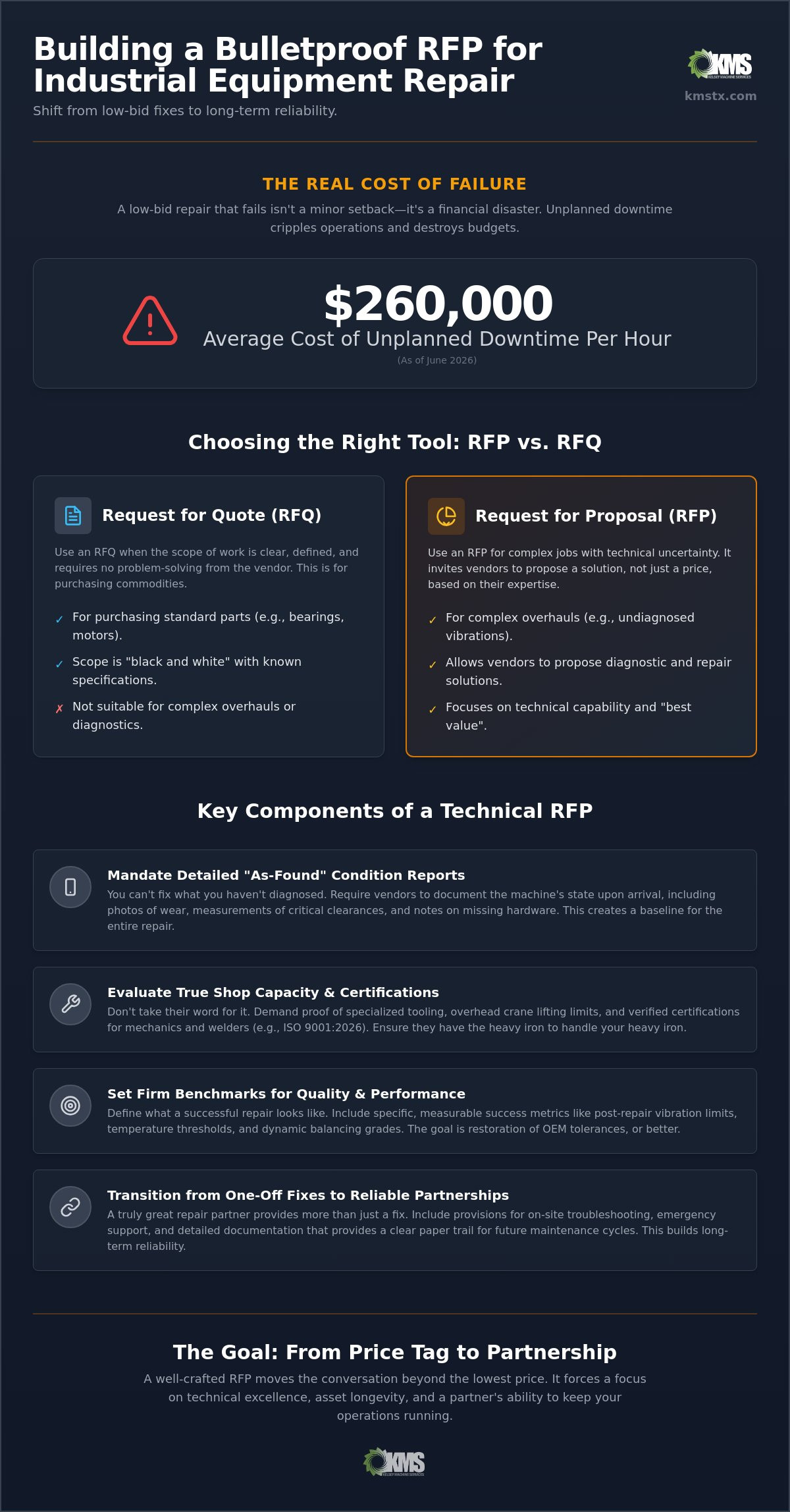
With unplanned downtime now costing industrial operations an average of $260,000 per hour as of June 2026, a low-bid repair that leads to a secondary failure isn’t just a mistake; it’s a budget catastrophe. You’ve likely felt the frustration of watching a critical centrifuge or compressor head out to a shop, only to have it return with the same vibration issues or “repaired” components that fail within weeks. It’s a common struggle when procurement focuses strictly on the lowest price while you’re left managing the technical fallout of a sub-par fix.
Learning how to write an RFP for equipment repair is the only way to bridge that gap between the front office and the shop floor. This guide will show you how to draft a technical Request for Proposal that forces vendors to meet your specific standards, ensuring every restoration hits OEM specifications or better. We’ll walk through the essential technical qualifiers for 2026, including the latest ISO 9001:2026 quality management standards and the specific data requirements you need to demand from a repair partner to guarantee long-term accountability and equipment reliability.
Key Takeaways
- Move beyond generic templates by mandating detailed “as-found” condition reports and decontamination standards to ensure a thorough restoration process.
- Evaluate a shop’s true capacity by requiring proof of specialized tooling, lifting limits, and verified mechanical staff certifications.
- Discover how to write an RFP for equipment repair that shifts the focus from the lowest price to technical excellence and asset longevity.
- Set firm benchmarks for turnaround times and quality assurance to keep your operations moving and prevent secondary failures after delivery.
- Transition from one-off fixes to reliable partnerships by including provisions for on-site troubleshooting and emergency repair support.
The Fundamentals of an Industrial Equipment Repair RFP
An industrial Request for Proposal (RFP) is much more than a procurement hurdle. Think of it as a technical roadmap that dictates exactly how your asset will be restored to service. When you’re dealing with high-stakes machinery like decanter centrifuges or multi-stage compressors, a vague document leads to vague results. Learning how to write an RFP for equipment repair ensures you aren’t just asking for a price; you’re defining the mechanical integrity of your plant.
Generic templates often fail because they focus on administrative compliance rather than engineering reality. They might ask about a vendor’s insurance or billing terms, but they skip over critical specs like dynamic balancing grades or seal face materials. This oversight creates a “low-bid” trap where the shop that cuts the most corners wins the work, leaving you to deal with the inevitable secondary failure. Successful technical procurement requires a document that prioritizes “best-value” by evaluating a shop’s actual capability to perform precision work.
To get a better grasp of the structural components involved in these documents, watch this helpful overview:
A successful solicitation must align with your broader rotating equipment maintenance strategy. You aren’t just looking for a fix; you’re looking for a partner that understands the cost of unplanned downtime. By prioritizing technical excellence over the bottom dollar, you filter out shops that lack the specialized tooling or lifting capacity to handle your heavy iron. This approach ensures that the finished repair supports your long-term reliability goals rather than just providing a temporary patch.
RFP vs. RFQ: Which One Do You Need?
It’s common to confuse a Request for Quote (RFQ) with an RFP. Use an RFQ when the scope is black and white, like buying a set of standard bearings or a replacement blower motor. However, an RFP is mandatory for complex overhauls where technical uncertainty exists. If you’ve got a gearbox with an undiagnosed vibration or a hydraulic drive that’s losing pressure, the RFP allows the vendor to propose a diagnostic and repair solution based on their expertise. It’s the right tool for when you need a shop to solve a problem, not just fulfill a parts list.
The Core Objectives of Your Repair Solicitation
Your primary goal is the restoration of OEM tolerances. A good repair doesn’t just make the machine spin; it ensures operational stability for the long haul. When you’re figuring out how to write an RFP for equipment repair, include specific success metrics like vibration limits, temperature thresholds, and detailed “as-found” reporting. Longevity and reliability should be your primary markers for success. Documentation shouldn’t be an afterthought; it’s your proof that the shop actually performed the work to your required standards, providing a clear paper trail for future maintenance cycles.
Drafting the Technical Scope of Work (SOW)
The Scope of Work (SOW) is where the technical requirements meet the shop floor. If your SOW is vague, you’re essentially giving a repair shop a blank check to do as little or as much as they want, which often leads to budget overruns or premature equipment failure. When learning How to Write an RFP & Vet Suppliers, industry veterans know the technical SOW must be the most detailed portion of the document. It has to cover everything from the initial arrival of the machine to the final coat of paint.
Your SOW should begin with a mandatory “as-found” condition report. You can’t fix a problem you haven’t fully diagnosed. This requirement forces the vendor to document the machine’s state exactly as it arrived, including photos of wear patterns, measurements of critical clearances, and notes on any missing hardware. For specialized assets, your SOW should mirror the rigorous standards found in industrial centrifuge repair Texas protocols, where every micron counts toward the machine’s balance and longevity.
Don’t overlook cleaning and decontamination standards. Industrial machinery often arrives covered in process chemicals, scale, or heavy grease. Specify that all components must be cleaned to a “white metal” or equivalent standard before inspection. This isn’t just for aesthetics; you can’t perform accurate non-destructive testing on a dirty gear or a fouled impeller. Having a reliable spare parts inventory on hand can also help you make these “repair vs. replace” decisions much faster during the initial phase.
Teardown, Cleaning, and Inspection (TCI)
The TCI phase is the most critical part of the repair cycle. Your RFP should mandate a witness-point during the initial teardown so your own team can see the internal damage firsthand. Require specific NDT (Non-Destructive Testing) methods like Magnetic Particle Inspection or Dye-Penetrant Testing to find cracks that the naked eye would miss. Mastering how to write an RFP for equipment repair means ensuring no work starts until you’ve signed off on a detailed inspection report that outlines every required fix.
Defining Repair Standards and Tolerances
Simply asking for a “repair” isn’t enough. You must specify adherence to OEM specifications as the bare minimum. In many cases, you might even demand improved engineering standards, such as upgraded coatings or harder base metals, to prevent a repeat failure. Your SOW needs to detail requirements for custom machining and component fabrication if OEM parts are unavailable. Finally, establish a clear “repair vs. replace” framework. If a component’s restoration cost exceeds 60% of its replacement value, the shop should be required to flag it for your review before proceeding.
Establishing Evaluation Criteria for Repair Vendors
Vetting a vendor’s administrative compliance is easy, but verifying their actual mechanical capability is where most procurement efforts fall short. When you’re determining how to write an RFP for equipment repair, you have to look past the sales brochure. You need to know if the shop has the physical infrastructure to handle your heaviest iron. If a shop’s overhead crane is rated for five tons and your centrifuge bowl weighs six, you’ve got a safety and quality problem before the first bolt is even turned. Always demand a detailed facility list that includes lifting capacities, floor space, and specialized tooling like horizontal boring mills or large-scale lathes.
Staff experience is just as critical as the machinery they use. Verify the technical certifications of the mechanical staff and ask for the average tenure of their lead technicians. In heavy industry, you want the person working on your $100,000 gearbox to have seen that specific failure mode dozens of times. Review their Quality Management System (QMS) to ensure they’re aligned with the latest standards, such as ISO 9001:2026. A shop with a disciplined QMS and a transparent safety record is far more likely to deliver a repair that lasts until the next scheduled turnaround.
For any asset that spins, you must include precision dynamic balancing services in Houston as a mandatory capability. High-speed rotors that aren’t balanced to tight tolerances will shake themselves to pieces, leading to the secondary failures mentioned earlier. If a shop has to outsource this critical step, you lose control over the quality and the timeline.
Shop Capabilities and Dynamic Balancing
Dynamic balancing is non-negotiable for high-speed industrial rotors. Without it, you’re looking at increased bearing wear and potential catastrophic housing failure. Your RFP should require the vendor to state their balancing machine’s weight capacity and sensitivity. Don’t just take their word for it; ask for sample balancing reports from previous industrial projects. These reports should show the initial unbalance, the correction weights added, and the final residual unbalance compared to ISO standards.
Parts Pedigree and Inventory Access
The origin of replacement parts can make or break a repair. Your RFP needs to force a distinction between OEM, aftermarket, and refurbished components. While aftermarket parts can sometimes offer better lead times, you need to know exactly what’s going into your machine. Evaluate the vendor’s industrial machine spare parts Texas access and their typical lead times for critical items like seals and bearings. Require full transparency regarding parts pedigree so you can make informed decisions about asset longevity versus immediate cost savings.
Managing Logistics, Timelines, and Quality Assurance
Logistics often get ignored in the procurement process until a critical machine is sitting on a trailer with nowhere to go. You have to define Turnaround Time (TAT) as a hard, measurable metric. When you’re determining how to write an RFP for equipment repair, specify whether TAT refers to calendar days or working days, and clarify that the clock starts the moment the asset leaves your dock. Don’t let a vendor hide behind freight delays they’re responsible for managing; the RFP should clearly state who owns the shipping and handling responsibilities for heavy loads.
If you’re looking for a partner that understands the urgency of industrial timelines, you can request a technical assessment for your next gearbox repair.
Expedited Services and Emergency Response
Your contract needs to define exactly what constitutes an “emergency.” Is it a partial production dip or a full-scale plant outage? Require 24/7 technical support availability for your most critical assets so you aren’t waiting for a Monday morning callback. It’s also smart to establish a “not-to-exceed” price for initial emergency mobilizations. This prevents price gouging during a crisis and keeps the focus on getting the machinery back in production as quickly as possible.
Final Testing and Documentation
Never allow a piece of equipment to leave a shop without a documented final test. Whether it’s a spin test for a centrifuge or a load test for a gearbox, the results must be included in a complete data package. This package should feature all assembly clearances, NDT results, and dynamic balancing reports. Specify that these maintenance records must be delivered in both digital and physical formats, providing your team with a clear technical baseline for future condition monitoring.
Partnering with a High-Level Industrial Repair Shop
Specialized expertise in industrial gearbox repair Houston is a prime example of why this partnership matters. These complex assets require more than a simple bearing swap. They need precision engineering to ensure gear teeth mesh perfectly and housings remain rigid under load. A specialized partner uses the data from your RFP to improve the machine’s longevity, often returning it in better-than-OEM condition. Before you sign a contract, use this final checklist to vet your mechanical partner:
- Does the shop provide documented “as-found” and “as-shipped” condition reports?
- Is there in-house dynamic balancing capability for high-speed rotors?
- Can they perform custom machining for obsolete or long-lead components?
- Do they maintain a robust inventory for your specific asset class, such as pumps, blowers, or centrifuges?
The Kelsey Machine Services Standard
We’ve spent over four decades refining our approach to heavy rotating equipment repair. We don’t just fix what’s broken; we use precision machining and dynamic balancing to ensure every asset meets or exceeds its original design parameters. Our approach is built on technical credibility and a deep understanding of industrial failure modes. We support national operations with rapid response capabilities, ensuring that when a critical compressor or hydraulic drive fails, your downtime is kept to an absolute minimum.
Getting Started with Your Next Repair
If you’ve got a critical asset nearing its next maintenance cycle, it’s time to put your RFP to work. You can submit your technical requirements to our engineering team for a preliminary review. We’ll help you refine the scope of work and identify potential reliability upgrades you might have missed. Our massive spare parts inventory is curated specifically to reduce lead times for the most common failure points. Contact our team today for a consultation on your next centrifuge, pump, or blower repair.
Securing Your Assets for the Next Production Cycle
Shifting your procurement strategy from a search for the lowest price to a demand for technical excellence is the most effective way to protect your plant’s bottom line. By prioritizing detailed “as-found” condition reports and verifying a shop’s actual mechanical capacity, you ensure that your machinery returns to service in better than OEM condition. We’ve seen that the real cost of a repair isn’t found in the initial quote; it’s found in the reliability of the machine over the next ten thousand hours of operation.
Refining how to write an RFP for equipment repair is your best defense against the high costs of unplanned downtime. When you’re ready to move from a generic solicitation to a precision restoration, our team is ready to assist. With over 40 years of specialized mechanical experience and full-service dynamic balancing and precision machining capabilities, we understand the high stakes of heavy industry. We provide 24/7 emergency field service and shop support to keep your operations moving without delay.
Partner with Kelsey Machine Services for your next critical equipment repair and take the guesswork out of your maintenance cycle. You’ve got the roadmap; now it’s time to put it into practice and get your equipment back to work.
Frequently Asked Questions
What are the most common mistakes in an equipment repair RFP?
The most frequent error is prioritizing the lowest initial bid over technical qualifications. When you’re learning how to write an RFP for equipment repair, you’ll find that a vague Scope of Work (SOW) often leads to expensive change orders once the machine is opened. Another mistake is failing to specify required tolerances or balancing grades, which allows shops to cut corners on precision to meet a lower price point.
How do I handle an RFP for an emergency repair with no time for a full draft?
You should rely on a pre-vetted Master Service Agreement (MSA) or a simplified “Emergency Mobilization Letter” that establishes a not-to-exceed price for initial diagnostics. This allows the shop to pick up the asset and begin the teardown while you finalize the formal SOW. It’s better to have a standing relationship with a trusted partner so you aren’t starting from scratch during a plant outage.
Should I require OEM parts in my RFP, or are aftermarket parts acceptable?
The choice depends on the criticality of the component and current lead times. While OEM parts are often preferred for high-speed rotors or proprietary seals, high-quality aftermarket parts can be acceptable if the shop provides material certifications. Your RFP should mandate full transparency regarding parts origin, allowing you to approve or reject non-OEM components based on the specific risks to your operation and asset longevity.
How do I evaluate the technical expertise of a machine shop staff?
Ask for a facility list and the average tenure of their lead technicians rather than just looking at certifications. A shop might have the right papers but lack experience with your specific brand of centrifuge or gearbox. Requesting redacted inspection reports from similar projects is a great way to see if their staff understands the failure modes common in your industry and can provide the necessary documentation.
What is the “Teardown and Inspection” phase, and why is it a separate RFP milestone?
The Teardown and Inspection (TCI) phase is the diagnostic milestone where the machine is cleaned and measured to find the root cause of failure. It’s a separate milestone because the full scope of repair is often unknown until the unit is disassembled. By making this a distinct step, you prevent the vendor from guessing at costs and ensure you only pay for the work that is actually required.
How much detail should I include about the machine’s failure history?
You should include as much data as possible, including recent vibration analysis reports and previous repair logs. Providing a clear failure history helps the repair shop identify systemic issues, such as chronic misalignment or lubrication failures, that a simple part replacement won’t fix. This context allows the vendor to propose engineering upgrades that can extend the mean time between failures for your critical equipment.
Is dynamic balancing required for all rotating equipment repairs?
Dynamic balancing is essential for any asset that operates at high speeds, such as blowers, pumps, and centrifuges. Even a minor unbalance can cause excessive vibration that destroys bearings and seals prematurely. Your RFP should specify the required balancing grade, such as ISO G1.0 or G2.5, to ensure the machine runs smoothly and reliably once it’s reinstalled in your process line and returned to its normal operating speed.
What are the standard warranty terms I should expect in an industrial repair RFP?
You should expect a minimum of a 12-month warranty on both parts and labor for most industrial repairs. Some shops may offer extended terms if they perform a full overhaul to OEM specifications. It’s important to clarify when the warranty period begins, whether it’s at the time of delivery or the date of installation, to ensure you’re covered during the critical first run and initial production cycle.