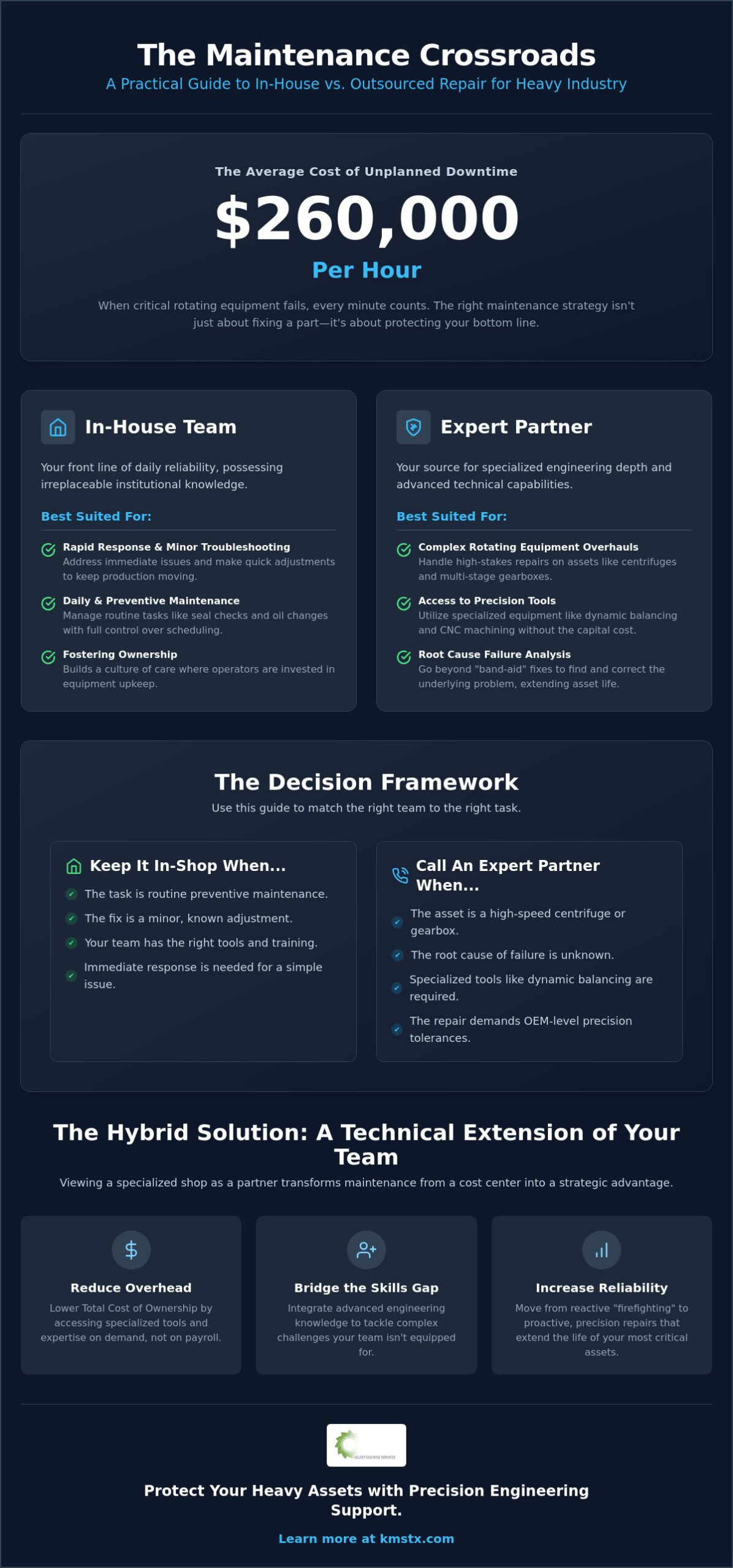
Did you know that unplanned downtime can drain an average of $260,000 from an industrial manufacturer’s bottom line every single hour? When a critical centrifuge or gearbox fails, the debate over in-house vs outsourced machinery maintenance stops being an academic exercise and becomes a high-stakes race against the clock. Most maintenance managers already know the struggle of trying to keep aging rotating equipment running while facing a shortage of expert technicians and the staggering cost of specialized diagnostic tools. It’s a tough balancing act that often leads to reactive repairs rather than proactive reliability.
You shouldn’t have to choose between a lean budget and equipment longevity. This guide provides a practical framework for balancing your internal team’s daily reliability with the specialized engineering depth required to protect your heavy assets. We’ll explore how to reduce maintenance overhead and access OEM-level precision without the OEM price tag. By the end of this article, you’ll know exactly which repairs to keep on-site and when to leverage an outside shop’s capabilities to keep your operation moving.
Key Takeaways
- Identify the right balance for in-house vs outsourced machinery maintenance by evaluating asset criticality and the specific engineering depth required for each repair.
- Utilize your internal team’s institutional knowledge for rapid response on minor troubleshooting and daily adjustments to maintain operational control.
- Access specialized precision tools like dynamic balancing and CNC machining through expert partners to handle complex rotating equipment overhauls.
- Reduce maintenance overhead without sacrificing reliability by integrating specialized engineering support for high-stakes assets like centrifuges and gearboxes.
- Transform your maintenance strategy by viewing specialized shops as a technical extension of your department to bridge the skilled labor gap.
The Maintenance Dilemma: Balancing Operational Control with Technical Complexity
Every maintenance manager feels the pull between two conflicting priorities. On one hand, you need the machine running right now to meet today’s production quota. On the other, you have to ensure that same machine is still running five years from now. This tension is the heart of the in-house vs outsourced machinery maintenance debate. While internal teams excel at keeping the lights on, the technical complexity of modern rotating assets often exceeds what a generalist can handle. It isn’t just about turning wrenches anymore; it’s about vibration analysis, precision tolerances, and specialized metallurgy.
To better understand the strategic choices involved in these maintenance models, watch this helpful video:
The evolution of industrial equipment has outpaced the traditional training of many internal departments. High-speed centrifuges and multi-stage gearboxes now require levels of precision that weren’t standard twenty years ago. This shift, combined with a persistent skills gap, means many plants struggle to find and keep technicians who can handle advanced types of machinery maintenance. Forcing an “either/or” decision between internal staff and outside shops usually creates operational friction. Your team ends up frustrated by a lack of resources, and the equipment suffers from band-aid fixes that don’t address the root cause.
The High Stakes of Rotating Equipment Failure
Rotating equipment operates under extreme forces. When a high-speed component loses its balance, the results aren’t just expensive; they can be catastrophic. We’ve seen cases where a simple bearing failure leads to a shaft whip that destroys the entire housing. Beyond the repair bill, the cost of unplanned downtime often hits an average of $260,000 per hour in lost revenue. This is why a rigorous approach to rotating equipment maintenance is non-negotiable. You aren’t just paying for a fix; you’re buying insurance against a total system shutdown.
Understanding the Total Cost of Ownership (TCO)
Looking at the hourly rate of a technician only tells half the story. To get the real picture of in-house vs outsourced machinery maintenance, you have to factor in the indirect overhead. This includes the cost of specialized dynamic balancing rigs, ongoing training for new hires, and the benefits packages that keep experts on your payroll. “Firefighting” a failure in-house often leads to a cycle of reactive repairs that shorten the lifespan of your gearboxes and blowers. True technical restoration, while it might seem more expensive upfront, extends the service life of the asset and lowers the total cost over its entire lifecycle.
In-House Maintenance: The Front Line of Daily Reliability
Your internal maintenance team is the heartbeat of the facility. They’re the ones who hear a slight change in a pump’s pitch before the vibration sensors even trigger an alert. This institutional knowledge is irreplaceable. When weighing the pros of in-house vs outsourced machinery maintenance, you have to value that your staff knows the specific quirks of your plant. They understand which processes are most critical to today’s production run and can pivot instantly when a minor issue threatens a line. This immediate response capability is often the difference between a ten-minute adjustment and a four-hour shutdown.
Beyond speed, having an internal crew fosters a culture of ownership. When the people operating the equipment are also responsible for its basic upkeep, they tend to treat the machinery with more care. You also gain complete control over the scheduling of preventive maintenance. You don’t have to wait for a service window from a third party; you can perform seal checks or oil changes during natural production gaps. Deciding whether to keep tasks in-house or outsource often comes down to this level of day-to-day operational control.
Where In-House Teams Excel
Internal staff are most effective when focused on the “health” of the equipment rather than its “reconstruction.” They excel at routine lubrication, monitoring seal integrity, and basic vibration data collection. These tasks act as an early warning system. By identifying a slight misalignment early, your team can prevent a catastrophic shaft failure. They manage the day-to-day operational adjustments that keep the equipment within its design parameters, ensuring that small problems don’t snowball into major mechanical failures.
The Limitations of Internal Staffing
The trouble starts when a repair requires more than a standard toolkit. Most plants cannot justify the massive capital investment for specialized dynamic balancing rigs or high-precision CNC machining centers. There’s also the issue of training fatigue. Expecting a generalist technician to stay current on the specific OEM tolerances for five different brands of gearboxes is a tall order. While the debate over in-house vs outsourced machinery maintenance often focuses on labor costs, the real bottleneck is usually a lack of specialized infrastructure. When the right tools or specialized knowledge aren’t available, teams often resort to band-aid repairs. These temporary fixes might get the machine running, but they often lead to recurring failures. If you find your team struggling with complex overhauls, it might be time to look at a specialist for expert gearbox repair to restore the unit to its original engineering specifications.
Outsourcing Specialized Machinery Maintenance: Accessing Engineering Depth
While internal teams provide the first line of defense, certain rotating assets require a level of precision that a typical plant floor simply isn’t built to accommodate. This is where the scale tips in the in-house vs outsourced machinery maintenance debate. A specialized shop acts as an engineering center rather than just a repair facility. These shops utilize heavy-duty CNC machining, thermal spray for surface restoration, and specialized diagnostic rigs that most companies can’t justify buying for a single site. You’re not just paying for labor; you’re accessing a specialized infrastructure designed for high-stakes mechanical restoration.
The real benefit comes from focused expertise. A shop technician might see hundreds of gearbox or centrifuge failures in a year, whereas your internal team might only see one every few seasons. This exposure allows specialists to recognize failure patterns and root causes that aren’t immediately obvious to a generalist. It turns a simple fix into a technical restoration. By leveraging extensive industrial machine spare parts inventories, these shops can often complete a full rebuild faster than an internal team waiting on a single OEM shipment. This reduces the risk of extended downtime and ensures the repair meets original engineering specifications.
The Necessity of Precision Dynamic Balancing
Field balancing has its place, but it has hard limits. On-site kits are great for minor corrections, but they can’t match the accuracy of shop-based precision dynamic balancing services. In a controlled shop environment, components are isolated on heavy-duty balancing rigs to correct mechanical imbalance with extreme granularity. This is critical for high-speed centrifuges where even a few grams of error can cause harmonic vibration that destroys bearings and seals. Proper shop balancing doesn’t just stop the shaking; it significantly extends the service life of every connected component in the drive train.
Major Overhauls and Technical Restoration
A true overhaul is more than just replacing worn parts. It starts with a comprehensive “teardown and inspect” process to identify the root cause of the failure, whether it’s lubrication starvation, misalignment, or metallurgical fatigue. Engineering restoration aims to return the asset to zero-hour condition, which is a different standard than just getting the machine back online. It’s often more efficient to move a complex gearbox repair to a specialized shop rather than struggling with it on the plant floor. The shop environment provides the overhead cranes, heavy presses, and climate-controlled assembly areas necessary for a warranted, reliable rebuild that lasts.
A Decision Framework: When to Keep it In-Shop vs. Call an Expert
Frequency also plays a massive role in the ROI of your maintenance strategy. If a task only occurs once every three to five years, the investment in specialized training and tools for your staff usually won’t pay off. They’ll likely lose that specialized “feel” for the machine by the time the next overhaul rolls around. You also have to consider the safety and liability risks. A failed repair on a high-speed rotating component can lead to catastrophic shrapnel or fires. Finally, look at lead times. While an internal fix might start sooner, a specialized shop with a deep inventory of spare parts can often finish the job faster and with a full warranty.
The Hybrid Model: The “Sweet Spot” for Modern Plants
Identifying “Red Flag” Repairs
Knowing when to walk away from a repair is a skill in itself. If you’re seeing severe harmonic vibration or catastrophic gear tooth failure, the root cause is likely deep within the machine’s geometry. Attempting a complex centrifuge repair without a shop-grade balancing rig is a recipe for a repeat failure within weeks. When the damage moves beyond simple parts replacement and into the territory of structural restoration, an expert second opinion isn’t just helpful; it’s necessary to prevent a total asset loss.
If you’re facing a repair that exceeds your team’s current tooling or expertise, it’s time to talk to the specialists at Kelsey Machine Services to ensure a precision restoration.
Partnering for Precision: How Kelsey Machine Services Supports Your In-House Team
Integrating an outside partner shouldn’t feel like a loss of control for your maintenance department. It’s actually about augmenting your team’s existing capabilities with specialized resources. When you’re managing the balance of in-house vs outsourced machinery maintenance, think of Kelsey Machine Services as the high-precision engineering arm of your own shop. We don’t aim to replace your technicians; we provide the dynamic balancing and custom machining tools they need to ensure long-term reliability. With over 40 years of technical heritage in mechanical overhauls, we’ve seen nearly every failure mode for high-stakes rotating equipment, including centrifuges, gearboxes, and pumps.
We know that a catastrophic failure doesn’t happen on a convenient schedule. That’s why our approach includes a 24/7 support promise to help reduce the anxiety of unplanned downtime. When a critical blower or compressor goes down, you need more than just a repairman; you need a partner who understands the geoscientific precision required to get that asset back into service. We focus on the high-complexity tasks so your team can stay focused on the daily operational adjustments that keep the plant moving.
Our Approach to Technical Restoration
Every project that enters our facility follows a rigorous protocol. We perform a full teardown and inspection to identify the root cause of failure, rather than just treating the symptoms. Our shop is equipped for advanced dynamic balancing and custom machining, which allows us to solve unique engineering challenges that standard kits can’t handle. We follow strict OEM-spec reassembly protocols to return your assets to a zero-hour condition. To ensure full transparency and accountability, we provide detailed documentation and warranties for every major repair we complete.
Minimizing Downtime with Spare Parts and Field Service
Global supply chain delays shouldn’t dictate your production schedule. We leverage a massive inventory of spare parts to bypass the long lead times often associated with OEM orders. This inventory allows us to move faster on repairs for hydraulic drives and gearboxes, getting your equipment back on the line sooner. If an asset is too large to transport easily, we can dispatch technicians for on-site troubleshooting and critical infrastructure support. This flexibility is a key part of a successful in-house vs outsourced machinery maintenance strategy, providing you with a technical safety net right when you need it most.
Ready to bridge the gap between daily maintenance and precision engineering? Consult with a Kelsey Machine expert on your maintenance strategy to learn how we can help protect your heavy rotating assets from costly failures.
Optimizing Your Maintenance Strategy for Long-Term Reliability
By choosing a partner with over 40 years of industrial repair expertise, you gain access to a technical safety net that includes a large-scale inventory of spare parts and 24/7 emergency response for those critical failures that can’t wait. Don’t let specialized technical requirements stall your production. Partner with Kelsey Machine Services for Expert Rotating Equipment Support and ensure your gearboxes, centrifuges, and pumps are restored to original specifications. With a clear framework in place, you can protect your assets and keep your facility running at peak performance.
Frequently Asked Questions
What are the main benefits of outsourcing machinery maintenance for rotating equipment?
Outsourcing provides immediate access to specialized engineering depth and high-precision tools that are cost-prohibitive for most plants to maintain. Specialized shops offer expertise in dynamic balancing and CNC machining that internal teams rarely utilize on a daily basis. This ensures every repair meets strict OEM tolerances, significantly reducing the risk of recurring failures and extending the service life of your heavy assets.
How do I know if my internal team is equipped for a centrifuge overhaul?
You should evaluate whether your team has access to a shop-grade dynamic balancing rig and the specific OEM torque and tolerance specifications for your exact model. Centrifuges operate under extreme G-forces; if you lack the calibrated equipment to verify balance within a few grams, the overhaul is best left to an outside shop. Without these specialized tools, you risk catastrophic mechanical failure upon restart.
Is a hybrid maintenance model more cost-effective than a purely in-house team?
Yes, a hybrid approach typically optimizes the in-house vs outsourced machinery maintenance balance by reducing fixed overhead while maintaining high reliability. You avoid the massive capital investment required for specialized tooling and the ongoing training costs for rare, complex tasks. This allows your internal staff to stay focused on high-value daily monitoring and preventive maintenance that prevents unplanned shutdowns in the first place.
What specialized tools are required for high-speed industrial gearbox repair?
High-speed gearbox restoration requires precision measurement tools like micrometers and bore gauges, along with heavy-duty hydraulic presses and thermal assembly equipment for interference fits. You also need CNC machining capabilities for housing restoration and dynamic balancing for high-speed shafts. Most general maintenance departments don’t carry this level of precision infrastructure because the capital investment doesn’t align with their daily operational needs.
How does dynamic balancing in a shop differ from field balancing?
Shop balancing uses a dedicated rig to isolate the component from external vibrations, allowing for much higher granularity in weight correction than on-site methods. Field balancing is essentially a “trim” procedure performed while the machine is fully assembled. While field kits are useful for minor adjustments, they cannot achieve the zero-tolerance precision of a controlled shop environment, which is critical for high-speed components.
What happens if an in-house repair fails on a critical piece of machinery?
An in-house failure often leads to compounded damage, such as shaft whip or housing destruction, which can easily triple the original repair cost. Beyond the mechanical damage, you face the extreme financial impact of unplanned downtime, which can cost an average of $260,000 per hour. This is why high-stakes assets are generally safer in a specialized shop that provides a full warranty on their work.
Can outsourcing maintenance actually reduce long-term operational costs?
Outsourcing reduces long-term costs by extending the Mean Time Between Failures (MTBF) through comprehensive technical restoration. When you weigh the pros of in-house vs outsourced machinery maintenance, you have to factor in the total lifespan of the repair. A shop-rebuilt asset often lasts years longer than a quick “band-aid” fix, which significantly lowers the total cost of ownership over the machine’s entire lifecycle.
How do I evaluate the technical credibility of an external repair shop?
Look for a shop with a deep technical heritage in your specific type of rotating equipment and ask to see their inspection and testing protocols. A credible partner will always provide detailed teardown reports, balance certificates, and clear warranties for their work. It’s also helpful to check if they maintain a large inventory of spare parts, which shows they have the resources to handle major overhauls quickly.