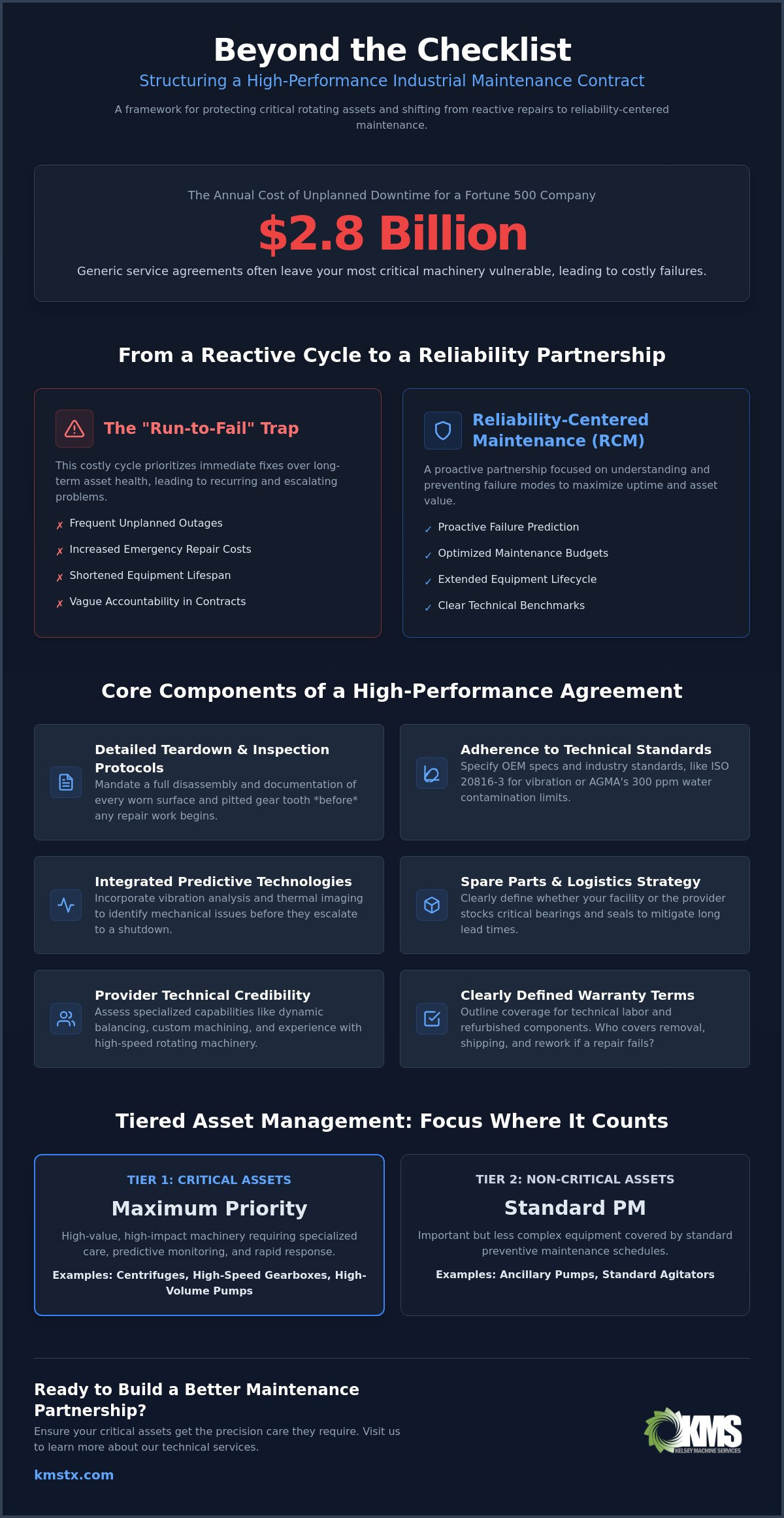
What if the most expensive part of your service agreement isn’t the monthly fee, but the technical gaps that leave your machinery vulnerable? Most veteran plant managers have learned the hard way that a generic contract rarely stands up to the reality of a seized bearing or a contaminated oil sump. Effective preventative maintenance for industrial gearboxes requires a framework that speaks the language of your equipment, not just the language of your legal department. With unplanned downtime costing the average Fortune 500 company approximately $2.8 billion annually, you’ve likely felt the sting of a “comprehensive” plan that fails to account for emergency repairs or specialized spare parts.
We understand that your priority is keeping critical centrifuges and high-value rotating assets in motion. This guide explains how to structure technical maintenance contracts that move beyond basic checklists to ensure rapid response and extended equipment lifespan. We’ll look at why integrating specific standards, like the ISO 20816-3:2022 vibration limits or AGMA’s 300 ppm water contamination threshold, is the only way to guarantee your machinery gets the precision care it requires to stay online.
Key Takeaways
- Learn how to shift from reactive cycles to a reliability-centered maintenance partnership that prioritizes the long-term health of your rotating assets.
- Discover the essential technical components of a service agreement, from detailed teardown protocols to clearly defined response times for field service calls.
- Integrate vibration analysis and thermal imaging into your preventative maintenance for industrial gearboxes to identify mechanical issues before they lead to a shutdown.
- Determine whether your facility or your service provider should stock critical bearings and seals to mitigate the risk of long lead times.
- Assess a provider’s technical credibility by looking for specialized capabilities like dynamic balancing and custom machining for heavy industrial components.
What is an Industrial Equipment Maintenance Contract for Rotating Assets?
An industrial equipment maintenance contract is a technical service agreement specifically for the upkeep and restoration of heavy machinery. It’s not a generic service level agreement; it’s a roadmap for asset health. For most plants, this marks a shift from reactive “run-to-fail” repairs to a reliability-centered maintenance (RCM) partnership. By focusing on the specific mechanical tolerances of your machinery, you can implement a strategy of Preventive maintenance (PM) that reduces the risk of unplanned outages.
Effective preventative maintenance for industrial gearboxes requires more than an oil change; it requires a deep understanding of rotational dynamics and load profiles. This specialized focus is what makes rotating equipment maintenance different from general facility upkeep. A contract ensures that your most critical assets receive the attention they need before a small vibration turns into a seized bearing.
To better understand the technical steps involved in these agreements, watch this helpful video:
The Critical Role of Expertise in Mechanical Overhauls
OEM specifications aren’t just suggestions; they’re the baseline for any industrial contract. If a shop isn’t checking clearances against the original drawings, they’re just guessing. Technical labor is essential here. High-speed machinery requires technicians who understand tolerances in the thousandths of an inch. This level of expertise is vital when performing preventative maintenance for industrial gearboxes, as even a slight misalignment can lead to premature gear wear. A solid contract focuses on long-term engineering restoration. It’s about bringing the machine back to its peak performance, not just getting it through the next shift.
Types of Equipment Covered in Industrial Agreements
Most contracts focus on high-value assets like centrifuges, gearboxes, and high-volume pumps. You’ll want to define critical versus non-critical assets to create tiered service levels. This ensures your budget goes where it matters most. For instance, integrating industrial centrifuge repair Texas standards ensures that your most complex separators receive the precision balancing they require. This tiered approach helps you manage costs while protecting the equipment that keeps the plant running. By categorizing your assets, you ensure that high-speed rotating machinery gets the specialized care that general facility maintenance simply can’t provide.
Core Components of a High-Performance Industrial Service Agreement
An effective contract for preventative maintenance for industrial gearboxes must go beyond simple oil changes and visual checks. It needs to be a technical document that defines exactly how a piece of equipment is handled from the moment it leaves your floor. A vague Scope of Work (SOW) is a recipe for budget overruns and missed deadlines. Instead, your agreement should mandate full teardown and inspection protocols, requiring the service provider to document every worn surface and pitted gear tooth before a single repair begins. This proactive approach to maintenance ensures that you aren’t just reacting to failures but actively managing the lifecycle of your most expensive machinery.
Precision is non-negotiable in heavy industry. Your contract must specify adherence to technical standards like dynamic balancing services Houston to ensure that high-speed assemblies operate without destructive vibration. It should also outline warranty terms for both technical labor and refurbished components. If a gear set fails six months after a rebuild, the contract should clearly state who covers the removal, shipping, and rework. Finally, address the money. A transparent fee structure, including hourly rates for field service, flat fees for standard overhauls, and specific call-out charges, prevents “sticker shock” when the invoice arrives.
Defining Technical Scope and Tolerances
Mechanical tolerance verification is the core of a technical contract because it establishes the empirical boundary between a reliable machine and an imminent failure. The agreement should require the shop to provide a detailed report of all “as-found” and “as-left” measurements. This isn’t just paperwork; it’s your proof that the equipment meets OEM specs. You should also include any proprietary technical restoration processes, such as specific heat-treating or custom machining methods, to ensure the shop follows your required standards every time.
Response Windows and Emergency Provisions
In the context of critical infrastructure, an “emergency” is any event that halts production or threatens site safety. Your contract needs to define these scenarios and set firm 24/7 availability requirements for field technicians. It’s not enough for a vendor to say they’ll be there; they need emergency machine repair Gulf Coast protocols that guarantee a response window, regardless of the hour. If you’re managing a fleet of critical assets, having a partner ready for expert gearbox repair can be the difference between a minor hiccup and a week of lost revenue.
Preventive vs. Predictive Maintenance: Contractual Strategies
Don’t fall into the trap of treating preventive and predictive strategies as interchangeable. They serve different roles in a technical service agreement. Preventive maintenance (PM) is your baseline; it’s the calendar-based work that keeps the machine within its design parameters. Predictive maintenance (PdM) is the layer of intelligence that tells you when those parameters are shifting. When you’re managing industrial gearbox repair Houston through a contract, you’re looking for a balance between fixed-interval tasks and condition-based intervention. The ROI of condition-based clauses is significant because it allows you to justify a mid-contract overhaul based on empirical data rather than just a date on a calendar.
Effective preventative maintenance for industrial gearboxes requires a contract that mandates specific data collection. For instance, relying on a fixed oil change interval of 2,500 operating hours for mineral oil is a solid PM step, but a PdM clause might identify water contamination above the 300 ppm threshold much earlier. By integrating both, you ensure that high-value rotating assets aren’t just surviving until the next inspection but are operating at peak efficiency. This dual approach helps you avoid the “run-to-fail” cycle that often plagues poorly structured agreements.
The Preventive Maintenance Checklist
Predictive Monitoring as a Contractual Requirement
Modern preventative maintenance for industrial gearboxes must include advanced diagnostic tools like vibration analysis and thermal imaging. Your contract should require technicians to capture these readings during every visit. Pay close attention to data ownership. You need to define who keeps the historical heat signatures and vibration data. If a reading hits 2.8 mm/s RMS on a rigid foundation, the contract should trigger a planned inspection per ISO 20816-3:2022 standards. Having this data in hand allows you to justify refurbishment costs before a vibration spike leads to a total mechanical shutdown.
Managing Spare Parts and Logistics in Maintenance Contracts
Getting the right parts on the shelf is often the biggest hurdle in any service agreement. You need to clarify exactly who is responsible for industrial machine spare parts Texas procurement before the first work order is ever cut. It’s a common story: a technician identifies a failing bearing during a routine check, but the repair stalls because the specific part is on a twelve-week backorder from the OEM. Your contract should define whether the vendor or your facility stocks these critical components. If you’re handling preventative maintenance for industrial gearboxes, having high-wear items like seals and input shaft bearings on-site can cut your downtime from days to hours.
Logistics for heavy rotating assets also require transparency regarding markups and shipping. Moving a five-ton gearbox across the state isn’t just about the freight cost; it’s about the specialized rigging and insurance required for high-value equipment. Ensure your agreement outlines how these costs are handled. You don’t want to be surprised by a 20% “handling fee” on a custom-forged gear set. Clear terms on parts markup and logistics ensure that both parties are focused on the technical restoration rather than arguing over an invoice.
Critical Spares Inventory Strategies
Identify your long-lead items early. These are the components that, if they fail, will stop your production line cold for weeks. Many plants now utilize a Vendor-Managed Inventory (VMI) model for industrial consumables. In this setup, your service partner monitors your stock levels of gaskets, lubricants, and standard fasteners. This directly impacts your Mean Time to Repair (MTTR). By keeping these basics on hand, your team can perform the small tasks identified during preventative maintenance for industrial gearboxes without waiting for a delivery truck.
Custom Fabrication for Aging Machinery
When you’re running legacy equipment, OEM support eventually disappears. Your maintenance contract should include provisions for precision CNC machining and custom fabrication. If a shaft is scored beyond repair and a replacement doesn’t exist, you need a partner who can machine a new one to original specs. These fabricated parts must meet or exceed the original tolerances to ensure reliability. Always require dynamic balancing for any custom-fabricated rotating component. This step verifies that the new part won’t introduce destructive harmonics into your machine. If you need help securing hard-to-find components for your rotating assets, check out our guide on sourcing industrial machine spare parts in Texas.
Why Technical Credibility Matters in Maintenance Partnerships
In the world of heavy rotating machinery, there’s a massive difference between a vendor and a technical partner. A vendor might sell you a generic seal kit or a standard bearing, but a technical partner understands the specific load profiles and rotational stresses that lead to component fatigue in the first place. When you’re structuring preventative maintenance for industrial gearboxes, you’re looking for a team that treats your equipment like an engineered system, not just a collection of parts. This level of partnership is built on technical credibility and a shared goal of zero unplanned downtime.
Kelsey Machine Services has spent four decades refining this approach. We don’t just perform simple repairs; we focus on full-scale engineering restoration. This history of handling complex rotating assets means we’ve seen nearly every failure mode imaginable, from harmonic vibration issues to specialized gear pitting. Our reliability-focused maintenance support is designed to catch these problems before they force a shutdown. By choosing a partner with deep technical roots, you’re investing in the long-term stability of your plant’s infrastructure rather than just checking a box on a service agreement.
Evaluating Shop Capabilities
Before you sign a contract, you need to know if the shop can actually handle your heaviest assets. A high-performance maintenance partner needs more than just basic hand tools. You should look for a facility equipped with heavy crane capacity for massive gearboxes, precision dynamic balancing stands for high-speed centrifuges, and in-house CNC machinery for custom fabrication. It’s also vital to verify their history with the specific brands you run. Whether it’s a Flottweg decanter, a Falk gearbox, or a Lufkin drive, your provider should have a proven track record of restoring these specific units to OEM standards. If your facility runs 24/7, your maintenance partner must be ready to provide field support with the same intensity.
Finalizing the Contract for Long-Term Success
Success starts with an initial equipment audit. Don’t sign an agreement until your partner has performed a baseline assessment of your machinery’s current condition. This audit allows both parties to set realistic Key Performance Indicators (KPIs) for equipment uptime and repair turnaround times. These metrics ensure that the preventative maintenance for industrial gearboxes is actually delivering the results you’re paying for. If you’re ready to move away from reactive repairs and toward a technical reliability framework, contact Kelsey Machine Services today to discuss a tailored maintenance plan for your facility.
Building a Framework for Long-Term Rotating Asset Health
Shifting your facility from a reactive repair cycle to a structured reliability partnership is the only way to protect your bottom line from the high cost of unplanned downtime. A technical service agreement is more than a legal formality; it’s a commitment to mechanical precision. By integrating predictive monitoring and clear spare parts logistics into your preventative maintenance for industrial gearboxes, you ensure that your critical assets operate within their designed tolerances for years to come.
Success in heavy industry depends on the technical credibility of your partners. With over 40 years of industrial rotating equipment expertise, 24/7 emergency field service, and a comprehensive inventory of critical spare parts, Kelsey Machine Services is built to support your most demanding operations. Don’t wait for a catastrophic failure to start thinking about your maintenance strategy. It’s time to put a plan in place that prioritizes engineering restoration and keeps your plant moving forward. Secure Your Critical Assets with a Kelsey Machine Services Maintenance Partnership and gain the peace of mind that comes with expert support.
Frequently Asked Questions
What is the difference between an Annual Maintenance Contract (AMC) and a Comprehensive Maintenance Contract (CMC)?
An Annual Maintenance Contract (AMC) typically covers only the labor and routine service visits required to keep equipment running, while a Comprehensive Maintenance Contract (CMC) includes the cost of replacement parts and major repairs. For heavy rotating machinery, a CMC provides more budget predictability because it absorbs the cost of high-value components. Most plant managers prefer the CMC model for critical assets where the cost of a single gear set could exceed the annual service fee.
How do response time guarantees work in industrial maintenance contracts?
Response time guarantees are contractually defined windows that specify how quickly a technician must arrive on-site after a service call is logged. These are usually tiered based on the severity of the issue, with emergency calls requiring a faster response, such as four to eight hours. For continuous operations, these guarantees are vital to minimize the financial impact of a shutdown. It’s essential to clarify if these windows apply 24/7 or only during standard business hours.
Should spare parts be included in the fixed cost of a maintenance agreement?
Including spare parts in a fixed-cost agreement is generally recommended for high-wear items to avoid procurement delays during a critical failure. However, for specialized or custom-machined components, some facilities prefer a “cost-plus” model to avoid paying a premium on parts that may never fail. When managing preventative maintenance for industrial gearboxes, having a pre-negotiated price list for common bearings and seals ensures that repairs proceed without waiting for budget approvals.
Can a maintenance contract cover equipment from multiple different manufacturers?
Yes, a single maintenance contract can cover equipment from multiple manufacturers provided the service partner has the technical depth to handle various OEM specifications. This “one-stop” approach simplifies logistics and ensures a consistent standard of care across your entire fleet of pumps, blowers, and gearboxes. It’s important to verify that the provider has access to the necessary technical drawings and specialized tooling for every brand in your facility to ensure precision restoration.
What happens if a piece of equipment fails between scheduled maintenance visits?
If a failure occurs between scheduled visits, the contract should trigger an emergency field service protocol to get the asset back online. Most high-performance agreements include provisions for unscheduled repairs, often at a pre-negotiated “call-out” rate. This is where the predictive data becomes valuable; if a failure happens despite regular monitoring, the provider should conduct a root cause analysis to determine if the maintenance interval needs adjustment for that specific unit.
How do I ensure a maintenance provider follows OEM specifications for repairs?
You ensure adherence to OEM specifications by mandating detailed “as-found” and “as-left” documentation in every service report. This documentation should include precise measurements of clearances, tolerances, and runout compared against the original manufacturer’s standards. A credible partner will use calibrated instruments and provide a paper trail that proves the equipment was restored to its intended design parameters. Without this verification, you’re essentially trusting the technician’s best guess rather than empirical engineering data.
Is vibration analysis usually included in a standard maintenance contract?
Vibration analysis is often treated as an “add-on” service, but it should be a baseline requirement in any modern agreement for rotating assets. Including this as part of your preventative maintenance for industrial gearboxes allows for the early detection of misalignment or bearing fatigue before a catastrophic failure occurs. If it isn’t explicitly listed in the scope of work, you should request it as a contractual requirement to ensure you’re getting a proactive reliability strategy rather than just basic lubrication.
How often should an industrial maintenance contract be reviewed and updated?
You should review and update your maintenance contract at least once a year or whenever there is a significant change in your plant’s operational load. As equipment ages, the frequency of required inspections may increase, or you might need to add new assets to the agreement. An annual review allows you to adjust KPIs, update the critical spares list, and ensure that the service levels still align with your current production goals and safety requirements.