Precision balancing is a preventive engineering requirement, not a reactive fix, that dictates the Mean Time Between Failure (MTBF) for your entire rotating assembly. You’ve likely seen how a minor vibration can quickly escalate into a catastrophic bearing failure or structural fatigue. When dealing with industrial fan and blower balancing, the difference between a reliable machine and a liability often comes down to meeting the tight tolerances defined by ANSI/AMCA Standard 204-20. We understand the pressure to maintain uptime while managing the energy inefficiency and noise caused by mechanical drag.
It’s frustrating to watch a critical asset shake itself apart because of a slight mass eccentricity. This technical guide provides the engineering principles and practical methodologies you need to correct these imbalances and protect your rotating assets. We’ll examine the shift from the old ISO 1940-1 to the current ISO 21940-11 standards and explain how to determine if your hardware requires a quick field trim or a comprehensive shop refurbishment.
Key Takeaways
- Identify the specific vibration profiles of your equipment by distinguishing between static, couple, and dynamic imbalance.
- Apply technical industrial fan and blower balancing methodologies, using optical tachometers to accurately measure phase angles and vibration intensity.
- Navigate the updated ISO 21940-11 and AMCA 204-20 quality grades to calculate permissible residual unbalance for your specific rotor weight and speed.
- Evaluate whether your assets require a quick in-situ field trim or a full shop refurbishment to restore factory-level precision.
- Reduce the risk of catastrophic bearing failure and structural fatigue by prioritizing precision balancing as a core preventive maintenance task.
The Mechanics of Industrial Fan and Blower Imbalance
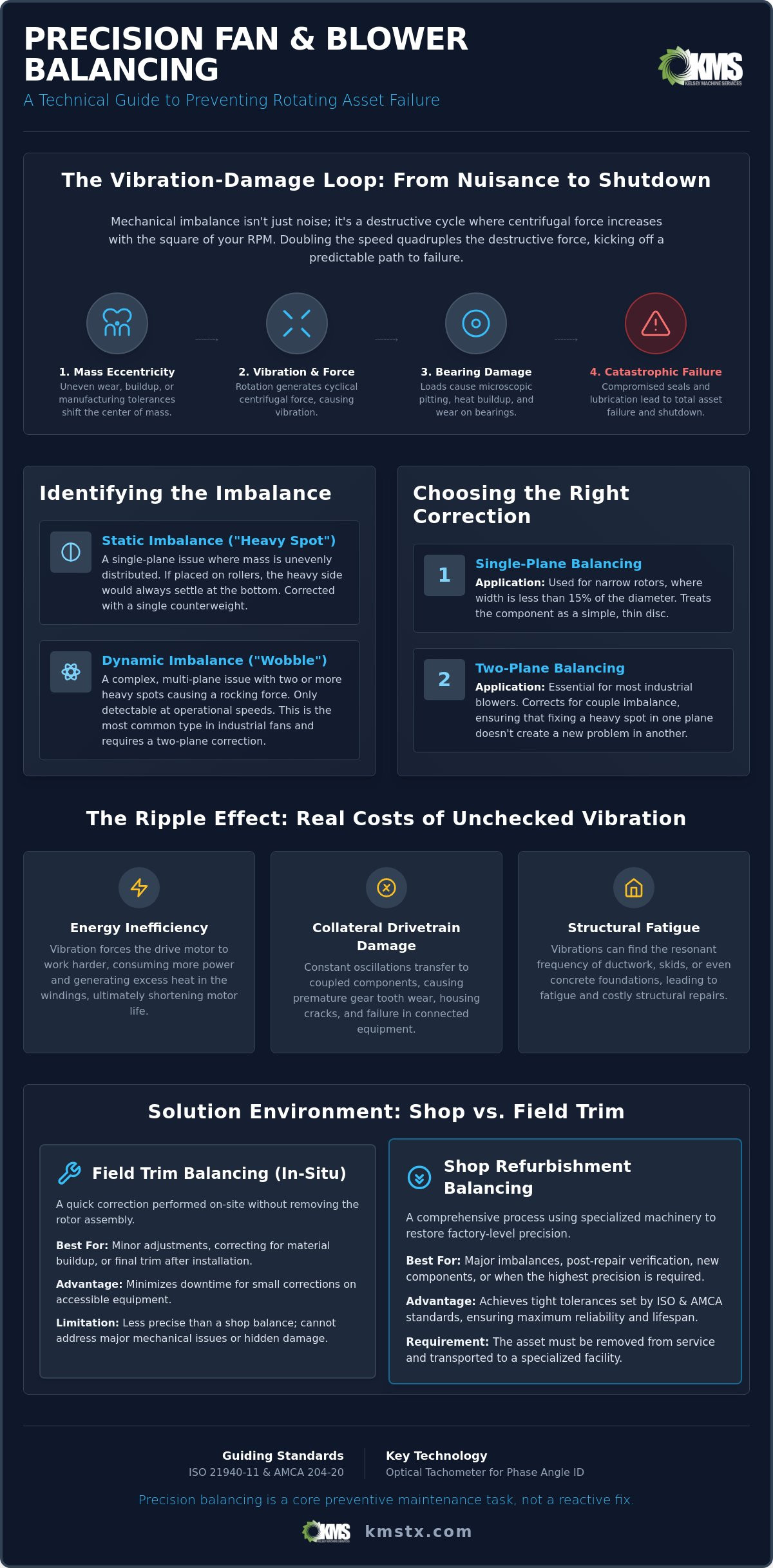
Mechanical imbalance is more than just a nuisance vibration; it’s a fundamental physics problem where the center of mass doesn’t align with the center of rotation. In a perfect world, these two points would be identical. In the field, variables like manufacturing tolerances, uneven wear, or thermal expansion cause the mass center to shift. The Mechanics of Industrial Fan and Blower Imbalance dictate that as the rotor spins, this eccentricity generates centrifugal force that increases with the square of the speed. Doubling your RPM doesn’t just double the vibration force; it quadruples it.
This force triggers what we call the “vibration-damage loop.” A minor oscillation might start at the impeller, but it quickly migrates through the shaft to the bearings. As bearings face these cyclical loads, they develop microscopic pitting, leading to heat buildup and eventual seal failure. Once a seal goes, lubrication is compromised, and the asset is on a fast track to an unscheduled shutdown. Effective industrial fan and blower balancing is the only way to break this cycle before it destroys your hardware.
To better understand how these forces are measured and corrected in a shop environment, watch this demonstration of a balancing machine in action:
Static vs. Dynamic Imbalance: What is the Difference?
Static imbalance is often called a “heavy spot.” If you put the fan on frictionless rollers, the heavy side would always swing to the bottom. It’s a single-plane problem. Dynamic imbalance is more complex because it only shows up when the machine is running at operational speeds. This occurs when two or more heavy spots exist in different planes, creating a “wobble” or rocking force. Because most industrial blowers have significant width or large diameters, they almost always require dynamic, two-plane correction to achieve true stability.
The Real Cost of Equipment Vibration
The damage doesn’t stop at the fan. Excessive vibration forces the drive motor to work harder, which generates heat in the windings and kills electrical efficiency. We often see secondary damage during rotating equipment maintenance where coupled gearboxes have suffered gear tooth wear or housing cracks due to the constant pounding from an unbalanced fan. Over time, these oscillations can even find the resonant frequency of your ductwork or foundation, leading to structural fatigue that’s incredibly expensive to repair. Precision industrial fan and blower balancing protects the entire drivetrain, not just the impeller.
Material buildup is another “creeping” factor. In many process industries, dust or moisture accumulates on the blades unevenly. Even a few grams of buildup on a large-diameter fan can create massive centrifugal forces. When you combine this with the natural thermal expansion of metals at high temperatures, a fan that was balanced in the shop can slowly drift out of spec during months of heavy operation.
Dynamic Balancing Methodologies: Single-Plane vs. Two-Plane
The logic behind industrial fan and blower balancing relies on two critical data points: amplitude and phase. While amplitude tells us the severity of the vibration, the phase angle, identified by an optical tachometer, tells us exactly where the “heavy spot” is located relative to a fixed reference point. An optical tachometer isn’t just for tracking RPM; it acts as the trigger for our vibration analyzer, allowing us to map the mass eccentricity of the rotor in real time. Without this phase data, you’re just guessing where to add weight.
The geometry of your equipment dictates the balancing methodology. Narrow impellers, where the width is less than 15% of the diameter, often only require single-plane balancing. This process treats the rotor as a thin disc. However, most industrial blowers are wide enough that a heavy spot on the drive side might be offset by another on the intake side. This creates a “couple” imbalance that causes the shaft to rock. To fix this, we perform two-plane analysis, calculating vector sums to ensure that adding weight to one plane doesn’t inadvertently increase the vibration in the other. For those deciding between Shop Balancing vs. Field Trim Balancing: When to Use Each, the physical dimensions and operational speed of the rotor are the primary deciding factors.
The Technical Balancing Process
We start by acquiring baseline vibration data at the machine’s normal operational RPM. Once we have a “dirty” reading, we apply a trial weight of a known mass. By measuring how the system responds to this weight, we calculate influence coefficients. These numbers tell us how much change in vibration we get per gram of weight added. The final step involves calculating the exact correction weight and its placement. Depending on the environment, these weights are permanently attached via precision welding or high-strength bolting to ensure they don’t shift under centrifugal load.
Advanced Diagnostic Tools
We don’t just look at the total vibration number. We use multi-channel analyzers to separate fan-specific frequencies from motor noise or belt slap. High-resolution sensors are essential for catching issues like “soft foot” or foundation resonance, which can mimic an unbalanced fan. If your team is struggling with persistent vibration that won’t settle down, our technicians utilize Dynamic Balancing and custom-machined weights to bring your equipment back within ISO 21940 tolerances. This level of precision ensures that your fix is permanent and doesn’t just mask a deeper mechanical problem.
Balance Quality Grades: Understanding ISO 21940 and AMCA 204
A Balance Quality Grade (G) isn’t just a random number assigned by a technician; it’s a calculated limit based on the physics of your specific rotor. The core of industrial fan and blower balancing relies on the formula: e_per * omega = constant. In this context, ‘e_per’ is the permissible eccentricity (the distance between the center of mass and the center of rotation) and ‘omega’ is the angular velocity of the rotor. This calculation defines the “permissible residual unbalance,” which is the total amount of mass eccentricity allowed to remain in the assembly after the balancing process is finished. Precision isn’t optional here. A G2.5 grade means the center of gravity is offset by only a few microns.
It’s vital to remember that this limit is highly dependent on the weight of the rotor and its operational speed. A heavy, slow-moving impeller can tolerate a larger heavy spot than a lightweight, high-speed blower. When you review a balancing report, you must verify that the technician used the actual weight of the rotating assembly in their calculations. If the weight input is off, your G-grade is technically invalid, and your machine is likely still at risk of premature failure. Precision balancing requires accurate data before the first trial weight is ever applied.
Standard Comparison: AMCA 204 vs. ISO 21940
While ISO 21940-11 is the international successor to the old ISO 1940-1 standard for all rotating machinery, many in the industry still look to AMCA 204-20 as the definitive guide for fans. AMCA 204-20 was last revised in 2020 and focuses specifically on the unique aerodynamic and structural challenges of fan impellers. It categorizes balance quality into “BV” levels, which roughly map to ISO G-grades but include tighter vibration limits for the fully assembled unit. Most heavy industrial applications will follow ISO 21940 for shop work, but AMCA 204 is the standard you’ll want for verifying performance once the fan is installed in its housing.
What Grade Does Your Fan Require?
The grade you target depends entirely on the criticality and speed of your process. Using the wrong grade can lead to either excessive maintenance costs or insufficient protection for your bearings.
- G6.3: This is the baseline standard for large process fans, agricultural blowers, and general HVAC equipment. It provides a reliable balance for machines running at moderate speeds where some residual vibration is acceptable.
- G2.5: The industry “sweet spot” for high-performance industrial fan and blower balancing. This grade is required for high-speed gas blowers, critical process air systems, and any application where downtime is prohibitively expensive.
- G1.0: Reserved for extreme precision. You’ll typically only see this grade applied to high-speed turbines or centrifuge components where even the slightest oscillation could cause immediate catastrophic failure.
Matching the right grade to your equipment ensures you aren’t over-engineering a simple exhaust fan while providing the necessary protection for your most expensive rotating assets.
Shop Balancing vs. Field Trim Balancing: When to Use Each
Deciding whether to perform industrial fan and blower balancing on-site or in a specialized workshop often comes down to the physical condition of the rotor and the urgency of the process. Field trim balancing is frequently the first line of defense. It allows a technician to correct vibration “in-situ” while the machine is fully assembled and running under its own power. This approach is highly effective for routine maintenance or when you need to account for the “system effect,” where the fan, motor, and shaft behave differently as a single unit than they do individually. By balancing the assembly in its own bearings, you’re correcting the vibration exactly as the machine experiences it during production.
However, field balancing has its limits. If the fan has structural issues or if the foundation is compromised, those external variables can mask the true imbalance and make it impossible to reach tight tolerances. Shop balancing is the gold standard for a reason. In a controlled shop environment, we isolate the rotor on a dedicated balancing machine. This removes the “noise” of the motor, belts, and ductwork, allowing for much higher precision. It’s the only way to guarantee a true Balance Quality Grade before the equipment is ever reinstalled.
When to Pull the Equipment for Shop Service
You should consider pulling the fan for shop service if the impeller shows signs of heavy erosion, corrosion, or significant material loss. A field weight might stop the shaking temporarily, but it won’t fix the underlying structural degradation. Shop service is also necessary when the fan’s bearings and seals have reached the end of their service life or when the drivetrain requires an industrial gearbox repair. If multiple field attempts have failed to bring the vibration levels down to OEM specs, it’s a clear signal that the rotor needs to be stripped, inspected, and balanced on a precision machine.
The Advantages of Field Trim Balancing
The primary driver for field trim balancing is downtime avoidance. You don’t have to deal with the logistics of teardown, crating, and transport. For many operations, the ability to get a critical blower back into spec within a single shift is invaluable. It’s particularly useful for correcting minor vibration issues caused by material buildup or small thermal shifts. Since the fan stays in its original housing, you’re also ensuring that the balance is optimized for the specific aerodynamic loads and structural resonances of that exact installation. If your equipment is structurally sound but needs a precision tune-up, our team can provide on-site Dynamic Balancing to restore reliability without the cost of a full teardown.
Ultimately, the choice depends on the economic trade-off. While shop balancing offers superior precision, the cost of removal and the resulting downtime must be weighed against the benefits. For new impeller installations or full refurbishments, shop balancing is mandatory. For routine vibration management, a well-executed field trim is often the most practical solution for maintaining industrial fan and blower balancing across your facility.
The Kelsey Machine Approach to Precision Balancing
Kelsey Machine Services has spent over forty years in the trenches of heavy industry. We’ve seen how a single unbalanced blower can shut down an entire production line or damage an expensive motor. That’s why we don’t just slap on a weight and call it a day. Our approach to industrial fan and blower balancing is deeply integrated with our mechanical overhaul process. If a shaft is scored or an impeller hub is wallowed out, our in-house custom machining team uses CNC technology to restore those tolerances before the final balance even begins. We provide comprehensive reporting on every job, ensuring our warranted repairs meet or exceed original OEM specifications. This data-driven approach gives you the confidence that the asset is truly restored, not just patched. When we finish a job, you get a full balance report that documents the starting vibration levels, the trial weights used, and the final residual unbalance, proving that the equipment meets the required ISO or AMCA grades.
We’ve learned that vibration rarely lives in a vacuum. A shaking fan might actually be a symptom of a failing coupler or a structural resonance issue elsewhere in the drivetrain. Our technicians take a holistic view of your rotating assets. It’s common for us to find crossover issues during an industrial centrifuge repair or a pump drive overhaul that started as a simple vibration complaint. By using advanced spectral analysis and high-resolution sensors, we ensure long-term operational stability rather than a temporary fix. Our precision dynamic balancing services are designed to protect high-value assets from the vibration-damage loop that causes premature bearing fatigue and seal failure.
A Holistic View of Rotating Equipment
When we inspect a fan, we’re also looking at the health of the bearings, the alignment of the couplings, and the integrity of the shaft. This thoroughness is why we’re trusted to handle complex industrial fan and blower balancing for some of the most demanding plants in the country. We don’t just treat the symptom; we fix the mechanical root cause. This ensures that once the fan is back in service, it stays there for its full intended life cycle. Our facility is equipped with specialized balancing machines that can handle rotors of various sizes and weights, providing the flexibility needed for diverse industrial applications.
Ready to Restore Your Equipment?
When a critical fan or blower fails, you don’t have weeks to wait for parts or a scheduled opening. We maintain an extensive spare parts inventory and offer 24/7 emergency response for critical failures across the nation. We’re a family-owned, expert-led shop, which means you’re talking to people who actually understand the gear, not just a sales rep reading from a script. We pride ourselves on rapid turnaround times because we know the real cost of every hour your process is down. Whether it’s a massive process fan or a high-speed blower, we have the floor space and the heavy-lift capability to handle it. We’ve built our reputation on being the shop that other shops call when the job is too complex or the tolerances are too tight. If you’re dealing with persistent vibration or a catastrophic failure, Contact Kelsey Machine Services for a technical consultation. We’ll help you determine the best path forward to get your equipment back in the rotation safely and reliably.
Securing the Future of Your Rotating Assets
Precision balancing is the baseline for long-term mechanical reliability. It’s the difference between a blower that runs for a decade and one that fails in six months. By adhering to updated standards like ISO 21940-11 and AMCA 204-20, you protect your bearings, seals, and gearboxes from the destructive centrifugal forces of unbalance. Mastering the technical nuances of industrial fan and blower balancing ensures your facility stays efficient while avoiding the high costs of unscheduled downtime.
Kelsey Machine Services brings over 40 years of industrial mechanical expertise to every project. Our full-service CNC machine shop and balancing facility are equipped to handle the most complex restoration projects; meanwhile, our 24/7 emergency response team stands ready to support critical infrastructure failures nationwide. We don’t just fix the vibration; we restore the engineering integrity of your equipment to meet or exceed OEM standards.
Request a Technical Quote for Precision Balancing to secure your high-value rotating assets today. We’re ready to help you keep your operations running smoothly and reliably.
Frequently Asked Questions
How often should an industrial fan be balanced?
Balancing isn’t a calendar event; it’s a condition-based requirement. Most heavy-duty fans should be checked annually during routine vibration monitoring. However, you’ll need to perform industrial fan and blower balancing immediately if you notice a spike in amplitude or after any major repair, such as a bearing replacement. In harsh environments with high particulate matter, you’ll likely find yourself balancing more frequently due to uneven blade wear.
Can I balance a fan that has significant corrosion or material buildup?
You shouldn’t try to balance a fan that’s caked with material or pitted by corrosion. Material buildup creates a “false” imbalance that shifts as chunks fly off, making your correction weights useless. If the impeller is corroded, the structural integrity might be compromised, which is a serious safety hazard. Always clean the blades to bare metal and inspect for thinning before starting the balancing process.
What is the difference between static and dynamic balancing?
Static balancing addresses the “heavy spot” that makes a rotor settle at the bottom when it’s at rest. It’s a single-plane correction. Dynamic balancing is more complex because it corrects for forces that only appear while the fan is spinning at speed. This involves two-plane analysis to stop the rotor from “wobbling” or rocking. Most industrial blowers require dynamic balancing because of their width and operational RPM.
How do I know if my vibration is caused by imbalance or a bad bearing?
You can tell the difference by looking at the vibration frequency spectrum. An unbalanced fan almost always shows a dominant peak at exactly 1x the shaft’s rotational speed. Bad bearings usually produce high-frequency noise or peaks at non-synchronous frequencies. If you see the vibration levels stay high even at lower speeds, it’s often a sign that the bearing races are pitted or the lubrication has failed.
What is a “trial weight” and why is it used in the balancing process?
A trial weight is a known mass we temporarily attach to the rotor to measure the system’s reaction. By seeing how much the vibration phase and amplitude change with this specific weight, we calculate the influence coefficients. These numbers tell us exactly how much weight is needed and where it should go to reach a perfect balance. It’s a fundamental step in any precision industrial fan and blower balancing job.
Does a higher Balance Quality Grade (like G1.0) always mean better performance?
A G1.0 grade is extremely precise, but it’s often overkill for a standard exhaust fan. While a tighter grade sounds better, it requires more time and specialized equipment to achieve, which drives up costs. If your fan only needs a G6.3 to run reliably for years, chasing a G1.0 is just wasting your maintenance budget. Always stick to the ISO 21940 grade that matches your machine’s specific speed and criticality.
Can you balance a fan while it is still installed in the plant?
Yes, this is known as field trim balancing. It’s a great option because it accounts for the “system effect,” including the motor, drive belts, and the fan’s unique mounting foundation. However, field balancing can’t fix a rotor that’s bent or has severe structural damage. If the vibration is caused by a loose foundation or a cracked housing, you’ll need to pull the equipment for a full shop refurbishment.
What information should be included in a professional balancing report?
A professional report needs to be a complete technical record of the work performed. It should include the rotor’s weight, the operational RPM, and the initial vibration levels. You’ll also want to see the trial weights used, the final residual unbalance, and the specific Balance Quality Grade achieved. Don’t accept a report that doesn’t clearly show the sensor locations and the phase angles used during the final correction.